
An ongoing discussion of how Star Trek comics provide prequels, sequels, and tie-ins to the episodes and films…
4: Gold Key, 1973-1975
During the months following Len Wein’s eight-issue tenure on Gold Key’s classic Star Trek comic book, the series offered fewer direct connections to the 1960s television series, presumably due to the writers having been less familiar with the show than Wein had been. Indeed, some of the issues published post-Wein were more like those written by his predecessor, Dick Wood, whose work had indicated a limited grasp of the show and its characters.
This column continues to examine how licensed Star Trek comics serve as prequels, sequels, or tie-ins to the films and episodes. Our focus this week is on Gold Key issues #17–28, likely written by Arnold Drake (#17–20 and 24–25), John David Warner (#21 and 26–27), Gerry Boudreau (#22–23), and George Kashdan (#28). I say “likely” because the issues were published sans writing credits, though Martin O’Hearn’s “Who Created the Comic Books?” blog does a good job of working out the creators’ identities based on their known styles.

Many issues in this group featured no episode references whatsoever: specifically, #17–20, 24, and 26–28. Issue #29, meanwhile, reprinted Gold Key’s first issue and is thus excluded from consideration. Four issues, however, are notable for the purpose of this discussion, even if their connections are only peripheral.
In issue #21, alien mummies (which are actually cyborgs beneath their wrappings) become reanimated and lock the Enterprise on course for Romulan space. The mummies’ tactics (aside from the Romulan interest) are similar to those of the Borg, introduced 16 years later in The Next Generation‘s “Q Who.” Intent on recreating all lifeforms in their own image, they generate personal force fields, wirelessly control the starship’s computers, and ignore anyone not presenting an immediate threat. These similarities, of course, are entirely coincidental since the Borg hadn’t yet debuted.

Issue #22 has no connections to any Star Trek episodes, but it’s worth noting that this story, according to O’Hearn’s blog, is a sequel to two non-Trek tales written by Boudreau for DC Comics’ Star-Spangled War Stories. Characters from Gold Key’s Trek tale—Rhuna and her lover, Kyr Nostrand—had previously appeared in issue #180 of the war-based comic series (which itself was a sequel to Star-Spangled War Stories #170), making this Star Trek‘s first crossover comic with another publisher. It’s doubtful readers realized it at the time, though, since the Trek issue failed to mention those prior chapters.’

The plot of issue #23 is remarkably similar to that of the episode “Miri.” In both tales, the Enterprise responds to a distress call and discovers a world where only children have survived a deadly plague, and McCoy must find a cure after the starship’s officers become infected. Reference is made to the number-based “industrial scale” used to rate planetary development, first cited in “Wink of an Eye” (“Spock’s Brain” would later utilize a letter-based scale). Scalos had rated a seven in “Wink of an Eye”—the scale’s highest rating, according to that episode—yet the planet Argylus (perhaps a misspelled reference to Argelius II, from “Wolf in the Fold”) here rates ten points higher at 17.

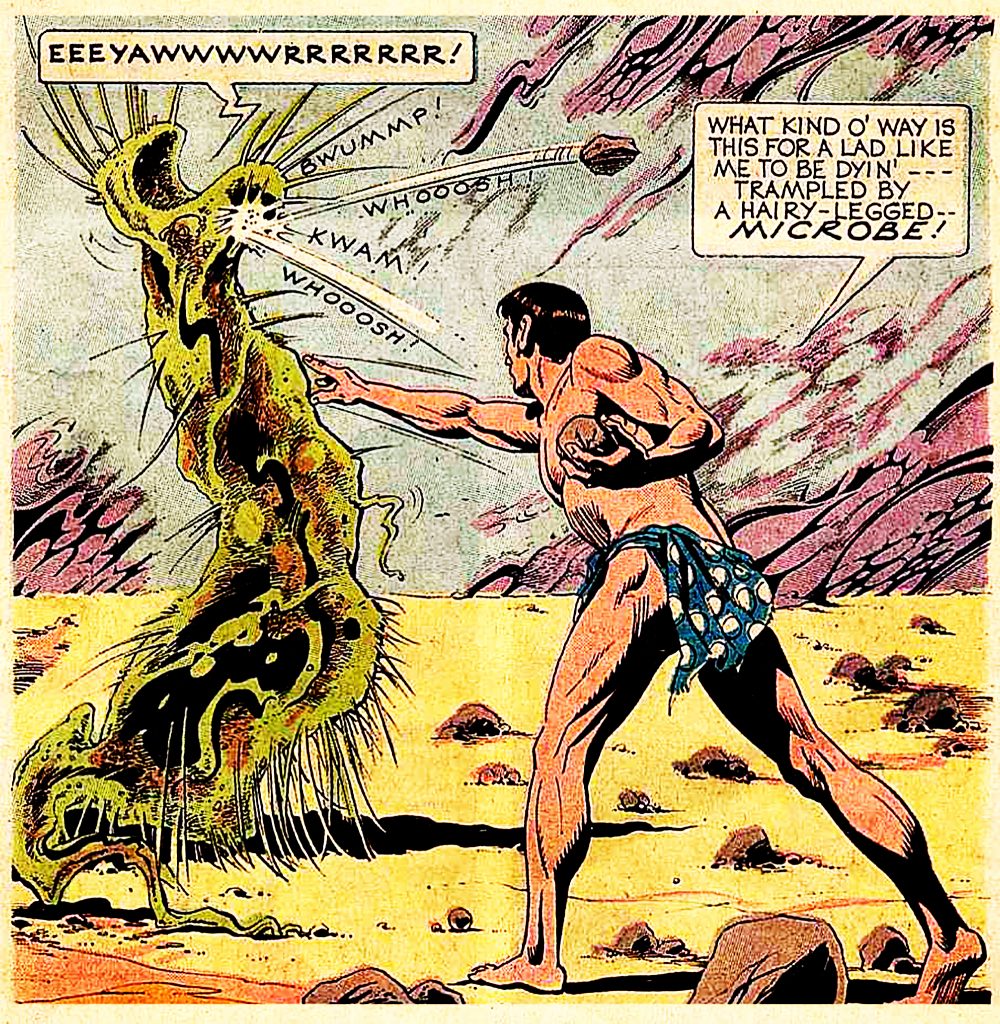
Finally, issue #25’s premise is reminiscent of two televised episodes: The Animated Series‘ “The Terratin Incident” and Deep Space Nine‘s lamentable “One Little Ship” (neither of which had yet aired at the time of the comic’s publication). In this tale—Gold Key’s take on Jonathan Swift’s Gulliver’s Travels—Kirk is captured by diminutive humans and Scotty is exposed to alien radiation, causing him to become miniaturized. The end result is predictably silly (as are the two mini-crewmember episodes), with the mostly naked engineer fighting a giant microbe while trapped in the microscopic world, before being restored to full-size.
No direct episode tie-ins appeared in the 12-issue span of Gold Key Star Trek #17–28. The few connections that do exist are tenuous at best… and are probably a bit of a stretch, at that. But the series would offer several entertaining sequels during its remaining issues, which we’ll continue to explore next week.
= = =
Looking for more information about Star Trek comics? Check out these resources:
- The Complete Star Trek Comics Index, by yours truly
- The Star Trek Comics Checklist, by Mark Martinez
- The Wixiban Star Trek Collectables Portal, by Colin Merry
- New Life and New Civilizations: Exploring Star Trek Comics, by Joseph F. Berenato
- Star Trek: A Comics History, by Alan J. Porter
Rich Handley has written books about Planet of the Apes, Back to the Future, and Watchmen, as well as licensed Star Wars and Planet of the Apes fiction, and he edited 70 volumes of Eaglemoss’s Star Trek Graphic Novel Collection. Rich co-edited Titan’s Scribe Award-nominated Planet of the Apes: Tales from the Forbidden Zone; nine Sequart anthologies discussing Planet of the Apes, Star Wars, Battlestar Galactica, Hellblazer, Stargate, and classic monsters; and four Crazy 8 Press anthologies about Batman and (now) the Joker. He has contributed essays to DC’s Hellblazer: 30th Anniversary Celebration; IDW’s Star Trek and Star Wars comic-strip reprint books; BOOM! Studios’ Planet of the Apes Archive hardcovers; Sequart anthologies about Star Trek and Blade Runner; ATB Publishing’s Outside In line exploring Star Trek, Buffy the Vampire Slayer, Angel, The X-Files, Twin Peaks, and Babylon 5; and a Becky Books anthology covering Dark Shadows.
“Deep Space Nine‘s lamentable “One Little Ship””
One vote in favour of One Little Ship, although it is a guilty pleasure.