
An ongoing discussion of how Star Trek comics provide prequels, sequels, and tie-ins to the episodes and films…
11: LA Times Syndicate, 1981-1983
Thomas Warkentin’s eight storylines for the L.A. Times Syndicate’s daily Star Trek comic strip reverentially continued the adventures of the USS Enterprise in the period following Star Trek: The Motion Picture. His final tale, “It’s a Living,” concluded in April 1981, closing out an admirable tenure with a humorous Harry Mudd sequel. The strips’ remaining 12 stories were not as consistently well told or drawn as Warkentin’s, but they did provide a few tie-ins to televised and filmed Star Trek. What’s more, they presented the first genuine sequel to an episode of Star Trek: The Animated Series.
Writer Sharman DiVono and artist Ron Harris helmed storylines #9 to #13, with award-winning novelist Larry Niven cowriting arc #12, “The Wristwatch Plantation.” Padraic Shigetani illustrated storylines #14 (which he wrote) and #15 (penned by Superman and Swamp Thing writer Martin Pasko), after which Man-Thing and Punisher co-creator Gerry Conway penned the remaining five tales, accompanied by a variety of artists.
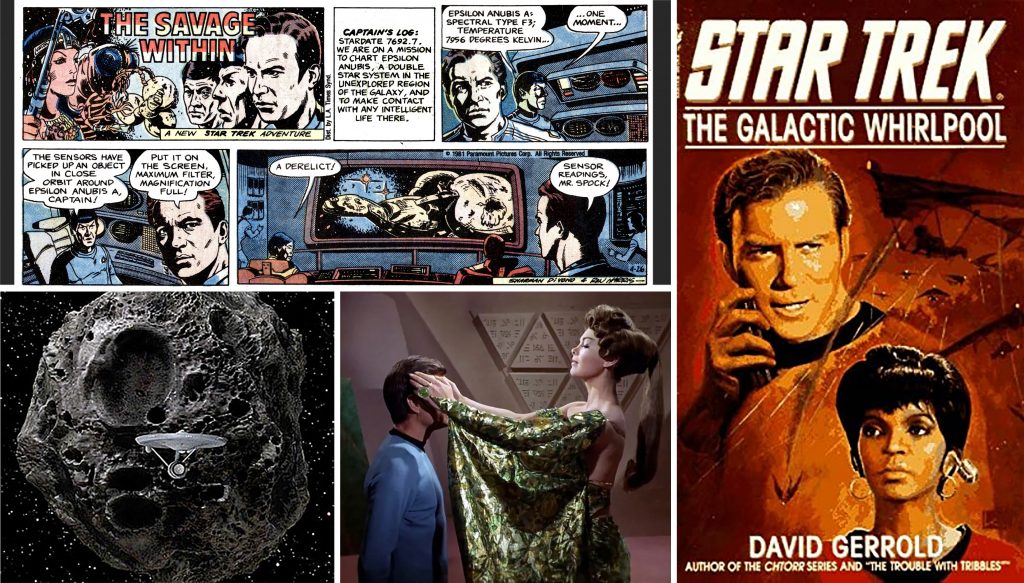
Harris’s top-notch artwork adeptly brought DiVono’s imaginative scripts to life, resulting in a span of stories that approached the quality of Warkentin’s work. Their collaborations provided only a handful of connections to the classic television show, though their first tale, “The Savage Within,” involved a plot similar to that of “For the World Is Hollow and I Have Touched the Sky” (as well as David Gerrold’s The Galactic Whirlpool), in that it featured a human colony living aboard a derelict generational ship, unaware of their vessel’s true nature or that they were in imminent peril.
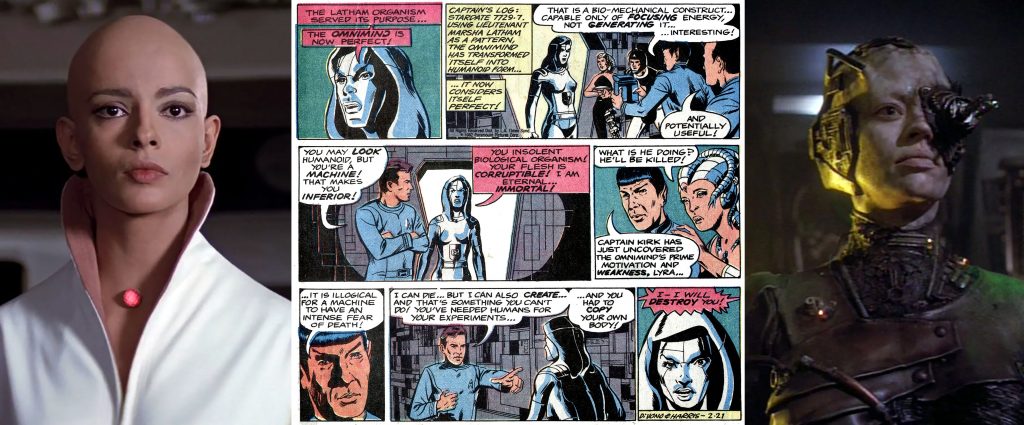
The duo’s third collaboration is often cited as their best. That arc, dubbed “Restructuring Is Futile” in IDW’s reprint collection, proved prophetic with its use of a single-minded machine intelligence called the Omnimind, which sought to restructure organic beings and thereby create a perfect biomechanical lifeform. Sound familiar? It should. The concept, as well as the cyborgs’ creepy undead appearance, set the stage for the Borg’s debut in Star Trek: The Next Generation‘s “Q Who,” predating that episode by a decade. The arc also borrowed elements of Ilia’s fate in The Motion Picture, with the Omnimind creating a female humanoid avatar to communicate with the crew.
The Niven-cowritten “The Wristwatch Plantation” presented a sequel to the 1970s cartoon’s “The Slaver Weapon.” Niven had incorporated the Kzinti—from his Known Space novels and short stories—into “The Slaver Weapon,” and his collaboration with DiVono and Harris brought the felinoid warrior species back into the Star Trek fold by having the Kzinti mount an invasion force against the tongue-twisting Bebebebeque (a diminutive insectoid culture from his short-story anthology The Draco Tavern). The Surak, a warp-sled-equipped Federation shuttle that Spock used to rendezvous with the Enterprise during the V’Ger incident, made an appearance in this tale, providing a nice tie-in for those well-versed in The Motion Picture.
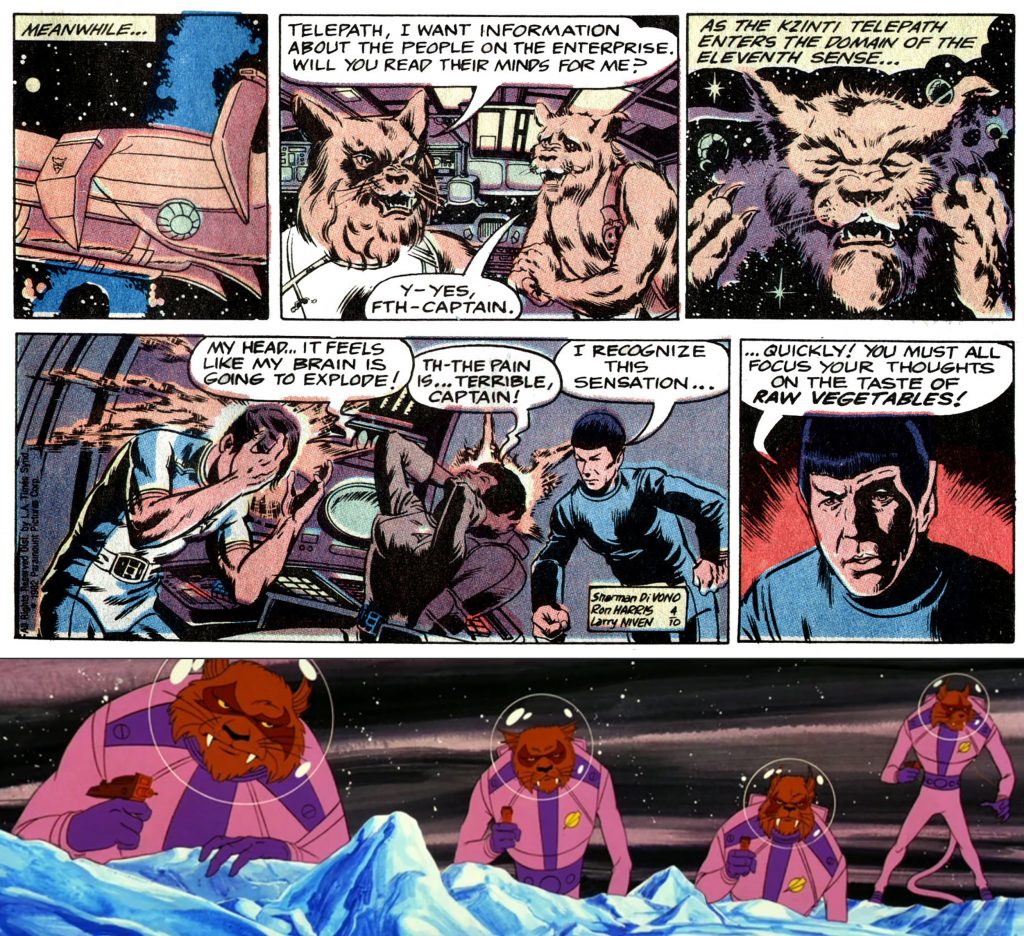
Unfortunately, an irrelevant drug-smuggling side story, which could have been wholly removed without much effect, took an exciting concept and hampered it with a dragging pace, with the Kzinti’s re-emergence almost an after-thought. Harris and the writers reportedly clashed over this tale, with the artist deeming the script too complex. Niven, meanwhile, blamed the rushed ending on Harris’s decision to quit the series. According to Niven’s Playgrounds of the Mind, he’d envisioned a larger climax, with an interaction between transporters causing every life form within a planetary square mile to be beamed aboard the Enterprise, leading to a massive rec-deck battle that he described as “a hallucinatory Vietnam.” It’s a shame that never materialized (pun intended, naturally).
The final DiVono-Harris outing, “The Nogura Regatta,” introduced Cadet Kyoshi Nogura, the grandson of The Motion Picture‘s Admiral Nogura, who planned a starship race to honor his revered grandfather and secretly hired the pirate Sturdevant to provide obstacles during the event. Anyone who has watched Voyager‘s “Drive,” or who has read the Star Trek novel The Great Starship Race or DC Comics’ TNG miniseries Ill Wind, won’t be at all surprised to discover that the competition did not go as planned.
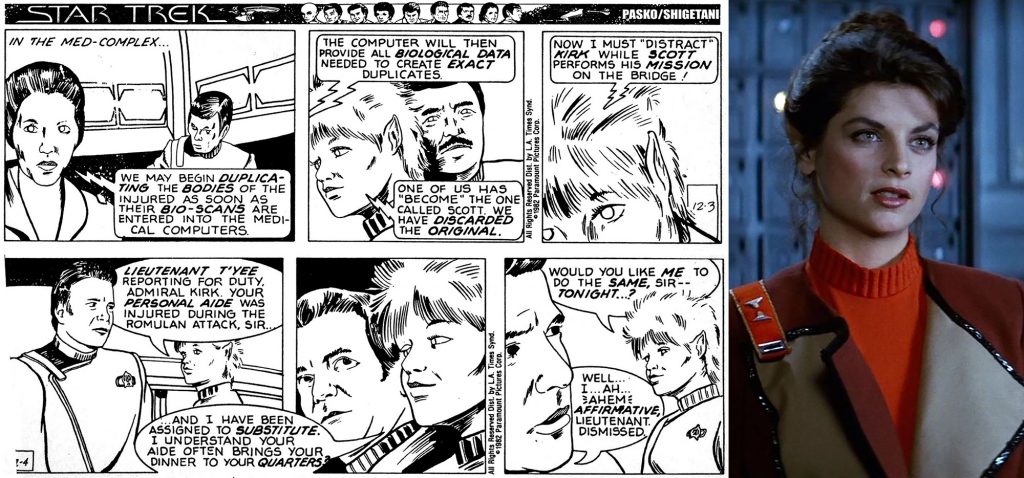
Following the duo’s departure, quality noticeably dropped during Shigetani’s two tales, with very few episode connections. Still, Pasko, in “Taking Shape,” managed to work in references to Organia (“Errand of Mercy”) and Rigellian fever (“Requiem for Methuselah”), establishing his familiarity with the original show (it’s no wonder he went on to write Star Trek comics for both Marvel and DC). Pasko had hoped to bring back Star Trek II: The Wrath of Khan‘s Saavik, but Paramount nixed the idea. Thus, he instead created a new character, a blonde Vulcan biologist called T’Yee, who was given Saavik’s intended role. Given Kirk’s love scenes with T’Yee, it’s probably a good thing the studio said “no” to Saavik’s involvement.
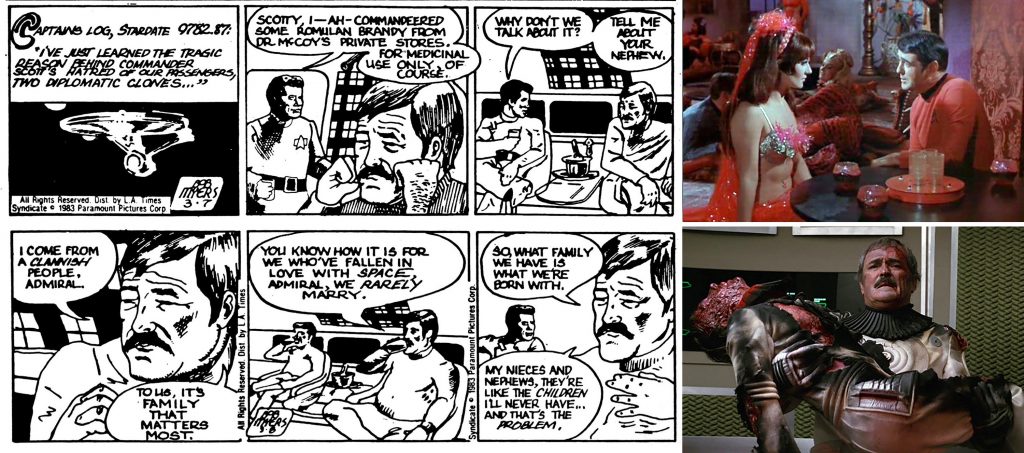
Conway’s run opened with an off-kilter tale, untitled at the time but now called “Send in the Clones.” The plot, in which Scotty was framed for murdering a beautiful woman due to his hatred of clones, shared similarities with that of the episode “Wolf in the Fold,” in which he nearly took the blame for Redjac’s murder of the dancer Kara on Argelius II. The reason behind his bigotry—his grieving over the death of his nephew—would be mirrored in the demise of young Peter Preston in Star Trek II: The Wrath of Khan.
The spotlight on the oft-underutilized Scotty had great potential, had it not been for abysmal artwork by L.A. Times staffer Bob Myers. Thankfully, Conway’s later work, illustrated by Ernie Colón, Alfredo Alcala, and Dick Kulpa, restored the strips’ waning quality. The writer’s run contained almost no references to any TV episodes, though in Conway’s final outing with Kulpa, “Getting Real,” half of Florida’s population died of a spaceborne microbe. The state has suffered greatly in the Star Trek franchise, for it was also a Xindi terrorist target in Star Trek: Enterprise‘s “The Expanse.”
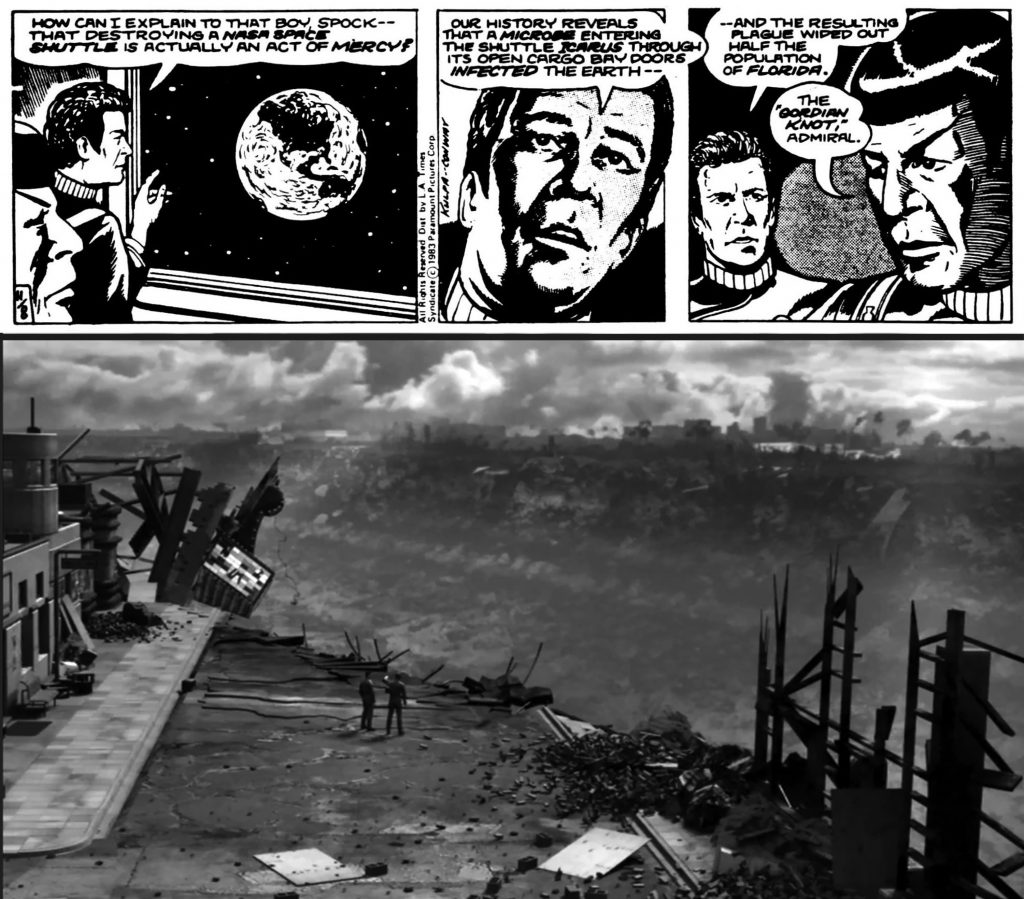
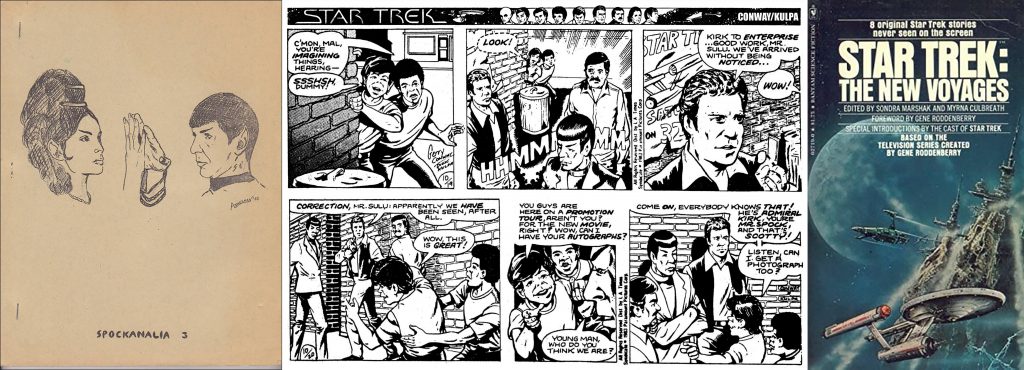
The storyline’s premise, with the Enterprise crew ending up in a reality in which Star Trek was just a science fiction TV show, was reminiscent of the popular story “Visit to a Weird Planet,” by Jean Lorrah and Willard F. Hunt, which debuted in the fanzine Spockanalia #3 and was reprinted in Computer Playback #5. Ruth Berman’s delightfully fun sequel, “Visit to a Weird Planet Revisited,” was published in Spockanalia #5, then in the licensed anthology Star Trek: The New Voyages. Those two fan-favorite fanfic tales spawned a host of other “Weird Planet” spinoffs, discussed here, and we can add “Getting Real” to that list as a spiritual cousin.
Next time, Star Trek Comics Weekly will leave the daily news behind and return to the comic book world. Join us for an examination of how Marvel approached its episode sequels, prequels, and tie-ins during the publisher’s first, brief foray into Star Trek, during the era of Star Trek: The Motion Picture. The human adventure is just beginning.
Looking for more information about Star Trek comics? Check out these resources:
- The Complete Star Trek Comics Index, by yours truly
- The Star Trek Comics Checklist, by Mark Martinez
- The Wixiban Star Trek Collectables Portal, by Colin Merry
- New Life and New Civilizations: Exploring Star Trek Comics, by Joseph F. Berenato
- Star Trek: A Comics History, by Alan J. Porter
Rich Handley has written books about Planet of the Apes, Back to the Future, and Watchmen, as well as licensed Star Wars and Planet of the Apes fiction, and he edited 70 volumes of Eaglemoss’s Star Trek Graphic Novel Collection. Rich co-edited Titan’s Scribe Award-nominated Planet of the Apes: Tales from the Forbidden Zone; nine Sequart anthologies discussing Planet of the Apes, Star Wars, Battlestar Galactica, Hellblazer, Stargate, and classic monsters; and four Crazy 8 Press anthologies about Batman and (now) the Joker. He has contributed essays to DC’s Hellblazer: 30th Anniversary Celebration; IDW’s Star Trek and Star Wars comic-strip reprint books; BOOM! Studios’ Planet of the Apes Archive hardcovers; Sequart anthologies about Star Trek and Blade Runner; ATB Publishing’s Outside In line exploring Star Trek, Buffy the Vampire Slayer, Angel, The X-Files, Twin Peaks, and Babylon 5; and a Becky Books anthology covering Dark Shadows.
The Myers art is the worst I’ve seen, except maybe in strictly amateur fanzine publications. Maybe.