
An ongoing discussion of how Star Trek comics provide prequels, sequels, and tie-ins to the episodes and films…
19: DC Comics, 1988
When DC Comics launched its Star Trek line in 1984, writer Mike W. Barr set the bar high with a thrilling four-parter that offered a combined sequel to the episodes “Errand of Mercy” and “The Savage Curtain.” Barr penned tie-ins to “A Taste of Armageddon” and “Where No Man Has Gone Before,” before concluding his run with a dizzying eight-chapter return to the alternate universe of “Mirror, Mirror.” This established a pattern for Barr’s successors to follow, with Len Wein and Mike Carlin, as well as numerous one-off writers, providing sequels, prequels, and tie-ins to onscreen Star Trek. The series’ final regular writer, Peter David, honored that same tradition, as we’ll see in a moment. But first, let’s examine the end of Carlin’s brief run.
In issue #46, Carlin presented an episode tie-in no one could have expected, by bringing back Tongo Rad, one of Doctor Sevrin’s “space hippies” from the much maligned “The Way to Eden.” In a fun twist, Rad has given up his anti-establishment philosophies to become a Federation bureaucrat, working for the very government he’d once rejected. Assigned to watchdog James T. Kirk (a parallel to DC’s later introduction of R.J. Blaise), Rad admits that “Tongo” was just a nickname—his real name is Herbert Rad, which is amusingly ironic since he has become the epitome of what his former cult would have called a “Herbert.”

Carlin’s swan song in #47 continued a theme explored in “The Return of the Serpent” (issues #43–45), with Jim Kirk’s past coming back to haunt him yet again. Ronald Penn, a young officer who idolizes Kirk, ignores Starfleet rules and picks a fight with Romulans, citing Kirk’s theft of the Enterprise in Star Trek III: The Search for Spock as his inspiration. Penn tries to bluff them into surrendering, taking a cue from how Kirk dealt with Balok in “The Corbomite Maneuver,” but the enemy sees through the ruse, and when Kirk comes to Penn’s rescue, he realizes some of his decisions have been misperceived by the next generation of officers. DC’s Trek stories often dealt with the concepts of aging and regret, and this tale is among the better examples.

Peter David joined the fold in issue #48, demonstrating a uniquely humorous style that has earned him a well-deserved reputation as one of the franchise’s finest novelists. David’s eight-issue run, concluding in #55, consisted of several interconnected stories comprising a larger single narrative built upon elements of two classic episodes, “Shore Leave” and “Whom Gods Destroy.” What made it particularly engaging was that fans had no idea they were reading a sequel to the latter until well into the storyline, when it was revealed that the villain was disgraced Starfleet Captain Garth of Izar.
Readers learned that Garth, following his asylum stint in “Whom Gods Destroy,” had been rehabilitated and allowed to return to Starfleet, but was relegated to desk duty, which he’d resented, manifesting in a desire for revenge. Garth now kills a Starfleet captain, assumes his form (and the name “Zair,” an anagram of “Izar”), hires a rogue crew of alien thugs, and sets out to spark a Klingon-Federation war by attacking targets on both sides. At the height of the tale, Garth takes the form of Enterprise crewman William Bearclaw and near-fatally stabs Kirk in the chest, sending the captain on an out-of-body experience around the Enterprise and out into space.
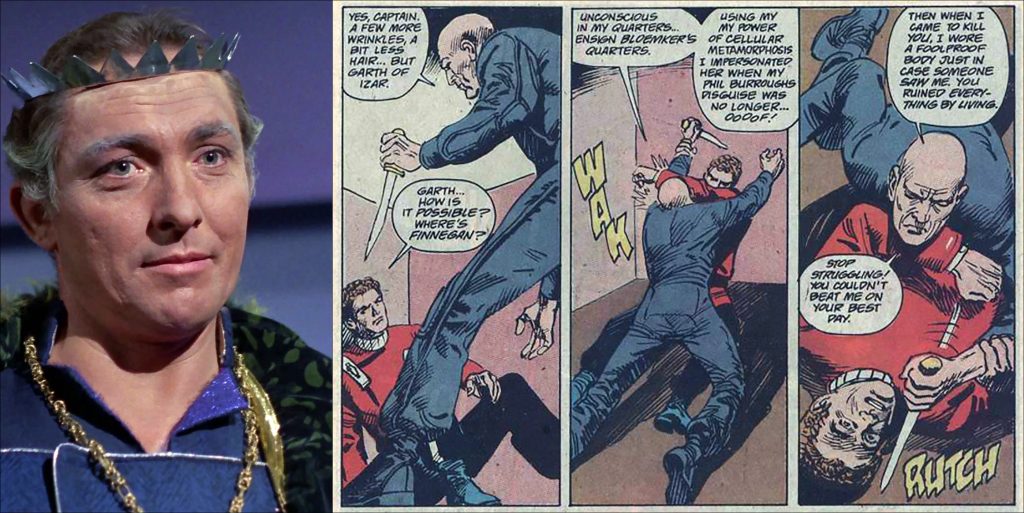
It’s easy to see why David’s run still receives such high praise—his Trek tales, despite an abundance of humor, are anything but light fare. There’s gravitas galore and the consequences are often dire. As with his novels, the author peppered his comics with allusions to episodes and films, proving how well-versed he is in Trek lore. In #49, for example, Kirk calls Bearclaw on his racism, noting, “Bigots, like whales, were thought to have died off. I aided the latter, but I have no desire to perpetuate the former.” This, of course, references the events of Star Trek IV: The Voyage Home.
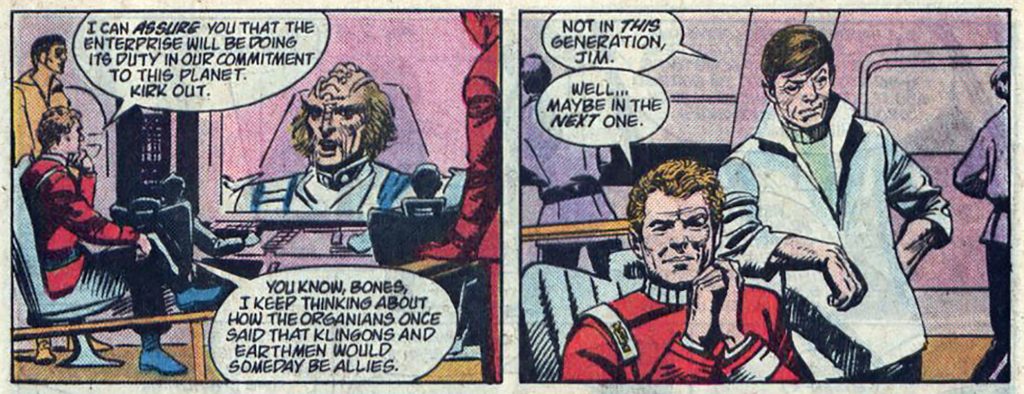
The 50th issue sees Garth attacking a farming settlement on Omicron Ceti IV, presumably located in the same system as the Omicron Ceti III agricultural colony in “This Side of Paradise” (one panel, in fact, erroneously identifies the planet by that name). As Starfleet and the Klingons cooperate to prevent interstellar war, Kirk recalls how the Organians, in “Errand of Mercy,” had predicted the governments would one day become allies. McCoy scoffs at this happening within their generation, and Kirk muses, “Maybe in the next,” slyly presaging the status quo of Star Trek: The Next Generation. This continues in #54, when Kirk jokingly calls Bones an old man; the doctor retorts that he’ll live another 87 years, setting up his 24th-century cameo in “Encounter at Farpoint.”
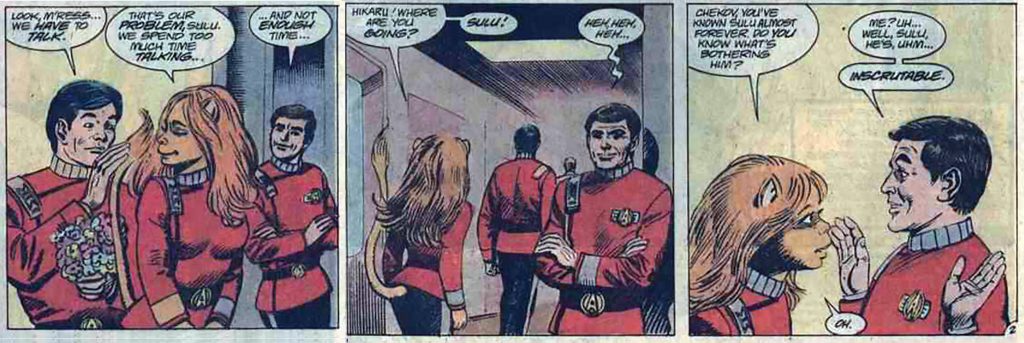
Trek trivia abounds in each issue. A particularly funny, but easily overlooked example can be found in #51, in which Chekov calls Sulu “inscrutable.” Fans of Star Trek: The Animated Series will recognize this as an in-joke reference to “The Infinite Vulcan,” in which Sulu described himself as such. That episode was written by actor Walter Koenig, so it’s doubly amusing that it’s Chekov who says it here. And in issue #52, when a feverish telepathic crewman turns the Enterprise into a recreation of Dante’s Inferno, Kirk suggests Spock cut through the illusion as he did in “Spectre of the Gun” with the Melkotians’ O.K. Corral scenario.
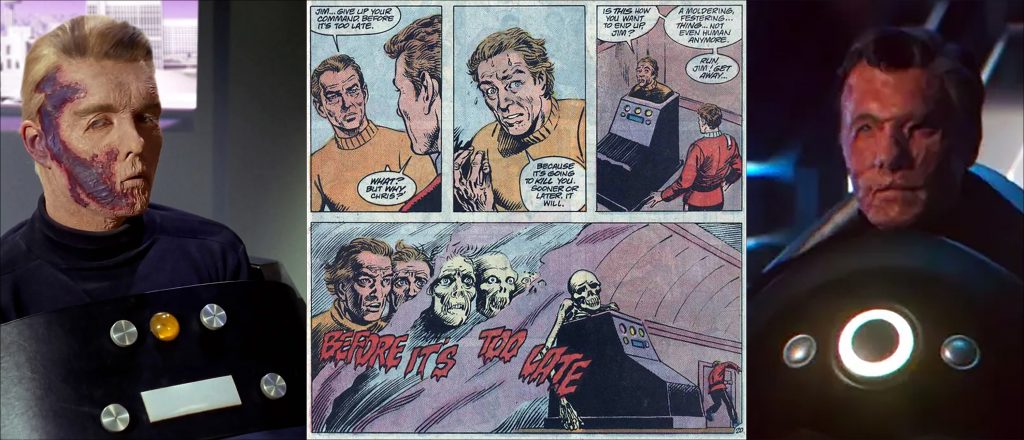
Especially powerful is issue #53, in which Kirk, stabbed and bleeding out, experiences visions of Christopher Pike (“The Menagerie”) urging him to fight to live, juxtaposed with his brother Sam (“Operation—Annihilate!”) and his son David Marcus (Star Trek II and III) welcoming him to the afterlife. Kirk comes close to joining them, too.

Chris Pike first appears healthy, then gruesomely degenerates to his wheelchair-bound form as Star Trek’s precursor to Breaking Bad‘s Hector Salamanca. In retrospect, the scene hits the same grim notes as one in Star Trek: Discovery‘s “Through the Valley of Shadows,” in which Pike foresees his own eventual fate in all its gory realism.
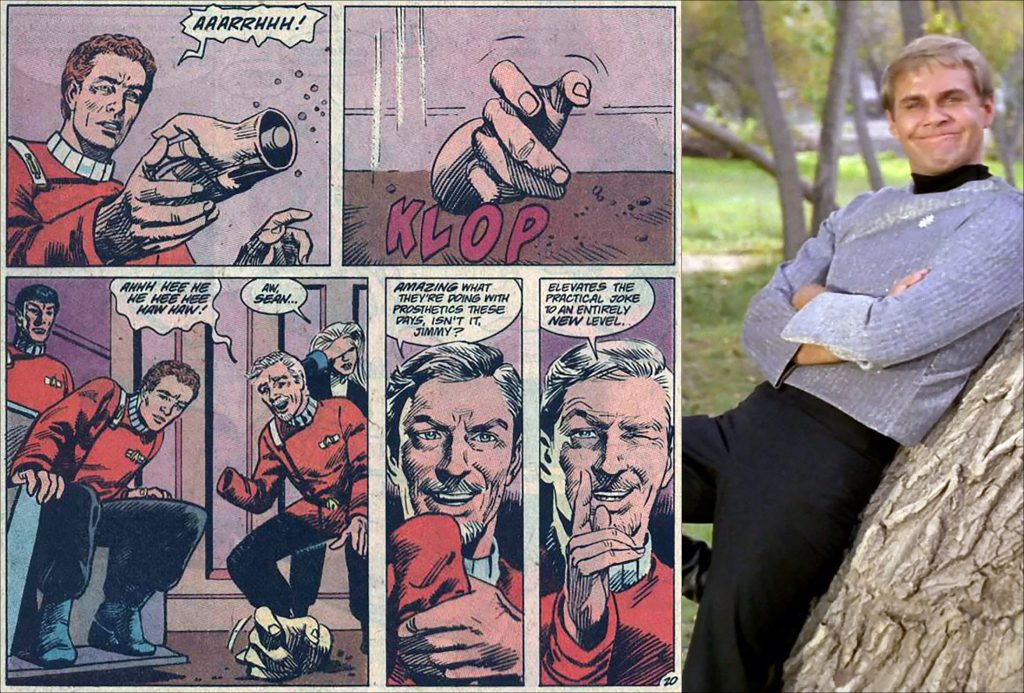
The “Shore Leave” tie-in occurs in #54–55, when Kirk’s Academy nemesis, Finnegan (here given the name Sean), investigates Bearclaw’s seeming assassination attempt. Ever the prankster, Finnegan pretends not to remember bullying Kirk and seeks his forgiveness and friendship, only to stage a practical joke moments later. Finnegan’s irreverent nature is said to have kept him from achieving a high rank, though his proficiency at gleaning information about the right people has ensured a successful career. That’s good news for readers, because Finnegan’s return and the reactions it instills in Kirk (who even plays a practical joke of his own) are hilarious.
The series’ 56th and final issue, from the late Martin Pasko, contains references aplenty and features a classic guest character rarely used in licensed lore. Tonia Barrows, whom McCoy had romanced in “Shore Leave,” now serves aboard the USS Defiant and nearly dies from exposure to Berthold rays (as described in “This Side of Paradise”). As readers might expect, the two share a night together once she is cured. The Defiant would eventually vanish into another universe in “The Tholian Web”—which, as revealed in Star Trek: Enterprise‘s “In a Mirror, Darkly,” turned out to be the mirror universe. It’s sad to think Barrows might have been aboard the starship when it met that fate.
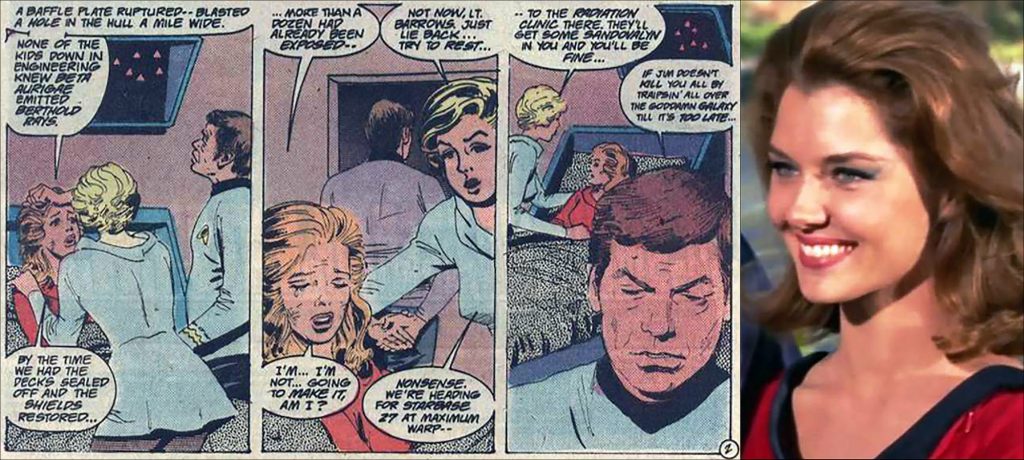
The Enterprise visits Beta Aurigae, the starship’s intended destination in “Turnabout Intruder,” to pick up the Defiant‘s afflicted. The story revolves around a faith healer called En-Lai, among whose patients is Rakaar of Kazar, the home world of the Kazarites, who appeared as background extras in Star Trek: The Motion Picture (though Rakaar is drawn physically different than the species’ onscreen depiction). Another patient, Haak Trobis, is from Daran V, a world almost destroyed by the Yonada in “For the World Is Hollow and I Have Touched the Sky.”
Pasko demonstrated remarkable prescience regarding Leonard McCoy, who tells Kirk that his father (David McCoy, per The Search for Spock) was a preacher who’d resented him for going into medicine; stricken ill, David had refused treatment when Bones tried to save him, claiming it was the Lord’s will that he die. As it happens, Star Trek V: The Final Frontier would depict David’s death less than a year after this comic’s release, with the elder McCoy begging his son to release him from pain rather than keeping him alive. Synchronicity at its finest.

Concomitant with Peter David’s monthly run, the writer also penned DC’s third Star Trek annual, one of the most poignant Trek tales ever published. The cover boldly proclaims “Scotty’s True Love,” with a montage reminiscent of classic romance-themed comic books, which likely raised some doubts in the minds of readers when it hit stands. But the engineer’s on-and-off lifelong love affair with the lovely Glynnis Campbell, his wife whom the audience and not even his shipmates had known about, provides a beautiful and touching story spanning multiple timeframes throughout Scotty’s lifetime.
It’s a self-contained tale with few direct connections to televised Trek since it largely takes place in Scotty’s home of Scotland, but there are several notable tie-ins. In one flashback, the engineer visits his sister (mentioned but unnamed in Star Trek II, here named Fran), his niece Dannan (from Star Trek III‘s novelization by Vonda N. McIntyre), and his nephew Peter (who died in The Wrath of Khan). Scotty is wearing his “space pajamas” uniform from The Motion Picture, setting that portion of the story in the first film’s timeframe. And in a flashback set a few weeks after “Who Mourns for Adonais?”, Kirk amusingly comments that Scotty hasn’t been the same “since he was hit by a lightning bolt from a Greek god.”

Glynnis’s death is what the annual’s plot (told in reverse chronological order) is built around, and by the time the reader reaches the end of the issue, with young Glyn as a little girl already in love with her “Monty,” it’s heartbreaking to know that Scotty will ultimately lose her. Gazing at her photo, he sadly notes that his other ex-lovers, Carolyn Palamas (“Who Mourns for Adonais?”) and Mira Romaine (“The Lights of Zetar”), were pale copies of Glynnis, his true love—and readers feel his pain. It’s a testament to David’s emotional storytelling, and to the beautiful artwork by Curt Swan and Ricardo Villagrán, that the team were able to believably introduce a heretofore unmentioned spouse without it seeming even remotely forced.
Fans were shocked and dismayed when DC’s Star Trek comics came to an abrupt end thanks to corporate decisions beyond the creative team’s control. But it’s hard to keep a good publisher down, and less than a year later, DC returned to the final frontier for a new set of adventures that would outlive its first foray by nearly 30 issues—and with Peter David still in the captain’s chair. Stay tuned, for it begins next week.
Looking for more information about Star Trek comics? Check out these resources:
- The Complete Star Trek Comics Index, by yours truly
- The Star Trek Comics Checklist, by Mark Martinez
- The Wixiban Star Trek Collectables Portal, by Colin Merry
- New Life and New Civilizations: Exploring Star Trek Comics, by Joseph F. Berenato
- Star Trek: A Comics History, by Alan J. Porter
Rich Handley has written books about Planet of the Apes, Back to the Future, and Watchmen, as well as licensed Star Wars and Planet of the Apes fiction, and he edited 70 volumes of Eaglemoss’s Star Trek Graphic Novel Collection. Rich co-edited Titan’s Scribe Award-nominated Planet of the Apes: Tales from the Forbidden Zone; nine Sequart anthologies discussing Planet of the Apes, Star Wars, Battlestar Galactica, Hellblazer, Stargate, and classic monsters; and four Crazy 8 Press anthologies about Batman and (now) the Joker. He has contributed essays to DC’s Hellblazer: 30th Anniversary Celebration; IDW’s Star Trek and Star Wars comic-strip reprint books; BOOM! Studios’ Planet of the Apes Archive hardcovers; Sequart anthologies about Star Trek and Blade Runner; ATB Publishing’s Outside In line exploring Star Trek, Buffy the Vampire Slayer, Angel, The X-Files, Twin Peaks, and Babylon 5; and a Becky Books anthology covering Dark Shadows.
One thought on “Star Trek Comics Weekly #19”
Comments are closed.