
An ongoing discussion of how Star Trek comics provide prequels, sequels, and tie-ins to the episodes and films…
22: DC Comics, 1990–1991
Peter David’s arrival on DC Comics’ Star Trek title elevated the quality immensely, setting the bar high for those who followed. All told, David wrote 34 issues of Star Trek for DC—nine chapters of the first Original Series run, 21 of the second, and a four-part Star Trek: The Next Generation miniseries. Accompanied by beautiful interior artwork from James W. Fry and Arne Starr, as well as breathtaking covers from fan favorite Jerome K. Moore, the author’s work on the second series started off a bit slowly but soon rose to the level of his earlier work and even surpassed it, culminating in the exciting three-part “The Trial of James T. Kirk.” This week, we’ll examine issues #13–24, as well as the second Star Trek Annual.

It’s not always possible for great things to be sustained, and that proved true with Peter David’s Trek tenure. Despite solid sales and an enthusiastic fanbase, corporate edicts at the studio level interfered with storytelling, as had happened during David’s prior run, with the author being told to eliminate all original characters once more, and to make other changes. R.J. Blaise thus abruptly vanishes from the series as of issue #14, with no explanation given until Star Trek Special #1, released four years later. Regrettably, though understandably, this prompted David to leave the series following “Return of the Worthy,” published in #13–15.
This three-part story paid homage to the Irwin Allen television series Lost in Space, which aired on CBS from 1965 to 1968, concurrent with Star Trek. Actor Bill Mumy, who co-wrote this storyline with David, portrayed Will Robinson on that show. The titular Worthy are drawn to resemble Lost in Space‘s heroes, the Robinson family, and have a similarly built robot protector and a saucer-shaped spaceship. What’s more, their leader Catalano is named after series star Guy Williams, born Armand Joseph Catalano. To hammer home the motif, one cover even features the Lost in Space robot’s frequent warning, “Danger! Danger!” Revel in the sheer lunacy of it, you bubble-headed boobies!

As is typical of David’s work, this storyline offered a number of tie-ins to onscreen Star Trek. Catalano tells Kirk his people encountered a powerful being known as Apollo (the Greek god), who demanded they worship him, just as he had with the Enterprise crew in “Who Mourns for Adonais?”—and when they refused, Apollo teleported them to a barren world, leaving them… lost in space!
Meanwhile, the Enterprise is attacked by a Lath vessel. You remember the Lath, right? From The Original Series? No? Well, actually, you kind of do, even if you don’t realize it. Originally, the Lath were written to be the Gorn (“Arena”), but a Paramount edict forbidding the Gorn’s use necessitated a species name change, the addition of hair, and a last-minute re-coloring of the lizards from green to brown. Still, they’re very clearly the Gorn—and several overlooked Gorn references even survived the editing process, rendering one panel particularly nonsensical, as shown below.

Readers learned that Captain Styles, following his humiliation in Star Trek III: The Search for Spock, was reassigned to the USS Exeter. The starship had appeared in “The Omega Glory,” commanded by Ronald Tracy, though it’s unclear whether this Exeter is the same vessel with a film-era refit or an entirely new ship. Kirk angers Starfleet by interfering in a questionable research project and Styles is ordered to deal with the situation.
Styles revels at the chance to get even, then admits to feeling bad about it since he and Kirk were once friends. This comes as a surprise to readers—and, indeed, the men’s interactions are far more congenial than they were during DC’s first series. Intriguingly, the ease with which the Excelsior‘s sabotage occurred is said to have delayed the transwarp program, neatly explaining why that technology was rarely used beyond the third film.

Babylon 5 creator J. Michael Straczynski contributed a fill-in tale for issue #16, and one can see the seeds of that landmark television show in his approach to Star Trek. “Worldsinger,” in fact, would have worked well as an episode of Babylon 5, a show with a controversial historical connection to the Star Trek franchise (see “Deep Space Nine and Babylon 5: Remarkably Similar—Or Similarly Remarkable?“). The Enterprise visits Theta VII to observe the planet’s final moments, where they meet Rell, whose mission is to record the world’s “song” for posterity during its dying moments (consider Earth’s future fate on Babylon 5 and you’ll see the parallel).
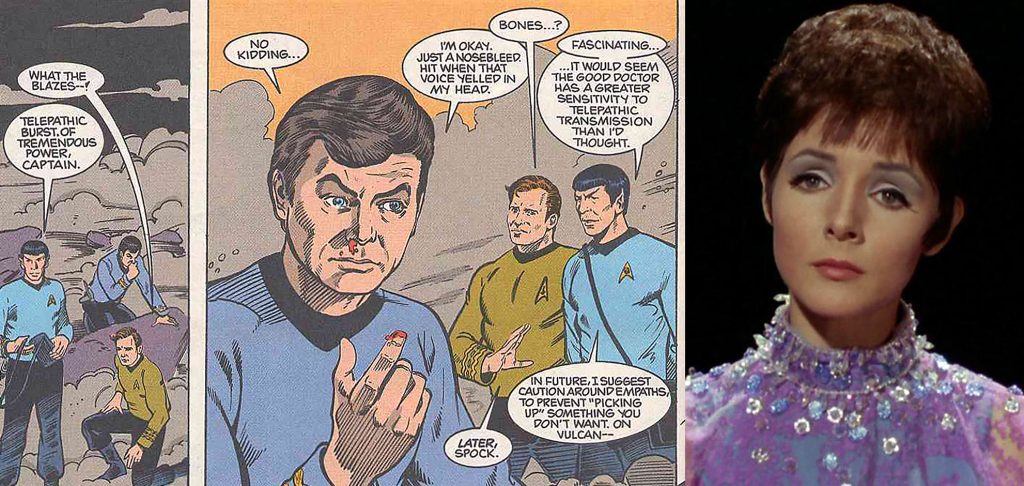
The Theta VII colony had faced a medical crisis in “Obsession,” and the Enterprise had delivered vaccines to the colonists there. In this story, Kirk seems to have never visited the planet before, as he’s amazed by its beauty, but that could mean he hadn’t beamed down during that prior visit, or that this is a separate world also called Theta VII (like how there are now two planets called Delta Vega, thanks to the 2009 film). McCoy suffers a nosebleed due to mental contact with Rell, and Spock muses that he must be more sensitive to telepathy than expected. He thus recommends Bones avoid contact with any empaths, foreshadowing the doctor’s eventual encounter with Gem in “The Empath.”

One of Peter David’s finest Trek comics was DC’s second annual, “Starfleet Academy.” As the title implies, the story takes place during Kirk’s Academy days, in which he befriends Gary Mitchell and Lee Kelso (“Where No Man Has Gone Before”), experiences frequent hazing from upperclassman Finnegan (“Shore Leave”), meets both Matt Decker (“The Doomsday Machine”) and Ben Finney (“Court-Martial”), and takes the Kobayashi Maru test (Star Trek II: The Wrath of Khan). Amusingly, future transporter chief Kyle helps Kirk humiliate Finnegan during the latter’s Kobayashi Maru test by beaming away the prankster’s uniform, leaving him naked in the simulation room.

All of this history is woven seamlessly into a witty and insightful coming-of-age tale in which Kirk loses one lover, Ruth (“Shore Leave”), and meets another, Carol Marcus, with whom he would eventually produce a son (Star Trek II). Kirk and Marcus meet when Gary asks her to spend time with Jim and help him relax. This adheres to a popular fan theory that Carol was the “little blonde lab technician” whom Gary had aimed Kirk’s way, according to “Where No Man Has Gone Before,” whom he’d almost married.

In addition, Kirk’s brother Sam (“Operation—Annihilate!” and Strange New Worlds) sees Jim off before he leaves for the Academy. Sam mentions his and Aurelan’s plan to relocate to Deneva (her name, unfortunately, is misspelled), setting up their tragic deaths in the 1960s episode.

Among the annual’s highlights is Kirk’s friendship with Gary Mitchell, which starts off rocky due to Jim being far too grim, then develops into a genuine bond. The comic establishes Gary as having a photographic memory, foreshadowing his psychic abilities in “Where No Man Has Gone Before,” and Gary provides much of the annual’s humor—but not all of it, as Carol jokes that Kirk’s breakup has left him “utterly Ruthless,” which is such a Peter David-style quip.

Kirk makes a bad first impression with both his future friend Finney, the dean of students, who views Jim as unable to get along with others, and Decker, a professor (later promoted to commodore) who finds Kirk nervous and indecisive. In time, both officers come to respect him and his talents. Other episode tie-ins abound, with references to Zefram Cochrane (“Metamorphosis”), Captain Dunsel (“The Ultimate Computer”), Garth of Izar (“Whom Gods Destroys”), the Daystrom Institute (“The Measure of a Man” and “Booby Trap”), and even a child-aged Will Decker (Star Trek: The Motion Picture).

Peter David would return for a one-off tale in issue #19, but most of the remaining issues would be written by Howard Weinstein, the highly talented author of The Covenant of the Crown and other Star Trek novels, as well as the script to the episode “The Pirates of Orion.” Weinstein’s issues, adeptly illustrated by Gordon Purcell, Arne Starr, Rod Whigham, Rachel Ketchum, and others, proved popular, and he stuck around until nearly the series’ end. As with David, Weinstein knew Star Trek well, and it showed. His early stories planted the seeds for the eventual Federation-Klingon treaty, signed in Star Trek VI: The Undiscovered Country and foretold in “Errand of Mercy,” by showing examples of Klingon and Starfleet crews uneasily cooperating toward common goals.
The author’s first home run was in issues #22–24, a humorous three-parter that wrapped up unresolved elements of Peter David’s aborted tenure, including the Nasgul threat, while bringing back Harcourt Fenton Mudd, now operating under the name Socrates. Older, grey-haired, and more rotund than ever, the jovial scoundrel—resembling actor Dom DeLuise on Moore’s gorgeous covers—travels with young con artist Shiloh, whom he has affectionately adopted as his protégé and ward. Mudd has stolen a sacred Nasgul relic, the Jaheelah, in the hope of retiring to a quiet life with his surrogate daughter.

Weinstein’s take on Harry Mudd is great fun, with Roger C. Carmel’s voice coming through in every line, and his role as a father-figure is unexpected and charming. Plus, the humor is dead-on. Upon overhearing a conspiracy to overthrow the Federation and the Klingon Empire, Mudd tells Kirk about it and swears on his wife’s grave that it’s the truth, implying the shrewish Stella (“I, Mudd”) has passed away—then hilariously adds that she’s likely “still alive and kicking… someone.” Kirk admits (not in Harry’s presence) that despite the trouble Mudd tends to cause, he actually likes the man and doesn’t mind him showing up every decade or so. (Had he known the angrier, murderous Harcourt of his younger years, portrayed by Rainn Wilson on Star Trek: Discovery and Short Treks, he might have a different opinion.)
The banter between Mudd and Kirk is a great callback to their exchanges in “Mudd’s Women,” “I, Mudd,” and “Mudd’s Passion,” but is tempered by the fact that both men have grown older, wiser (even Harry), and wearier in the interim. Harry learns that Starfleet had put Kirk on trial and reduced his rank (Star Trek IV: The Voyage Home) for stealing and destroying the USS Enterprise (Star Trek III) and is amused at the notion that deep down, he and the captain are alike.
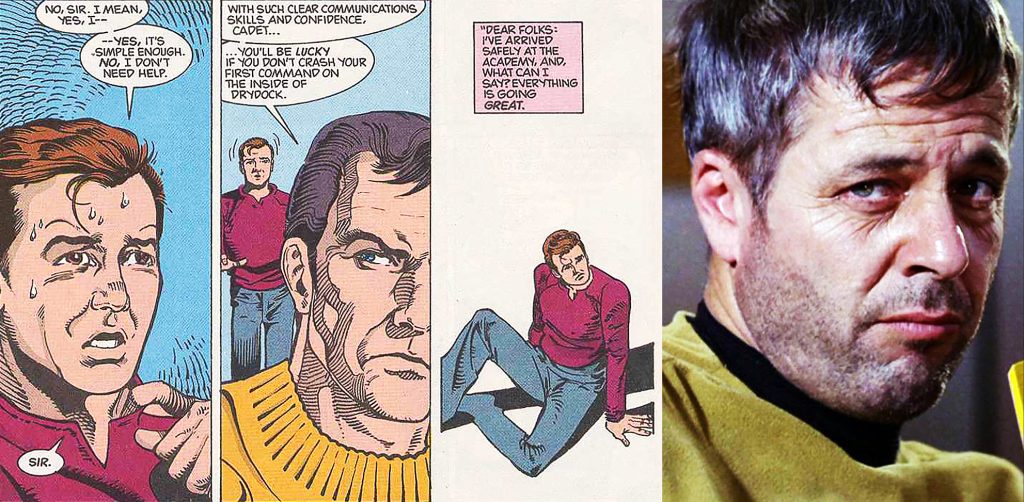
As it happens, Roger Carmel was rumored to appear in Star Trek IV as a character witness against Kirk during that same trial, so it’s possible this was an intentional allusion on Howard Weinstein’s part. In any case, the discussion of Weinstein’s run will continue in a few weeks, following DC’s epic eight-part generational crossover series, Star Trek: The Modala Imperative. But first, be here next week as we take another look at Michael Jan Friedman’s monthly Star Trek: The Generation adventures.
Looking for more information about Star Trek comics? Check out these resources:
- The Complete Star Trek Comics Index, by yours truly
- The Star Trek Comics Checklist, by Mark Martinez
- The Wixiban Star Trek Collectables Portal, by Colin Merry
- New Life and New Civilizations: Exploring Star Trek Comics, by Joseph F. Berenato
- Star Trek: A Comics History, by Alan J. Porter
Rich Handley has written books about Planet of the Apes, Back to the Future, and Watchmen, as well as licensed Star Wars and Planet of the Apes fiction, and he edited 70 volumes of Eaglemoss’s Star Trek Graphic Novel Collection. Rich co-edited Titan’s Scribe Award-nominated Planet of the Apes: Tales from the Forbidden Zone; nine Sequart anthologies discussing Planet of the Apes, Star Wars, Battlestar Galactica, Hellblazer, Stargate, and classic monsters; and four Crazy 8 Press anthologies about Batman and (now) the Joker. He has contributed essays to DC’s Hellblazer: 30th Anniversary Celebration; IDW’s Star Trek and Star Wars comic-strip reprint books; BOOM! Studios’ Planet of the Apes Archive hardcovers; Sequart anthologies about Star Trek and Blade Runner; ATB Publishing’s Outside In line exploring Star Trek, Buffy the Vampire Slayer, Angel, The X-Files, Twin Peaks, and Babylon 5; and a Becky Books anthology covering Dark Shadows.
3 thoughts on “Star Trek Comics Weekly #22”
Comments are closed.