
An ongoing discussion of how Star Trek comics provide prequels, sequels, and tie-ins to the episodes and films…
29: DC Comics, 1992–1993
Comic book writers often bring back characters from the Star Trek television shows and films. In some cases, it’s to be expected—no one is overly surprised when writers revisit Koloth, Q, the Borg, Gul Dukat, or the crews’ mirror-universe counterparts. They’re very popular, so it’s natural that licensed writers would relish utilizing them. But other times, a character’s return is unexpected, and it can be a delight to open up the latest issue to find that it features someone you’d never thought you’d see again.

One such character is Ardra—or, rather, the con-artist pretending to be Ardra—from Star Trek: The Next Generation‘s episode “Devil’s Due.” The impostor had posed as a mythical devil in order to fool the Ventaxian culture into believing she was that deity so they would fear and serve her. Thanks to the Enterprise crew’s intervention, “Ardra” was exposed as a fraud and arrested by the Ventaxians. The fake Ardra, portrayed by Marta Dubois, was among the more entertaining foils of The Next Generation‘s fourth season, but her return hardly seemed likely beyond that single tale.
So when Michael Jan Friedman brought the con artist back for issues #36–38 of DC Comics’ The Next Generation title, it was an unexpected pleasure to see her annoying Jean-Luc Picard again, while simultaneously trying to fleece a planetary treasury. Friedman clearly had fun exploring Ardra’s flirtatious, self-motivated persona, but he also showed her to be capable of doing the right thing… even if doing so was partly motivated by greed. He’d recently done something similar with Thadiun Okona.

Picard’s crew finds Ardra on the planet Shanzibar after being jailed during a shore leave gone awry, since she shares the same cell with them. She’d come to Shanzibar hoping to marry its elderly king and thus inherit his immense wealth upon his death, but after learning of a conspiracy among his advisors to murder the monarch, she’d been imprisoned to prevent her from exposing the plot. Once reunited with the Enterprise crew, Ardra convinces Picard to help her escape so they can thwart the assassination (and, of course, so she can go through with her marriage scheme). The king still offers to marry the seductress, but only if she’ll agree to a prenuptial arrangement. Not surprisingly, Ardra declines.

Friedman’s use of the character is spot-on compared to her onscreen debut, and the interior and cover art by Peter Krause, Pablo Marcos, and Jason Palmer perfectly capture her alluring, smirky essence. The writer’s penchant for bringing back characters from TV remained in full force in the next span of issues (#39–45), as he revisited numerous members of Picard’s crew, including Mot the barber (“Ensign Ro,” “Unification,” and “Schisms”), tactical officer Lieutenant Burke (“Peak Performance”), school teacher Miss Kyle (“New Ground”), Data’s ex-girlfriend Jenna D’Sora (“In Theory”), novice conn officer Orfil Solis (“The Arsenal of Freedom”), and Wesely Crusher’s gal-pal Robin Lefler (“Darmok” and “The Game”).

Lefler’s inclusion was a particular joy, as her portrayal by Ashley Judd won viewers over with her sparkling smile and running list of personal rules. Here, readers learn that Robin is still dating Wes in a long-distance relationship, and that Beverly sometimes brags about this to her shipmates (in space, no one can hear you scream… about your mom butting into your love life). While trying to reassure a room full of scared children, Lefler cites rule #26: “Never lie, even when it’s easier than telling the truth, and especially to children—because they’ll know it right away.” One can hear Judd’s inflection in every word.
Mot has an enjoyable arc as well in issues #39–44, in which the Bolian shows himself to be more than merely an overly talkative busybody. The barber is embarrassed when Worf’s son Alexander points out errors in the narrative of his latest tall tale, but that doesn’t stop him from watching out for the boy. The Enterprise‘s saucer section and battle bridge are separated when a Sztazzan fleet lays claim to an artificial moon, and a burst of energy from said moon sends the saucer, containing Mot and Alexander, to unexplored space. Mot, ever the softy, takes the child under his blue-tinted wing.

Seeing how nervous Alexander is about his father’s fate, Mot keeps him distracted by helping him strategize a way for the saucer to get home. Alexander presents that idea to Riker—who has already implemented that same strategy, but who lets Mot and Alexander think it was their idea. Mot’s willingness to put aside his bruised ego to help Alexander is endearing, and the bond that develops would be echoed on Star Trek: Voyager in Naomi Wildman’s friendships with Neelix and Seven of Nine. It’s a shame the comic team didn’t pair the two for more adventures, as they make for a surprisingly fun team-up… in a way that, alas, Alexander and Lwaxana Troi did not onscreen in “Cost of Living.”
The Sztazzan storyline introduces a new member of the Enterprise crew: Terry Oliver, whose mother, Katherine Pulaski, had been the ship’s chief medical officer during season two. Terry had survived a past skirmish with the Sztazzan, leaving her with an irrational hatred of their species, unable to view them as anything but enemies. At the time, she’d served aboard the badly damaged USS Grissom, named after the starship featured in Star Trek III: The Search for Spock. According to Deep Space Nine‘s “Field of Fire,” the 24th-century Grissom would be among those destroyed by the Jem’Hadar during the Battle of Ricktor Prime, making this issue sadly prophetic.

O’Brien relates to how Oliver feels, given his former bigotry toward Cardassians as explored in “The Wounded,” and after he shares with her how he has reevaluated his species hatred, she begins to do the same. When Oliver saves the life of a fallen Sztazzan soldier, the aliens reappraise the Federation, whom they’d perceived as aggressors—shades of the Gorn and their view of Starfleet before the events of “Arena.” Thanks to Terry’s ability to overcome bigotry and spare an enemy, the two governments set aside long-held differences, similar to Kirk’s actions toward the Gorn commander.
Issue #45 has a subtle connection to The Original Series‘ “Space Seed,” which I’ll get to in a moment. Allis, a blind Chorrtan prince, boards the Enterprise to meet with the medical-electronics team who’d built Geordi La Forge’s VISOR. Geordi bonds with the young nobleman, who requires sight in order to endure a manhood ritual. Two team members plot to kill the youth during surgery, having survived a brutal Chorrtan attack in the past, but La Forge saves the prince’s life, enabling him to be fitted with a VISOR in time for his ordeal.
Two issues in a row, a Federation citizen with a deep hatred toward an alien species due to a past atrocity sets aside that bigotry to save a life. The first was Terry Oliver. Now, one of Allis’s would-be murderers has a change of heart and proceeds with the surgery to give the prince eyesight. It’s a charming tale that does something the TV show wasn’t always successful at doing: providing La Forge with a strong solo story.

I’m not sure why La Forge didn’t always work as a spotlight character, for LeVar Burton threw himself into the role with admirable gusto, but episodes focused on the unlucky-at-love engineer tended to fall flat. Friedman should have been writing all of Geordi’s onscreen arcs, as he showed—not only in this issue but in DC’s third annual, to be discussed below—that he had a solid handle on how to make the character shine. The engineer’s interactions with the scientists who’d created his VISOR, their recollections of what he was like as an overly inquisitive child, his bonding with the prince over their mutual disability, and his efforts to save the youth from assassination all form an eminently enjoyable examination of what makes La Forge tick.
The “Space Seed” connection has to do with the VISOR’s creators. A past encounter with the Chorrtan is said to have involved research unsanctioned by the Federation, using gene-splicing to remove human imperfections, despite such technology having been outlawed following the Eugenics Wars. A similar thread would be explored in Deep Space Nine‘s “Doctor Bashir, I Presume,” with Julian Bashir’s parents accessing such forbidden technology to augment their son’s intelligence and physical traits. Picard dates the Eugenics Wars back to the early 21st century, but according to “Space Seed,” the wars lasted from 1992 to 1996. Friedman can be forgiven the continuity error since the TV shows themselves were inconsistent about when mankind’s various wars occurred.
Issue #46, about a despot forcing the Enterprise crew to fight for their lives in a deadly maze, offered no direct connections to any particular episodes. On the other hand, the aforementioned annual, “The Broken Moon,” was a direct episode sequel—though that wasn’t readily apparent at first. The annual was impressively illustrated by Brandon Peterson and Pablo Marcos, with a gorgeous cover by T.C. Hamilton. Like issue #45, it revolves around Geordi La Forge’s relationship with an alien prince—in this case, Onglaatu nobleman Kalonis.
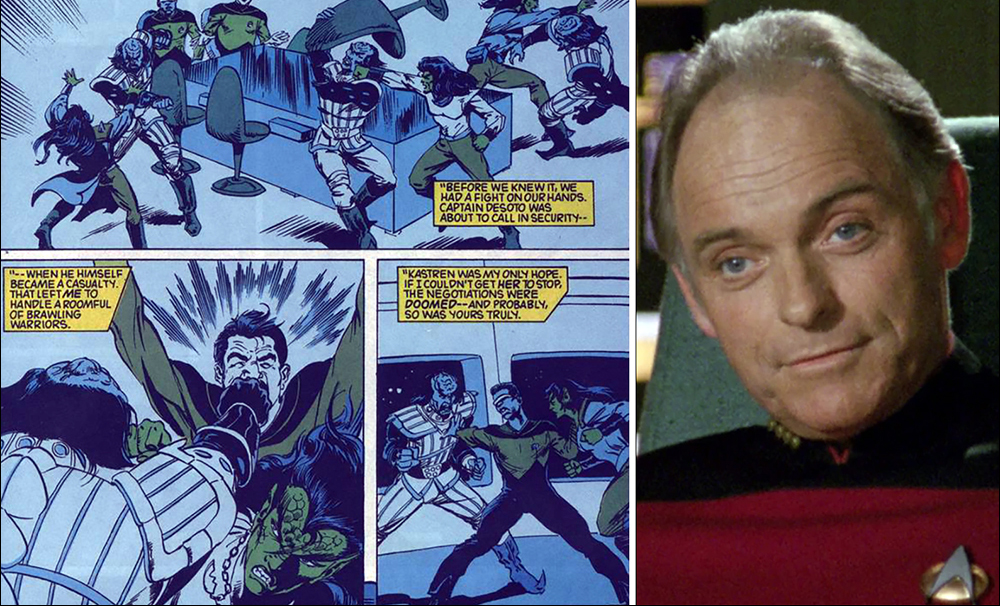
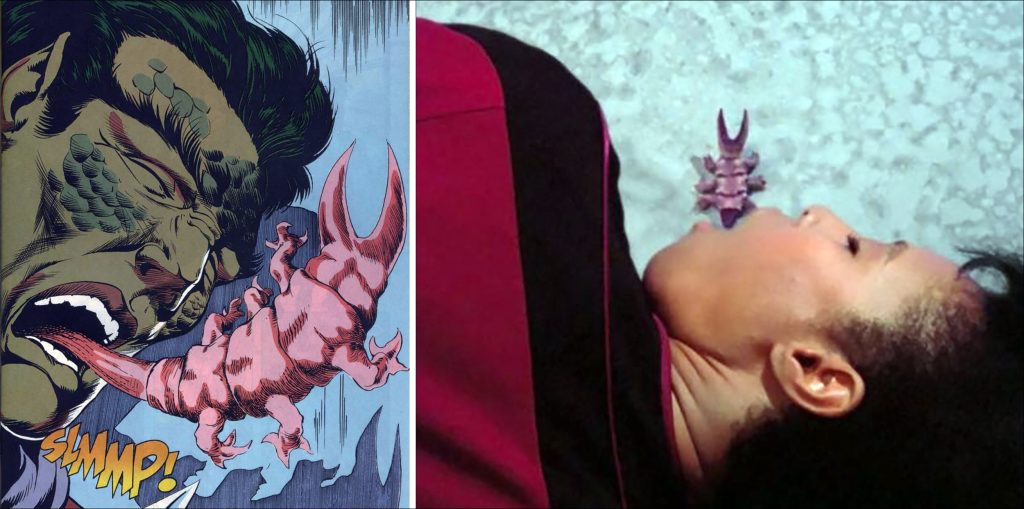
Kalonis’s mother, Kastren, had made La Forge her blood-brother after he’d saved her life while an ensign aboard the USS Hood under Captain Robert DeSoto (“Encounter at Farpoint” and “Tim Man”). Kastren has inexplicably incited a civil war on Glaa, and her son seeks Geordi’s help in finding out why. La Forge takes a leave of absence to visit the planet, but Kastren has both men imprisoned and seems not to know who Geordi is when he arrives. The latter foreshadows the reveal that the annual is an episode sequel, as Geordi discovers Kastren and her people have been possessed by the alien parasites from “Conspiracy.” After noticing the aliens’ telltale… er, tail… in a guard’s neck, he destroys the parasites, saving Kastren’s life and earning Glaa’s gratitude.
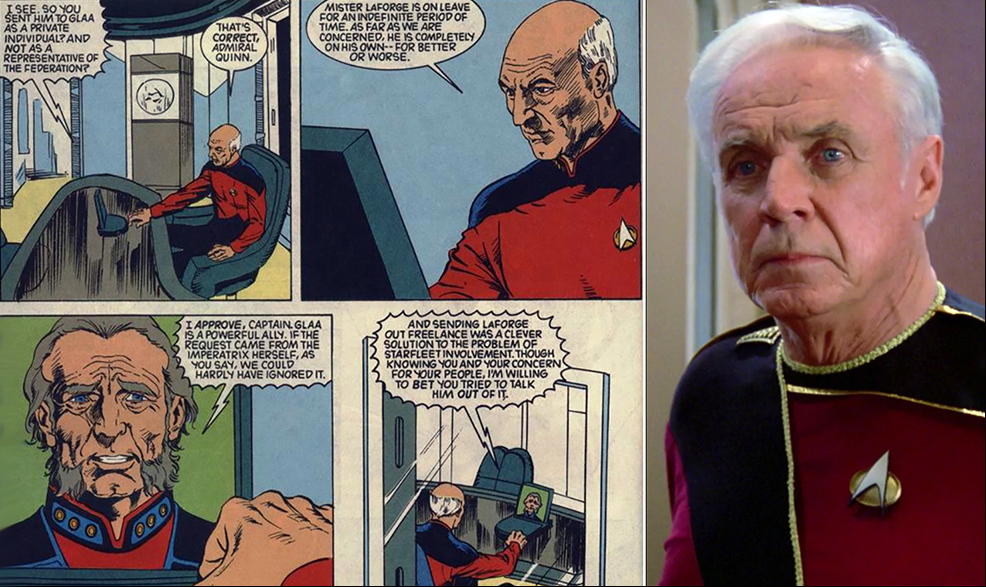
An appearance by Admiral Quinn foreshadows the big reveal. However, the artists’ depiction of the admiral radically differs from how he appears onscreen, perhaps due to their having been unaware Quinn was an existing character (or possibly due to likeness rights). On television, Gregory Quinn was an elderly, clean-shaven man with white hair, whereas here he sports brown hair and mutton-chop sideburns. Still, the annual’s unexpected parasite twist is highly effective, providing an engaging sequel to “Conspiracy,” one of the best episodes from The Next Generation‘s first season.
Between “Broken Moon” and the VISOR-centric issue, Friedman delivered on La Forge’s long-undeveloped potential to be a great character. In the coming weeks, this column will take another look at Howard Weinstein’s Kirk-era run, as well as more of Friedman’s Picard-era adventures, after which we’ll begin our examination of Malibu Comics’ Star Trek: Deep Space Nine spinoff. Happy holidays, everyone.
Looking for more information about Star Trek comics? Check out these resources:
- The Complete Star Trek Comics Index, by yours truly
- The Star Trek Comics Checklist, by Mark Martinez
- The Wixiban Star Trek Collectables Portal, by Colin Merry
- New Life and New Civilizations: Exploring Star Trek Comics, by Joseph F. Berenato
- Star Trek: A Comics History, by Alan J. Porter
Rich Handley has written books about Planet of the Apes, Back to the Future, and Watchmen, as well as licensed Star Wars and Planet of the Apes fiction, and he edited 70 volumes of Eaglemoss’s Star Trek Graphic Novel Collection. Rich co-edited Titan’s Scribe Award-nominated Planet of the Apes: Tales from the Forbidden Zone; nine Sequart anthologies discussing Planet of the Apes, Star Wars, Battlestar Galactica, Hellblazer, Stargate, and classic monsters; and four Crazy 8 Press anthologies about Batman and (now) the Joker. He has contributed essays to DC’s Hellblazer: 30th Anniversary Celebration; IDW’s Star Trek and Star Wars comic-strip reprint books; BOOM! Studios’ Planet of the Apes Archive hardcovers; Sequart anthologies about Star Trek and Blade Runner; ATB Publishing’s Outside In line exploring Star Trek, Buffy the Vampire Slayer, Angel, The X-Files, Twin Peaks, and Babylon 5; and a Becky Books anthology covering Dark Shadows.
One thought on “Star Trek Comics Weekly #29”
Comments are closed.