
An ongoing discussion of how Star Trek comics provide prequels, sequels, and tie-ins to the episodes and films…
31: DC Comics, 1993–1994
Michael Jan Friedman’s early Star Trek: The Next Generation stories for DC Comics were standalone tales with few direct ties to TV episodes. This gave the author time to become comfortable writing Star Trek comics before delving into longer arcs, while allowing DC to keep things simple until it knew the series was a bona fide success. In time, though, Friedman began offering episode sequels, bringing back such characters as Q, Thadiun Okona, Ardra, Helena and Sergey Rozhenko, Jeremy Aster, and the alien parasites from “Conspiracy.”

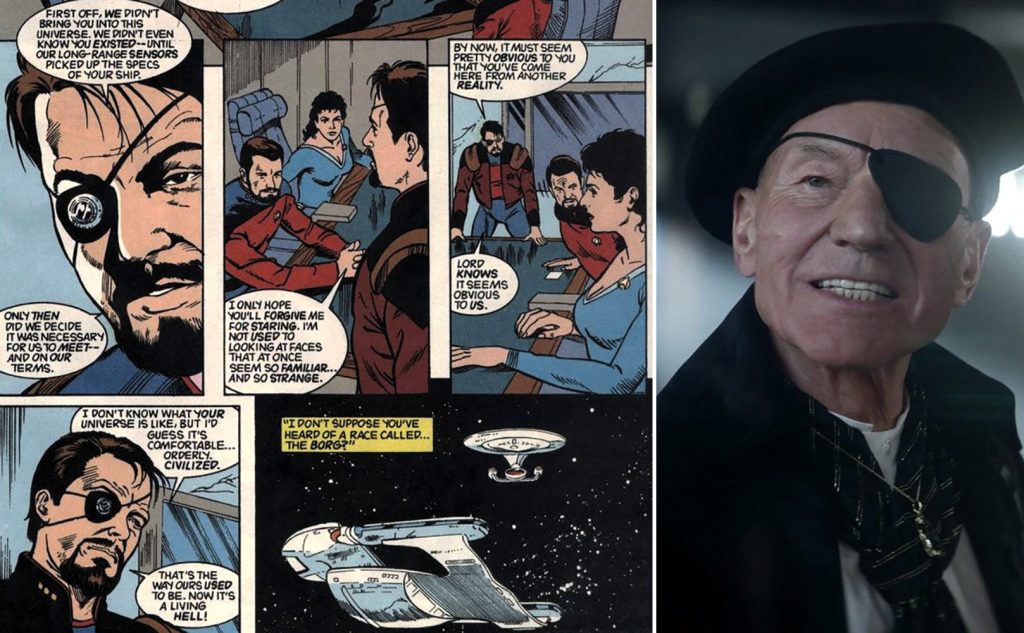
In fact, nearly all of the stories to be discussed this week (from monthly issues #47–58, as well as ST:TNG Annual #4 and ST:TNG Special #1) constitute multi-arc sequels, showcasing how comfortable Friedman had become during his time at bat. One of his best was a four-parter in issues #47–50, titled “The Worst of Both Worlds.” The story revisited one of Trek‘s greatest episodes, “The Best of Both Worlds,” in which the Borg captured Jean-Luc Picard and forced him to oversee an Earth invasion as the cyborg-enhanced Locutus. The twist? It’s set in an alternate timeline in which efforts to rescue Picard from the Borg had failed, resulting in the Collective assimilating Earth.

An anomaly brings the prime Enterprise into this reality, where the crew encounters a second Enterprise missing its saucer section. Will Riker serves as its eye-patched captain, with a mutinous Commander Elizabeth Shelby as his first officer. Readers learn that Data, Deanna Troi, Guinan, Keiko O’Brien, and others were lost during the Battle of Wolf 359, while Beverly Crusher was among those assimilated on Earth. Miles O’Brien and Wesley Crusher join Shelby’s mutiny due to Riker’s hesitancy to strike back at the Borg, but they rethink their choices after meeting the prime Keiko and Beverly, and Miles eventually shoots Shelby. The prime crew frees Locutus (this time using an “eat” command instead of “sleep”) and Earth’s population from mechanized existence.
Issue #51 presented a fill-in from Judith and Garfield Reeves-Stevens, with incorporeal beings invading the starship and draining its power. It contained no direct connections to onscreen Trek, but the sequels resumed when Friedman returned, with the Enterprise crew taking shore leave in issues #52–54. Picard and Crusher enjoy a new Dixon Hill adventure titled The Rich and the Dead, providing a sequel to “The Big Goodbye,” while Riker brings Troi, Geordi La Forge, Worf, and Alexander Rozhenko to a circus. Going to a circus has apparently been Deanna’s lifelong dream, since such entertainment has gone extinct on Earth. (A quick check at Memory Alpha confirms that, indeed, no circus has been featured or name-checked in any onscreen iteration of Star Trek. Menageries and zoos, certainly, but no circuses.)

Tying the Dixon Hill and circus narratives together is the latest scheme by Q to test the crew. Q interrupts the holo-program to warn Picard and Crusher that they must solve the fictional murder mystery or else Troi and Worf will die. The entity has shrunken them to the size of a dust mote and has trapped them in the folds of a circus performer’s uniform, which means they’ll perish during a cannonball routine if not restored to their stature. In so doing, Q enables Troi to expose an animal-smuggling operation, leaving the crew to wonder whether that had been the trickster’s intention all along.

Data, meanwhile, pilots Phillipa Louvois (last seen in issues #10–12) to a legal conference. The two travel aboard the Sakharov (“Unnatural Selection”), and she apologizes for her role in the trial to establish the android’s rights as a sentient being, depicted in “The Measure of a Man.” Their shuttle collides with another vessel, killing nine Terviorii, and they are put on trial for failing to serve the good of the many, since nine have died at the hands of only two.

Louvois’ legal argument—that Data is the last of his kind and thus represents an entire species—wins in court, as the Terviorii have no wish to commit genocide. Perhaps a stronger argument, given the peculiar Terviorii justice system’s focus on the many over the few, might be that Data possesses the personal memories of 411 Omicron Theta colonists (per “Silicon Avatar”), which means he represents far more life forms than the nine who’d died, by a factor of 45. However, this never comes up and her strategy thankfully pays off.
It’s worth noting that Louvois calls Data “the only one of his kind in the entire galaxy,” but this is not true. Lore (“Datalore,” “Brothers,” and “Descent”) is still active at this time, while Lal (“The Offspring”) exists but is deactivated. And unbeknownst to Data and Louvois, at least two others exist as well, waiting to be discovered: Juliana Tainer (“Inheritance”) and B-4 (Star Trek: Nemesis). There’s also an entire planet of androids, per The Original Series‘ “I, Mudd,” though they were not created by Noonian Soong.

Overlapping the Data-Louvois tale is a multi-parter running in issues #55–58, which brings back not only Lwaxana Troi (Deanna’s mother, introduced in “Haven”), but also Vulcan physician Selar (“The Schizoid Man”). Lwaxana attends a conference to convince the planet Eregeus to join the Federation, and she brings Alexander and his class, including teacher Miss Kyle (“New Ground”), along for an educational experience, building on the bond she and Worf’s son had forged in “Cost of Living.”

The conference goes awry (as such events tend to do in Star Trek) when a neighboring world, Sakerion, abducts Lwaxana and Selar, as well as Deanna, Worf, Alexander, and La Forge, to frame Eregeus and prevent its Federation membership. Ancient technology causes the six to mentally merge, with Lwaxana sharing consciousness with Worf, Alexander joining with Deanna, and Geordi becoming one with Selar. The resultant interactions are as amusing as one would expect, with each persona alternately assuming prominence in each particular pairing. (Worf, naturally, is not a merry man.)
The Bradbury delivers Lwaxana to the Enterprise. The vessel had been slated to bring Wesley Crusher to Starfleet Academy in the Lwaxana-centric “Ménage à Troi,” and was orbiting Betazed at the time, so its inclusion in another tale starring the ambassador is likely not coincidental. During her visit, Lwaxana spends more time with Alexander, using her telepathic skills to read his mind and create another holodeck adventure for them to share, customized to satisfy his fascination with dinosaurs. To Friedman’s great credit, these holodeck scenes are not cringeworthy like those in “Cost in Living,” and in a charming anachronism, Ms. Troi dresses up as Snow White for the dino-adventure.

One of Friedman’s strengths as a writer is in the dialogue he gives Picard and Riker for the calm scenes between storms. One such exchange ties in with “Chain of Command,” in which Edward Jellico had served as the Enterprise‘s temporary captain. Jellico and Riker had butted heads in that episode, and Picard informs Will that the captain has filed a report with Starfleet. Although he praises Riker’s nerve and piloting skills, Jellico finds Will lacking in discipline and leadership potential—which could pose a problem, Picard admits, since Starfleet strongly values Jellico’s opinions. Jean-Luc, of course, disagrees with the other’s assessment.
Mike W. Barr, from DC’s inaugural Star Trek comic line, contributed the script to the fourth Next Generation Annual, illustrated by Jim Key, Aaron McClellan, and Bob Smith. The issue provided an unexpected sequel to “The Host”—unexpected because after that episode, which had introduced the Trill in the form of ridge-headed Ambassador Odan, Trill hosts were retooled for Deep Space Nine as having spots instead of ridges, making Odan’s return rather unlikely. That early design for the Trills has never again shown up on any Star Trek television series, in fact.

With radiation threatening a penal colony on Tantalus VII, the Enterprise evacuates Keb Dalor, a joined Trill whose symbiote is guilty of many crimes, along with visiting dignitary Odan. The planet’s name provides a callback to The Original Series‘ “Dagger of the Mind,” which had featured a penal colony on Tantalus V; this suggests the entire star system may be designated for prison use. Dalor’s thugs free him, commandeer the Enterprise, and force Crusher to place the symbiote inside Picard, but Odan and Beverly help retake the starship. Odan, still in Kareel’s female form, tries to rekindle their love affair, but Crusher remains unwilling to consider a romantic relationship with a female, in keeping with Trek‘s 1990s sexual/gender politics.
Trivia hounds take note: among Picard’s crew is an officer named Sherwood. During his tenure on DC’s Star Trek, Mike Barr had introduced Elizabeth Sherwood, who would remain a recurring character throughout the series and become romantically involved with reformed bigot William Bearclaw. If the Sherwood in this tale is an intentional nod to Barr’s prior work, this may indicate a familial relationship.
The TNG Special presented a trio of shorter stories. “Good Listener,” penned by Tony Isabella and Bob Ingersoll, centered around Guinan’s efforts to help a friend establish a bar for mining colonists. “A True Son of Kahless,” in which Worf takes Alexander on vacation so the youth can learn what it means to be Klingon, was written by Kenneth Penders and Anne Wokanovicz. Finally, the adorable “Spot’s Day” was contributed by novelist Diane Duane; as one might expect, it spotlights a day in the life of Data’s inquisitive cat, which includes facing down—and frightening—a holographic tiger.

None of these three tales are overly connected to specific episodes, other than the second, which includes multiple callbacks to K’Ehleyr’s death in “Reunion.” Unfortunately, a production error caused several panels of Alexander’s story to contain no speech bubbles, obscuring the context of the first two pages. This problem would continue in Spot’s tale, due to the production department being confused by a cat having an internal monologue. Thus, Spot’s inner musings were regrettably removed, aside from the feline’s final line.
To Duane’s credit, her story reads fine without the missing text; alas, Penders’ otherwise engaging tale is weakened by perplexing panels in which characters stare silently without speaking. Thankfully, both authors allowed me to include their original script pages in Cry Vengeance, volume 128 of Eaglemoss’s Star Trek Graphic Novel Collection, enabling fans to at last learn what they’d long been missing.
Next week, we’ll examine some Star Trek comics exclusive to Indonesia and Japan. Then, we’ll embark on our first trip through the Bajoran wormhole, courtesy of Malibu Comics’ highly praised Star Trek: Deep Space Nine run. See you then.
Looking for more information about Star Trek comics? Check out these resources:
- The Complete Star Trek Comics Index, by yours truly
- The Star Trek Comics Checklist, by Mark Martinez
- The Wixiban Star Trek Collectables Portal, by Colin Merry
- New Life and New Civilizations: Exploring Star Trek Comics, by Joseph F. Berenato
- Star Trek: A Comics History, by Alan J. Porter
Rich Handley has written or contributed to dozens of books about pop culture. He edited 70 volumes of Eaglemoss’s Star Trek Graphic Novel Collection, contributed to IDW’s Star Trek 400th Issue, and currently writes for Titan’s Star Trek Explorer magazine. Rich helped to produce IDW’s five Star Trek comic strip reprint hardcovers, and he penned an essay about those strips for Sequart’s New Life and New Civilizations: Exploring Star Trek Comics. In addition, he was a columnist for Star Trek Communicator magazine and a consultant on GIT Corp.’s Star Trek: The Complete Comic Book Collection, and he contributed to Modiphius’s Star Trek Adventures: Shackleton Expanse Campaign Guide.
2 thoughts on “Star Trek Comics Weekly #31”
Comments are closed.