
An ongoing discussion of how Star Trek comics provide prequels, sequels, and tie-ins to the episodes and films…
35: DC Comics, 1994–1995
One advantage of the comic book medium is that it enables writers to focus on characters introduced on television who haven’t had much airtime, and to tie in with episodes that the TV writers might never revisit. We’re now nearing the end of Michael Jan Friedman’s tenure on DC Comics’ Star Trek: The Next Generation, and we’ll see several examples of this as we examine how issues #59–70 provided prequels and sequels to onscreen Trek.
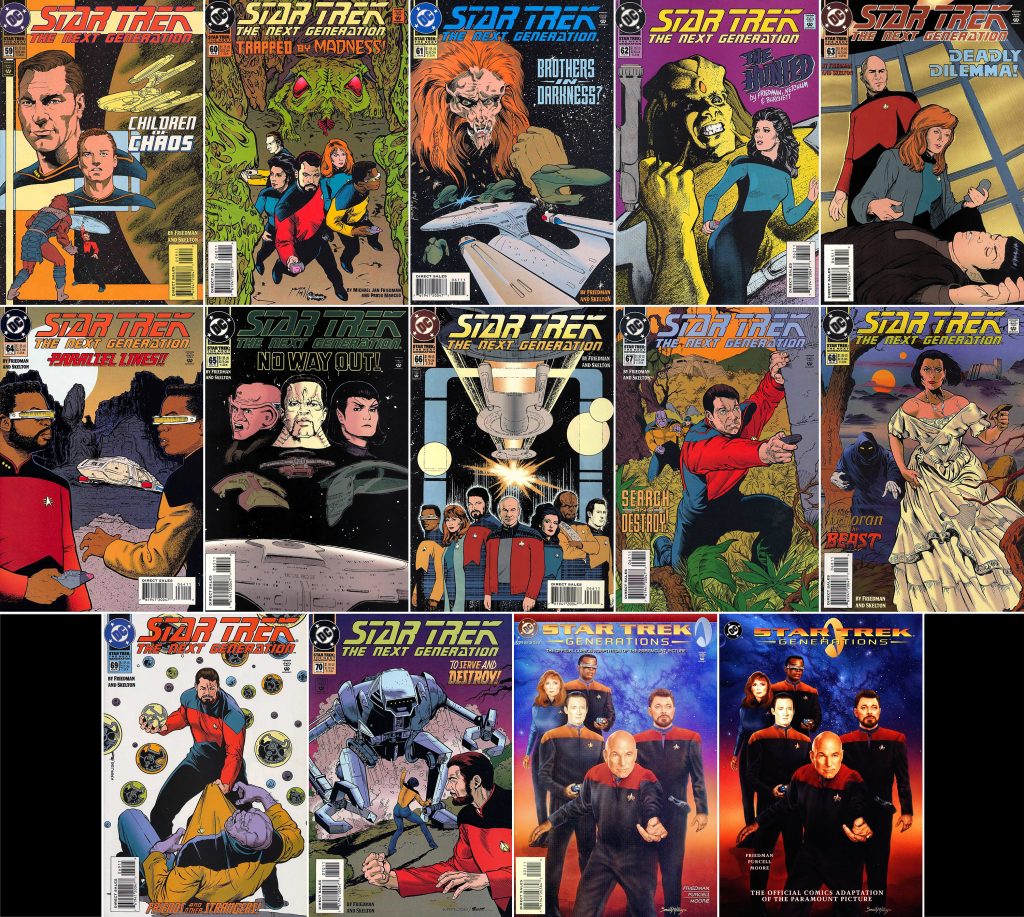
Margaret Clark inherited the editor’s chair in DC’s final years, overseeing the final two dozen issues of both The Next Generation and the original Star Trek. Deryl Skelton illustrated most of the issues covered below, providing a starkly different (though no less enjoyable) aesthetic compared to prior installments drawn by Pablo Marcos, Peter Krause, and Carlos Garzon.
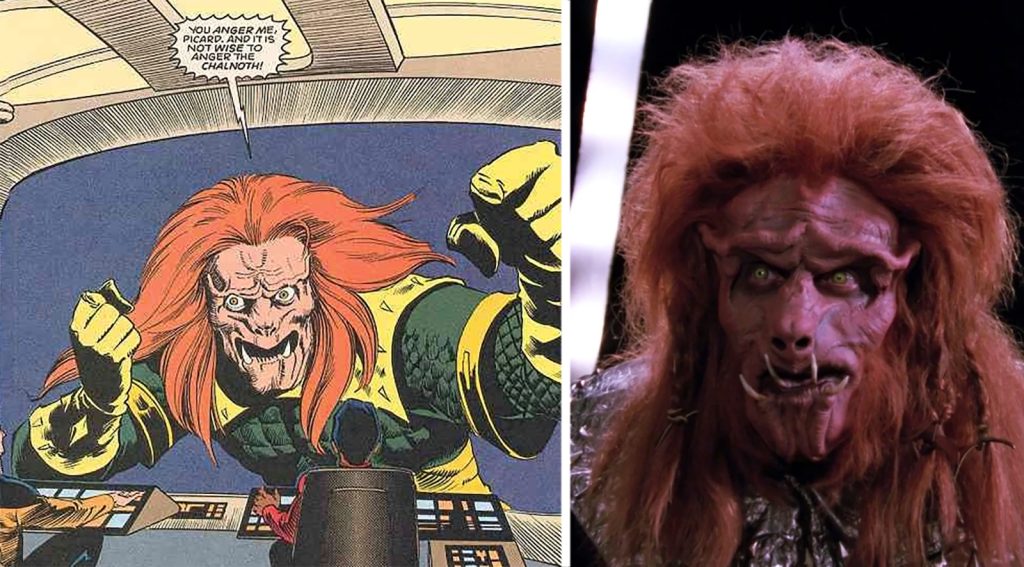
The Chalnoth (from “Allegiance,” in which Picard was abducted, along with a Chalnoth named Esoqq, by aliens studying the nature of command) return in issues #59–61. A flashback in this three-parter sees Picard and the USS Stargazer (“The Battle”) on a diplomatic mission involving the anarchistic warriors. Picard meets with Chalnoth leader Antocch, who demands that a Federation colony on Ynathaia be evacuated. After Picard beats Antocch’s champion in combat, he begrudgingly lets the colonists complete their research. (It’s remarkable how often Picard ends up being tested by aliens, isn’t it?)
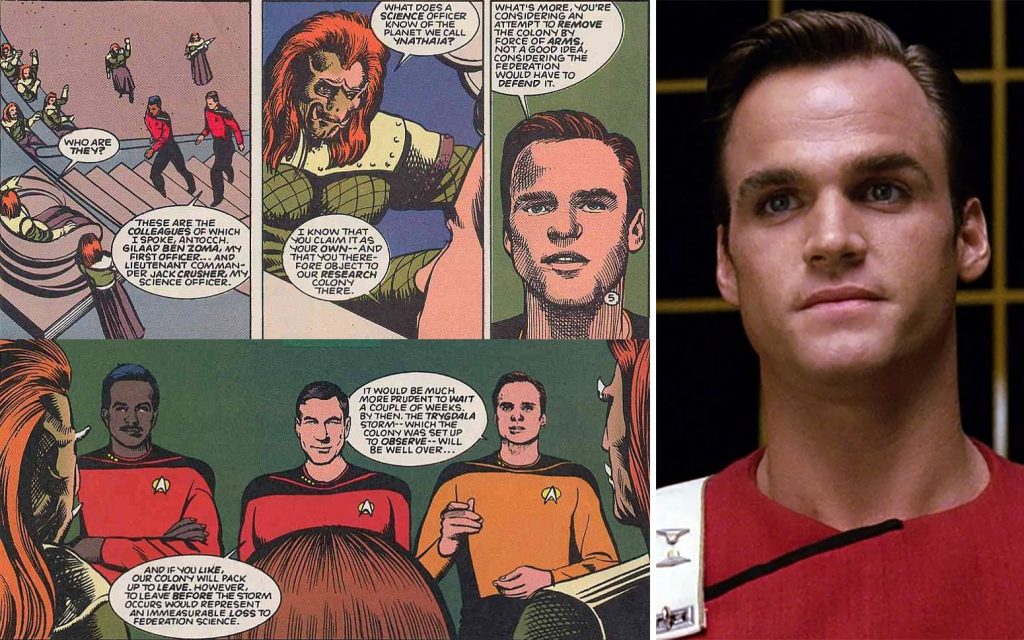
Featured in the flashback are Jack Crusher (resembling actor Doug Wert, who first played the character in “Family”) and Gilaad Ben Zoma (from Friedman’s novels, including Reunion, Requiem, The First Virtue, The Valiant, Stargazer: Oblivion, and Death in Winter). Having a popular character from the books show up in a comic is a rare delight. A Paramount edict had been in place at the time of publication, discouraging novel writers from referencing the comics, and vice versa, though since Ben Zoma was an original Friedman character, it’s not surprising the studio would let the crossover take place. Or perhaps no one at Paramount realized Gilaad had originated in prose, and DC simply slipped that in without anyone noticing.
The next four issues featured no direct tie-ins, though they were among Friedman’s stronger stories. In issue #62, Deanna Troi is hunted by a powerful alien who has seemingly murdered her fellow officers. This alien kills her when she can’t bring herself to shoot him first, after which she awakens to find it’s a simulated test (naturally, since Friedman would not have been allowed to kill the main cast) to determine her innocence in a murder investigation. Then, a tale of intrigue in issues #63–65 is built around deceptions perpetrated by pretty much every featured faction: a Romulan scientist who has created a dilithium-eating virus, as well as Cardassian, Romulan, and Ferengi fleets that want to capture him and acquire his research for their own use.
The environment takes center stage in issue #66, a cautionary tale about the dangers of stockpiling nuclear materials, as well as the importance of self-reliance. The Enterprise visits Utalabria to celebrate the hundredth anniversary of the planet’s cleanup by a spacefaring creature that had fortuitously consumed all its waste. The so-named “Eater” returns to feast after a century, but instead of consuming more waste, the entity this time has an allergic reaction to it and nearly destroys all life on the planet.
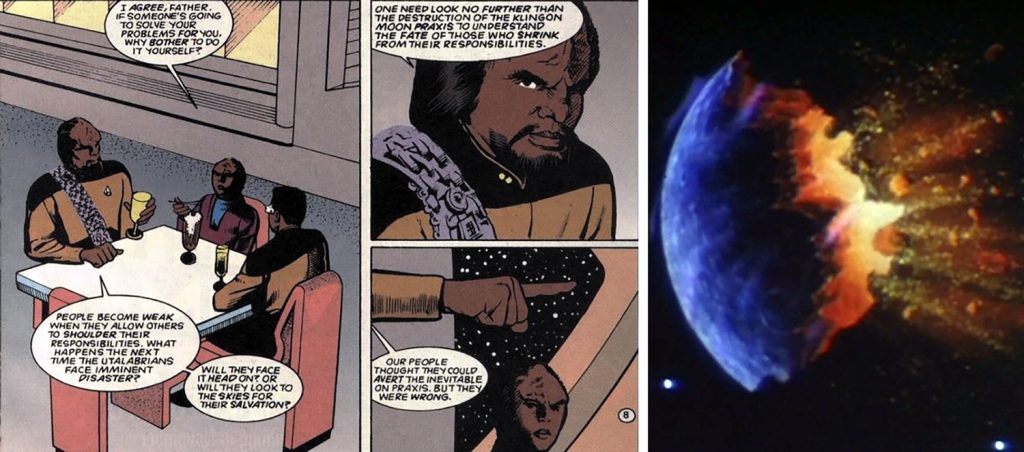
Worf expresses disdain at watching this culture let others solve its problems rather than tackling them head-on. He compares the situation to the Praxis explosion in Star Trek VI: The Undiscovered Country, calling the moon’s destruction an example of what happens when a civilization assumes it can avert an inevitable disaster. Nuclear technology was highly topical in the mid-1999s. Only a few years had passed since the end of the Cold War and the fall of the U.S.S.R., and the threat of mutual annihilation in a global thermonuclear war, not to mention the dangers posed by ever-increasing levels of nuclear waste, filled many with trepidation. Given the current state of the world, Friedman’s message is disturbingly relevant once more.
Issues #67–70 revisit Will Riker’s days aboard the USS Hood, as the officer reunites with former crewmates to fulfill a promise made long ago. This four-parter is replete with callbacks, particularly to “Encounter at Farpoint” and “The Pegasus.” The story explores an incident mentioned in those episodes, when Riker risked a court-martial by refusing to let Captain DeSoto transport to Altair III due to danger on the planet’s surface. DeSoto is here named Jonathan (he’s called Robert in “Tin Man”) and is said to have died at the Battle of Wolf 359 (“The Best of Both Worlds”), despite being alive in “The Pegasus,” but such errors are inevitable in licensed lore—just as they are in televised tales, too—and shouldn’t stop readers from enjoying otherwise engaging stories.

The Altair III incident is depicted as a civil war between rebels and the planetary government, with a monastery caught in the crossfire. According to Friedman’s account, the Hood had been sent to offer humanitarian aid, with Riker leading an away team to evacuate the monks. The effort had failed and the monks had been slaughtered, but Riker and four crewmates had preserved memory bubbles said to contain sacred texts, which they’d promised to return to the planet once the civil conflict had ended. Built into the story is an engaging murder mystery that is unfortunately ruined by issue #69, which spoils the killer’s identity on the cover.
Riker’s ex-comrades serve on starships noted in various episodes. Randy Green works aboard the USS Tripoli, which discovered Data following the Omicron Theta colony’s destruction by the crystalline entity (“Datalore”). Another shipmate, Brian, is assigned to the USS Cochrane, which transported Norah Satie to the Enterprise in “The Drumhead” so she could investigate Romulan espionage. And Flad Orzon serves on the USS Hornet, which blockaded the Klingon-Romulan border in “Redemption.” The use of vessels referenced on TV tightens continuity, making the comics seem part of the larger saga.
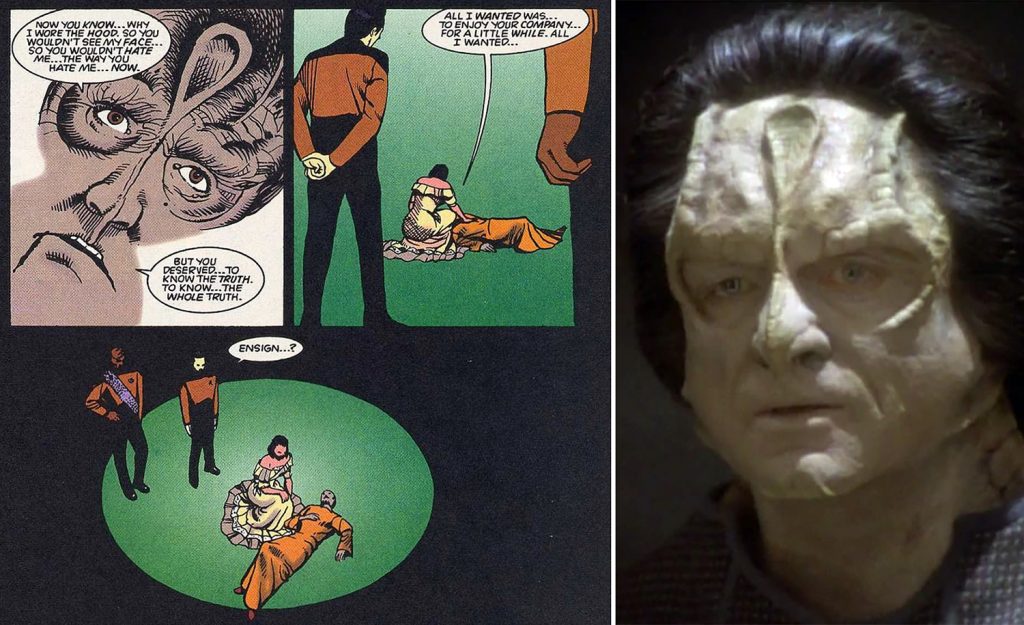
An emotionally stirring B-story sees Ro Laren ferrying an ambassador aboard the Onizuka (“The Ensigns of Command”). A Tisatti vessel attacks the shuttlepod, causing itto crash on a nearby world, where Ro awakens in a castle. Her hooded host, a Cardassian Gul living in self-exile to atone for his actions as a Bajoran labor camp administrator, feeds and protects her. He dies saving her life, moments before the Enterprise rescues Ro, who tearfully calls him a friend despite his past offenses. The scene echoes Kira Nerys’s forgiveness of Aamin Marritza (Deep Space Nine‘s “Duet”), who lived in shame at having lacked the courage to stop his people’s atrocities.
On a lighter note, one of Riker’s buddies recalls hearing that Will had been demoted to lieutenant and transferred to the USS Gandhi. This, of course, pertains to Thomas Riker’s assignment following his rescue in “Second Chances,” but it’s amusing to consider the confusion that must have resulted from identical Rikers of different ranks serving on separate vessels, and how often the men must have been mistaken for the other. Given Thomas’s alignment with the Maquis in Deep Space Nine‘s “Defiant,” it’s possible many Starfleet officers think Will Riker turned traitor!

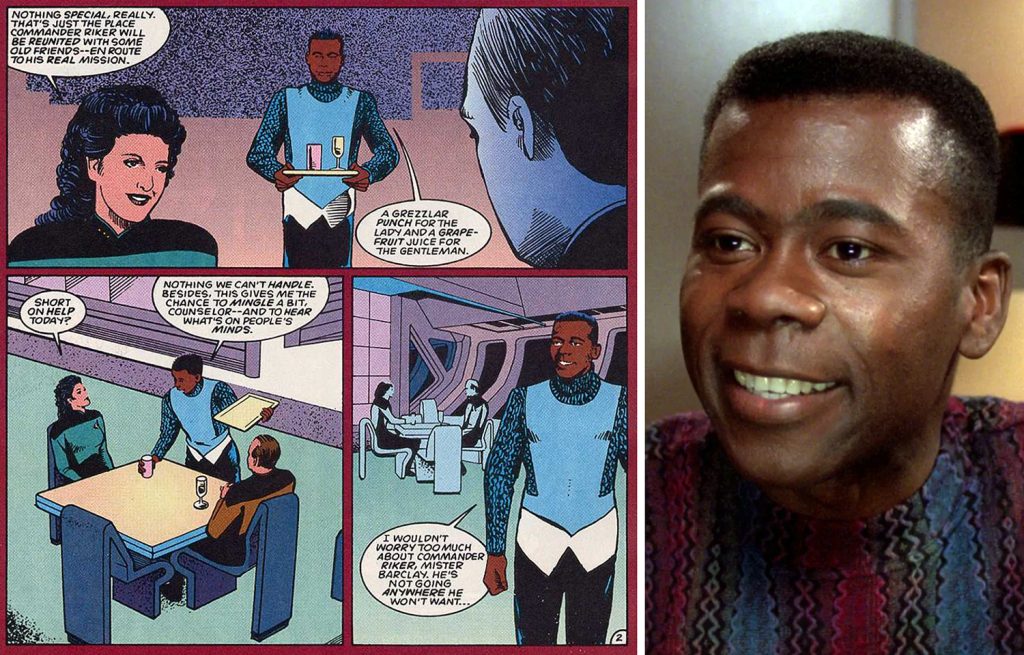
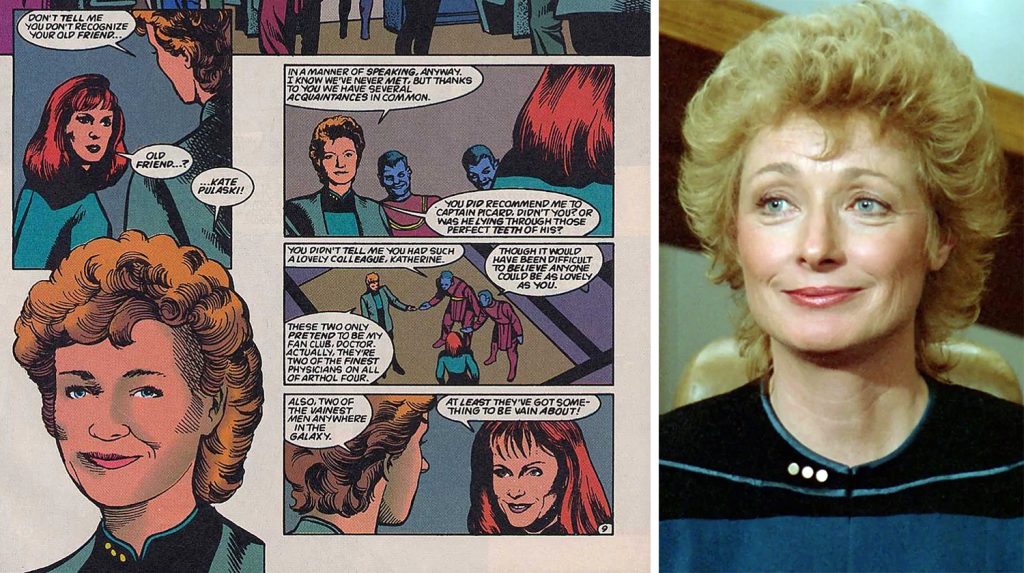
Ben (presumably no relation to Zoma), one of Guinan’s waiters from “Lower Decks,” has a cameo, as does the oft-featured Selar (“The Schizoid Man”). More significant is the return of Katherine Pulaski, Beverly Crusher’s replacement during The Next Generation‘s second season, in issue #70. Pulaski and Crusher attend a medical conference and meet in person for the first time—which is surprising, really, since Crusher had recommended her for the Enterprise posting.
When a disgraced researcher threatens the conference-goers with a bomb, the two doctors not only thwart the terrorist by adjusting life-support controls, but also expose a scientist who’d stolen the man’s credit for a vaccine, resulting in the bomb threat. It’s a fun team-up utilizing the two physicians’ strengths (Pulaski is arguably more entertaining here than on television, in fact, thanks to Friedman’s witty dialogue), and it’s one of the few times Crusher and Pulaski have ever appeared together in a comic.
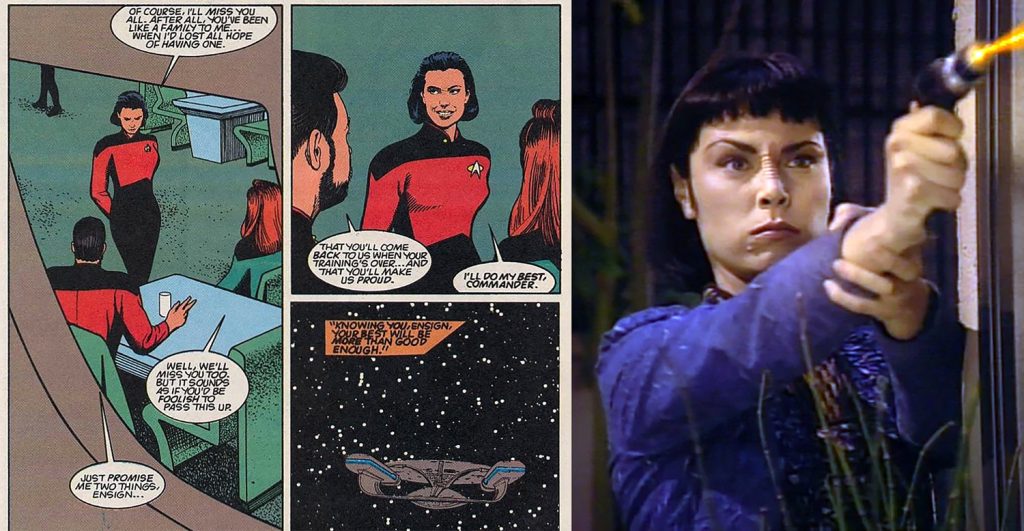
With The Next Generation winding down on television, Friedman began setting the stage in these issues for the season-seven finale and the crew’s silver-screen transition in Star Trek: Generations. Ro bids farewell to her shipmates before leaving the Enterprise to take part in a Starfleet tactical training program, and Riker urges her to come back once her training is complete, and to make her shipmates proud. This ironically sets up the plot twist of “Preemptive Strike,” in which Ro returns following her training, only to betray her friends, captain, and oath by joining the Maquis.
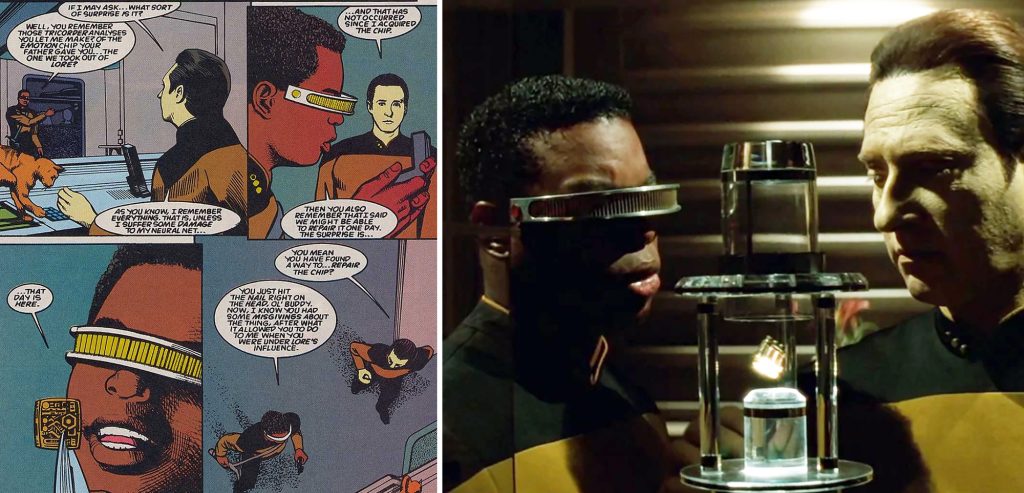
Meanwhile, Geordi La Forge repairs the emotion chip Noonian Soong made for Data in “Brothers,” having analyzed it ever since the chip’s retrieval from Lore’s positronic brain in “Descent.” Data hesitates to install the device for now, concerned that it might erase his memories and experiences, though he would soon take that risk in Generations, proving such concerns unfounded—particularly since he’d be dead only three movies later. (Star Trek: Picard has since revived the android as a hybrid being, with not only Lore but also B4 and Lal integrated into his personality.)
DC adapted Generations as both a regular comic and as a deluxe prestige-format edition featuring supplementary behind-the-scenes materials. Written by Michael Jan Friedman (from a story by Rick Berman, Ronald D. Moore, and Brannon Braga), the adaptation was illustrated by Gordon Purcell, Jerome K. Moore, and Terry Pallot. Its cover, gorgeously painted by Sonia Hillios, formed a mural with the covers to the first issues of DC’s Shadowheart miniseries and its Deep Space Nine crossover with Malibu. The mural was also released as a promotional poster that proudly hangs on my office wall.
In two weeks, we’ll take a closer look at Shadowheart, along with other issues in DC’s Star Trek: The Next Generation comic line. But first, we’ll continue to chronicle Malibu’s deep-space adventures. See you next time at the edge of the final frontier.
Looking for more information about Star Trek comics? Check out these resources:
- The Complete Star Trek Comics Index, by yours truly
- The Star Trek Comics Checklist, by Mark Martinez
- The Wixiban Star Trek Collectables Portal, by Colin Merry
- New Life and New Civilizations: Exploring Star Trek Comics, by Joseph F. Berenato
- Star Trek: A Comics History, by Alan J. Porter
Rich Handley has written, co-written, co-edited, or contributed to dozens of books, both fiction and non-fiction, about Planet of the Apes, Watchmen, Back to the Future, Star Trek, Star Wars, Battlestar Galactica, Hellblazer, Swamp Thing, Stargate, Dark Shadows, The X-Files, Twin Peaks, Red Dwarf, Blade Runner, Doctor Who, Buffy the Vampire Slayer, Batman, the Joker, classic monsters, and more. He has also been a magazine writer and editor for nearly three decades. Rich edited Eaglemoss’s Star Trek Graphic Novel Collection, and he currently writes articles for Titan’s Star Trek Explorer magazine, as well as books for an as-yet-unannounced role-playing game. Learn more about Rich and his work at richhandley.com.
One thought on “Star Trek Comics Weekly #35”
Comments are closed.