Archival article, previously published in A Galaxy Far, Far Away: Exploring Star Wars Comics (Sequart, 2016), edited by Rich Handley and Joseph F. Berenato
When Disney revealed its plans to reboot the licensed Star Wars franchise in anticipation of Episode VII: The Force Awakens, it also announced that Marvel Comics would take over the Star Wars comic book line following the impending changeover. Although many decried the loss of Dark Horse Comics’ amazing two decades’ worth of stories, others saw it as fitting that it would be Marvel holding the reins at the dawn of this new era of Star Wars. After all, the publisher was there at the very dawn of the franchise. In the beginning, there was Marvel, and fans saw that it was good.
Unbeknownst to many American fans is that when Marvel’s original series was released in the United Kingdom, it was a very different dish than what we Yanks were served. Marvel UK’s editors varied the story order and heavily edited many of the issues, printing them mostly in black and white. What’s more, the Brits received several items not on the U.S. menu.
The U.S. Series
Between 1977 and 1987, Marvel Comics’ U.S. branch crafted a sprawling saga set before, during, and after the trilogy’s events as depicted on the silver screen. In the United States, Marvel published a monthly series spanning three eras: #1–38 (A New Hope to The Empire Strikes Back), #39–80 (The Empire Strikes Back to Return of the Jedi), and #81–107 (post-Return of the Jedi). In addition, the publisher produced three annuals containing longer stories, a four-part miniseries adapting Return of the Jedi, 14 issues based on the Ewoks animated series, eight issues based on Droids, and two pocket-sized digests offering tales not included in the monthly series.
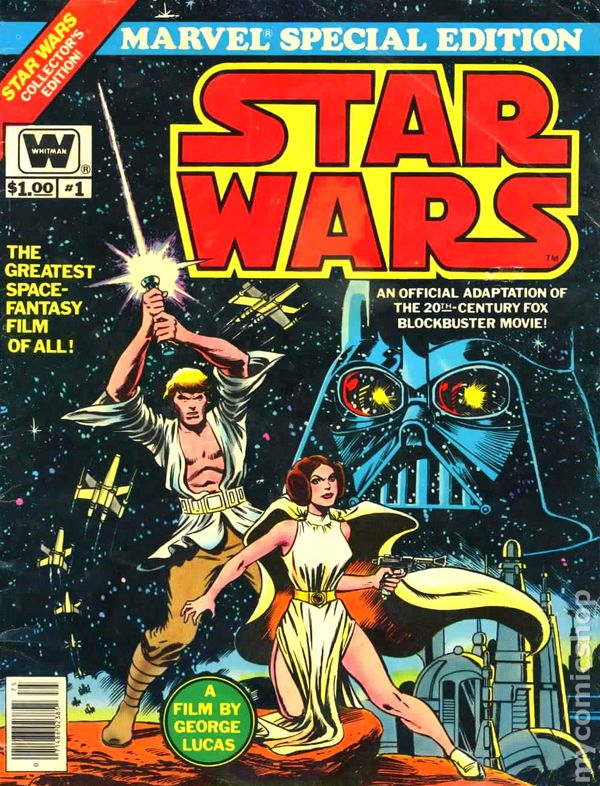
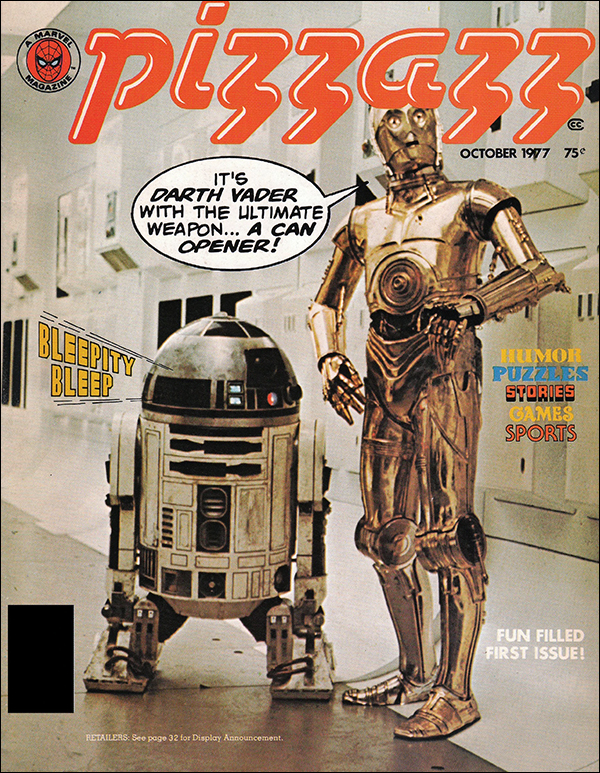
Moreover, Buena Vista Records produced book-and-record adaptations of two Marvel issues (Droid World and Planet of the Hoojibs), while Pizzazz magazine ran a 16-part serialized strip in cooperation with Marvel. And in 2019, decades after the series’ conclusion, Marvel surprised fans with a Star Wars issue #108, providing a satisfying coda to the classic run.
Roy Thomas, Archie Goodwin, David Michelinie, and Jo Duffy crafted ongoing storylines for the U.S. run, while a number of guest scribes turned in filler stories, including Chris Claremont, J.M. DeMatteis, Larry Hama, Mike W. Barr, and Randy Stradley (who went on to become Dark Horse’s vice president of publishing). Art chores for the series were handled by an impressive lineup of illustrators, such as Howard Chaykin, Steve Leialoha, Tom Palmer, Carmine Infantino, Walt Simonson, Cynthia Martin, Michael Golden, and others, particularly Al Williamson (revered among Star Wars fans for the amazing newspaper strips he created with Goodwin) and Jan Duursema (in recent years, a fan-favorite Dark Horse artist).
As the saga unfolded, the Rebels scouted out new bases on Arbra and Endor’s Forest Moon. Luke Skywalker averted Darth Vader’s forces, growing stronger in the Force. Han Solo’s friends searched for clues to his whereabouts following The Empire Strikes Back and helped to retrieve the second Death Star’s Bothan tapes. Admiral Ackbar and Mon Mothma built an Alliance of Free Planets from the Empire’s ashes. And new allies joined the ranks, including Iskalonian warrior Kiro, Corellian smuggler Rik Duel and his gang, the telepathic Hoojibs, and the gleeful, cowardly Hiromi.
Meanwhile, new nemeses threatened the Rebels’ existence, from the House of Tagge, Senator Simon Greyshade, and pirate Crimson Jack to Sith apprentices Shira “Lumiya” Brie and Flint, as well as warring enemies the Nagai and the Tofs. For American readers, the storyline had an organic flow from one creative team to the next, with a recognizable beginning, middle, and (admittedly rushed) ending. But, for those in Britain, reading Marvel’s Star Wars saga was an entirely different experience.
Star Wars Weekly
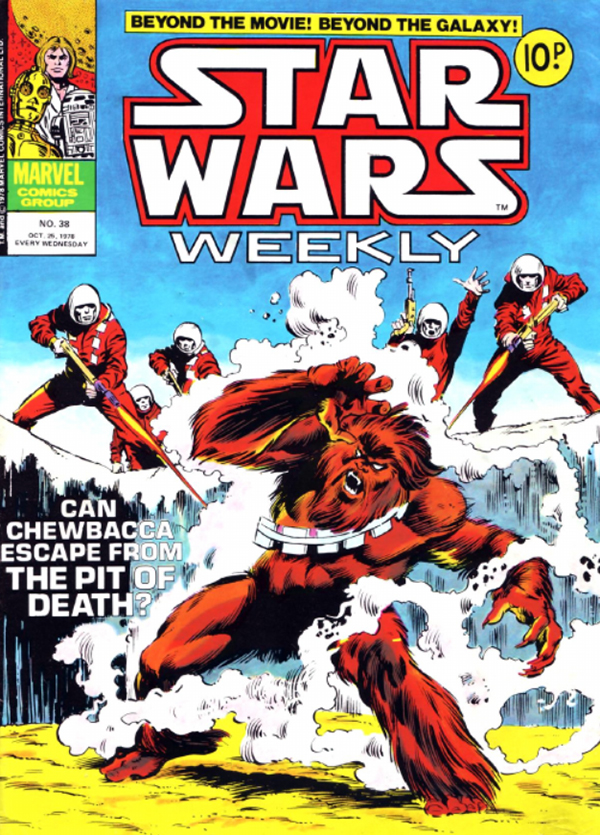
On 27 December 1977, the first Star Wars film hit British theaters. A few months later, Marvel UK’s comic magazine debuted during the week of 8 February 1978, just shy of a year after U.S. readers’ first issue, which was released on 8 March despite sporting a July 1977 cover date. The British comics reprinted American storylines, beginning with Marvel’s A New Hope adaptation, but, unlike the monthly U.S. run, Marvel’s overseas tenure was launched as a weekly publication. Star Wars Weekly, as it was initially titled, lasted for 117 issues before the series underwent a string of name changes. This initial iteration repackaged the first thirty-eight monthlies, as well as the first annual and the Pizzazz strips.
British comics were often presented as anthology magazines containing multiple standalone or serialized tales based on a variety of genres and franchises, along with pinups, photographs, and behind-the-scenes feature articles. The content was typically diverse, ranging from adventure, superhero, and science-fiction tales to stories about the supernatural, cartoon characters, and Gerry Anderson’s Supermarionation puppets.
Marvel UK’s Star Wars followed this format, presenting a revolving lineup of non-Star Wars material—The Micronauts, Tales of the Watcher, and Star-Lord, for instance—published alongside the adventures of the so-called “star warriors.” At the time, editor Derek “Dez” Skinn had hoped to incorporate Marvel’s monthly Battlestar Galactica series into the mix, but higher-ups rejected this idea.
The Star Wars license, to put it bluntly, saved Marvel from financial ruin. In a 2015 interview with StarWars.com, Skinn recalled: “Marvel UK was hemorrhaging money. The only thing that was making any money was Star Wars Weekly. It was doing so badly they tried to sell the company off. Nobody wanted it; nobody found it viable. The only interest they got was from IPC because Star Wars Weekly was outselling 2000 A.D., and they only wanted Star Wars Weekly. They didn’t want Spider-Man and the Hulk and The Avengers; they didn’t want any of that. So that didn’t work for Marvel because they were already licensing Star Wars from Lucasfilm, so they wouldn’t get much out of a shared sub-license.”
Obtaining the license was profitable, but adapting it for the British market involved a lot of work. Since the U.S. Star Wars comic was published monthly, adhering to British format required that editors break up each issue into multiple chapters and commission new covers for the additional issues. The editorial team also had to alter several tales to make them fit, which involved resizing, re-ordering, or removing panels or even entire pages for the U.K. release. As a result, what Americans and Brits read in each issue, and how they thus perceived the series as a whole, was decidedly different.
Four or five British issues were released in the course of a single month, but each U.S. publication only contained sufficient story pages to span two or three U.K. editions. This presented a problem, as the amount of lag time between American and overseas releases rapidly decreased as a result. The premiere Star Wars Weekly issue hit shelves eleven months after Star Wars #1 debuted in the United States, whereas Star Wars Weekly #30 was released only three months after the U.S. issue in which that tale first appeared.
Within only thirty issues, British editors had lost eight months of lead time. By the time Star Wars Weekly #40 reprinted U.S. issue #20, the American and British titles were running concurrently, making the possibility of bottlenecks an ever-looming and inevitable concern. The result? British audiences received the stories first published in U.S. issues #21–25 out of their intended order, and it wasn’t long before the existing supply of American material was exhausted. A solution was needed, and fast.
Reprinting Pizzazz‘s unfinished serial helped to alleviate the problem, but Marvel was aware that the reprieve was a temporary one, and thus assigned Goodwin to write additional tales for publication in Great Britain. The first of these stories, printed in Star Wars Weekly #60, was titled “Pursuit,” and it allowed Marvel to conclude the Pizzazz storyline, which had been prematurely canceled along with the magazine, denying readers a proper ending.
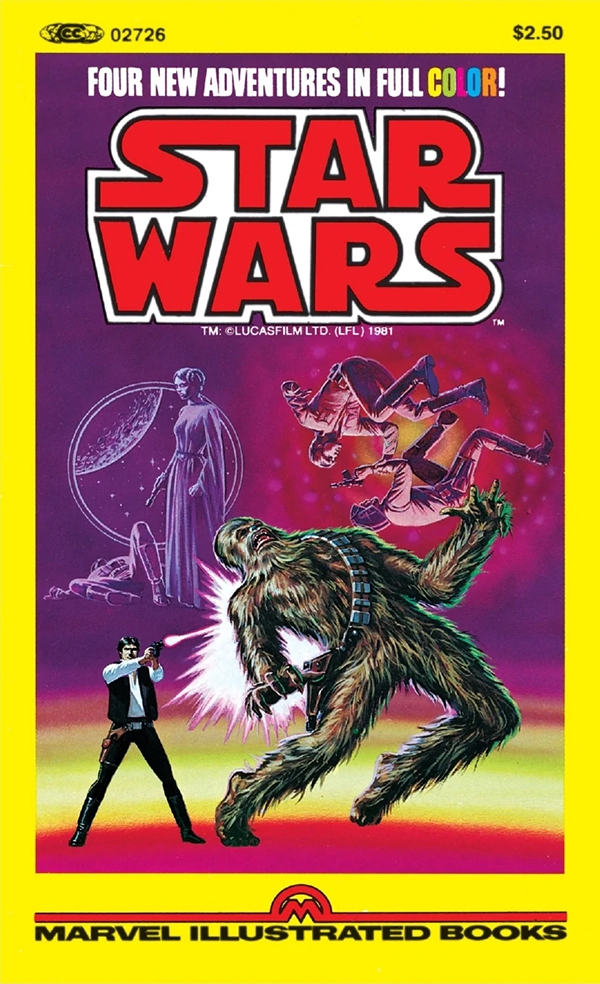
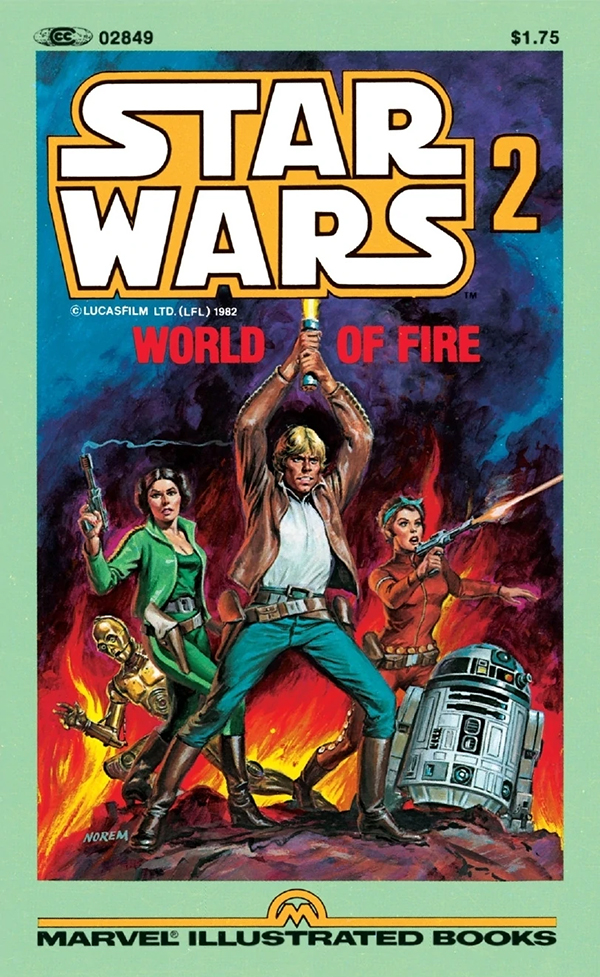
This was followed by two serialized tales in Star Wars Weekly #94–99 (“Way of the Wookiee,” highlighting Kashyyyk-style honor, and “The Day After the Death Star,” with Luke pursuing a TIE pilot on Yavin IV); a third in #104–106 (“The Weapons Master,” revealing how Leia learned how to shoot on weaponless Alderaan); and a fourth in #107–115 (“World of Fire,” in which Luke and Leia accepted a truce with Imperials to escape a world guarded by a deadly alien sentinel). The Pizzazz conclusion and the first three serials were repackaged for U.S. readers as Star Wars: Four New Adventures in Full Color, a digest-sized Marvel Illustrated Book, while the fourth story was collected in a second such digest, titled Star Wars 2: World of Fire.
Included in several U.K. issues was a page labeled “The Story So Far,” intended to bring new readers, or those who had missed prior issues, up to date. (Download a PDF compiling every “The Story So Far” page.) Others, meanwhile, featured opening narrations from C-3PO and R2-D2. (Download a PDF collecting all the droid intros.) Additionally, the U.K. issues contained nearly 90 posters and pinups, most of which had never appeared in the American comics, drawn by popular artists. (Download a PDF containing all the pinups and posters.)
The Empire Strikes Back Weekly

On 21 May 1980 (by no coincidence, The Empire Strikes Back‘s theatrical release date), Star Wars Weekly came to an end as of issue #117. But a week later, the comic was re-launched as The Empire Strikes Back Weekly, with the previous series’ numbering scheme resumed. TESB Weekly debuted with issue #118 on 29 May 1980, later undergoing another format change as of #139, on 22 October 1980. During this five-month incarnation, which lasted for 22 issues, the magazine serialized Marvel’s Empire adaptation throughout a whopping 18 issues, followed by the second of five British reprintings of A New Hope.
Alongside the film adaptations, the U.K. comics also contained Marvel stories beyond the movies. Concurrent with A New Hope was a serialization of “The Third Law,” from American issue #48. The TESB adaptation had originally run in U.S. issues #39–44, however, and the British editors had not yet reprinted #45–47, which meant the series was no longer being presented according to its American chronology. Marvel followed this same template for the remainder of its British Star Wars line. Given the series’ tendency to jump from one creative team and era to another without warning—and, at times, without even concluding the preceding storyline—British readers were undoubtedly confused by the chaos.
The Empire Strikes Back Monthly
The weekly The Empire Strikes Back comic went monthly in November 1980, starting with issue #140, and lasted for 19 issues. Like its predecessor, TESB Monthly reprinted multiple Star Wars tales per issue, with the A New Hope adaptation concluding in #140–147 (though the fourth chapter was inexplicably excluded, leaving a major gap in the film’s story). Simultaneously, the magazine finally reprinted overlooked U.S. issues #45–47. U.S. issues #53–54, 49, and 51 followed, in that jumbled order, after which the remaining stint reprinted #52, 16, and 55–58. The U.S. comic contained an ongoing narrative, so reading the stories in so random an order would be highly difficult to follow. My condolences to U.K. fans.

British readers must have been especially perplexed by Marvel’s bizarre handling of U.S. issues #56–57, in which Lando Calrissian returns to Bespin to find that the Ugnaughts are in rebellion and someone has sabotaged Lobot’s cyborg brain. The Empire Strikes Back Monthly #154 contained the first half of U.S. #56. Issue #155 presented not the remainder of that story, but rather the first half of U.S. #57. Issues #156 and #157 then offered the second halves of each American chapter, respectively. The result? A non-chronological mash-up in which effect nonsensically preceded cause—a sort of “Star Wars in the style of Lost, by way of Memento” pastiche. (Ironically, this predated the announcement of Lost creator J.J. Abrams as The Force Awakens‘ director by three decades.)
One of the most significant aspects of Marvel UK’s Star Wars line occurred during The Empire Strikes Back Monthly. As had previously happened with Star Wars Weekly, the British editors again ran out of American material to reprint, and thus needed to commission new stories to fill in the gaps. This time, rather than having the regular writer pen more tales, Marvel brought in Moore authors—Alan and Steve Moore, to be exact. (Despite being long-time friends, collaborators, and fellow occultists, the two Moores are unrelated.)
Alan Moore, before writing what is near-universally considered one of Swamp Thing‘s greatest eras, and prior to creating such classics as Watchmen, V for Vendetta, The League of Extraordinary Gentlemen, From Hell, and The Killing Joke, penned five black-and-white Star Wars tales every bit as macabre as his quintessential works. These early gems illustrate the immense talent that Moore exhibited even as an up-and-coming young scribe.
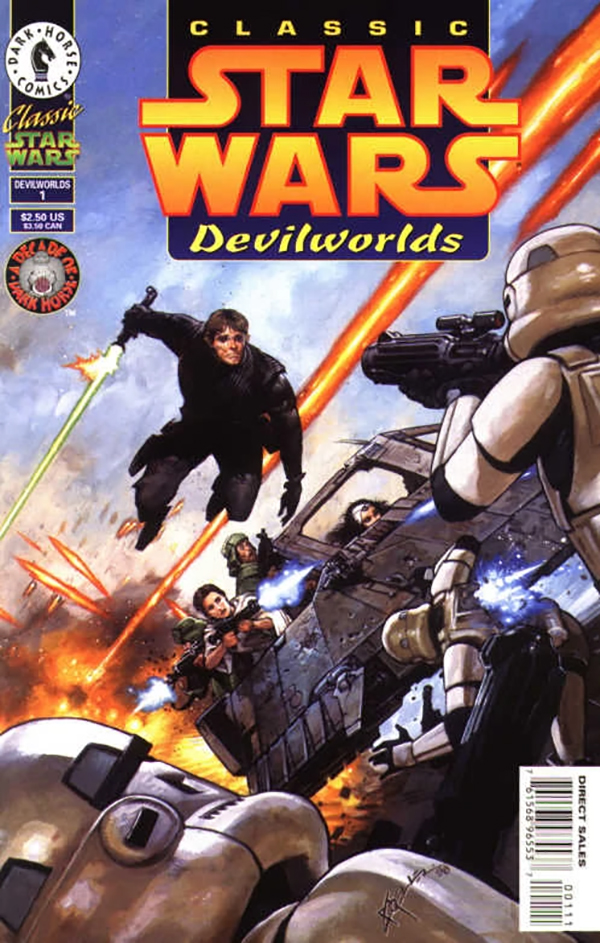
This quintet of stories—”The Pandora Effect” (in which a sadistic cult called The Five tortures Han, Leia, and Chewie for the sheer fun of it), “Tilotny Throws a Shape” (about surreal gods playing with reality), “Rust Never Sleeps” (in which R2-D2 and C-3PO visit a planet of junked droids that have achieved a group consciousness), “Blind Fury” (a Lovecraftian tale of cultism and creepy, crawly critters), and particularly “Dark Lord’s Conscience” (in which Vader plays a deadly chess-like game of wits against an assassin)—are compelling and disturbing.
Though different than anything else from Marvel (or, really, from any Star Wars publisher), some of these stories rank among the best Star Wars lore to date. And yet, until Dark Horse reprinted Alan Moore’s work years later as the colorized two-issue miniseries Classic Star Wars: Devilworlds, few Americans even knew they existed. Devilworlds also contained two other British Marvel tales: Steve Moore’s “Dark Knight’s Devilry” (a time travel story, which is a rarity in Star Wars) and Steve Parkhouse’s “The Flight of the Falcon” (an account of how Han Solo obtained the Millennium Falcon that is as gloriously fun as it is spectacularly inaccurate).
The original British release of “Dark Lord’s Conscience” inadvertently omitted the story’s final page, which Devilworlds restored. To Alan Moore’s great credit, though, the conclusion is equally effective either way, and fans never realized the ending was even missing.
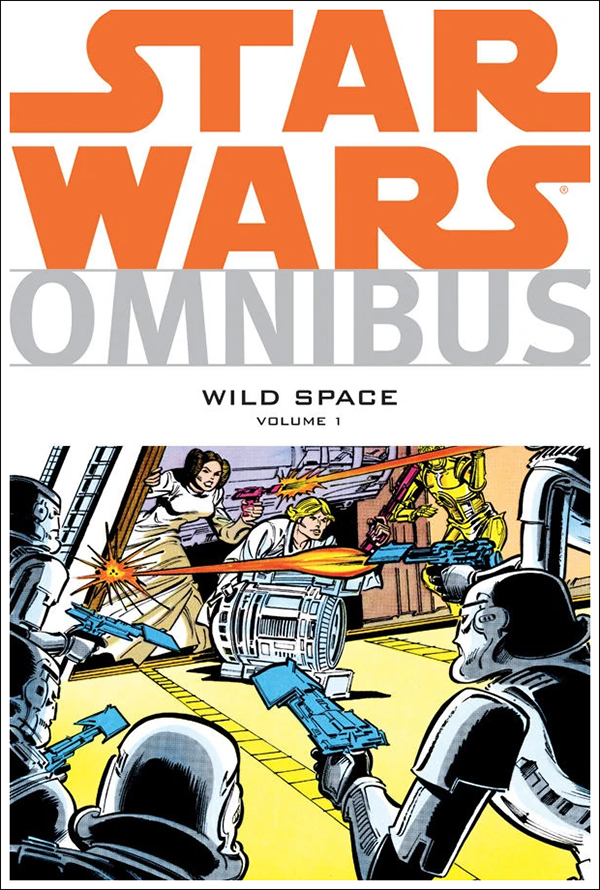
Absent from Devilworlds was “Death-Masque,” another Marvel UK story by Steve Moore, in which Luke faced off against a nightmare demon—a creature sporting a monkey’s body and a skull for a head. This was eventually collected in Dark Horse’s Star Wars Omnibus: Wild Space, Volume 1, along with the other U.K.-only lore. More recently (bringing the reprinting cycle full-circle), Marvel, after regaining the license in the Disney era, included every British story in its reprint book Legends: The Original Marvel Years—Omnibus 3.
TESB Monthly #141 is particularly worth noting, as it reprinted J. M. DeMatteis’s “The Dreams of Cody Sunn-Childe,” from U.S. issue #46. When the story was originally presented to American readers, the ending had been altered per editorial edict, greatly changing DeMatteis’s intended meaning. The ending as he wrote it showed Lando mourning Cody’s passing without judging his pacifism, whereas in the published version, Lando instead condemned Cody’s philosophy as wrong, just because it contradicted the Rebels’ ideals. Since DeMatteis had named the character after his son and objected to the new ending, he requested that the issue be published under a pseudonym, “Wally Lombego.” But in Britain, the unaltered conclusion survived intact, allowing readers across the pond to experience it as DeMatteis had intended.
Star Wars Monthly
Fans might be surprised to learn that due to the different publishing schedules of Marvel’s two headquarters, there were several U.S. issues (#24–37, 45–48, 53–54) that contained stories which had been published in the United Kingdom before their American releases—by as much as several months, in some cases. In other words, 20 issues of the U.S. run are technically reprints of U.K. material! This occurred throughout the Star Wars Weekly, The Empire Strikes Back Weekly, and TESB Monthly eras, but was apparently resolved by July 1982, when the British series underwent yet another format and name change, to become Star Wars Monthly.
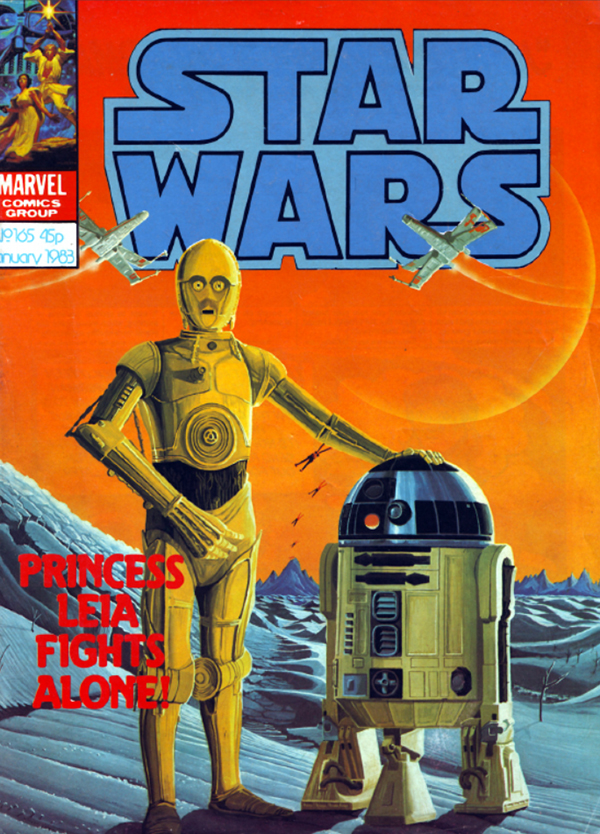
As Star Wars Monthly, the series lasted for a mere 13 more issues (#159–171) that offered a straightforward reprinting of U.S. issues #59–71—exactly 100 issues apart in numbering from the American versions—without breaking them up into multiple chapters. In fact, other than a few edits to three issues and a changeover from color to black and white in all of them, most of these stories ran in the British series exactly as they had in the American comics, which was very much a change of pace.
Star Wars Monthly hit a homerun on its first swing, with Alan Moore’s abovementioned “Blind Fury” debuting in issue #159. This surreal and otherwise gripping tale is especially noteworthy for a scene in which Luke conducts a lightsaber practice session while standing in a large room that is seemingly inside his X-Wing, which would only make sense if Luke were a Time Lord and his fighter were secretly a TARDIS. (Though an astoundingly brilliant writer, Moore apparently didn’t think that one through very well, and his editors unfortunately let it pass.) Like the author’s other work, “Blind Fury” was later reprinted in Dark Horse’s Devilworlds and Wild Space, and more recently in Marvel’s own Legends ombinus.
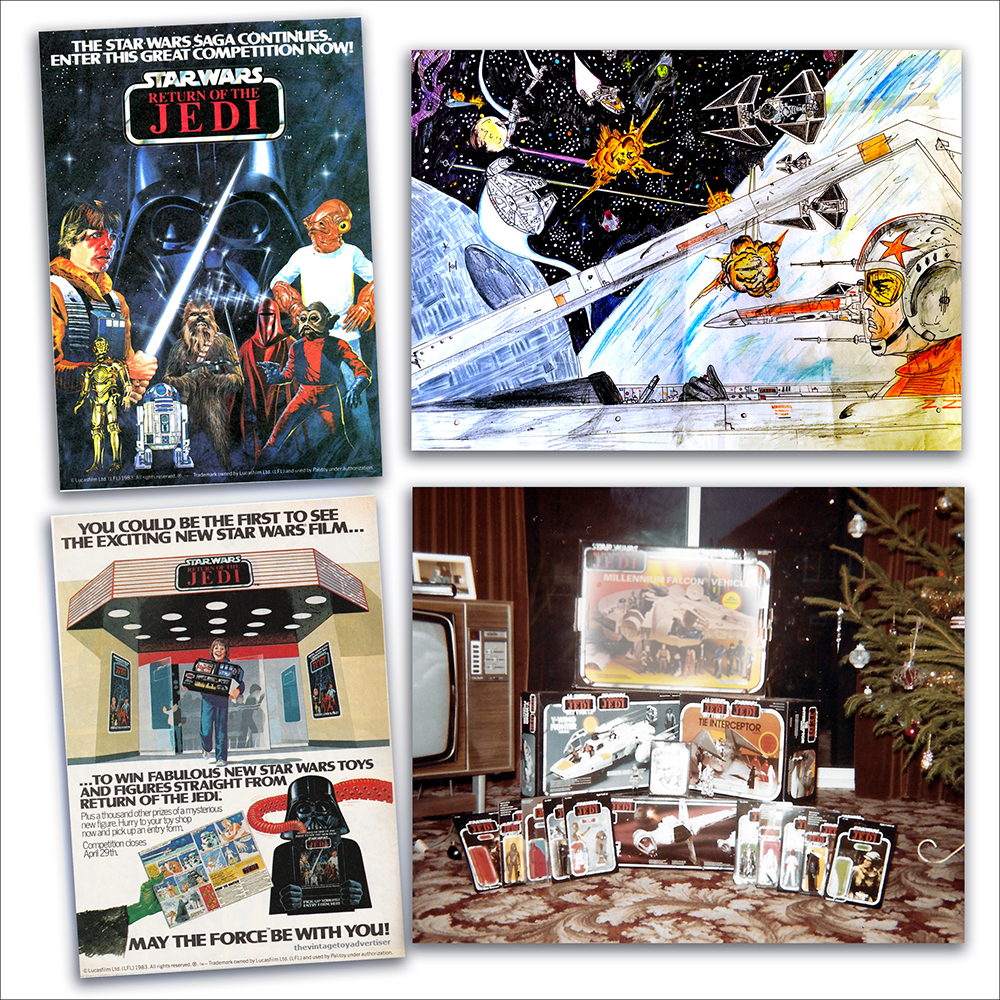
A promotional contest produced by toy company Palitoy was packaged with the magazine ten issues later, as a four-page leaflet containing an open-ended comic in which Luke encountered a mysterious figure on Tatooine. Readers were invited to imagine the identity of the speaker (who, in retrospect, we immediately recognize as having been Emperor Palpatine), and to then submit their idea as an illustration for a chance to attend a special viewing of Return of the Jedi, then soon to arrive in theaters. Given its nature as a contest entry form, it is now rare to find this promotional Star Wars comic pristine and intact. (Download a PDF containing the leaflet, along with other Palitoy ads presented as comic strips.) The winner was Howard Rushfirth, whose drawing beat those of thousands of other children.
Return of the Jedi Weekly
With the release of Star Wars Monthly‘s final issue, Marvel UK’s foray into the galaxy far, far away came to an end in July 1983—or, more accurately, its numbering scheme did, as the comic actually continued for several more years. Numbering was reset to the starting point so as to usher in Return of the Jedi‘s release and the reprinting of Jo Duffy’s post-Jedi tenure. On 22 June 1983, after having already undergone four name changes in the span of only five years, Marvel UK’s Star Wars line began its fifth and final incarnation with the publication of Return of the Jedi Weekly #1. This iteration continued for a total of 155 issues—almost as many as the previous four tenures combined—before finally ending on 7 June 1986.
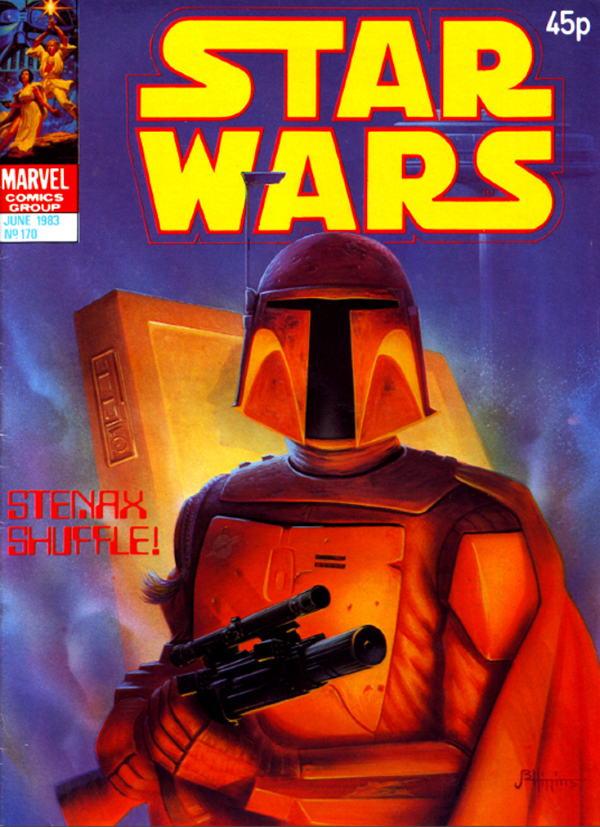
As ROTJ Weekly, the magazine was upgraded to color interiors and sported a mix of photo and art covers. Skinn commented on the changeover to photo covers in a 2011 interview for The Daily P.O.P. While discussing the magazine Doctor Who Monthly, he expressed his disdain for illustrated covers, noting: “I was somewhat amazed by some of the well-meaning but naïve changes made [following his departure as DWM‘s editor]. Cartoon covers on a live-action TV tie-in? I’d done exactly the opposite when I took over Star Wars Weekly, dropping those awful drawings in favor of actual scenes from the film, resulting in an obvious sales boost.”
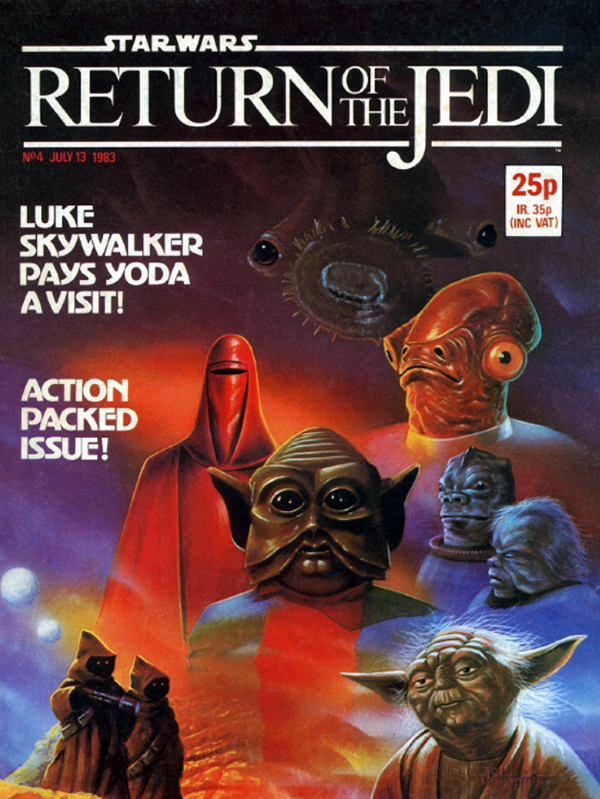
With all due respect to the legend who is Mr. Skinn, this seems an unfairly harsh assessment, as Marvel UK’s Star Wars series featured a number of wonderfully drawn covers, some even surpassing the American originals, whereas the photo covers from the Return of the Jedi Weekly period come off as dull, corporate, and non-creative by comparison. When it comes to publishing, the bottom line is very important, yes, and if the photo-cover era made more money, then so be it, Jedi. But the majority of the drawings were most definitely not awful. (Download a PDF collecting all the Marvel UK covers.)
A serialization of Marvel’s ROTJ adaptation launched the new magazine, spread out over the first eight issues. This was followed by a third reprinting of A New Hope in issues #9–19 and a second helping of The Empire Strikes Back in #51–64. Serialized reprints of other Star Wars tales accompanied these adaptations, with each American issue spread out over as many as four to seven British chapters. It took the first nineteen editions of ROTJ Weekly, for example, to rerun the contents of only five U.S. issues (#72–76). What’s more, excerpts of three different American tales appeared in the Brits’ issue #19: in addition to concluding both the A New Hope adaptation and U.S. issue #76, the comic also began serializing U.S. #7 (featuring the infamous space-rabbit Jaxxon) for a second time.
Thus began an erratic publishing schedule that defined Return of the Jedi Weekly, with British readers concurrently following multiple, randomly ordered storylines from throughout the American run. It’s as though the British editors put the entire U.S. series into a large box and tossed it down a flight of stairs without a lid, causing the staples to rip out and the pages to separate, and then reprinted the series in whatever order they retrieved all of the pages while descending the staircase.
Take a look and you’ll see what I mean: U.K. issues #20–63 reprinted U.S. #77–85, simultaneous with double-dippings of U.S. #7–15 and #18–27. U.K. #64–95 presented U.S. #86–94, while also rerunning U.S. #46–47 and #50–55. The British series then serialized American issues #17 and #56 in U.K. #96–98, followed by U.S. #95–104 and #57–67 in U.K. #99–137, and U.S. #50 and #67–69 in U.K. #138–143. Rounding out the final editions were reprints of U.S. #70 and #105 in U.K. #144–147, with the last eight weeks once again repackaging Marvel’s Jedi adaptation, alongside the stories from American issues #71–72.
Whew.
If this confuses you, just think about how those in the United Kingdom must surely have felt while reading the series in that order back in the 1980s. Imagine, if you will, watching all of the Star Wars films for the first time, but starting with Attack of the Clones, then proceeding in the following order: The Force Awakens, Return of the Jedi, the Clone Wars theatrical film, The Empire Strikes Back, Rogue One, the two Ewok telefilms (in reverse order), The Phantom Menace, the Star Wars Holiday Special, Solo, The Rise of Skywalker, and Droids: The Great Heep, while skipping over A New Hope, Revenge of the Sith, and The Last Jedi entirely. Now try to make heads or tails of what the heck Star Wars is supposed to be about. That should give you an idea of what reading the British series must have been like.
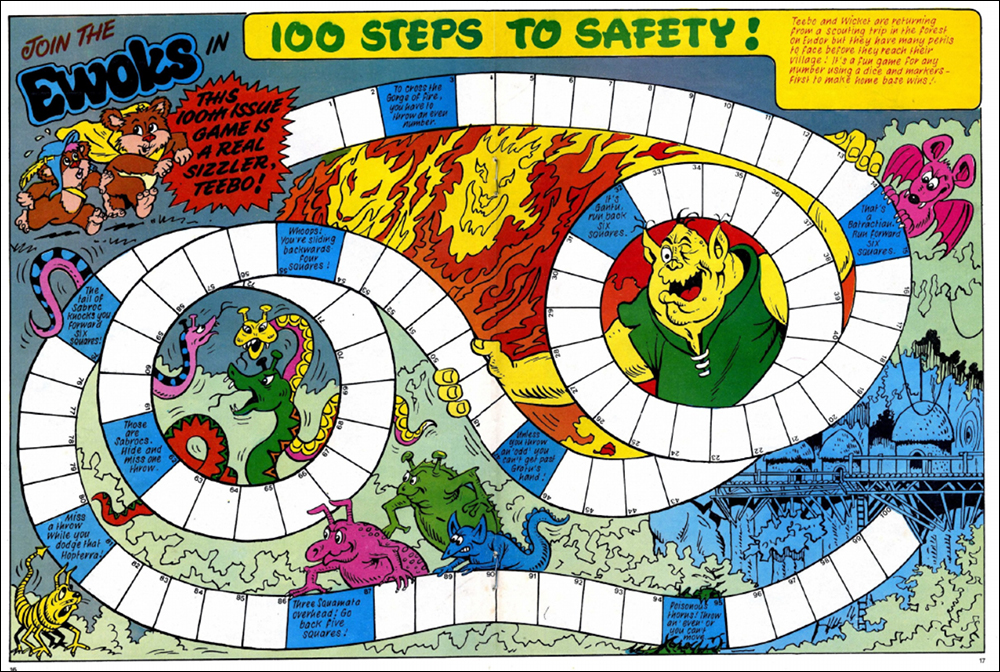
Still, utter chaos aside, there are forgotten gems to be found. Throughout ROTJ Weekly (as well as Star Wars Weekly issues #1–3 and TESB Weekly #118), Marvel offered bonus content in the form of hats, paper models, stickers, and more. Some material—such as an Ewoks board game, shown above—introduced newly created Star Wars creatures and spaceships that have never been referenced outside of Marvel UK. In that board game, “100 Steps to Safety,” players must help Teebo and Wicket survive perils in the forest while returning to their village from a scouting trip. The rather simplistic game is notable for introducing several new aliens (Sabrocs, Hopterras, Squamata, and Batractians) and denizens (Gantu/Gratu) to Endor’s already far-overcrowded moon. (Download a PDF collecting the Ewoks board game and all the other extras.)
Stan Lee and Artoo’s
Astonishing Adventures
C-3PO once noted that he was “not very good at telling stories.” While the validity of that claim may be debatable, given his mesmerizing Ewok fireside chat in Return of the Jedi, it turns out he wasn’t the franchise’s real storyteller anyway. That distinction, it appears, goes to R2-D2. In 1985, Marvel UK published two Star Wars tales under the banner “R2-D2’s Tales from the Data Banks.” If you’ve never heard of them, that’s not surprising, as they were pretty obscure—in fact, they were so obscure that technically, they weren’t even Star Wars tales. In January of that year, the first “R2-D2’s Tale” appeared in Return of the Jedi Weekly issue #83. The conceit, as the title suggests, involved the droid presenting a new adventure to Star Wars fans, stored in his banks.
The story was actually not new, however, nor was it originally set in the Star Wars universe. In fact, it had already been published more than 20 years prior, in April 1963—a full decade before George Lucas began writing A New Hope—in the pages of Marvel’s Tales to Astonish #45. That anthology comic presented a handful of science fiction tales, including “Bronson’s Brain,” scripted by Stan Lee, with inks by Steve Ditko and lettering by Art Simek.
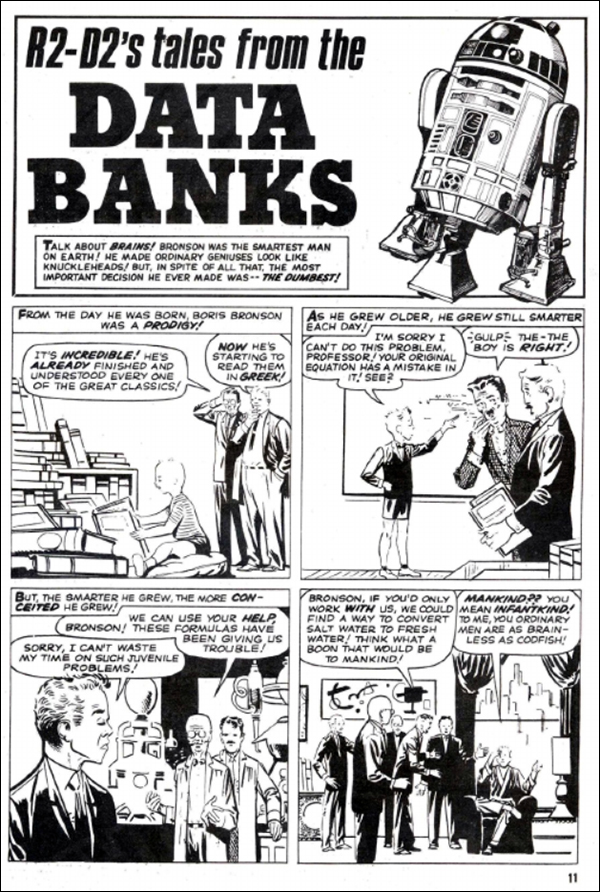
In “Bronson’s Brain,” title character Bruno Bronson was the smartest man on Earth. A child prodigy, he grew more intelligent each year—and more conceited. Bronson was unbearable to work with, condemning his “brainless” coworkers. Rather than help the human race abolish sickness, poverty, crime, and war, he sought only to use his vast intelligence to benefit himself. He designed a thought-powered spaceship to search other universes for his mental equals, and he discovered an extraterrestrial world whose advanced natives welcomed him, offering an exchange of knowledge. However, when Bronson donned an educational helmet, he understood none of the information (which the aliens had learned as children) entering his brain. Floored at such simple-mindedness, they locked Bronson in a cage marked “Alien Moron (Do Not Feed),” deeming him too stupid to fend for himself.
While repackaging “Bronson’s Brain” for Star Wars fans, Marvel UK made several format alterations. In addition to changing the tale from color to black and white, the publisher also removed the original title and trimmed away three panels. These included an opening close-up of Bronson’s condescending face, as well as two panels showing how the would-be genius discovered the alien world and its wise inhabitants. Aside from a graphic of R2-D2 added alongside the opening narration, this story was unconnected to the Star Wars mythos. The same was true of the second of “R2-D2’s Tales,” presented in the June 1985 Star Wars Summer Special. That story, by the same creative team of Lee, Ditko, and Simek, was reprinted from Tales to Astonish #42, published in January 1963.

Originally titled “I Am Not Human,” this tale introduced Robot E-1, a mechanical being built in human form. E-1’s creator frequently chided the droid, “You must never forget—you are not human. You are only a robot.” Since he had been created to think and speak like a human, however, E-1 decided he should lead a human life. Fashioning a human skin mask, he escaped into the world of men and obtained an office job but was shocked at how unfriendly and untrusting his employers were, and at how hostile his coworkers were regarding his strong work ethic. Upon witnessing the crime, war, poverty, and disease outside his creator’s laboratory, E-1 grew disenfranchised with mankind, who had squandered the amazing life they’d been granted. Depressed, he returned to the lab, where the scientist reminded him he could never be a human’s equal. Sadly, E-1 replied, “Perhaps no robot would ever want to be.”
Thematically, Lee’s scripts for both tales were quite similar, condemning humanity’s weaknesses from an outsider’s viewpoint. Whereas “Bronson’s Brain” employed a twist ending worthy of The Twilight Zone, “I Am Not Human,” with its central Edward Scissorhands-like theme of droid persecution, would fit surprisingly well into Star Wars mythology, aside from its Earth-centricity. The relationship between the scientist and E-1, in fact, was not dissimilar to that displayed by Simon Greyshade and Master-Com in Marvel’s U.S. issues #18–23. This observation is reinforced by the strong physical resemblance between E-1 and C-3PO. Ralph McQuarrie’s original aesthetic for C-3PO was heavily influenced by the design of Maria, the Maschinenmensch robot portrayed by actress Brigitte Helm in Fritz Lang’s 1927 expressionist science-fiction film Metropolis. Undoubtedly, E-1 was modeled after Maria’s likeness as well.
Perhaps the most astounding aspect is the team behind these stories. Lee was the co-creator of Spider-Man, the Hulk, the X-Men, the Fantastic Four, Iron Man, Thor, and other iconic characters, while Ditko co-created Spider-Man and Doctor Strange before a falling-out ended his collaboration with Lee. Both men are comics legends, so the fact that these two icons wrote and drew a pair of tales peripherally part of the Star Wars universe—and for Marvel, no less—is pretty astounding.
No further installments of “R2-D2’s Tales from the Data Banks” were presented beyond these initial offerings. The reason for the concept being dropped is unknown, but it is probably for the best. Despite thematic similarities and a single drawing of R2-D2, nothing about these comics truly tied them to Star Wars continuity. Even labeling them as Star Wars comics may be a bit of a stretch, given that they both predated the franchise by more than a decade. But for diehard completists who revel in finding the most obscure of Star Wars lore, “R2-D2’s Tales” fit the bill.
C.Y.R.I.L., the Adventures
of an Editor-Droid
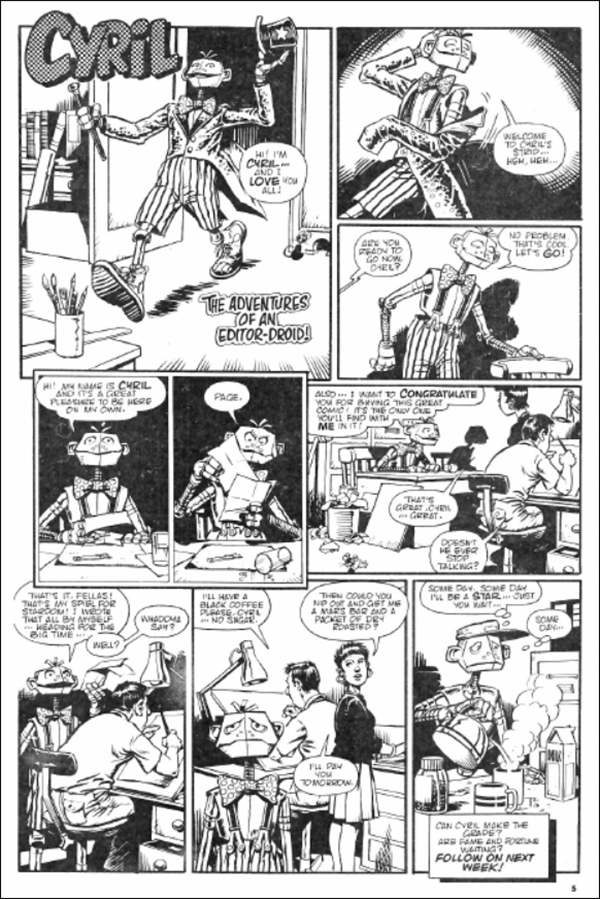
The British editors took a tongue-in-cheek approach to fan letters, particularly regarding errors spotted and reported by letter-writers. This led to a running joke, starting in Star Wars Weekly #41, that evolved into a droid character unique to the British series.
After fan Costas Charitou wrote a letter chastising Marvel for dismissing his correction on a prior letters page regarding the meaning of the acronym “TIE” (he had accurately explained that the term stood for “Twin Ion Engines,” which Marvel erroneously denied), the editors jokingly blamed the gaffe on faulty computer circuits, noting that they’d been replaced with C.Y.R.I.L., a Class ‘Y‘ Reader’s Inquiry Logistical computer. Marvel promised readers that C.Y.R.I.L. would do a better job than his “predecessor” (the editors) of preventing such mistakes. (As you might expect, “he” didn’t. Errors continued to occur.)

Over time, the mythology surrounding C.Y.R.I.L. evolved. Instead of merely being an editorial computer, he soon became a droid who worked at Marvel’s British headquarters, and he even received his own backup strip in the magazine. While visiting said HQ in 1984, writer Steve Parkhouse pitched a serial about the hapless robot’s humorous misadventures. Thus spawned “C.Y.R.I.L., the Adventures of an Editor-Droid,” which spanned 54 issues, published in Return of the Jedi Weekly #73–126. For decades, these strips, which featured gags focused on the droid’s frustration at being underappreciated and overworked, were never reprinted, but Marvel finally collected them in its 2017 Star Wars: The Marvel UK Collection Omnibus hardcover edition. (Download a PDF containing the complete C.Y.R.I.L. strip.)
Spidey Comic /
Spider-Man and Zoids
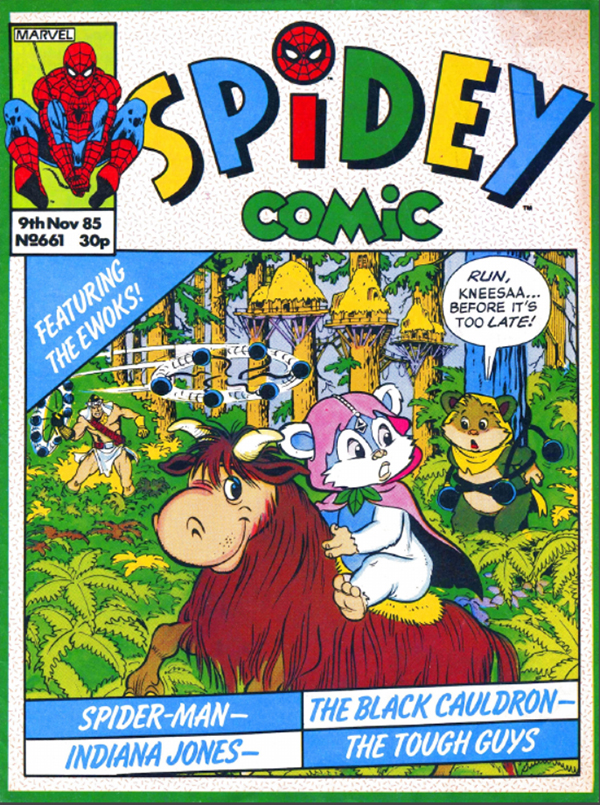
Concurrent with Return of the Jedi Weekly #125–130, a Spider-Man magazine called Spidey Comic, aimed at young children, offered serialized reprints of issues #2 and 3 of Ewoks (from Marvel’s Star Comics imprint), in issues #661–664 and #665–666, respectively. If you’ve never imagined George Lucas’s space teddy bears and Marvel’s friendly neighborhood wall-crawler co-starring in a publication together, you’re probably not alone.
It wouldn’t be the last time, either. As the end of Marvel UK’s Star Wars line drew near, non-Star Wars magazine Spider-Man and Zoids serialized “The Apprentice,” written by Jo Duffy and published in the third American annual. Reprinted in its entirety, the story was broken up into eight chapters for Spider-Man and Zoids #15–22.
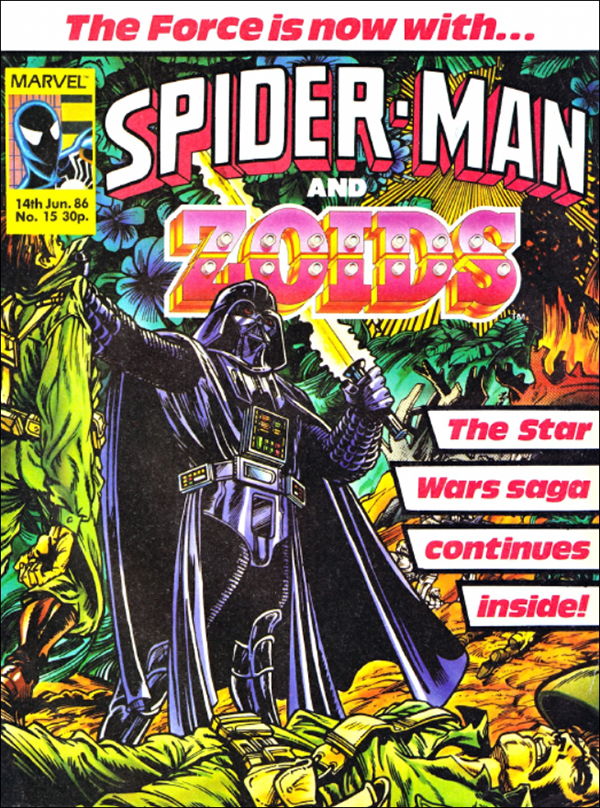
Created by a Japanese toy manufacturer called Tomy, the Zoids franchise was initially a series of model kits. However, it was later expanded to include video games, action figures, manga, anime, and other marketing areas. The series spun off a tie-in strip in the 1980s, published in Marvel UK’s Secret Wars comic line, before Marvel combined Zoids with Spider-Man in their own weekly comic periodical (apparently, Spider-Man really got around). Spider-Man and Zoids was especially notable for featuring early work from Scottish comic book writer and playwright Grant Morrison—and, of course, for its brief voyage through the galaxy far, far away.
Annuals, Specials,
and Digests—Oh, My
Throughout its weekly and monthly runs, Marvel UK produced a number of additional Star Wars titles, including ten hardcover annuals, seven softcover specials, and two digest books. Four of the annuals (Star Wars Annual No. 1, the 1980 TESB Annual, the 1983 ROTJ Annual, and Star Wars Special Edition), as well as both digests (Marvel Comics Illustrated Version of Star Wars and TESB—The Marvel Comics Version), repackaged the film adaptations in altered formats. Many panels and pages were omitted, while The Empire Strikes Back was laid out differently than in the States.
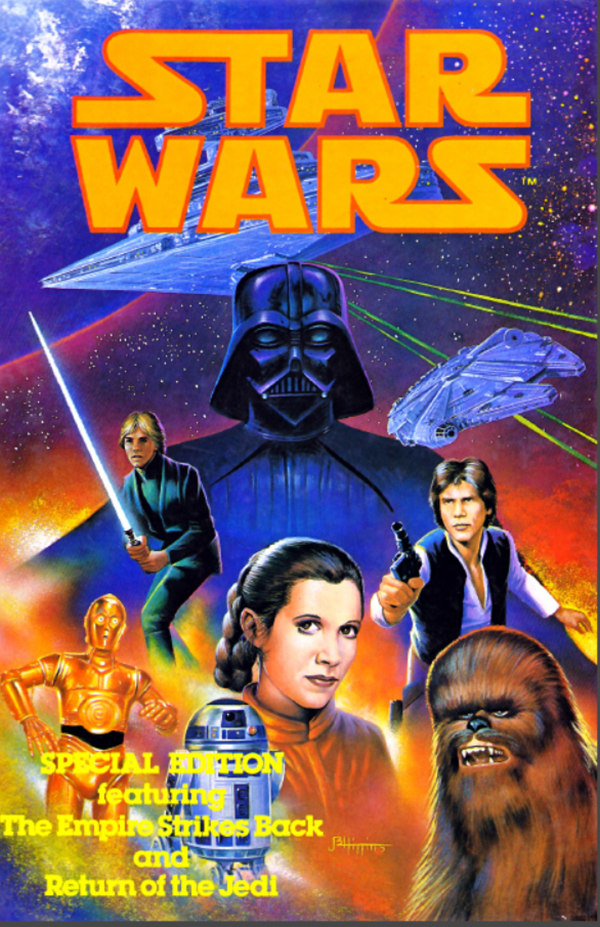
Most significantly, Yoda was drawn with purple skin and long white hair, due to the creative team having initially received only concept illustrations of the enigmatic new Jedi Master. This was corrected in the U.S. adaptation once Yoda’s look was finalized, as well as in the TESB Weekly and ROTJ Weekly reprints, but not in either the TESB Annual or Special Edition.
Four other volumes (Marvel Presents Star Wars Annual, the simply named Star Wars Annual, TESB Annual No. 2, and the 1984 ROTJ Annual) collectively repackaged U.S. issues #13–14, 45–48, 50, 77, and 79–80. What’s most interesting from this batch is the 1984 ROTJ Annual‘s treatment of U.S. issue #79. The original American run included a scene in which Lando, during a high-speed chase, stopped to ask directions of a passing prostitute, who purposely sent him the wrong way. The entire three-page sequence was censored from the British version, presumably due to puritanical morality standards (brutal murders are fine for the kiddies, but not sex workers), which is a shame since it removed a humorous bit of storytelling.
The final two books, Star Wars Annual Featuring Ewoks and Ewoks Annual, presented issues from Star Comics’ Ewoks series. The first volume included Ewoks #1 and, oddly, the third U.S. Star Wars annual (previously repackaged in Spider-Man and Zoids), while the second offered Ewoks #2 and 9—both of which had already been reprinted in Ewoks Monthly.
The most notable aspect of the second Ewoks annual is not what it reprinted, but what it also included: three original Star Wars prose stories based on the Ewoks animated series. These tales (“Chief Chirpa Kidnapped,” “Return of the Great One,” and “The Ice Princess”) had been all but forgotten by many fans, as they’d never been republished in any medium. That changed in June 2016, however, when Disney-era Marvel reprinted Dark Horse’s Star Wars Omnibus: Droids and Ewoks in hardcover, finally adding the three British prose stories to the mix.
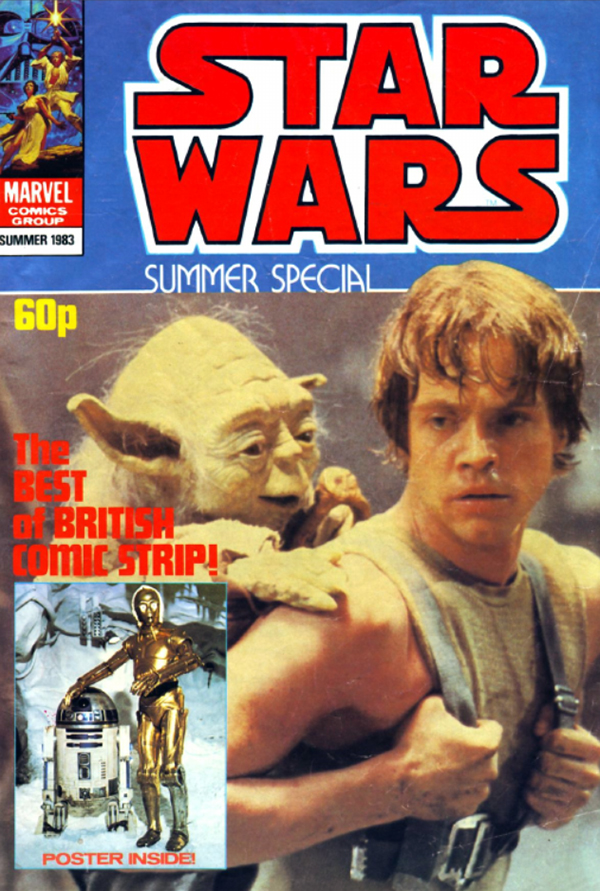
In addition, the 1983 Star Wars Summer Special collected “The Flight of the Falcon,” “Rust Never Sleeps,” “The Pandora Effect,” and “Death-Masque” (from TESB Monthly #157, 155, 151, and 149, respectively—why they were presented in reverse order is anyone’s guess, but it tracks with all the above), with a cover-blurb promising “The Best of British Comic Strip” (sic). The next four softcovers (the ROTJ Winter Special, Christmas Special, and Summer Special, as well as the 1985 Star Wars Summer Special) presented American issues #17–18, 24, and 29, along with the first two U.S. annuals. Meanwhile, the Droids TV Special and Droids Spring Special reprinted issues #1 and 3 of Star Comics’ Droids run.
Ewoks Monthly /
The Marvel Bumper Comic
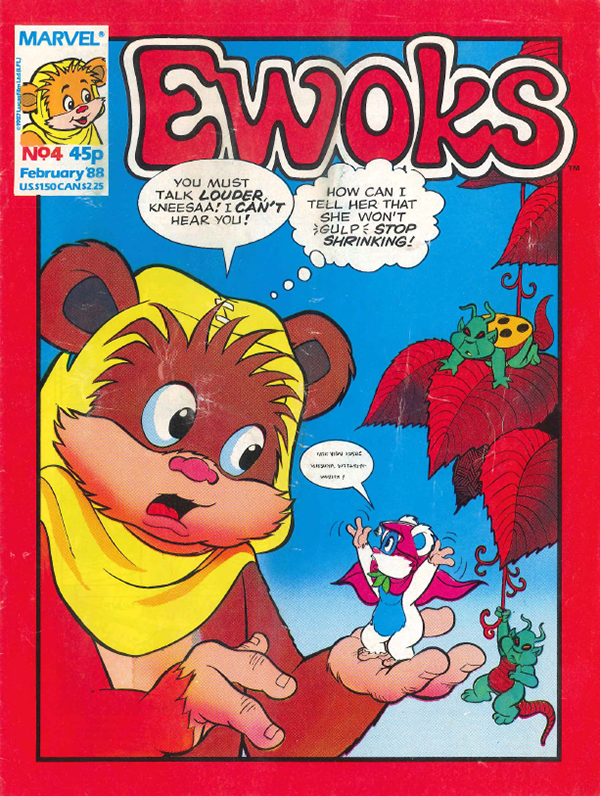
In November 1987, Marvel UK returned to Endor’s Forest Moon. Over the course of ten issues, Ewoks Monthly presented nine American Ewoks tales, though in a completely random order (#9, 2, 7, 11, 5, 8, 4, 14, and 10), along with Droids #4, the first of Star Comics’ two-part Ewoks-Droids crossover. Why Marvel opted to present the stories so haphazardly is unclear, particularly when one considers that Ewoks #2 had already run in the pages of Spidey Comic. Several other issues that had yet to receive a reprinting probably should have been given preference instead. But, then, that’s not the sort of logic Marvel UK employed when it came to Star Wars.
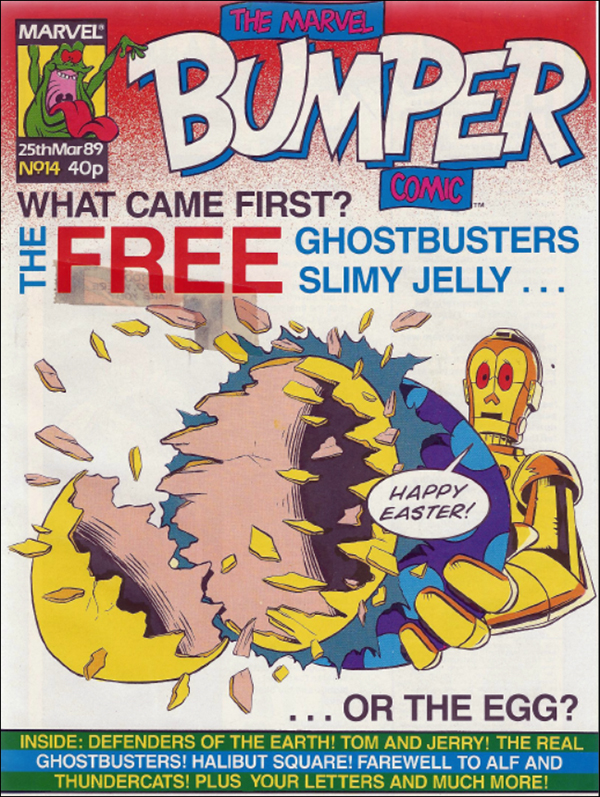
Subsequently, four Droids tales appeared in issues #15–25 of another non-Star Wars anthology, The Marvel Bumper Comic, which repackaged Droids #2, 5, and 4, in that order, as well as the Droids-related story from Ewoks #10. Once again, Marvel UK inexplicably offered tales already repackaged (Droids #4 and Ewoks #10), rather than presenting those yet to be reprinted. This time, all Ewoks elements were expunged from the crossover, creating a Droids-only adventure in which R2-D2 and C-3PO skipped their visit to Endor (which, in truth, was an improvement).
Marvel Bumper Comic‘s brief foray into Star Wars content lasted from April to June 1989. Issue #25 marked Marvel UK’s final Star Wars publication until the Disney reboot. That the company was still publishing Star Wars titles as late as 1989 might seem surprising, given that the U.S. series had ended in 1987, but it makes sense when one recalls that Marvel’s Epic Comics imprint had planned to publish Tom Veitch’s Dark Empire miniseries—even advertising it in 1990’s Marvel Age Special Preview #1—before Dark Horse picked up the license and that title.
Missing in Action
Marvel UK reprinted several American stories two or three times apiece, and a few even more often than that. Throughout the series, the company repackaged the A New Hope and The Empire Strikes Back adaptations five times each, as well as Return of the Jedi four times. And yet, despite such incredible redundancy, eight chapters of the U.S. comic inconceivably never made their way to the United Kingdom: U.S. monthly Star Wars issues #106–107 (denying British readers the Nagai-Tof storyline’s conclusion), as well as (from the Star Comics line) Ewoks #6, 12, and 13, and the eminently goofy A New Hope adaptation in Droids #6–8.
Moreover, while the Four New Adventures and World of Fire digests repackaged a number of British-exclusive tales for American audiences, U.S. readers were denied eight others (the macabre Parkhouse and Moore stories published in The Empire Strikes Back Monthly and Star Wars Monthly) for two decades until the release of Dark Horse’s Devilworlds two-pater, with “Death-Masque” remaining “lost” until its inclusion in the Wild Space omnibus. “R2-D2’s Tales from the Data Banks” has never been reprinted (at least, not in its pseudo-Star Wars format), and US issue #108, published in 2019, would not be released for several more decades.
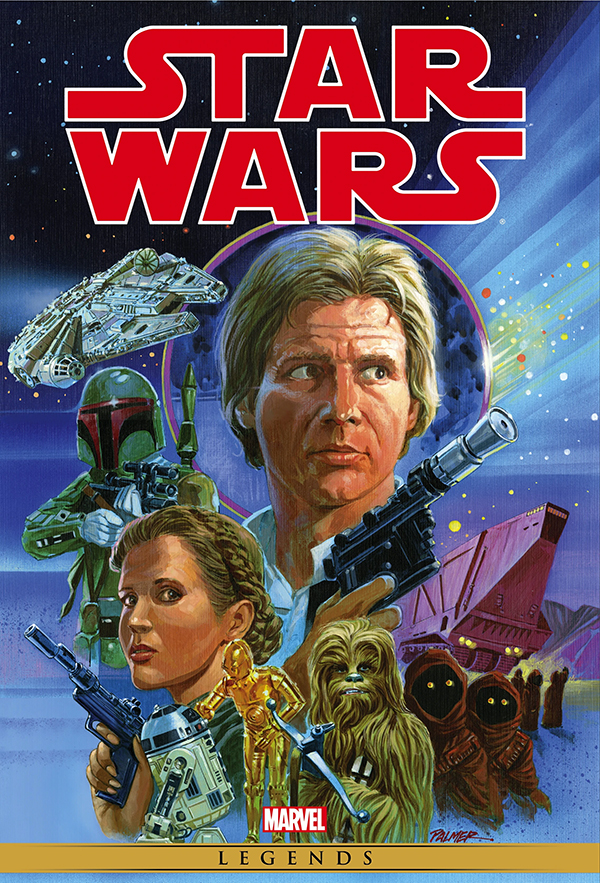
Taking into account the comics, annuals, specials, and digests, Marvel UK produced an astounding 380 Star Wars publications over the course of more than a decade—nearly three times the number of issues released in the United States. Click here to download a detailed spreadsheet providing issue numbers, dates, titles, creators, and British-to-American conversions.
Reading the British series can be jarring for U.S. fans, given the frequent truncation, repetition, and erratic story order. And yet, it has much to offer, particularly hundreds of new and often gorgeous covers, allowing classic tales to be viewed from an entirely new perspective. For collectors, tracking down every issue might be no easy feat, but with a bit of perseverance and patience—and the above spreadsheet—American fans can experience Marvel the way readers did a long time ago, in a nation not so far, far away.
The research assistance of Jon Carpenter, Marc Fiebelkorn, James Gallo, Marek Kielak, Greg Mitchell, Abel G. Peña, Jay Shepard, Eddie van der Heijden, and Ryder Windham proved invaluable in the writing of this essay.
Hey there! Thanks for the ping back! Interviewing Dez was a treat! What a lovely man.