(Originally published in Daytime Gothic 2, editor: Stuart Manning, 2026)
“My name is Victoria Winters. My journey is beginning.” With Alexandra Moltke’s first haunting narration as the young governess of Dark Shadows, Vicki Winters embarked on what she called “a journey that will bring me to a strange and dark place, to the edge of the sea, high atop Widows’ Hill—a house called Collinwood.” Before the story had begun, before the players had entered the stage, the audience already knew one aspect of this macabre new gothic soap opera: it would take place at a strange house. That’s fitting, for the concept had been birthed a dozen years prior to Dark Shadows, in a television script aptly titled “The House.”
“The House” aired on The Web, a black-and-white Mark Goodson and Bill Todman production, which was broadcast live on CBS from 1950 to 1954. It’s understandable if that doesn’t ring a bell, for the show has not enjoyed the staying power of its anthological contemporaries like The Twilight Zone, Alfred Hitchcock Presents, and Science Fiction Theater. Yet The Web was well-received at the time, with Herbert Hirschman and Dark Shadows’ own Lela Swift taking turns directing, and the episodes adapted stories by members of the Mystery Writers of America, Art Wallace among them.
Dark Shadows fans are no strangers to the name Art Wallace. In addition to writing for Star Trek, Planet of the Apes, Space: 1999, The Invaders, All My Children, and Tom Corbett, Space Cadet, Wallace scripted the majority of Dark Shadows’ first 85 episodes after crafting the show’s story bible, Shadows on the Wall. That document outlined the premise of what would become Dark Shadows, along with the cast who would occupy its storylines. Titles considered for the soap included not only Shadows on the Wall, but also Castle of Darkness, The House on Widows’ Hill, Terror at Collinwood, and The House on Storm Cliff.
Some details of Shadows on the Wall changed once the show aired. Collins House became Collinwood, while Laura Robin Collins became Laura Murdoch Collins. Laura was originally just a human, not a phoenix, and Vicki was accused of her murder. Liz and Roger’s parents were Joseph and Carolyn in the story bible, whereas onscreen their father was Jamison, and Big Finish’s 2012 audio A Collinwood Christmas would christen the mother Catherine. Liz’s daughter Carolyn married Joe Haskell in Shadows on the Wall, and their union proved disastrous, whereas on TV they broke up. Bill Malloy didn’t die in the story bible, though Roger did, and a spark of romance blossomed between Bill and Elizabeth by the outline’s end.
In two drafts of Shadows on the Wall, the governess’s name cycled from Sheila March to Shelia Winters to Vicki Winters, and she’d suffered a fiancé’s death offscreen that was never mentioned on the show. Still, a lot of what Wallace’s 100-page document described ended up on TV—though thankfully not Roger falling to his death from Widows’ Hill while trying to murder Vicki, which would have deprived fans of four years of Louis Edmonds’ brilliantly sarcastic day-drinking schemer. Vicki’s attempted assassination instead fell to Matthew Morgan once it was decided not to kill off Roger, and the cause of death changed from Widows’ Hill to the Widows themselves, whose ghosts scared the caretaker into a fatal heart attack.
Intriguingly, the first Paperback Library novel by Dan “Marilyn” Ross, simply titled Dark Shadows—published in December 1966, half a year into the show’s run—adhered quite closely to the character descriptions and setting notes in Shadows on the Wall, with a few additions such as violinist Ernest Collins and attorney Will Grant. Ross’s follow-up novels went in some bizarre directions that wildly diverged from Dan Curtis’s Dark Shadows, but that first volume is a strong indicator that the author, who had not watched the soap opera, may have mined Shadows on the Wall as a resource.
Series creator Dan Curtis tends to dominate the spotlight when it comes to discussions of Dark Shadows’ origins. Curtis dreaming of a young woman on a train and then turning that dream into a gothic retelling of Charlotte Brontë’s Jane Eyre is well-documented. It was Wallace, though, who forged the show’s nuts and bolts, and who charted the house’s murky crevices and corridors and secrets, with Shadows on the Wall. It was he who, a decade prior, had laid the groundwork on The Web for a major year-one storyline. And that brings us, at last, to “The House.”

Directed by Hirschman, “The House” aired on August 29, 1954. Lost in obscurity for decades, it was unearthed and packaged with Master of Dark Shadows, a 2019 Blu-ray exploring the impact that Curtis and his low-budget daily soap had on Hollywood. Directed by David Gregory and narrated by Ian McShane (Deadwood, John Wick), the feature-length documentary allowed fans to view at last Dark Shadows’ oft-overlooked psuedo-pilot.
The anthology’s announcer introduces “The House” as “another exciting and dramatic story of people caught in the Web,” presented for the audience’s “entertainment and pleasure” by Kent, “the cigarette with a Micronite filter.” Tobacco advertisers were prominent on daytime television in the mid-20th century, and shows pitched their deadly products to viewers with gusto. That’s unfortunate, for in addition to the cigarettes’ harmful nicotine, the Micronite filters were made of crocidolite, a highly toxic form of asbestos fibers. These were, to quote Attack of the Clones, “death sticks.” At least they didn’t turn people into vampires, zombies, or werewolves.
The premise of “The House”: A shady seafarer returns to a quaint New England town after years abroad and visits a wealthy recluse who lives in a moldering home by the sea with her daughter, a young woman dating a fisherman. The lonely, depressed matriarch harbors guilt over having killed her husband when he’d tried to steal her jewelry. The seafarer, who’d helped her cover up the murder by burying him in the basement, blackmails her into letting him live at the mansion, and pressures her into marrying him so he can access her inherited family wealth. Concerned for her daughter’s future, the widow admits her crime rather than continue the charade, and the cellar floor is dug up. The body isn’t there, however, for she never really killed her spouse—the two conmen had staged the death to abscond with her jewels.
Sound familiar? It should, because “The House” provided the blueprint, plot point by plot point, for Dark Shadows’ 1967 Jason McGuire arc in episodes #193–275. In that storyline from the black-and-white era—which home-video releases and streaming services have misleadingly dubbed The Beginning—McGuire blackmails Elizabeth Collins Stoddard over the supposed murder of her husband, Paul Stoddard. Jason nearly succeeds in stealing her home, fortune, and fishing fleet before his extortion is exposed, then admits Paul hadn’t really died. A miserable Liz had needlessly hidden from the world for two decades, wallowing in guilt over a crime she hadn’t committed. In the end, Jason ends up an early victim of vampire Barnabas Collins.
These two iterations of the storyline are remarkably similar, because Wallace incorporated “The House” into Dark Shadows while crafting Shadows on the Wall, albeit with some name changes. The parallels here are significant, with both shows—due to budgetary restraints, as well as the tendency for TV show sets of that era to be staged like theater sets—having the action take place in a dark-paneled parlor filled with painted portraits, a foyer containing a front door and a carpeted staircase to its left, and a nondescript pub with few patrons.
There are differences, however. Dark Shadows’ Joe Haskell, for example, has limited money saved up and dresses casually, whereas The Web’s Joe (surname unknown) is wealthy and suit-clad. And his girlfriend, fishing heiress Louise Stover, is mousy compared to rebellious party girl Carolyn Stoddard. Also, the smaller scale of “The House”—a single contained story, compared to five weekly, serialized chapters of Dark Shadows—meant no predecessor analogues for Vicki, Roger, Burke, Maggie, Bill, David, or Matthew… and, obviously, no vampire.
Sam Evans is a major player on Dark Shadows, but the Sam of “The House” is a no-dialogue extra. The Web’s Joe mentions an Aunt Ellen, who has no Dark Shadows counterpart, though the mother of Joe Haskell’s cousins, Tom, Chris, and Amy Jennings, might fit the bill. And while Willie Loomis evolves from predatory lowlife to vampiric thrall to hero, Will Johnson is a minor background player. It’s worth noting, though, that Will’s surname would be retained with housekeeper Sarah Johnson and her regrettably named son, Harry Johnson.
Jason McGuire appears nowhere in Art Wallace’s story bible, for the character was still Walt Cummings (his name in “The House”) at that stage in the soap’s development. But whereas The Web’s Walt is elderly, obese, and crude, Shadows on the Wall describes Walt as “In his early fifties… still a relatively good-looking man… with an abundance of charm and an absence of morality. His creed is opportunism, his methods are whatever suits the occasion, and his shield is a ready smile that serves to mask the underlying greed.” This is far more in line with the villain’s depiction as Jason on Dark Shadows, as played by Dennis Patrick.
It’s a shame one notation never plays out onscreen: Cummings knows the secret of Vicki’s parentage but refuses to tell her. As the bible explains, “Vicki… the outsider… and yet not the outsider… is oppressed by the fear that now lives, in even greater strength, in Collins House. Walt is an enigma, possibly part of her own enigma. He, in fact, leaves little doubt that he knows all about her… including her background. He thinks it’s funny that Elizabeth should have ‘that girl’ living under her own roof.”
In Shadows on the Wall, Elizabeth admits Vicki is Paul’s daughter by another woman. Liz doesn’t know her identity, though episode 60 strongly implies a familial relationship with the late Betty Hanscombe, whose painting is based on a photograph of Alexandra Moltke. Maggie Evans, in fact, comments “She could pass for your sister,” clearly setting up a new mystery for the show. That mystery is never resolved onscreen, though an alternate answer has gained widespread fan acceptance, and it involves not Paul Stoddard but Elizabeth herself.
The Dark Shadows Companion (1993, Kathryn Leigh Scott) and Dark Shadows: The First Year (2006, Nina Johnson and O. Crock) indicate plans were in place to make Vicki Liz’s daughter, not by Paul, but by either Betty’s father or uncle, or even by McGuire. A more likely candidate would be old flame Ned Calder, though that thread was dropped. Oddly enough, Dan Ross had intended to reveal Barnabas as the father before Vicki left both the show and the novels. A 1986 video recording of Joan Bennett[1] confirms the “mother Liz” theory, as do the 2003 MPI audio Return to Collinwood and Lara Parker’s 2016 novel Heiress of Collinwood.
In each of the above scenarios, Vicki and Carolyn would be revealed as half-sisters. Betty could be a half-sister as well—to Vicki, at least—and Maggie could be somehow related, too, since Sam was apparently involved with Betty romantically in the past. None of this ever played out onscreen, of course, since Vicki’s “Who am I?” foundling-home arc was quietly dropped.
Alas, Shadows on the Wall also contains this disturbing comment: “The problems for Vicki are heightened by the fact that Walt is basically a sensual man, and Vicki is an attractive girl. He lets her know that he might… just might… trade a bit of information, if she would show him the ‘proper attention’.” On behalf of fandom, Art Wallace: eeuuww. In any case, the bible retains the husband’s shooting from “The House,” rather than the head-bludgeoning from Dark Shadows, and it foreshadows Paul’s return in the Leviathans saga.
On The Web, actors Charles Dingle (Walt) and Joanna Roos (Liz) each turned in performances that are enjoyable, if uninspired. A veteran of more than 50 films, notably Somewhere I’ll Find You, The Wife of Monte Cristo, Call Me Madam, and The Little Foxes, Dingle plays Walt as gruff and sinister. His Irish accent is subtler than Jason’s (it’s easy not even to notice it, in fact), and his acting choices are designed to make the audience detest the man immediately.
Compare that to Jason McGuire, whom viewers simultaneously hate and adore, thanks to Dennis Patrick’s palpable charisma and malevolent smile. Patrick infuses McGuire with affable traits—he can be quite friendly, if not entirely sincere, and he holds Willie accountable for preying on the women of the Collins household—yet Dingle’s Cummings is irredeemably sleazy. Unlike Jason, who attempts to placate Liz for the sake of peace, Walt is a one-dimensional villain who revels in causing emotional pain, making him less effective.
Dingle’s costar, Joanna Roos, prospered on Broadway from the 1920s to the ‘60s. She acted on the soaps As the World Turns, The Edge of Night, and The Doctors, as well as on The Alcoa Hour, The Defenders, and The Jackie Gleason Show. Roos’s Elizabeth is markedly different than Joan Bennett’s ex-socialite. The Web’s Liz is the type of fragile, frightened, small-town elderly woman one might encounter on The Twilight Zone, whereas Dark Shadows’ Liz, though sad, carries herself with dignity and poise. Liz Stoddard stands up to McGuire’s blackmail, whereas Liz Stover resorts to meek pleading, and that acting/directing choice makes her a helpless victim. The Dark Shadows approach, thanks to Bennett’s strength, is more relatable.
Marian Russell, Jamie Smith, and Nelson Olmsted do the most they can with the rather limited material afforded to them as daughter Louise, boyfriend Joe, and handyman Will. Russell and Smith appeared in a handful of series in the 1950s and ‘60s, but neither had lasting TV careers. Olmstead, on the other hand, amassed a long list of credits, with roles on The Big Story, Sea Hunt, Thriller, My Three Sons, Maverick, 77 Sunset Strip, The Twilight Zone, Perry Mason, Lassie, Batman, and many other shows.
In 1957, Wallace repurposed “The House” for The Goodyear Playhouse. That show aired on NBC from 1951 to 1957, alternating weekly with The Alcoa Hour. Rather than merely reusing his existing script, the writer added new characters and scenes to accommodate Playhouse’s one-hour length. This second take on “The House,” which has sadly been lost, starred Hope Emerson as Caroline “Carrie” Barnes and Frances Sternhagen as young Elizabeth “Liz” Barnes—note the mother-daughter name swap—with Peter Mark Richman as Liz’s boyfriend Larry Barton (akin to The Web’s Joe) and Jay C. Flippen as Walt Cummings revamp Jeb Calloway.
The September 6, 1957, edition of Oklahoma City Advertiser summarizes the plot as follows: “The return of a mysterious seaman to a New England fishing town strikes terror into the heart of a widow who has nursed a devastating secret for twenty-five years.” A review published in The Modesto Bee and The Pittsburgh Press on September 7 is less than enthusiastic about it: “A workmanlike mystery about a woman’s 25-year vigil for her missing husband and its effect on her young daughter. Hardly inspired but okeh fare for thriller fans.” Still, the September 8 edition of The Philadelphia Inquirer offers this tantalizing tidbit: “Wife of seaman who disappeared plans dinner party to end her life of seclusion.”
The dinner party element, not present on The Web, was added as part of the script’s expanded length, and a write-up for The South Bend Tribune on September 7 sheds light on The Goodyear Playhouse’s approach:
A dark, decaying dwelling in Maine spreads a mysterious influence over the mother and daughter who live in it, in “The House”… J.C. Flippen, veteran comedy headliner, will portray the scheming heartless old sailor Jeb who, too old for the sea, returns to the house to reveal a tragic secret it has hidden for 25 years. Jeb wants to spend the rest of his days living in the house with Caroline Barnes (Hope Emerson) and her daughter Elizabeth (Miss Sternhagen). He is a stranger to Elizabeth, but to Caroline he is a heartless menace who has returned, after 25 years, to impose his evil will on her and her daughter. But Caroline is afraid to oppose Jeb’s presence, for 25 years ago, he was the only witness to an act that caused her husband’s death—and only he knows the secret the house holds in its cellar.
That description is fascinating on several levels. First, it demonstrates how closely Art Wallace mirrored the stories of Liz/Caroline/Liz, Louise/Elizabeth/Carolyn, and Walt/Jeb/Jason in the three generations of his script and in Shadows on the Wall. Second, it’s interesting to see a Jeb villain so early in Dark Shadows’ development, long predating actor Christopher Pennock’s debut as Jebez “Jeb” Hawkes—in the same Leviathans arc, incidentally, that would usher in Wallace’s teased Paul Stoddard return.
Hope Emerson stood more than six feet tall and worked as a vaudevillian and strongwoman. She appeared in films including Adam’s Rib, as well as TV series like The Danny Thomas Show, The Red Skeleton Hour, Peter Gunn, and Playhouse 90. Emerson’s imposing physique and stature provided a stark contrast to the smaller Bennett and Roos, and her Caroline would thus have had a noticeably different screen presence than the other two matriarchs, simply due to the physical strength the actress embodied.
The highly recognizable Frances Sternhagen received multiple Tony Award nominations and wins for roles in Neil Simon’s The Good Doctor and other plays, as well as Emmy nods as Cliff Clavin’s mother Esther on Cheers and as Bunny MacDougal on Sex and the City, each demonstrating her dominating personality. Sternhagen’s Elizabeth no doubt contrasted with mousy homemaker Louise Stover and especially with flighty partier Carolyn Stoddard.
Peter Mark Richman is just as recognizable as his co-stars, having appeared on more than 130 TV shows spanning six decades. These included Hawaii Five-O, The Fugitive, The F.B.I., The Twilight Zone, The Outer Limits, Alfred Hitchcock Presents, The Man from U.N.C.L.E., The Wild Wild West, Bonanza, Knight Rider, The Incredible Hulk, Mission: Impossible, Star Trek: The Next Generation, and many others. He also had recurring roles on Three’s Company as the reverend father of Chrissy Snow, and on Dynasty as Andrew Laird.
The trio acted alongside character actor and vaudevillian singer Jay C. Flippen as Jeb Calloway. Flippen appeared in a slew of shows and films from the Thirties to the Sixties, including Hot Summer Night, The Midnight Story, How the West Was Won, and Stanley Kubrick’s The Killing, with a starring role on the sitcom Ensign O’Toole. The actor’s grizzled, dour expression and strong physique had served him well in a plethora of criminal, police, and military roles. Flippen’s Jeb was cut from a different cloth than Patrick’s McGuire, though he was written quite similarly to Dingle’s Cummings.
Two new minor characters were created for the 1957 production: Martha and Jane Stoddard (played by Paula Trueman and Tirrell Barbery, respectively), whose surname would be repurposed on Dark Shadows as Liz, Paul, and Carolyn Stoddard. Unlike the latter family, the Stoddards of the “The House” add little to the story and are there to make the script fit the hour-length timeslot. Daughter Jane is Caroline’s piano student, with mother Martha accompanying her to lessons and commenting on Carrie’s solitude. Note that Carrie’s piano expertise presages Liz’s piano scenes in early Dark Shadows episodes, and that her first name would resurface with Carrie Stokes… daughter of Martha.
Unlike the storylines from The Web and later Dark Shadows, The Goodyear Playhouse’s tale is set in 1910 in Collinsville, Maine, a precursor to Collinsport—which is intriguing, given the lack of Collins characters at this juncture in the script’s development. It repurposes Walt Cummings (now played by Ford Rainey) as Jeb’s salty ex-shipmate, resulting in two versions of the same character sharing screentime for the purpose of script-padding. The two seadogs reunite at a New Orleans bar, where Jeb grouses about being too old to find work, leading to his decision to blackmail Carrie Barnes.
The writing of Larry Barton brings The Web’s Joe a step closer to the kindhearted but financially uncertain Joe Haskell, and the Larry-Liz romance on The Goodyear Playhouse would be mirrored in Dark Shadows’ Carolyn-Joe dynamic. In fact, Joe’s angry tirade in episode 33, in which he blames the recluse for her daughter’s problems, also plays out in 1957’s “The House.” Compared to both Joe characters, though, Larry comes off as an unsophisticated bumpkin.
A character named Sam appears, but he is not a Sam Evans analogue as one might expect; rather, he’s a kinder Willie Loomis prototype, assisting his older friend Jeb in skirting legalities. Meanwhile, the barfly Sam from The Web is now Billy, still annoying the bartender just as barfly Sam had in the 1954 production, by playing with his toy sailboat without permission. Sheriff George Patterson’s counterpart is here Constable John Raines, while the dead husband has been rechristened Fred Barnes.
Though the 1957 recording has been lost, the script survives, and the 2007 Dark Shadows Festival, held at the Westminster Marriott in Tarrytown, New York, featured a four-act “reader’s theater format” recreating the episode on stage for its fiftieth anniversary. That fourth take on “The House” starred several Dark Shadows actors present at the convention, including Marie Wallace, John Karlen, Kathryn Leigh Scott, David Selby, Lara Parker, and Denise Nickerson. The recreation has not been released commercially.
The Web featured many major stars’ early work, and it won the Edgar Allan Poe Award for excellence in the presentation of suspense stories. The Goodyear Playhouse was an Emmy Award winner in its own right, featuring original plays and adaptations of other works, including Gore Vidal’s Visit to a Small Planet. That Art Wallace sold “The House” to both anthology shows and to Dark Shadows within a dozen-year span may seem unusual, but that was par for the course during the Golden Age of Television, when multiple series, notably Westerns, often filmed the same scripts, but with the names changed.
When one considers the dramatis personae of “The House” and Dark Shadows side by side, the parallels become obvious. One can only hope a recording of the missing 1957 version will someday be recovered. Perhaps TV archivists searching for Dark Shadows’ single lost episode (#1219) might someday also unearth The Goodyear Playhouse’s restaging of Art Wallace’s script. Then fans will finally be able to view it alongside both its 1954 predecessor and its 1967 successor.
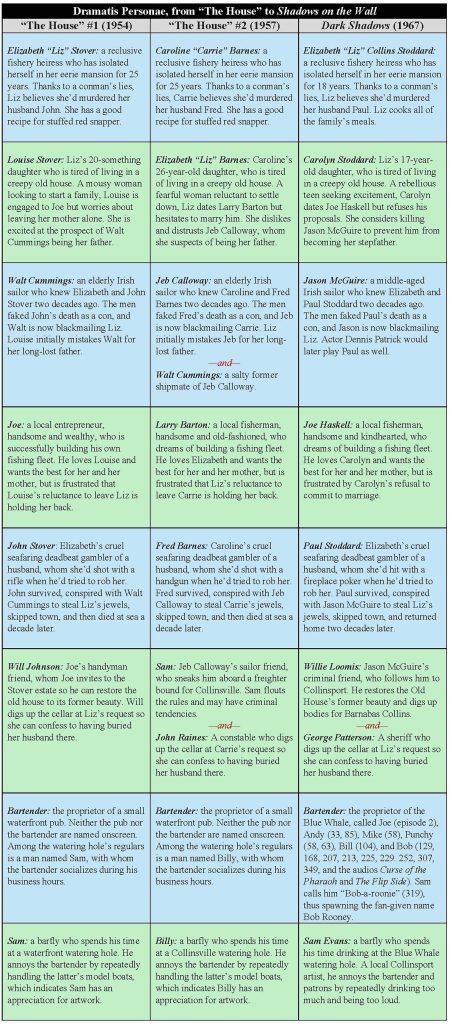
Comparing “The House” with Dark Shadows is perhaps unfair, for the Walt and Jeb tales comprise a single episode each, whereas Jason’s spans forty-six chapters. Jeb and Walt thus come off as two-bit thugs, while charming sociopath McGuire is a more compelling antagonist. There’s no denying Dark Shadows’ version is superior, thanks to standout performances by Joan Bennett and Dennis Patrick, the fact that McGuire ushered John Karlen’s fantastic Willie Loomis into the narrative, and Jason’s terrifying demise at a vampire’s hands.
Dark Shadows holds a unique place in television annals as a soap opera that mined a wide range of classic stories, from the aforementioned Jane Eyre to Bram Stoker’s Dracula, Mary Shelley’s Frankenstein, Universal’s The Wolf Man, Oscar Wilde’s The Picture of Dorian Gray, Robert Louis Stevenson’s Strange Case of Dr Jekyll and Mr Hyde, and more. In crafting Shadows on the Wall, Art Wallace also borrowed from a pair of Gail Russell films: The Uninvited (about wealthy siblings living in a haunted seaside mansion alongside a perilous cliff) and The Unseen (featuring a hateful young boy who terrorizes his governess, along with characters named Elizabeth, David, and Evans). So it’s no surprise he also utilized his own script for “The House.”
Wallace had departed Dark Shadows by the time the McGuire arc had played out. The writers had to work around a vampire kidnapping story and actor Jonathan Frid’s vacation, delaying the build-up to Liz’s forced marriage and shocking cellar reveal. Wallace’s last scripted episode was #85, whereas Jason’s arc continued until #275, so the writer was long gone by the time of the wedding in #270. Bill Malloy’s ghost appears to Vicki in Wallace’s last episode, which is ironic, for despite having established Dark Shadows’ occult nature, the writer stepped down at the precise moment the show’s subtle supernatural elements were stepped up to overt.
The recording of the wedding scenes on June 22, 1967, for a July 7 broadcast coincided with the first anniversary of Dark Shadows’ debut on June 27, 1966, and Art Wallace’s third iteration of “The House” concluded with the soap marking its first birthday by casting off the last vestiges of its original format. With McGuire’s death, five episodes after the marriage was called off, Dark Shadows fully embraced the occult at last. Pre-Barnabas, the show had been a soap opera story with supernatural undertones—but post-McGuire, it became a supernatural story with soap operatic undertones, and that made an enormous difference.
The wedding week provided Elizabeth’s most exciting material in the soap’s history, and viewers anxiously anticipated the outcome. Would Liz continue to let herself be Jason’s victim, with the scoundrel controlling her life and finances? Would the extortionist take over the Collins clan as her husband? Or would she muster the courage to face the consequences of her past? Since this arc was based on “The House,” its conclusion mirrors that of its predecessor. Episode #270 ends with Liz halting the wedding and, to the shock of her family and the audience, confessing “I killed Paul Stoddard! And that man [McGuire] was my accomplice!”
What a heart-stopping conclusion to a long-planned story that had played out over nearly a year, and what a satisfying sendoff for Art Wallace’s concepts. Shadows on the Wall had laid the gothic groundwork for Dan Curtis to sell Dark Shadows, providing firm footing that carried the soap from Vicki’s parental pursuance, Burke’s cannery connivery, and Roger’s alcoholic anger to Malloy’s mysterious murder, the Phoenix’s fiery fiendishness, and McGuire’s malevolent machinations—and it apparently shaped the early Dan Ross novels, too.
Thanks to Dark Shadows, viewers who’d watched Art Wallace’s “The House” in 1954 and ‘57 were treated to a third adaptation—the best one—in 1967. The names may have changed, but the details remained largely the same from one iteration to the next. Yet the departures of Wallace as writer and McGuire as antagonist opened the door wide for the vampire, the witch, the mad scientist, the werewolves, the zealot, and the warlock to take center-stage.
Without Wallace’s adeptly crafted framework, Dark Shadows morphed into something wholly different—still very entertaining, but less coherent without its original creative figurehead. From that point forward, the writers seemed to be working out plots as they went along, rather than carefully planning and ordering their thoughts, as they’d done in the early days. The result was an uptick in inconsistencies from one arc to the next, not to mention abandoned plot threads. Nonetheless, those changes in storytelling focus and format saved Dark Shadows from cancelation. The vampire’s bite drained veins but revitalized the ratings lifeblood, and viewers were just as entranced as Willie, Maggie, and Carolyn.
Art Wallace’s “The House” trilogy began with Elizabeth Stover’s guilt-ridden isolation, evolved into Caroline Barnes’ revelatory dinner party, and culminated with Elizabeth Collins Stoddard’s shocking wedding confession. What came after was different, with the villain torch passed from thieving grifter to living dead. Yet grieve not for the end of Wallace’s influence, for Jason McGuire’s death set Liz—and Dark Shadows—free from their restrictive past. As a new, more supernatural journey began, fans remained at that strange and dark place at the edge of the sea, high atop Widows’ Hill—at that house called Collinwood.
[1] “Joan Bennett Reveals Elizabeth to be Victoria’s Mother on Dark Shadows,” filmed on July 20, 1986, at Bennett’s home, and posted by Belleroguy on Nov. 26, 2009: www.youtube.com/watch?v=Hzdndt8OwIU.