
An ongoing discussion of how Star Trek comics provide prequels, sequels, and tie-ins to the episodes and films…
41: Malibu Comics, 1995
By mid-1995, Malibu Comics was nearing the end of its Star Trek tenure. The company had done an admirable job of bringing Trek‘s third live-action television show to the four-color realm, but with Paramount soon handing the reins back to Marvel, Malibu’s time at the helm would prove far too short. Thankfully, the monthly Deep Space Nine title’s later issues were among its best, with issues #21–28 offering a range of stories featuring prequels, sequels, and tie-ins to onscreen Star Trek.
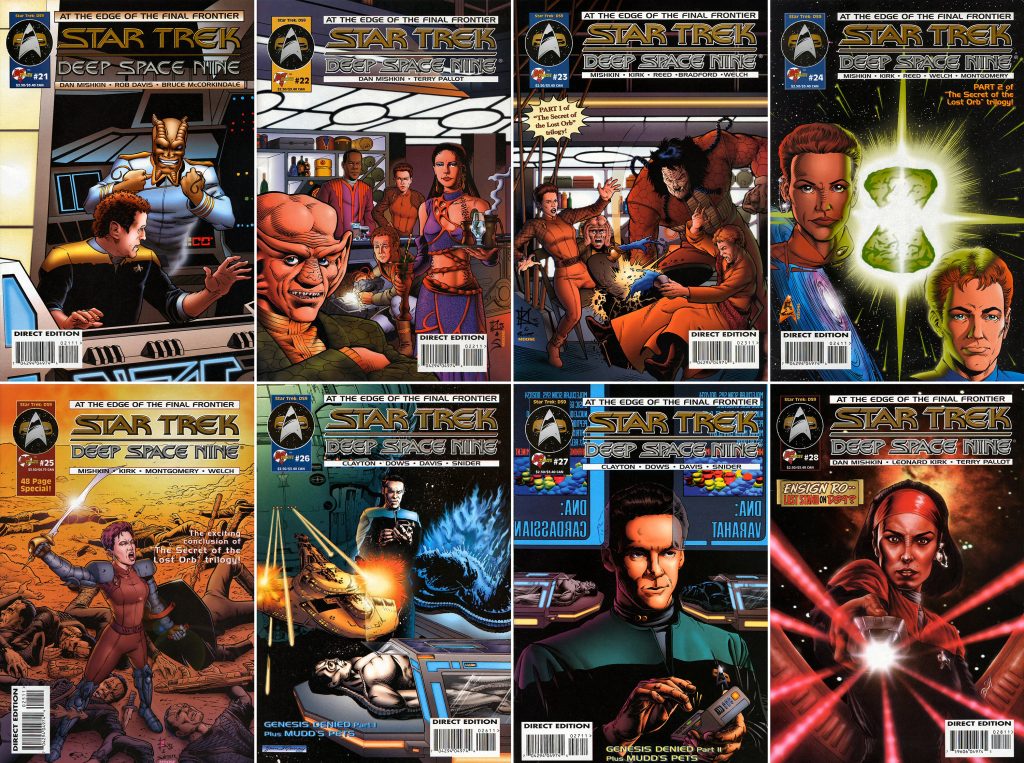
Dan Mishkin penned issues #21–25 and 28, accompanied by a rotating lineup of artists, including the highly talented Leonard Kirk, who consistently displayed a strong grasp of how to capture the actors’ likenesses and the show’s visual aesthetic. Chris Dows, Colin Clayton, and the husband-wife team of Randy and Jean-Marc Lofficier stepped in for issues #26–27, while Kirk, Rob Davis, Terry Pallot, Jack Snider, Brian Murray, and Mark Brill turned in some of the most vibrant covers ever to grace a Deep Space Nine comic.
In issue #21, aliens steal hallucinogenic implants from Starbase 112, then escape capture by dematerializing their ship via transporter. This causes part of the station and its personnel to vanish into a parallel dimension in which one’s fears and wishes are given form. (In Rom’s case, this involves visions of gigantic Bajoran women.) Starbase 112 was mentioned in two episodes of Star Trek: The Next Generation: in “Identity Crisis,” Geordi La Forge’s former shipmate, Anthony Brevelle, had been assigned to this facility before vanishing, while Amanda Rogers, in “True Q,” had boarded the Enterprise here to begin her internship.
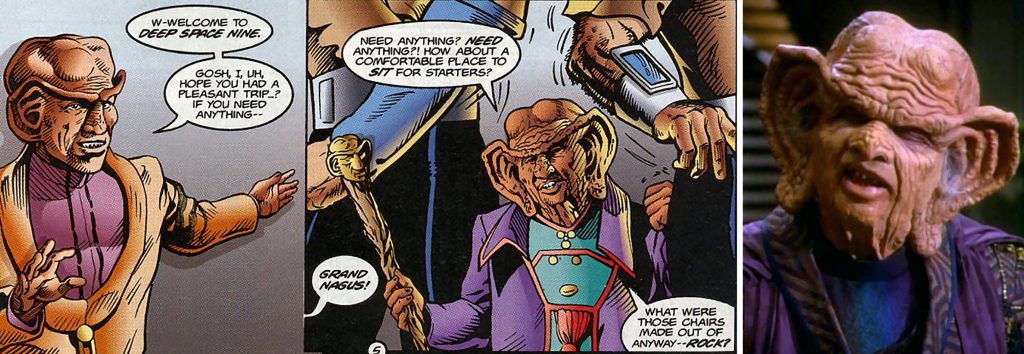
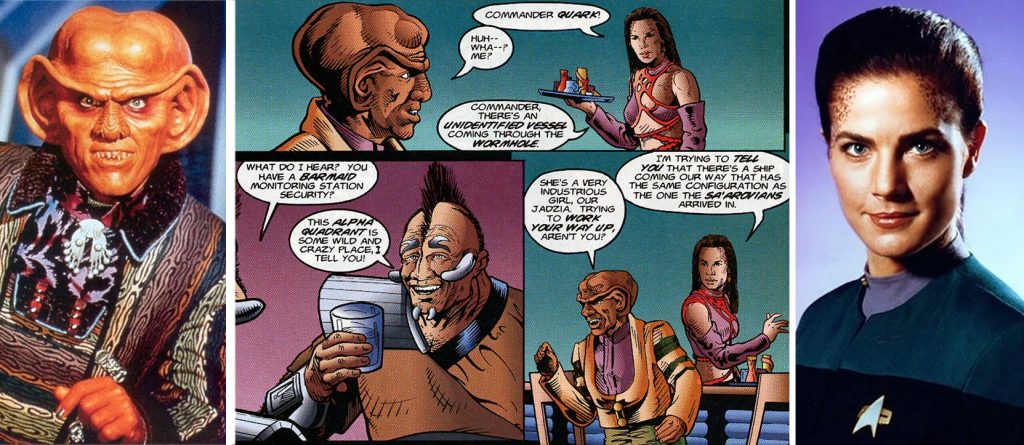
A less tenuous tie-in forms the premise of issue #22, in which Ferengi Grand Nagus Zek (from “The Nagus” and other episodes) learns of a Sa’arovian doomsday device capable of destroying planets. Zek lies that the Ferengi run Deep Space Nine, and Sisko goes along with the ruse in order to stop the device’s sale, posing as a barkeep while Quark assumes the role of station commander. Silliness ensues, with Quark hamming up his newfound role and reveling in Odo’s discomfort at having to call him “sir,” and Deep Space Nine’s officers discreetly manage the situation while pretending to work at the bar. The deal goes south, as expected, and the Sa’arovians threaten to destroy Bajor until Quark realizes the aliens are bluffing about the weapon’s existence.
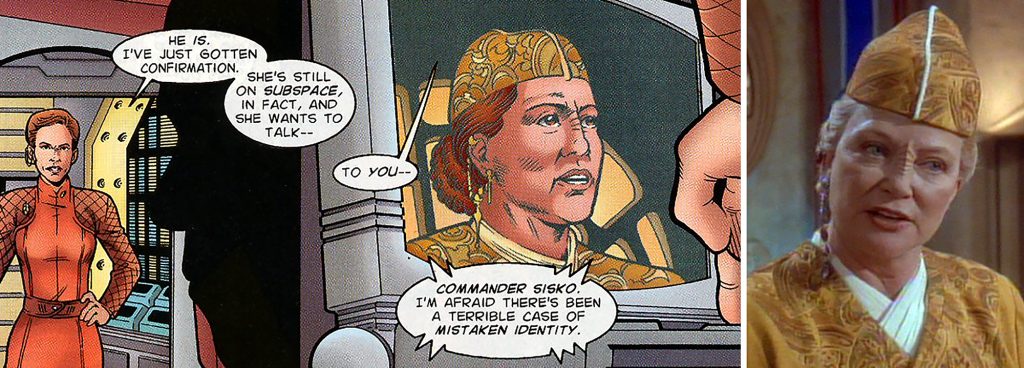
Spanning issues #23–25 was a tale built around Bajoran worship. A human conman, Lane Crockett, masquerades as a vedek to trick Kira into helping him find the Lost Orb of the Prophets. He visits a religious sect on Bajor whose members have used another orb to study personal combat, then steals the artifact and escapes to the planet Ares, located in the Gamma Quadrant. Apparently, his Aresian employers have received instructions from the Prophets—whom they call the Wargods—to steal Bajor’s orbs and use them for conquest.
Kira finds her faith shaken by the revelation that the Prophets have allowed their teachings to be perverted to justify killing, and she worries that she might have made the same mistake during her freedom-fighter days. In the end, she and Kai Winn decide the Aresians have as much right to the words of the Prophets as the Bajorans do, and thus end the conflict by gifting them with an orb. Connections to the TV shows are few, other than appearances by recurring characters Winn Adami and Gul Dukat, though references to the deaths of Bareil Antos (“Life Support”) and Kai Opaka (“Battle Lines”) reinforce Kira’s crisis of faith.
Early in the story, a Nausicaan (first mentioned in “Samaritan Snare”) interrupts a meeting between Kira and Crockett, furious about a con the latter has perpetrated. The Nausicaan’s first line, “Play games, Krok-it,” calls back to “Tapesty,” in which a member of that species invited Cortan Zweller to “Play dom-jot, hu-mon.” The meaning of the statement is cleverly inverted here, as this Nausicaan is not suggesting a friendly game, but rather accusing Crockett of having betrayed a trust.
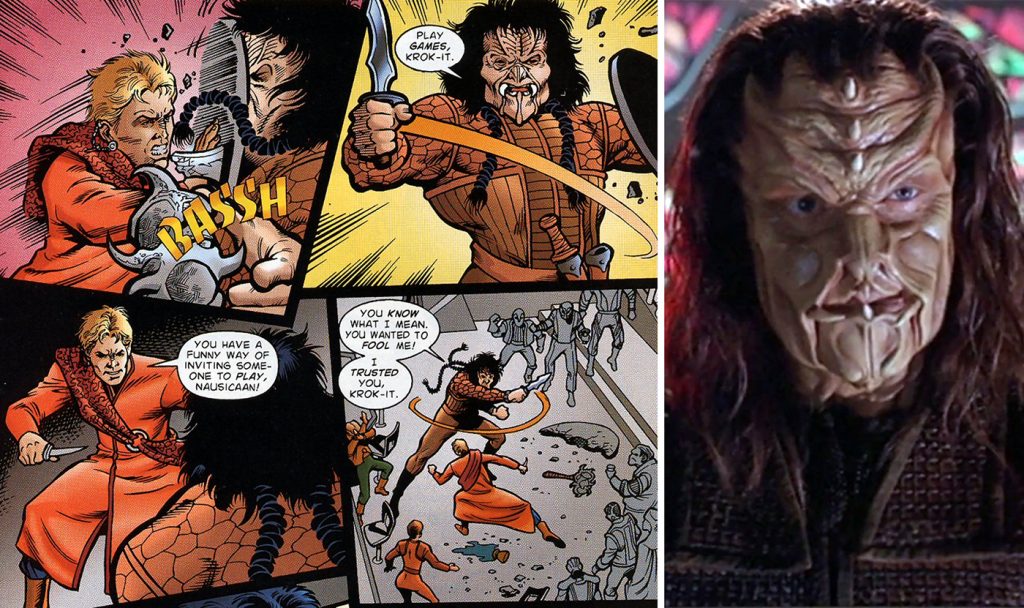
A pair of stories were presented in issues #26–27, with both issues featuring half of each tale. “Genesis Denied,” depicting a battle between the Cardassians and their enemies the Varahat, featured no direct connections to specific episodes, though “Mudd’s Pets” (as one might surmise, given the title) was a treasure trove for trivia lovers.
Horace Tiberius Mudd—Harry Mudd’s grandson—visits Deep Space Nine and gets into trouble with Odo for hatching a scheme with Quark to smuggle adorable little meeps. As a sequel to classic episodes “Mudd’s Women,” “I, Mudd,” and “Mudd’s Passion,” the comic pays wonderfully silly homage to Roger C. Carmel’s performance as Harry, with Horace displaying the same tendency toward obfuscation, subterfuge, and corpulence as his infamous ancestor. Horace is named after James T. Kirk, in fact, and claims his grandad was quite fond of the good captain, which is fitting.
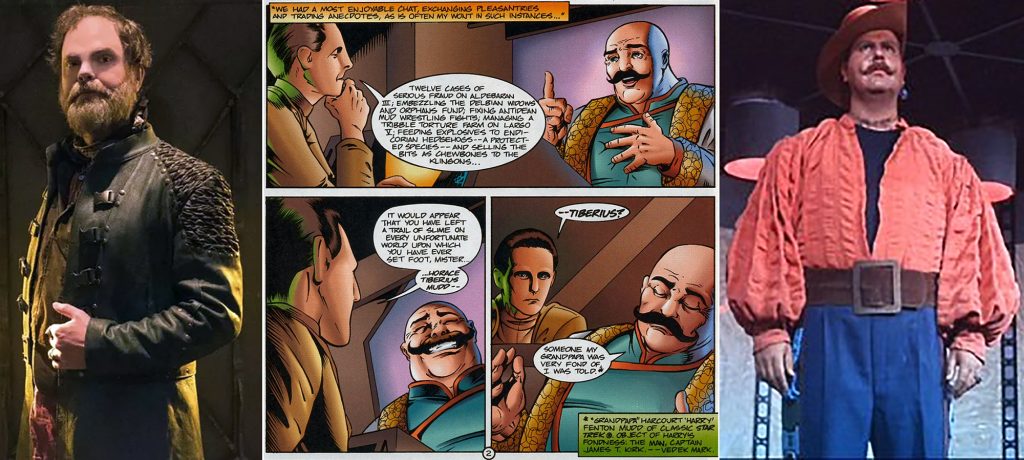
The genetically bred creatures, which destroyed their creators millennia ago, get loose and wreak havoc (naturally—when do cute but dangerous creatures ever not get loose on Star Trek?). Sisko’s crew coerces Quark to donate pest-control equipment he’d intended to sell, and the Ferengi agrees to this profit loss rather than facing criminal charges. When that plan fails, Bashir alters the meeps’ molecular structure, causing their corrosive secretions to dissolve their own bodies. Arrested, Horace lies non-stop at his hearing, providing an amusing callback to Harry’s less-than-honest accounts of his own actions, then Mudd and Quark are forced to clean up the gag-inducing goo covering the station’s walls and floors (shades of Cyrano Jones’ punishment for the tribble incident).
Guest scribes Randy and Jean-Marc Lofficier impressively prove their knowledge of all things Trek, for despite the short length of “Mudd’s Pets,” it’s jam-packed with tie-ins. When the station becomes meep-infested, O’Brien recalls the infestation of Cardassian voles in “Playing God.” Horace, meanwhile, is said to have perpetrated fraud on Aldebaran III, a world mentioned—with a slightly different spelling—in “Where No Man Has Gone Before.” He also procures a false-bottomed sarcophagus on Deneb IV, where Gary Mitchell once encountered a “nova” of a woman, and which was later the Bandi homeworld in “Encounter at Farpoint.”
Horace is accused of managing a tribble torture farm (“The Trouble With Tribbles”) on Largo V (“Babel”); feeding explosives to Endicorian hedgehogs and selling the bits as Klingon chewbones (referencing the planet Endicor from “Time Squared”); bribing the senior magister of Ventax II (“Devil’s Due”); and embezzling the Delbian Widows and Orphans Fund (the script to “The Drumhead” identified Nellen Tore as a member of this species). Plus, he plans to sell the meeps at a fair on Ogus II, where the Enterprise‘s young Willie Potts once ingested a poisonous fruit (“Brothers”).
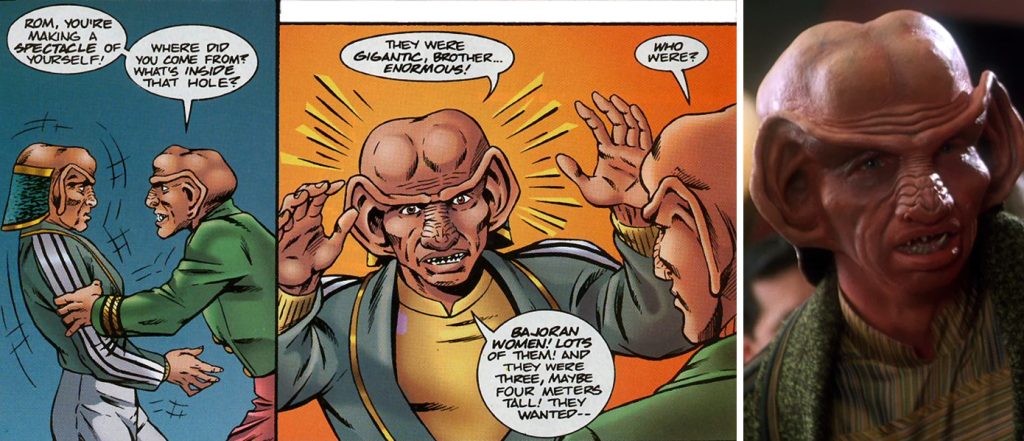
Mudd is also accused of fixing Antidean mud-wrestling fights, which muddies the waters a bit in terms of sourcing the reference. The species’ name was spelled “Antedian” in The Next Generation‘s “Manhunt,” with the similar name “Antidean” describing another species entirely in Deep Space Nine‘s “Doctor Bashir, I Presume.” Since the latter episode aired two years after this issue, however, the comic must logically be referencing TNG‘s Antedians. In space, no one can hear you spell.
Horace mentions the civilization of Erabus, which Q and Vash had visited in “Q-Less,” and he recalls a trip to the Gamma Quadrant’s Rakhar V; in “Vortex,” Dax and Sisko had journeyed to the planet Rakhar, also located in that quadrant (and likely in the same star system). And in a witty double-callback, Quark describes Mudd’s schemes as being “as slippery as a Deltan card-shark dipped in Troyian butter,” referencing both Lieutenant Ilia’s people (Star Trek: The Motion Picture) and Dohlman Elaan’s (“Elaan of Troyius”).
The tie-ins don’t stop there, for Horace boasts that those on Rigel IV—the home of Administrator Hengist (“Wolf in the Fold”)—call him “Just the Facts” Mudd. That claim is of course dubious, just like every statement anyone named Mudd utters on Star Trek, but the Lofficiers’ Trek cred is beyond question. The couple’s fandom clearly extends beyond Star Trek, too, for the presiding justice at Mudd’s trial is called Judge Sdred, a subtle nod at Judge Dredd, a character created by John Wagner and Carlos Ezquerra for 2000 AD magazine.
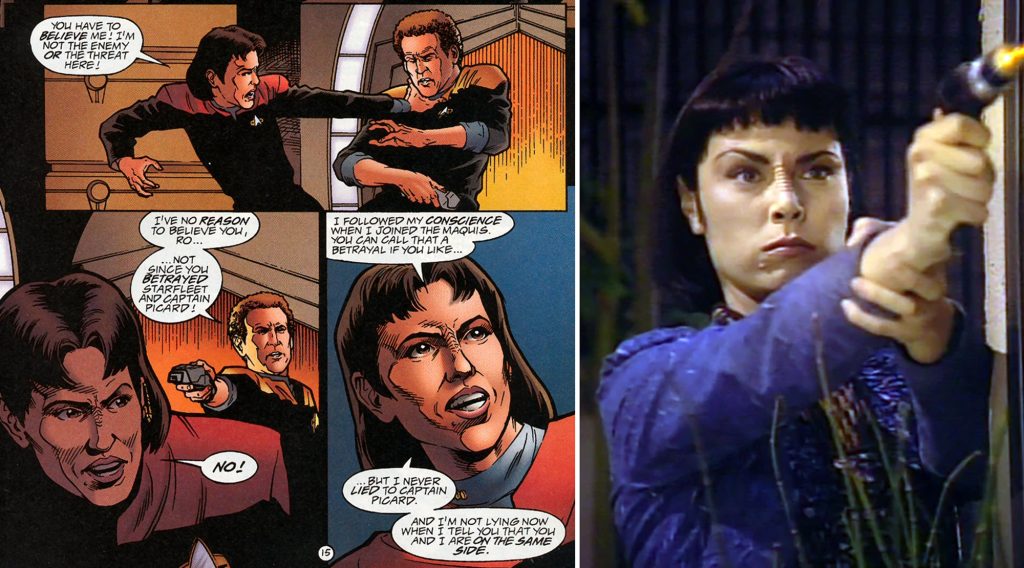
Ro Laren visits Deep Space Nine in issue #28, sometime after the events of The Next Generation‘s “Preemptive Strike,” in which Ro turned her back on Starfleet to join the Maquis, and before her return on Star Trek: Picard. When Cardassian leader Gul Engor retires, his presence on the station causes distress among the Bajorans. Ro is spotted after Engor is nearly assassinated, and a manhunt ensues to bring her to justice. O’Brien tracks Ro down, and she reveals her mission is to stop a Maquis operative from killing Engor and destroying the base. Ro beams out after defending her decision to betray Starfleet, leaving Miles (and readers) with much to think about.
It’s a thrill to see Ro visit Sisko’s station, even if it’s not how producers had originally intended. When Deep Space Nine was being developed, the plan had been for Ro to become his first officer, but actor Michelle Forbes declined the offer to reprise the role, resulting in the character being rewritten as Kira Nerys, played by Nana Visitor. Forbes was then invited to return on Star Trek: Voyager, but she gave the same answer. As such, seeing her not only face O’Brien’s disappointment in her, but also meet—and fight—her replacement, Kira, makes issue #28 a highlight of the Malibu run.
In two weeks, Star Trek Comics Weekly will return to Terok Nor for more of Malibu’s deep-space adventures. But first, we’ll take a side route on the Star Trek comic book highway—one where the signposts are in German.
Looking for more information about Star Trek comics? Check out these resources:
- The Complete Star Trek Comics Index, by yours truly
- The Star Trek Comics Checklist, by Mark Martinez
- The Wixiban Star Trek Collectables Portal, by Colin Merry
- New Life and New Civilizations: Exploring Star Trek Comics, by Joseph F. Berenato
- Star Trek: A Comics History, by Alan J. Porter
Rich Handley has written, co-written, co-edited, or contributed to dozens of books, both fiction and non-fiction, about Planet of the Apes, Watchmen, Back to the Future, Star Trek, Star Wars, Battlestar Galactica, Hellblazer, Swamp Thing, Stargate, Dark Shadows, The X-Files, Twin Peaks, Red Dwarf, Blade Runner, Doctor Who, Buffy the Vampire Slayer, Batman, the Joker, classic monsters, and more. He has also been a magazine writer and editor for nearly three decades. Rich edited Eaglemoss’s Star Trek Graphic Novel Collection, and he currently writes articles for Titan’s Star Trek Explorer magazine, as well as books for an as-yet-unannounced role-playing game. Learn more about Rich and his work at richhandley.com.
One thought on “Star Trek Comics Weekly #41”
Comments are closed.