
An ongoing discussion of how Star Trek comics provide prequels, sequels, and tie-ins to the episodes and films…
40: DC Comics, 1995
In early 1995, DC Comics neared the conclusion of its second monthly Star Trek run. Writer Howard Weinstein had departed five issues before that endpoint, however, with Kevin J. Ryan contributing the final five chapters. This week, we’ll examine Weinstein’s last two storylines from the standpoint of how each offered prequels, sequels, and tie-ins to episodes and movies. Also in the spotlight: The Ashes of Eden.
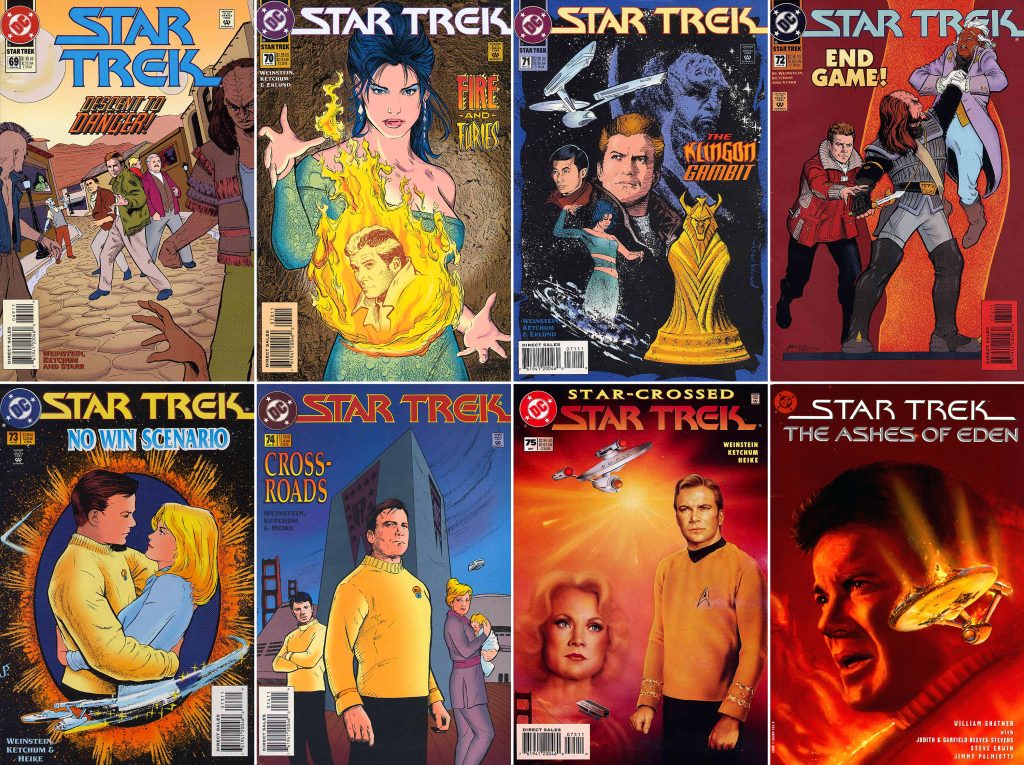
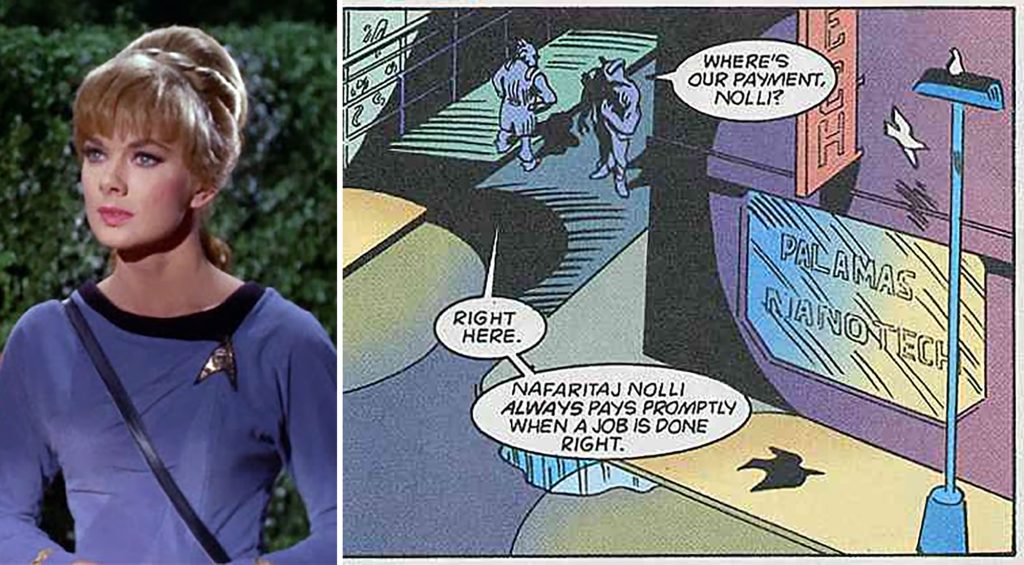
“A Wolf… in Cheap Clothing” (issues #69–72), illustrated by Rachel Ketchum, Arne Starr, and Pam Eklund, reunites the Enterprise and Excelsior crews, with James Kirk, Montgomery Scott, and Hikaru Sulu posing as merchants to investigate discord among some Klingon colonists. Kirk encounters former Academy classmate Nafaritaj Nolli, now a rogue Starfleet intelligence agent plotting to steal a sacred Klingon artifact, who lies about his true intentions to keep Kirk off his back.
Though standalone in nature, “A Wolf…” is tied to with several filmed tales. Admiral Cartwright (Star Trek VI: The Undiscovered Country) predicts the Klingon Empire may face imminent extinction, setting up the movie’s destruction of Praxis and the subsequent Klingon economic collapse. His assigning of a covert operation to spy on the Klingons illustrates Cartwright’s willingness to bend Starfleet’s rules for the sake of an objective, while reinforcing his bigoted bias.

A building on the planet Zantak Prime bears the company logo of Palamas Nanotech, referencing Enterprise archaeology and anthropology officer Carolyn Palamas, who dated Scotty in “Who Mourns for Adonais?” until falling in lust with a Greek god. Meanwhile, the backstory of the Klingon artifact incorporates episodes from two Star Trek TV shows: the tIq’a’ contains bone fragments and hair from Kahless the Unforgettable (The Original Series‘ “The Savage Curtain”) and has been stolen from the monastery on Boreth (The Next Generation‘s “Rightful Heir”).
“Star-Crossed” (#73–75) is more heavily immersed in TV and film trivia. The three-parter details the origins of Kirk’s romance with Carol Marcus (Star Trek II: The Wrath of Khan), as well as why Jim played no part in raising their son David. Carol is said to have attended Starfleet Academy with Kirk and Gary Mitchell (“Where No Man Has Gone Before”); she has no use for Starfleet, as the movie makes clear, but Kirk convinces her to sign up since it would afford her the best chance to explore the galaxy. After angering her superior officers for not following protocols, Carol foresees a court-martial in her future and resigns, shortly after realizing she’s carrying Kirk’s child.
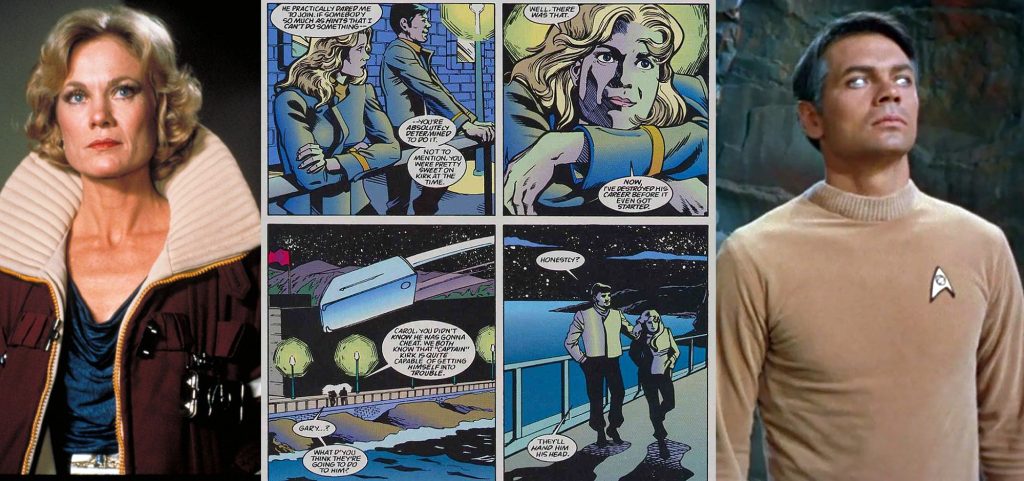
Carol’s failure to thrive in a paramilitary environment synchs up with her outlook in The Wrath of Khan. What’s more, it’s Carol who teaches Kirk to reprogram the Kobayashi Maru simulator, which makes sense given her role as the architect of Project Genesis in Star Trek II, and as an advanced weapons expert in Star Trek Into Darkness, both of which illustrate her knack for computer programming. The latter received fan backlash for portraying the Kelvin timeline’s Carol as a Starfleet officer, but it’s interesting to realize this controversial twist was not without precedent.
Kirk’s solution to the test differs from that depicted in the 2009 film, as well as other accounts, including those in the novel The Kobayashi Maru and in DC’s second annual. Here, while commanding a simulated USS Potemkin, he matches wits with a belligerent Klingon named Kozor—who, upon learning his opponent is “the Captain Kirk,” gushes awe instead of opening fire, then offers assistance in locating the Kobayashi Maru, much to Gary’s delight. Despite contradicting other accounts, it’s damn funny.

Kirk proposes to Carol after learning about David, but she turns him down and asks that he keep his distance, justifying why Kirk remains an absentee father despite knowing of his son’s existence. Her post-Starfleet role as a terraformer foreshadows her work on Project Genesis. David, meanwhile, attends a science program at Oxford while very young, and his mother describes him as “frighteningly bright,” presaging his later helping her create Genesis, as well as his decision to use protomatter in its matrix.
In addition to Mitchell’s presence, “Star-Crossed” contains an intriguing connection to “Where No Man Has Gone Before.” In that episode, Mitchell recalled aiming a “little blonde lab technician” Kirk’s way to make him less grim during their studies, and Kirk almost married her. One popular fan theory has long suggested that Carol (a blonde scientist) was that lab technician, and the three of them attending the Academy together in this tale supports such a notion. The comic also follows Gary’s onscreen depiction as a ladies’ man, as he declines the offer to join Kirk in Iowa since his prospects for finding sexual partners would be greater in San Francisco.
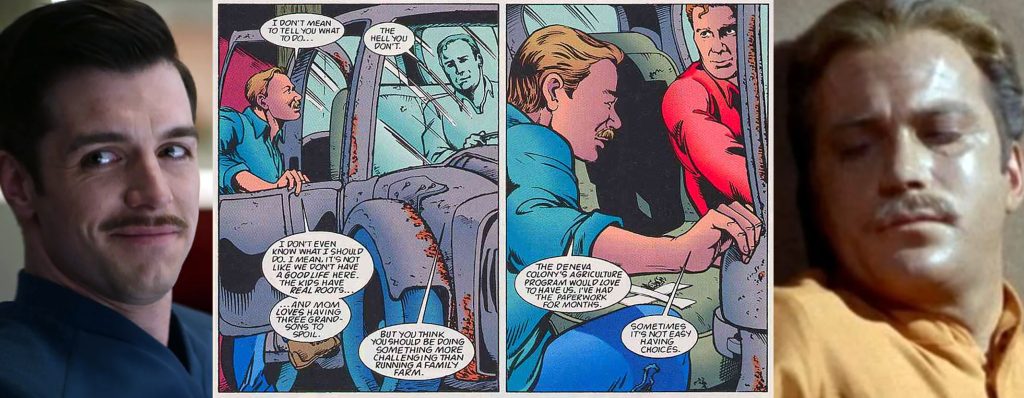
Kirk’s brother Sam (“What Are Little Girls Made Of?” and “Operation—Annihilate!,” more recently a recurring character on Strange New Worlds) returns as well. In the former episode, Jim was said to have three nephews, but when Sam showed up (and died) in the latter, only Peter was with Sam and his wife Aurelan. The comic names Peter’s siblings Brett and Robbie, though DC’s Star Trek Special #3 would call them Adam and Jason only a few months later. Sam considers moving his family to Deneva (their home in “Operation—Annihilate!”), but is concerned about uprooting them, preferring stability and continuity over Jim’s life of adventure—ironic, since that decision would see the couple killed by flying parasites.
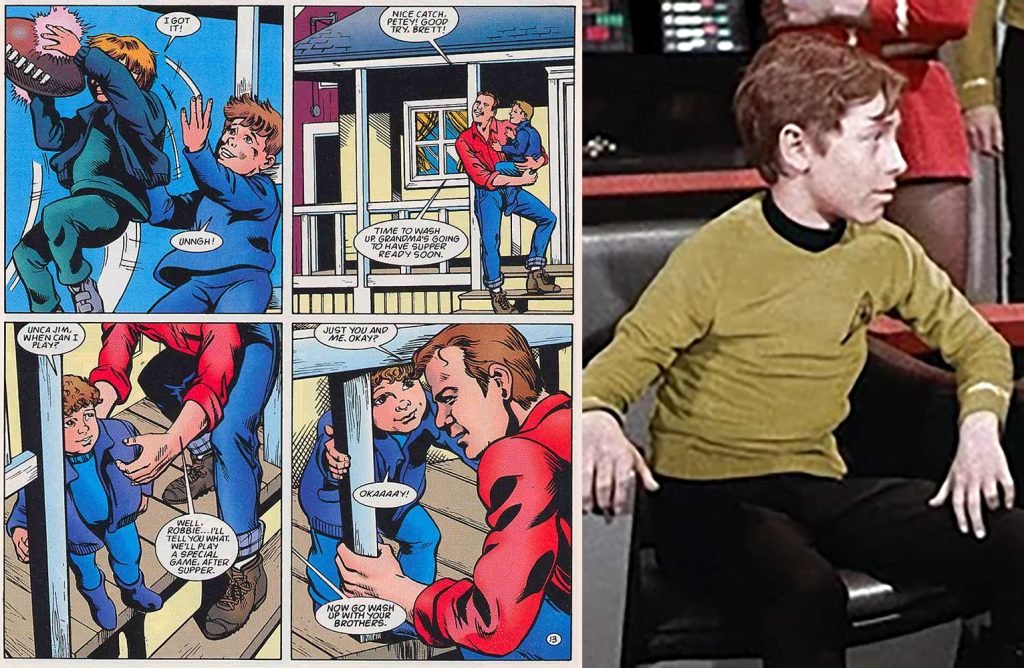
Meanwhile, George Kirk Sr. is noted as being deceased when Jim receives his first command, whereas Spock would recall, in the 2009 film, that the elder Kirk lived long enough to see this happen. (Clearly, this isn’t Weinstein’s fault since the movie was more than a decade away when the comic was published.) George’s wife Winona now lives on a farm—the same one depicted in the movie, perhaps?—and it’s she who sees Kirk off in this version of history.
Upon assuming command of the USS Oxford, Kirk replaces its retiring commander, Captain Maiewski. Shirley S. Maiewski, a first-generation Trek fan and the author of the acclaimed short story “Mind Sifter” (published in Bantam’s Star Trek: The New Voyages), was a prolific fanzine editor who’d helped Bjo Trimble campaign to save The Original Series from cancelation in 1968. Hopefully, Shirley got to see this fitting tribute to her contributions before she passed away in 2004.
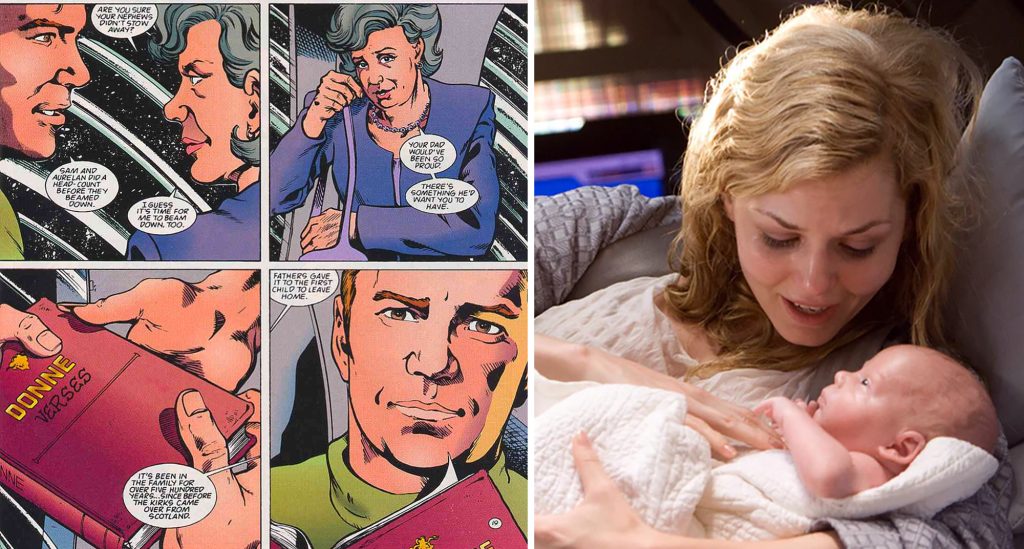
Issue #75, set at the end of the Enterprise‘s five-year mission, ushers in the status quo of Star Trek: The Motion Picture. The Enterprise is slated to receive a refit that will take eighteen months to complete, though starting delays will leave the starship out of commission for three years, clarifying the time spans mentioned in the movie, while setting the stage for the starship’s onscreen engine imbalance.
Spock retires to Vulcan to study kolinahr, while Kirk is named Chief of Starfleet Operations and reluctantly accepts a promotion to admiral. McCoy grows a beard and becomes bitter toward Starfleet, and a passing officer wears the movie’s “space pajamas” uniform. Moreover, Jim rekindles with Carol, but when he lies about his whereabouts after investigating the mismanagement of a starship-testing program, she realizes his career remains his top priority and leaves him again.

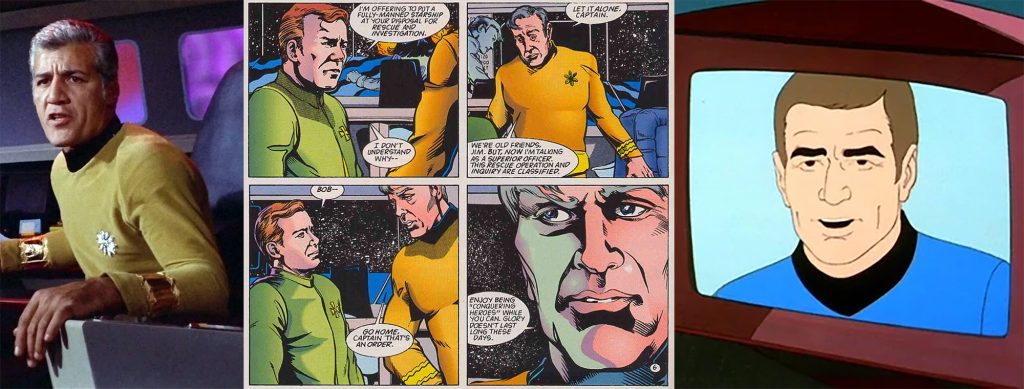
The program is led by Bob Wesley, who’d commanded the USS Lexington during the M-5 wargames (The Original Series‘ “The Ultimate Computer”) and later governed Mantilles on The Animated Series (“One of Our Planets Is Missing”). Now back in Starfleet, Wesley oversees classified engine-propulsion projects. After two prototype vessels lose crewmembers due to engine imbalances, Kirk realizes the program is being mismanaged, though he stops short of accusing his longtime friend of incompetence when complaining to Starfleet. (He probably considers it, given Wesley’s “Captain Dunsel” cheap shot.)
Carol also features in DC’s abridged adaptation of The Ashes of Eden, a novel attributed to William Shatner, though Judith and Garfield Reeves-Stevens are believed to have written it based on the actor’s concepts. Illustrated by Steve Irwin and Jimmy Palmiotti, with a stunning cover by Nicholas Jainschigg, The Ashes of Eden is firmly steeped in live-action lore. The novel and the comic are set shortly before the events of Star Trek: Generations, with the Enterprise-A being decommissioned and its B replacement being prepared.
Kirk yet again rekindles his relationship with Carol, but their renewed romance falters when Jim finds life meaningless without a starship. He returns to his family farm in Iowa, then retires from Starfleet to help a Klingon-Romulan hybrid (Teilani—with whom he falls in love, quickly forgetting about Carol) protect her world’s secret of eternal youth. Pavel Chekov and Nyota Uhura pose as Starfleet renegades to infiltrate Klingon and Andorian gunrunners, culminating in the Enterprise and Excelsior crews exposing a Starfleet conspiracy—and in the Enterprise-A’s destruction.
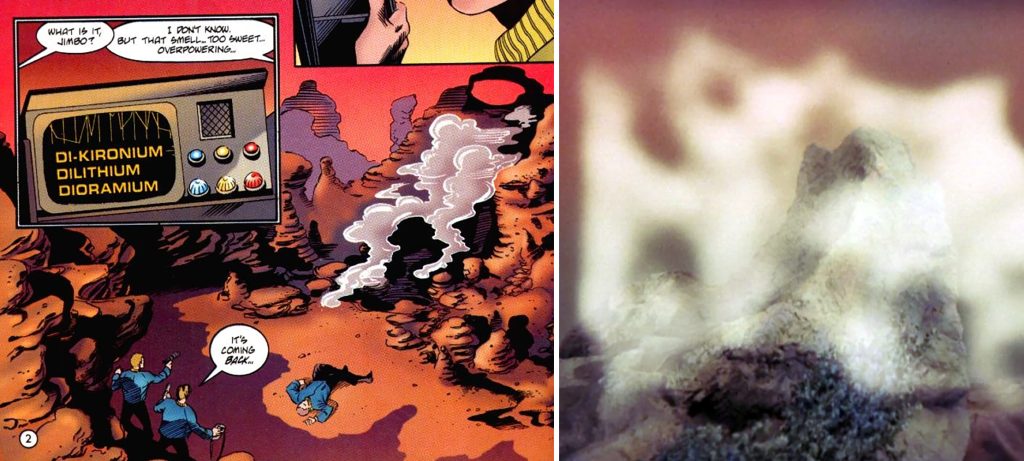
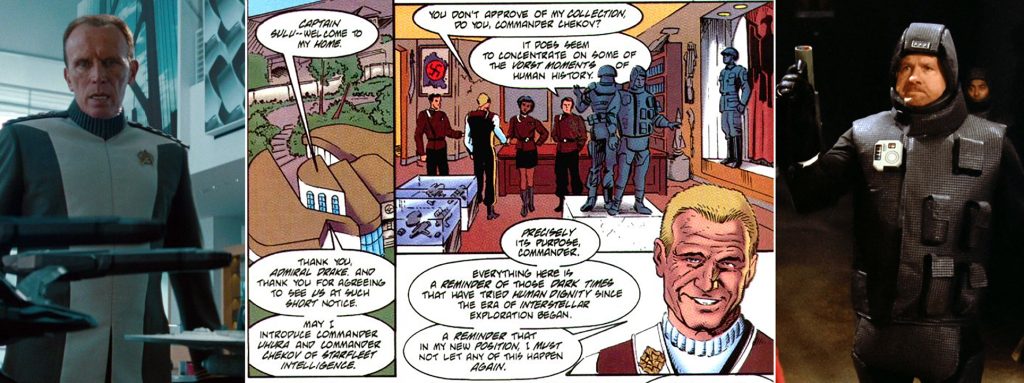
The episode and film tie-ins are many. Kirk tries out a holographic recreation of his mission to Tycho IV aboard the USS Farragut (“Obsession”), when he’d hesitated to fire at a cloud creature attacking his shipmates. This time he fires immediately, but the simulated creature outright destroys the Farragut, revealing his hesitation had actually saved lives. Kirk also learns that Academy rival Androvar Drake, a former Farragut crewmate, has been named the new head of Starfleet.
Drake has much in common with Star Trek Into Darkness‘s Admiral Marcus. Both men secretly conduct unsanctioned weapons research; both have a daughter (Jade and Carol, respectively) whose identity the Enterprise crew initially doesn’t know about; both hope to start a war with the Klingons; both keep mementos of the past in their office, including starship models; both violate Starfleet laws to achieve their goals; and both try to destroy the Enterprise. What’s more, Drake decorates his office with symbols of Earth’s darker historical eras to remind himself not to let past atrocities repeat. Among these mementos is the uniform of a 21st-century Post-Atomic Horror soldier, identical to that worn by Q in The Next Generation‘s “Encounter at Farpoint.”
Kirk’s now-adult nephew Peter still resides on Deneva. Jim muses that no one in his family wants to keep the farm in Iowa, but oddly, no mention is made of Peter’s brothers. (On the bright side, the boys don’t receive another set of names during DC’s tenure… though the confusion continues with the novel The Last Roundup, which dubs them Alexander and Julius, and the video game Away Team, which calls one of them Craig.) The farm is located in Riverside, an Iowa city that had proclaimed itself the captain’s future birthplace in 1985. That fact was never spoken onscreen until the 2009 film, and more recently in Strange New Worlds‘ “Tomorrow and Tomorrow and Tomorrow.”
In addition, the graphic novel references Klingon mind-sifters (“Errand of Mercy”), Deneb V (“I, Mudd” and “The Pirates of Orion”), Chancellor Azetbur (Star Trek VI), and Captain Harrimon (Generations). Plus, when Kirk tells Spock and McCoy about his plans to join Teilani’s quest, the three friends share a bottle of wine from the Picard vineyard in La Barre, France. Jean-Luc Picard’s family owned the vineyard for generations, as depicted in The Next Generation‘s “Family” and on Star Trek: Picard. Considering The Ashes of Eden‘s function as a lead-in to Generations, it’s a nice touch.
For the next two weeks, we’ll return to Malibu’s Star Trek: Deep Space Nine series, after which we’ll wrap up not only the Malibu line, but also DC’s Kirk- and Picard-era titles. Then, the countdown will begin until Marvel makes its triumphant return, as House Lee allies once more with House Roddenberry.
Looking for more information about Star Trek comics? Check out these resources:
- The Complete Star Trek Comics Index, by yours truly
- The Star Trek Comics Checklist, by Mark Martinez
- The Wixiban Star Trek Collectables Portal, by Colin Merry
- New Life and New Civilizations: Exploring Star Trek Comics, by Joseph F. Berenato
- Star Trek: A Comics History, by Alan J. Porter
Rich Handley has written, co-written, co-edited, or contributed to dozens of books, both fiction and non-fiction, about Planet of the Apes, Watchmen, Back to the Future, Star Trek, Star Wars, Battlestar Galactica, Hellblazer, Swamp Thing, Stargate, Dark Shadows, The X-Files, Twin Peaks, Red Dwarf, Blade Runner, Doctor Who, Buffy the Vampire Slayer, Batman, the Joker, classic monsters, and more. He has also been a magazine writer and editor for nearly three decades. Rich edited Eaglemoss’s Star Trek Graphic Novel Collection, and he currently writes articles for Titan’s Star Trek Explorer magazine, as well as books for an as-yet-unannounced role-playing game. Learn more about Rich and his work at richhandley.com.
3 thoughts on “Star Trek Comics Weekly #40”
Comments are closed.