
An ongoing discussion of how the comics provide prequels, sequels, and tie-ins to the Star Trek episodes and films, soon to be a book from BearManor Media. Click here to view an archive of this article series.
67: WildStorm Comics, 2000–2001
When it comes to Star Trek comics, history tends to repeat itself. After Marvel lost the license for its post-The Motion Picture line, DC picked up the reins and produced a long-running series that remains the gold standard. Once DC’s run ended, the publisher that replaced it was Marvel, so when Marvel again lost the license in 1998, it’s poetic that its successor was once more DC—or rather, DC’s WildStorm imprint.
WildStorm produced licensed comics for such franchises as Friday the 13th, A Nightmare on Elm Street, The Texas Chainsaw Massacre, World of Warcraft, The X-Files, and more, so Star Trek was a natural fit. It offered one-shots and miniseries based on The Original Series, The Next Generation, Deep Space Nine, and Voyager, along with a tie-in to Peter David’s New Frontier novels. With Jeff Mariotte editing every issue, the imprint brought in writers from the Pocket Books line, as well as from prior comic publishers.
The company had all the right ingredients, yet it produced only twenty-seven issues and two graphic novels before it, too, left the playing field. This resulted in a five-year gap without new comics—the longest since Gold Key’s debut in 1967. In fact, WildStorm’s run was among the shortest to date, with only Marvel’s first tenure and the Peter Pan and Tokyopop lines producing fewer issues. But quantity and quality don’t always go hand in hand, and what WildStorm lacked in volume it made up for with storytelling.
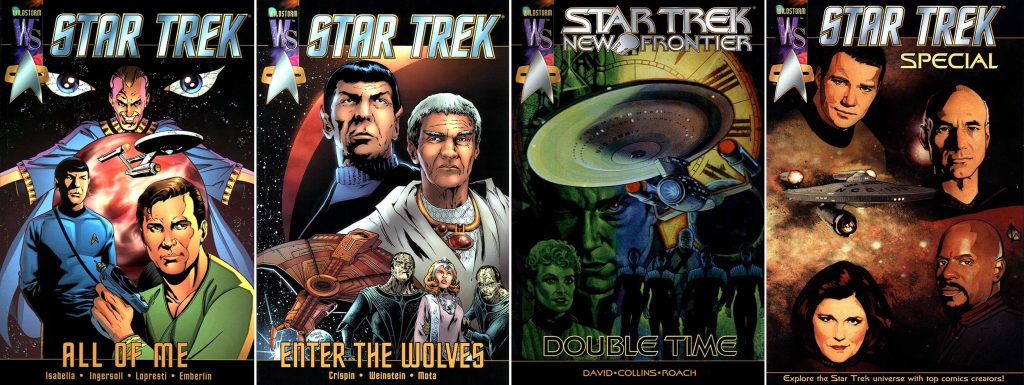
This week, we’ll kick off our WildStorm discussion with four one-shots that provided prequels, sequels, and tie-ins to onscreen Star Trek. I asked Mariotte if he had insight into why the line ended so prematurely, but he admitted he doesn’t know. “Our biggest profit-earner one year was the Trek comic that we sold to be placed in a game box,” he said, recalling the Star Trek: Voyager—Special Collector’s Edition, packaged with Activision’s Elite Force game. “We made a ton on that deal, so it shouldn’t have been financial, though our fully painted graphic novels might’ve lost money.”
Mariotte added, “I thought we were doing some creative stuff. I wish I could tell you why it ended, but I’m coming up blank. Part of what I liked was bringing in science fiction writers who’d been lifelong fans of Star Trek, but had never written Star Trek fiction, like David Brin, Kevin J. Anderson, K.W. Jeter, Lawrence Watt Evans, etc. I don’t know if that spoke to the hardcore fan base, but I thought it was good to have some new voices mixed in.” Among the new voices were some who were quite familiar.
Star Trek: All of Me, from DC Trek veteran Tony Isabella and Bob Ingersoll, features art by Aaron Lopresti and Randy Emberlin. Spock’s former Academy classmate, Armand St. John, claims to have discovered a method for studying parallel universes after reading about the reality from “Mirror, Mirror.” Not unexpectedly, St. John has ulterior motives, with scientific achievement hardly his goal; he plans to assemble his own counterparts from other realms and conquer the Federation.
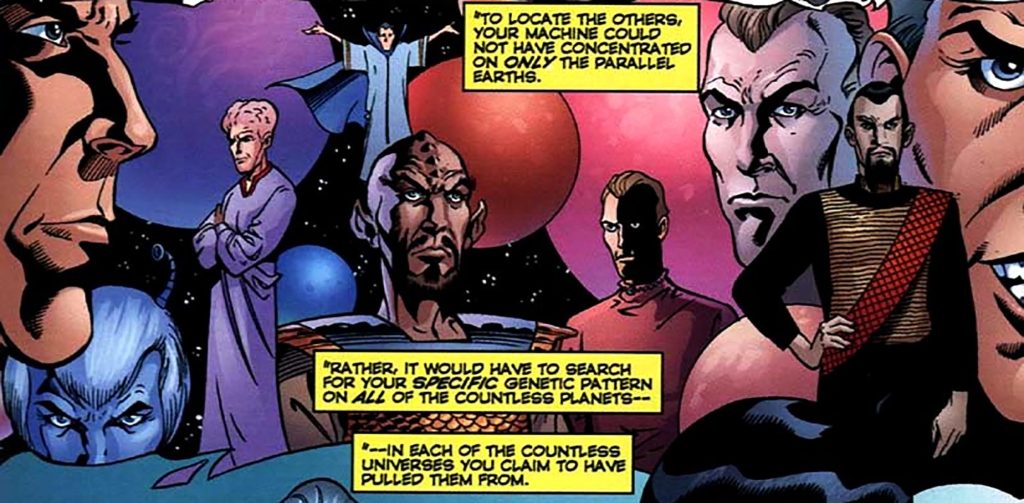
James T. Kirk’s crew encounters St. John duplicates from various species, which he says hail from other realities. These include humans (both male and female), Klingons (both ridged and smooth-headed), Romulans, and Andorians, not to mention a Cheron (“Let That Be Your Last Battlefield”) and a Talosian (“The Cage”), which is pretty hilarious to behold. Bearded Spock even puts in an appearance, because for some reason St. John has a bunch of Spock duplicates, too (perhaps he’s a student of Stavos Keniclius V from The Animated Series‘ “The Infinite Vulcan”).
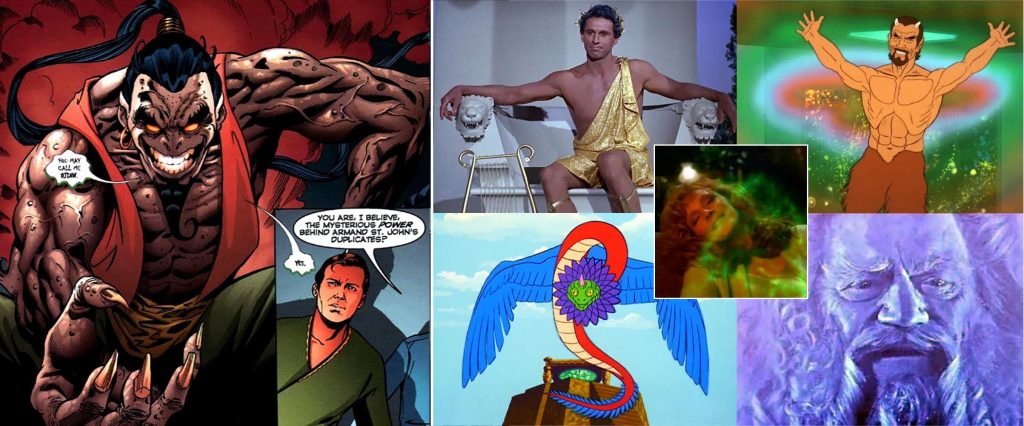
Spock exposes his ex-classmate as a fraud, however—and this is where the story puts the “wild” in WildStorm, for Armand has been assisted in his scheme by a djinn from Islamic mythology! While that might raise eyebrows, keep in mind that Kirk’s crew has met the Greek god Apollo, the Aztec deity Kukulkan, and Lucifer, and they even set out to find God. Moreover, countless other omnipotent beings have graced the franchise in the years since, and Beverly Crusher even had sex with a ghost candle. So are genies any more outlandish? Not at all.
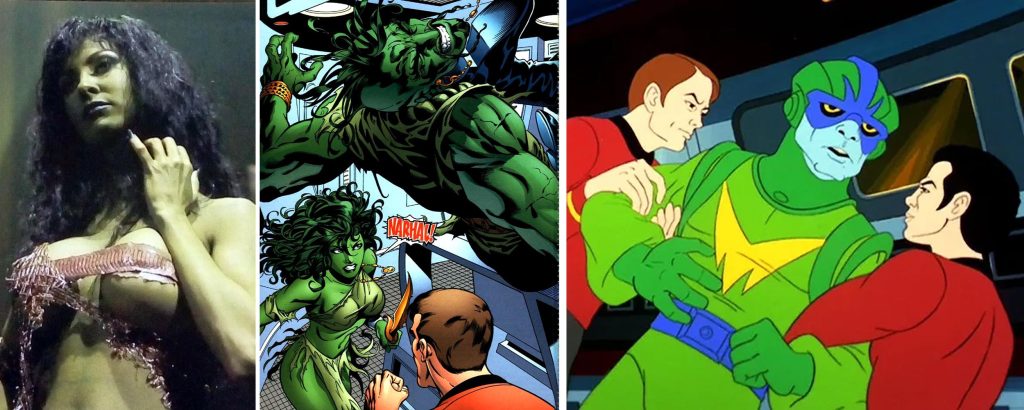
Amidst all this, the crew tangles with a rogue Orion crew raiding Federation colonies. Kirk vows to prove the Orions have been engaging in piracy, as depicted in “The Pirates of Orion,” and that their claims of neutrality are a lie, but the Orion plot is a minor B-story. By the issue’s end, the Orions and St. John’s duplicates are all defeated, and the insane scientist is sent to Elba II (“Whom Gods Destroy”) for psychiatric treatment.
In Star Trek: Enter the Wolves, from prolific novelists Ann “A.C.” Crispin and Howard Weinstein, Spock clashes with Perrin, his father’s new wife (“Sarek” and “Unification”), after he publicly denounces the elder Vulcan’s political stance, and because he—rather immaturely—can’t accept her as a replacement for his mother Amanda (“Journey to Babel”). This one-shot, set four decades before Deep Space Nine, sports stunning artwork from Carlos Mota, Keith Aiken, John Nyberg, and Derek Fridolfs.
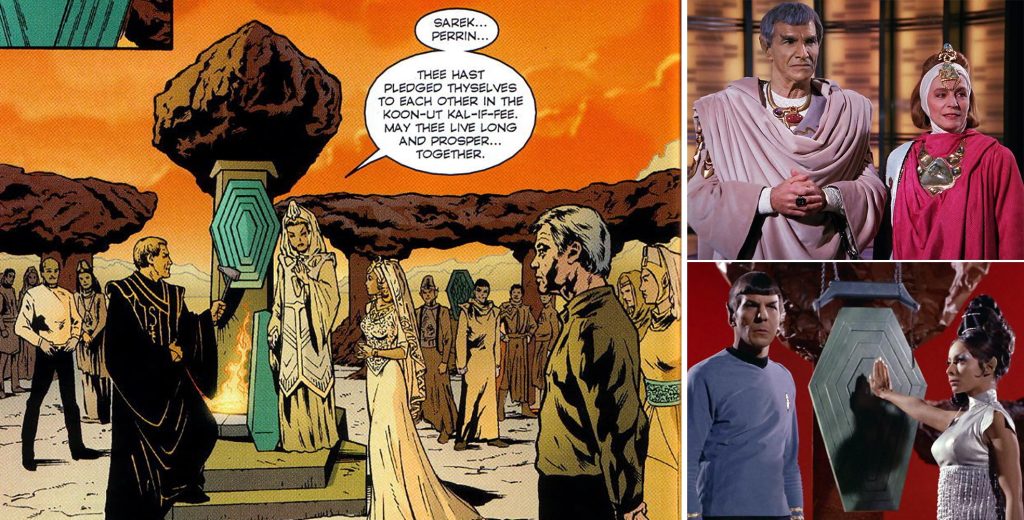
The issue depicts the wedding of Sarek and Perrin, who are joined in koon-ut-kal-if-fee, like Spock’s ritual in “Amok Time,” and a reception is held at Sarek’s home in ShiKahr. The estate looks different than it did on The Animated Series‘ “Yesteryear,” but decades have passed since that episode, so the house may simply have been updated in the interim, just as it differed on Star Trek: Discovery. Spock fails to attend the wedding, or even to reply to the invitation, concluding that the couple would not notice his absence. He’s wrong, of course, and while his father shows no outward sign of hurt feelings, Perrin angrily calls Spock on his rudeness.
Really, though, it’s hard not to side with Spock here, given how lousy a parent Sarek has been to all of his children—not just Spock, but Sybok (Star Trek V: The Final Frontier) and Michael Burnham (Discovery) as well (see Sarek of Vulcan: Star Trek’s Worst Father). As “Journey to Babel” revealed, Spock became estranged from Sarek over an argument regarding his career choice, and the two never reconciled until Spock’s death and resurrection in the third and fourth films. Enter the Wolves explores how father and son could become again estranged after making such progress, and it all stems from the wedding snub and a diplomatic conference.
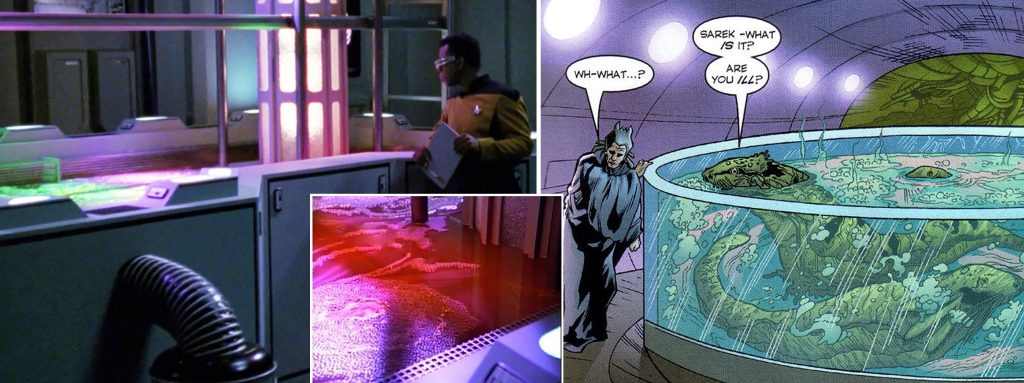
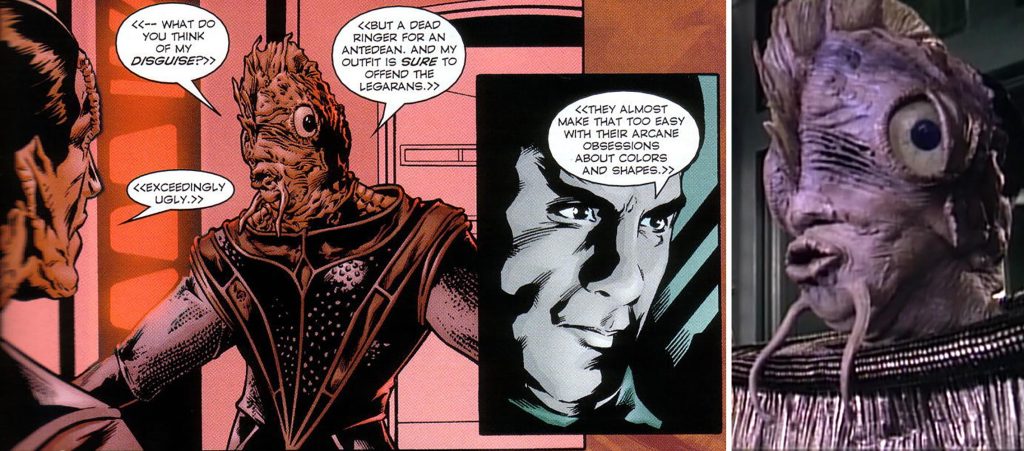
Sarek invites the Legarans to the conference, which the Cardassians disrupt so they can annex Legara IV. Spock publicly argues with Sarek and Perrin about whether to trust the Cardassians, resulting in their renewed rift—even after the aliens’ scheme is exposed. Said scheme ties in with “Manhunt,” for an operative poses as an Antedian to infiltrate the conference. Since the Legarans find the color orange extremely offensive, the fake Antedian wears an orange outfit to the ceremony, which so outrages the Legarans that it takes decades for the ambassador to finalize negotiations in the episode “Sarek.”
Leonard McCoy is promoted to admiral, the rank he holds in The Next Generation‘s “Encounter at Farpoint.” When Spock congratulates him, Bones admits Starfleet may have promoted him only because it wasn’t sure what else to do after so many years of service. That’s amusing, considering that Starfleet had to draft him to get him back into uniform in The Motion Picture.
Another WildStorm one-shot was Star Trek: New Frontier—Double Time. In 1997, Peter David introduced Trek fans to a new iteration of the franchise, with a brand-new starship, captain, crew, and mission. But this saga did not play out on the large or small screens. Rather, it was the first original Trek concept to be told entirely on the printed page, via more than twenty interlinked novels under the New Frontier umbrella. Ebooks and short stories were added to the mix, along with WildStorm’s Double Time and a five-issue IDW miniseries, Turnaround (to be discussed in a later column).
New Frontier starred Captain Mackenzie Calhoun of the USS Excalibur. The concept was devised by Pocket editor John Ordover to get around a Paramount edict at the time that the novels could not feature ongoing continuity, and that characters could not die, change, quit, or evolve. Ordover and David built New Frontier around the idea that this crew would not be held back by the franchise’s status quo since they would not appear onscreen. The premise: the Thallonian Empire collapses, destabilizing an entire region, and the Excalibur is sent to offer long-term Federation assistance.
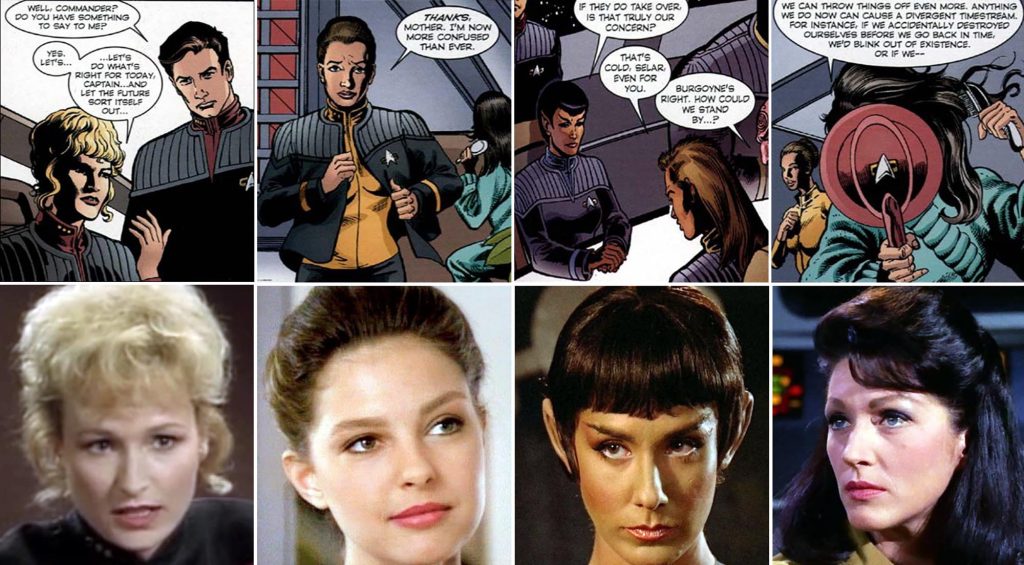
Worried that readers might not embrace the books, Paramount requested that the cast include secondary characters from television. Thus, Elizabeth Shelby (“The Best of Both Worlds”), Selar (“The Schizoid Man”), Robin Lefler (“Darmok” and “The Game”), and Edward Jellico (“Chain of Command”) joined the roster, in addition to The Animated Series‘ M’Ress and Arex, as well as Number One (“The Cage”), now officially named Una Chin-Riley. Shelby, Lefler, Selar, and Chin-Riley all appear in Double Time, which is set between the novels Once Burned and Double or Nothing. The comic explains the Excalibur‘s absence during Deep Space Nine‘s Dominion War, since an eighteen-month time jump causes the starship to bypass the conflict. Pretty clever, Mr. David.
The New Frontier saga portrays Number One as a human named Morgan Primus—and she’s Robin Lefler’s mother. Her presence provides tie-ins to numerous corners of the franchise, most recently Discovery, Short Treks, and Strange New Worlds. Not only is she said to be an immortal like Flint (“Requiem for Methuselah”), but she resembles Christine Chapel, is the aunt of a woman named Xana (implied to be Lwaxana Troi), and sounds like the voice of starship computers—an in-joke referencing the fact that Majel Barrett portrayed all of these roles (aside from Flint, obviously). Oddly, she never shows her face in this tale, possibly to avoid confusing readers unfamiliar with the novels. Strange New Worlds has since overwritten her New Frontier backstory.
A fanatical species commits genocide, and the Excalibur crew fails to prevent the massacre since they instead protect an Enevian colony from a magnetic storm. Calhoun tries to change history via time travel, besting Captain Braxton and the timeship Relativity (Voyager‘s “Relativity”) in their efforts to stop him. Calhoun later learns that the Enevians will become future tyrants as a result of his unethical actions—in essence, he may have made things worse, and Braxton may have been right.
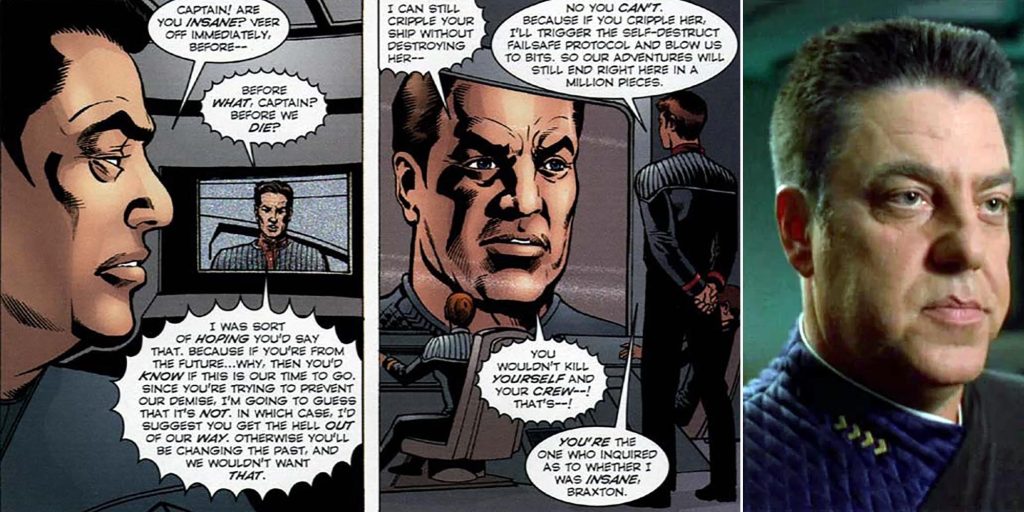
Readers discover that by the 24th century, the term “Captain Christopher Paradox” refers to the contradictory process of bodies at rest from different time streams co-existing. This happened to John Christopher in “Tomorrow Is Yesterday,” when he defied all story logic by safely beaming into his younger body, thereby erasing his memory of the episode’s events… instead of, say, doubling his body density and exploding in his cockpit, which perhaps should have been the result of the beam-in but was not.
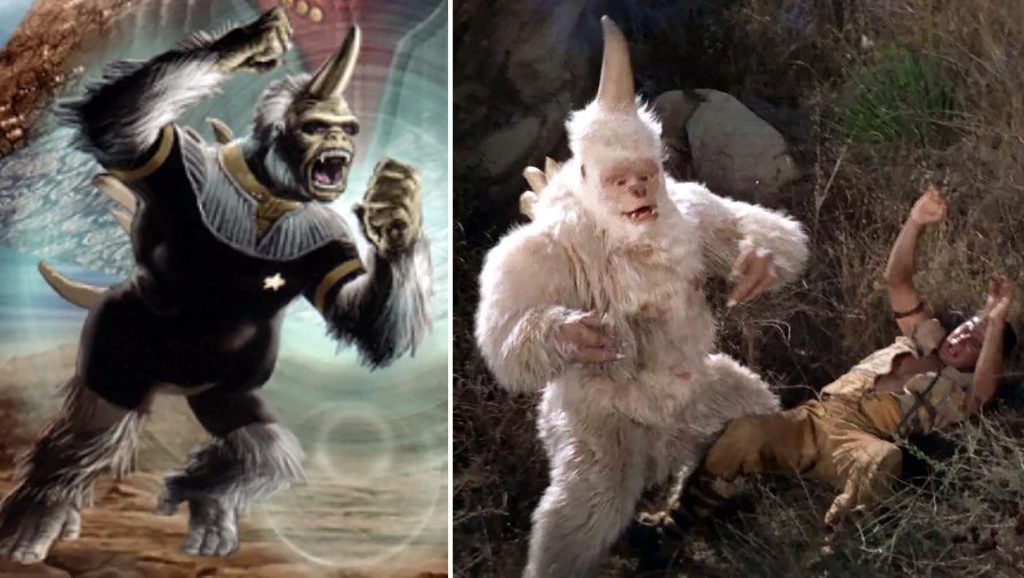
Briefly featured, though unnamed and sans dialogue, is Lieutenant Janos, a genetically altered Mugato who serves aboard the Excalibur. The very idea of a Mugato in Starfleet is hysterical, so it’s a shame his involvement in the comic is a mere cameo. Introduced in the New Frontier novel Martyr, he’s named after Janos Prohaska, who designed and portrayed the ape-like Mugato in “A Private Little War.” More on that in a moment.
WildStorm’s Star Trek Special anthology offered a sextet of short tales involving the crews of Jim Kirk, Jean-Luc Picard, Ben Sisko, and Kathry Janeway, with artist John Van Fleet contributing one of the publisher’s best covers. In “Bloodline,” from writer Ian Edington and artists Carlos Mota and Keith Aiken, the Enterprise-A responds to a distress call from a vessel whose crew includes Kirk’s nephew Peter (“Operation—Annihilate!”). The story occurs between the sixth and seventh films.
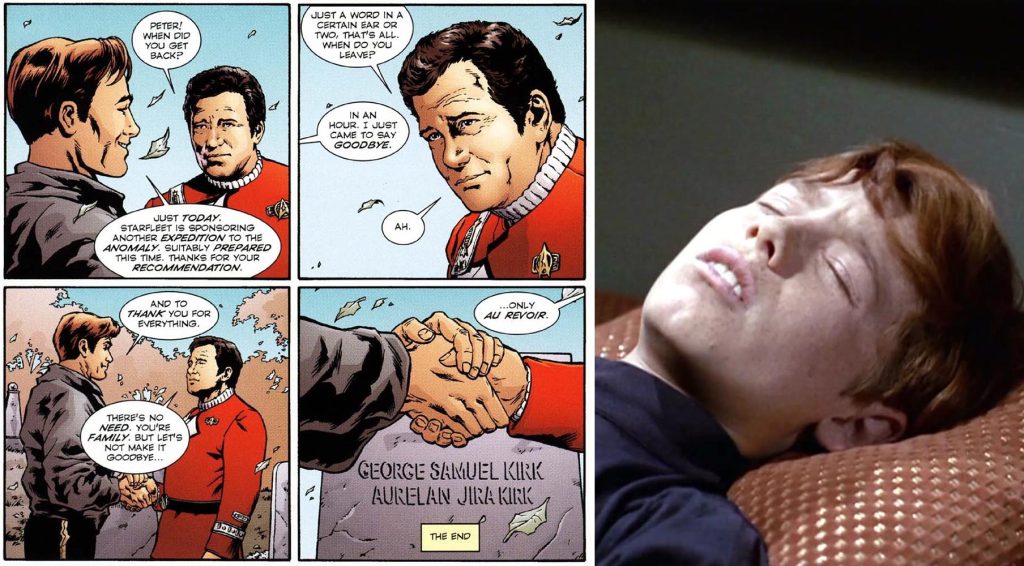
Kirk recalls that he’d considered quitting Starfleet after his brother’s death so he could raise Sam’s three sons, though he’d decided against it, believing they’d be better off with Aurelan’s sister (whom DC’s Star Trek Special #3 had named Riselle). Peter held a grudge, though his brothers—here named Marcus and Virgil, despite being called Brett and Robbie in DC’s Star Trek #74, then Adam and Jason in the DC special—accept it. Eventually, the two mend old wounds and together visit the graves of Peter’s parents.
Picard’s crew are the focus of “A Rolling Stone Gathers No Nanoprobes,” from Andy Mangels, Michael A. Martin, Paul Neary, and David A. Roach, and the title cleverly foreshadows the return of both the Hortas (“The Devil in the Dark”) and the Borg. The Collective, seeking out a carbon-silicone hybrid life form that doesn’t actually exist, attacks Lythos Prime, a mining world run by a partnership of humans and Hortas. In the century that has passed since the classic episode, the Janus VI team have expanded their operations to this ore-rich world, colloquially known as “Rockpile.”
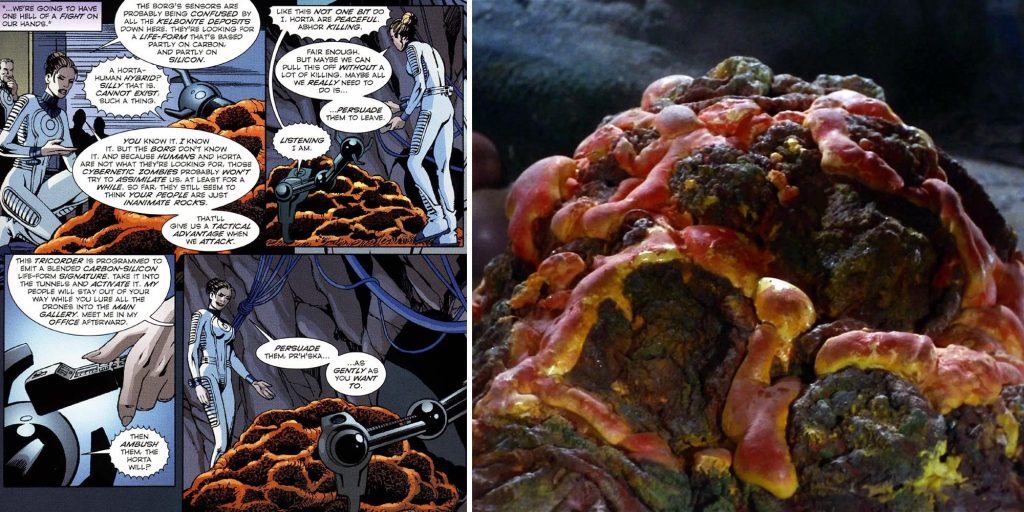
The story features a Horta named Pr’h’ska, another tribute to Janos Prohaska, and it’s a delight to read. Other than DC’s Lieutenant Naraht, the comics have rarely revisited the Hortas, and it’s fitting that this one would be named after the man who’d designed and portrayed the mother Horta. Other onscreen callouts include a Tzenkethi freighter (“The Adversary”) visiting Lythos Prime to stock up on pergium, as well as an appearance by Darey Hawk, a brother of Star Trek: First Contact‘s Lieutenant Hawk, who also showed up in the Mangels-Martin Section 31 novel Rogue.
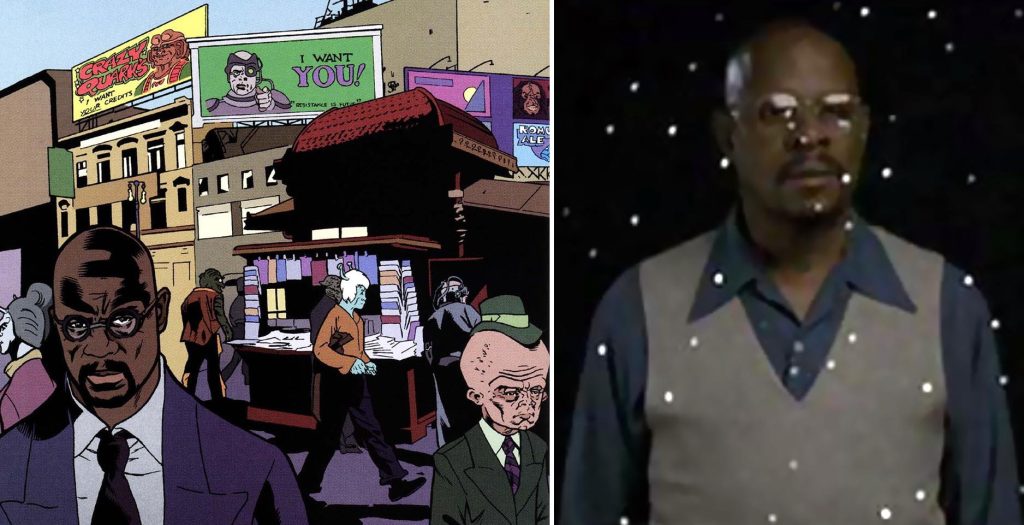
Story #3, “When the Stars Come A-Calling,” involves Deep Space Nine, but in a unique way that hits all the right notes. Written by Ben Raab, with art by John Lucas, this illustrated prose tale brings back Benny Russell, Ben Sisko’s fictional Prophet-inspired identity from “Far Beyond the Stars.” It’s particularly effective when read through a 2020s lens, given the rampant racism and violence that has erupted in the United States since 2016.
Russell was a black writer frustrated at his inability to sell stories during the pre-Civil Rights era. He’s beaten due to his skin color, then experiences visions of Klingons, Borg, Ferengi, and other aliens he’s never before seen. Thus inspired, he pens an extraordinary science fiction tale and submits it to several magazines, which praise his work but reject him upon learning he’s a person of color. Finally, Benny lands a job with the episode’s Incredible Tales, whose staff welcomes him despite his differences. The fact that this story still resonates so strongly is tragic, as it highlights how little has truly changed.
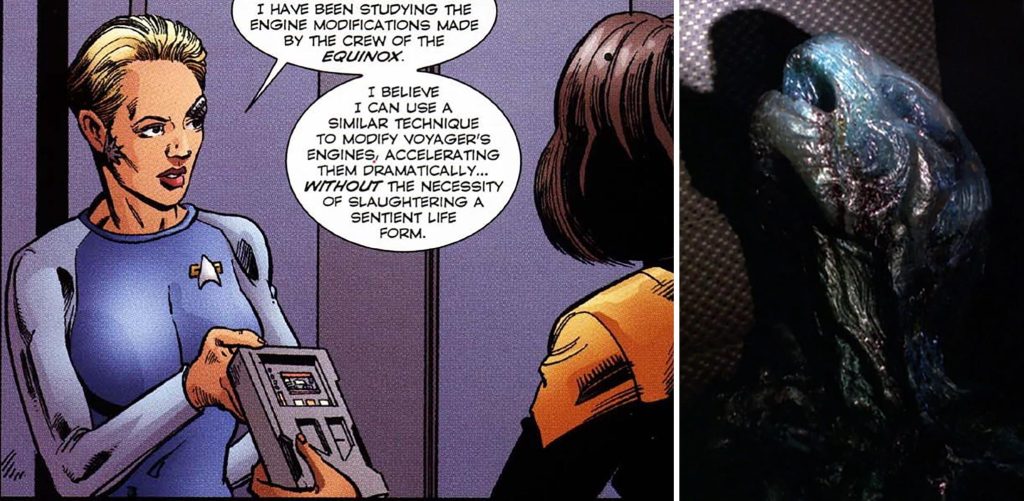
Seven of Nine takes center stage in the inventive Voyager tale “Exercises in Futility,” from Stuart Moore, Gordon Purcell, and John Stanisci. Seven simulates various methods of getting the Voyager to Earth within mere months, including subspace shortcuts and artificial wormholes. However, each solution leaves the starship worse off—stranded without propulsion or even destroyed—and she elects not to mention any of it.
Though mostly standalone, this story ties in with Voyager‘s “Equinox.” In that episode, Janeway’s crew encountered the USS Equinox, another Federation starship tossed into the Delta Quadrant by the Caretaker, whose crew had done the unthinkable: slaughtering another species to fuel their starship. One of Seven’s failed simulations attempts to recreate the engine modifications made to the Equinox, but thankfully without murdering sentient life forms.
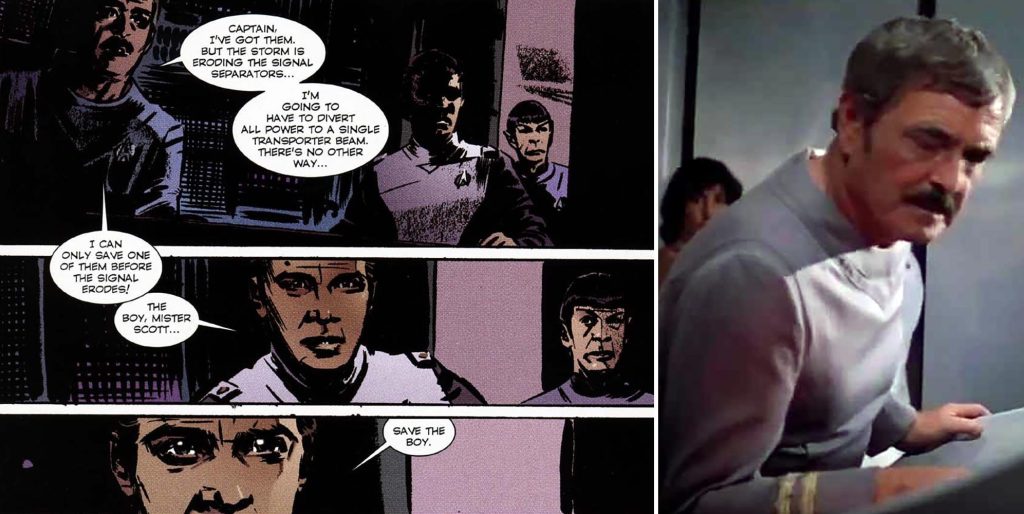
The fifth chapter, an emotional Next Generation tale from Christopher Hinz and Tommy Lee Edwards called “The Legacy of Elenor Dain,” contains no tie-ins to onscreen Trek, though flashbacks take place during Kirk’s post-The Motion Picture five-year mission. The Enterprise-D studies the aftermath of a radiation storm and finds the remains of artist Elenor Dain, whom Kirk’s officers had failed to evacuate decades prior. In caves, they discover tons of artwork she’d created during her isolation. Her work is put on display in a museum, and her orphaned son, now an old man, attends the unveiling.
The sixth story, on the other hand, connects to multiple episodes and films… and it’s a tear-jerker. Jeffrey Lang’s “The Wake,” illustrated by Steve Lieber and set between Generations and First Contact, stars a sick, bedridden Leonard McCoy. Montgomery Scott visits the good doctor, now 144 years old and awaiting death. “Encounter at Farpoint” had revealed McCoy to be alive at the time of The Next Generation, and as this story reveals, he’s still around in 2371, making him old even by 24th-century standards.
The two commemorate Kirk’s death on Veridian III (Generations) and discuss plans to reunite their shipmates, though both know Leonard has little time left. Sometime later, Spock, on temporary leave from Romulus (“Unification”), visits as well so he can bid farewell to friends both deceased (Kirk) and dying (Bones). The closing shot, though ambiguous, seems to show McCoy’s final moments of life, and it’s quite powerful.
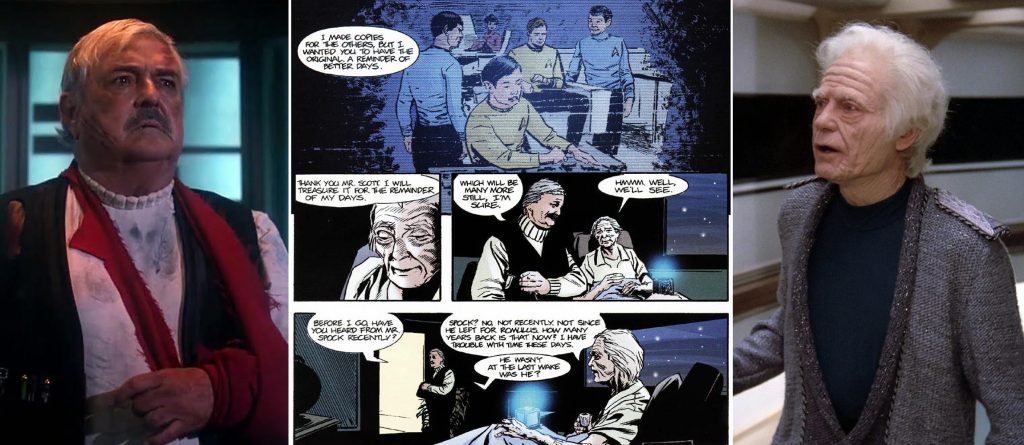
In a poignant tribute to The Original Series, Scotty gives his dying friend a hologram of their younger years when they served together aboard the Enterprise. Though born five years before the ol’ county doctor, Scotty is now half his age, thanks to the quarter-century he’d spent spooling in a transporter buffer, per “Relics.” Following that episode’s events, he’d grown tired of wandering the galaxy, so Starfleet assigned him to a shipyard, where he’d helped to design the Enterprise-E, featured in First Contact, Insurrection, and Nemesis. Apparently, Scotty’s gotten past his aversion to lettered Enterprises.
The Star Trek Special was supposed to contain a seventh story, which this column’s author was slated to write until a last-minute page-count reduction precluded its inclusion. I’d pitched two concepts: “The Barber of Seville,” spotlighting Mot the Bolian hairstylist, and “The Needs of the One,” featuring Spock and the Romulan underground. Mariotte liked both ideas and was still deciding which to commission when word came down of a financial need to cut one story. As the last invited, I was the logical choice to be nixed… but a certain budding young writer was one sad yeoman that day. (IDW: call me!)
Our WildStorm discussion will continue next week with two Picard-centric miniseries: Perchance to Dream and The Killing Shadows. Make it so.
Looking for more information about Star Trek comics? Check out these resources:
- My ongoing column for Titan Books’ Star Trek Explorer magazine
- The Complete Star Trek Comics Index, curated by yours truly
- The Star Trek Comics Checklist, by Mark Martinez
- The Wixiban Star Trek Collectables Portal, by Colin Merry
- New Life and New Civilizations: Exploring Star Trek Comics, by Joseph F. Berenato (Sequart, 2014)
- Star Trek: A Comics History, by Alan J. Porter (Hermes Press, 2009)
- The Star Trek Comics Weekly page on Facebook
Rich Handley has written, co-written, co-edited, or contributed to dozens of books, both fiction and non-fiction, about Planet of the Apes, Watchmen, Back to the Future, Star Trek, Star Wars, Battlestar Galactica, Hellblazer, Swamp Thing, Stargate, Dark Shadows, The X-Files, Twin Peaks, Red Dwarf, Blade Runner, Doctor Who, Buffy the Vampire Slayer, Batman, the Joker, classic monsters, and more. He has also been a magazine writer and editor for nearly three decades. Rich edited Eaglemoss’s Star Trek Graphic Novel Collection, and he currently writes articles for Titan’s Star Trek Explorer magazine, as well as books for an as-yet-unannounced role-playing game. Learn more about Rich and his work at richhandley.com.
2 thoughts on “Star Trek Comics Weekly #67”
Comments are closed.