
An ongoing discussion of how the comics provide prequels, sequels, and tie-ins to the Star Trek episodes and films, soon to be a book from BearManor Media. Click here to view an archive of this article series.
50: Marvel Comics, 1996–1997
This week, the 50th installment of this column fittingly celebrates a landmark event: Marvel Comics’ return to the fold following a fourteen-year absence. DC Comics’ sister-titles based on The Original Series and The Next Generation had proved popular with readers, as had Malibu Graphics’ Deep Space Nine spinoff. Despite this, all three abruptly ended at the end of 1995, which came as a shock to readers and the publishers alike. The reason? Paramount Pictures had opted to create its own publishing imprint, Paramount Comics, in cooperation with Marvel. The entire Trek comics license thus reverted to Marvel in 1996.
Marvel hit the ground running with five ongoing series: the bimonthly Star Trek Unlimited, as well as monthly titles Deep Space Nine, Voyager, Starfleet Academy (starring DS9‘s Cadet Nog), and Early Voyages (chronicling the missions of Christopher Pike’s Enterprise crew pre-Kirk). In addition, the publisher produced several one-shots, including crossovers with its X-Men franchise, plus Untold Voyages, a miniseries set between Star Trek: The Motion Picture and Star Trek II: The Wrath of Khan. We’ll get to all of these in the months ahead, but for now, let’s examine the first five issues of Star Trek Unlimited, which offered prequels, sequels, and tie-ins aplenty to onscreen Trek.

The Original Series and The Next Generation, rather than each having its own monthly title, were packaged together as the ten-issue Unlimited. Dan Abnett and Ian Edgington wrote all but the final issue (penned by Michael Martin and Andy Mangels), with a rotating lineup of artists that included award-winning cartoonist Al Williamson. Other artists for issues #1–5 included Mark Buckingham, Derek Fisher, Carlos Garzon, Jerome K. Moore, Tom Morgan, Ron Randall, and Kevin F. Sutherland. This same bullpen of illustrators also created the impressive covers—and Buckingham and Sutherland even gave Scotty the mustache he sports in The Motion Picture.
In issue #1’s “Directives,” the Enterprise-D visits Endrella to establish first contact, and the crew finds the technologically advanced Lom Coalition creating an artificial global disaster—not out of malice, but merely to help the Endrel develop and thrive. This presents a philosophical conundrum for Jean-Luc Picard, for despite their peaceful motives, the Lom’s methods are diametrically opposed to the Prime Directive.
Starfleet’s non-interference directive has been much discussed, often divisively. Some view the choice to let planets develop naturally as an altruistic effort to avoid cultural contamination, while others consider it selfish and shortsighted. The Lom, more akin to Babylon 5‘s Shadows than its Vorlons, would presumably fall into the latter category. Disturbed by the Coalition’s method of manipulating evolution, Picard faces the difficult choice of whether to intercede. Deanna Troi pointedly reminds him of a similar choice the Preservers (“The Chase”) had made when they’d manipulated the DNA of all humanoid species millennia ago. Such lofty discussions are the franchise’s bread and butter—and in this case, Picard is left feeling rather toasted.

The second story, “Dying of the Light,” provides a compelling sequel to “Arena.” A human archeologist, convinced that Gorn evolution parallels how Earth dinosaurs would have fared had they not gone extinct, raids a cemetery planet to obtain remains for study. The Gorn accuse the Federation of defiling sacred ground and nearly go to war over it, but James T. Kirk defuses the situation by using Norse funeral traditions to honor the defiled remains. Kirk encounters his old Gorn enemy from “Arena,” who is here named S’alath (other licensed stories have called him S’salk, Arijog, Rheuzz’r, and S’slee). Impressed by Kirk’s actions, S’alath extends a hand of friendship, providing a satisfying coda that mirrors Kirk’s decision in that episode to spare his enemy.
Issue #2’s “Action of the Tiger” sees Kirk and Pavel Chekov attending a Starfleet summit to discuss recent Klingon activities, and the former Commodore (now Admiral) Stone presides over the conference. Despite having already forgiven Stone for the man’s role in his trial during the Ben Finney affair (“Court Martial”), Kirk finds being in his presence uncomfortable—and really, who could blame him?

Rogue Klingons infiltrate the base and hold attendees hostage in order to spark a Federation-Klingon war, but Kirk and an Academy buddy, Ted Horner, defeat the would-be conquerors and expose a traitor among Starfleet’s ranks. Commander Kor (“Errand of Mercy”) arrives in time to gleefully execute the rogue warriors, and the all-too-brief appearance by Kirk’s frequent frenemy is pitch-perfect, with John Colicos’s smarmy yet predatory delivery coming through in each line. Readers learn that Horner had helped Jim cheat on the Kobayashi Maru test, mentioned in The Wrath of Khan and depicted in Star Trek (2009), as well as in DC’s Starfleet Academy annual.

“The Unkindest Cut” grants Picard’s crew a shore leave at Risa (“Captain’s Holiday”), where the Enterprise loads up on medical supplies. Will Riker’s eagerly anticipated sexual escapades are put on hold when an invisible assassin sabotages the starship with hidden explosives and a computer virus in an attempt to murder Mot, the starship’s blabbermouthed Bolian barber, for the crimes of his pirate uncle. As a result, Riker’s jamaharon-seeking libido is left as blue as Mot’s face.
While on Risa, Troi purchases Tholian silk from a street vendor—a surprising turn of events, since the Tholians’ xenophobic nature (displayed in both “The Tholian Web” and “In a Mirror, Darkly”) should preclude their trading silk outside the Assembly or visiting a galactic resort world. In any case, it’s fortuitous that Troi does so, for when a professional killer targets Mot, Geordi La Forge combines the highly conductive silk with his VISOR’s power cell to rig up a clever trap and electrocute the assassin.

Nyota Uhura leads a mission in issue #3’s “Message in a Bottle.” The shuttlecraft Columbus traverses a wormhole to a small pocket universe that turns out to be sentient, and Uhura assumes command when Kirk is injured. The dimension is one giant life form—a fascinating concept that would have benefitted from a greater story length—and its attempt to communicate with the larger universe destroys the shuttle, leaving the crew stranded in EVA suits. A fellow officer blames Uhura, serving the same role as the bigoted Boma in “The Galileo Seven.” Bigotry does not seem to be a motivation in this case, though, for Uhura’s antagonist resents her not for her gender or skin color, but rather her lack of command experience.
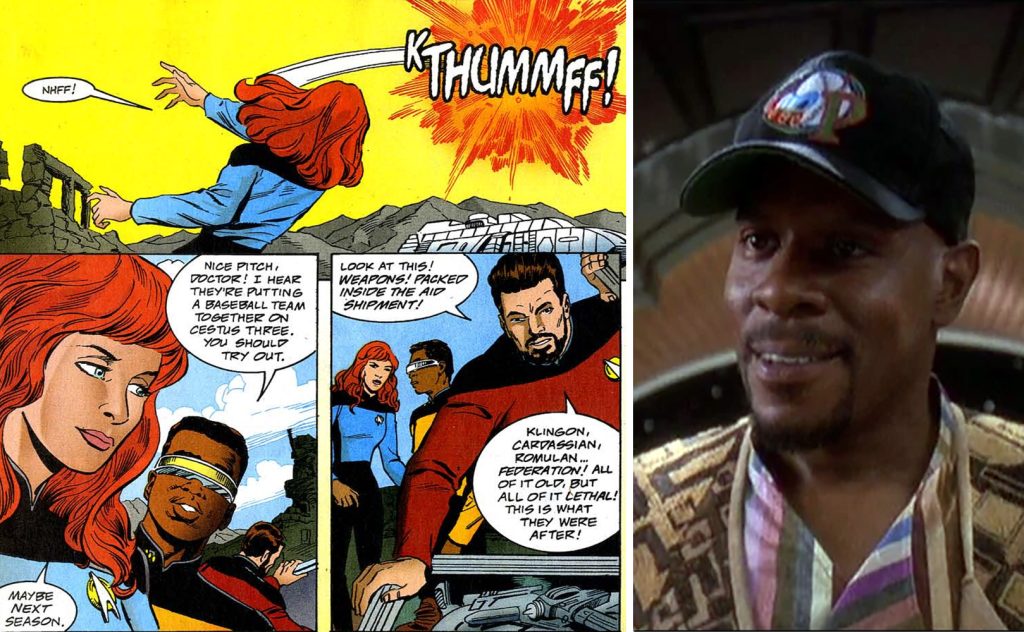
Meanwhile, in “Sins of the Fathers,” Picard arbitrates on a world marked by centuries of ethnic feuding. The only episode connection lies in a joke on La Forge’s part: after Beverly Crusher lobs a grenade to save an away team, he suggests the doctor join a newly formed baseball team on Cestus III (the Gorn-held world in “Arena”). By the time of Deep Space Nine‘s “Family Business,” colonists there had formed a league consisting of six teams. How the Gorn would feel about that is unknown, but let’s hope the Xenomorph-like Gorn from Star Trek: Strange New Worlds don’t attend the games, because it wouldn’t be peanuts and Cracker Jacks they’d eat.
Issue #4 features a pair of connected tales centered around the Romulan Empire, spanning two generations of Star Trek and three generations of Leah Brahms’ family. La Forge had created an idealized holographic version of Leah in “Booby Trap,” then had encountered the actual Brahms in “Galaxy’s Child,” only to realize she was different than how he’d imagined her to be—and that she was married.

In “None But the Brave,” a Romulan commander attacks the Enterprise to avenge her sister, who’d been disgraced when Kirk had stolen her cloaking device (“The Enterprise Incident”). This character’s name was not provided on TV, though licensed sources have alternately dubbed her Di’on Charvon, Nevesa, Thea, and Liviana Charvanek. (She remains unnamed here, though her sister is called Mirek.)
Scotty, meanwhile, goes undercover to infiltrate a Romulan depot and retrieve the captured USS Confederate—a starship name that has really not aged well, particularly following the Jan. 6 domestic terrorist attack on the U.S. Capitol—which had been testing an experimental propulsion system invented by Virgil Brahms, Leah’s grandfather. With the starship damaged, Scotty rigs it to collapse into a spatial rift. A century later, in “Inheritance,” La Forge attends Leah’s lecture on her granddad’s never-finished warp accelerator, and she asks Geordi to help her continue Virgil’s work.

Commander Tomalak (a frequent foe of Picard’s crew, appearing in “The Enemy” and other episodes) kidnaps the two engineers and orders them to complete the accelerator, but Leah sabotages the Confederate rather than let the device fall into Romulan hands. Fully expecting to die, Leah and Geordi share a passionate kiss despite her being married, which proves awkward once the Enterprise rescues them, though it sets the stage for their future romance in “All Good Things…”—which may or may not have resulted in Geordi’s two daughters from Star Trek: Picard season three.
Disturbing visions are a frequent Trek trope, and issue #5’s “Secret Lives” continues that tradition. Stories like this are always fun because fear is such a powerful motivator; knowing what scares our favorite characters affords insight into what makes them tick as individuals. In “Secret Lives,” the Federation loses contact with a deep space array, the Enterprise crew discovers mutilated bodies on the station, and a virus causes them to envision their worst fears coming true.
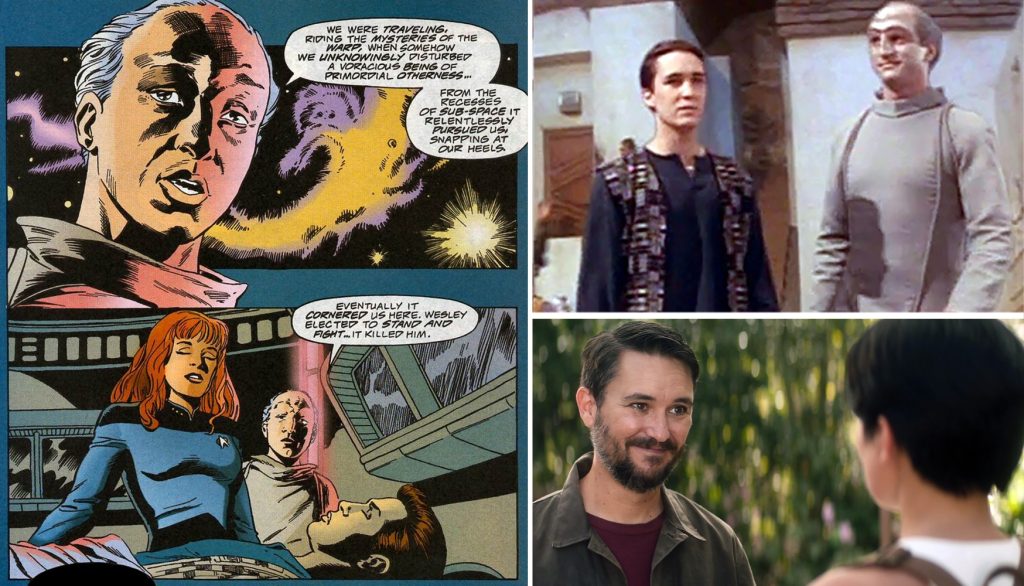
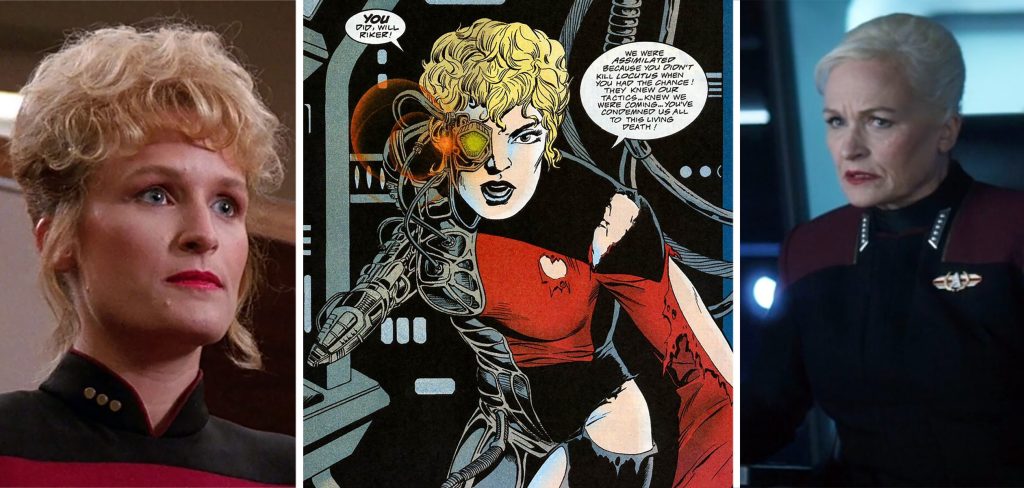
The visions include the Traveler (“Where No One Has Gone Before”) informing Beverly that Wesley was killed by a subspace entity following “Journey’s End,” a fate recently nullified by Wes’s return in Picard season two’s “Farewell,” when he was revealed to be not only a Traveler himself, but also a Supervisor (“Assignment: Earth”). Riker, meanwhile, experiences a Borgified Elizbeth Shelby (“The Best of Both Worlds”) accusing him of condemning the Federation to assimilation. By eerie coincidence, Shelby almost caused this very outcome in Picard season three’s “Võx.” And Worf imagines his son Alexander arranging his assimilation to avenge K’Ehleyr’s death (“Reunion”).
Finally, in “As Flies to Wanton Boys,” the shuttle Armstrong crashes while exploring an ancient structure. Starfleet orders the Enterprise to evacuate an endangered colony, but Spock delays departure to search for his comrades. He encounters the Monitor, an artificial intelligence whose people were slain by savage marauders called the Xhosa. They’d been artificially engineered millennia prior, using the genetic material of various species, including Gorns—because in Star Trek, scientists are prone to doing remarkably stupid things, the likes of which Jurassic Park has been warning us about for years. In any case, Starfleet should really stop handing out shuttles, because the only character more likely to crash a ship than Star Trek‘s various casts is Space: 1999‘s Alan Carter.
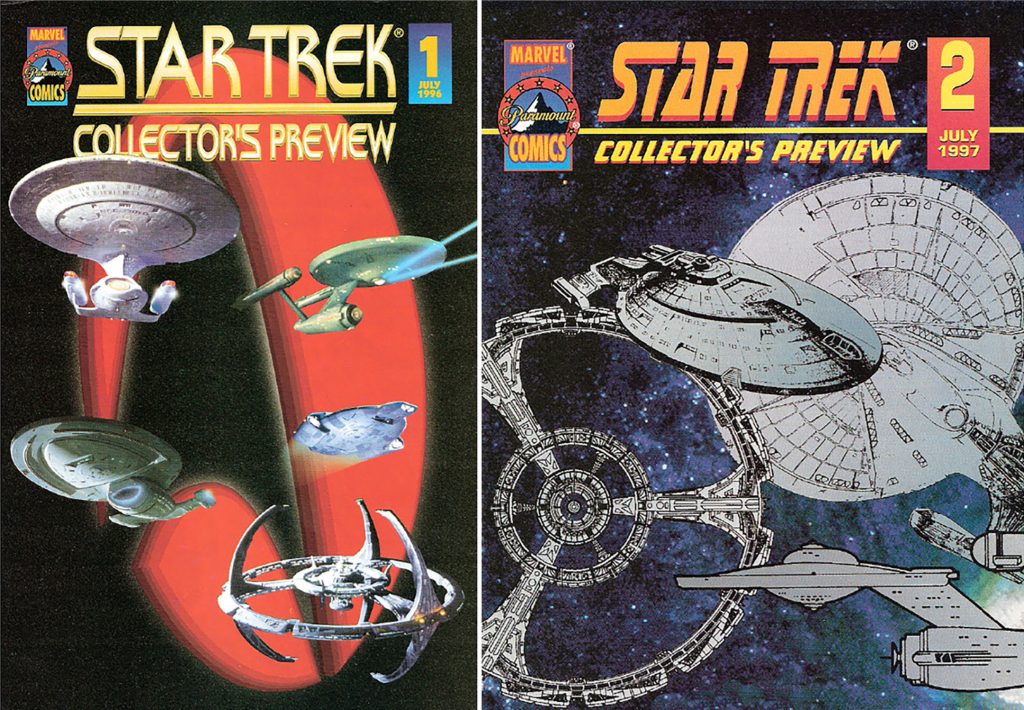
A pair of preview ashcans, distributed at the 1996 and 1997 San Diego Comic Cons, also announced Star Trek: Phase 3, “an all-new series with an all-new ship, an all-new crew, and all-new adventures.” Two others, Star Trek: Realities and a spinoff of The Animated Series, were in the works as well. Unfortunately, none of these saw the light of day, and the company retained the license for only a year a half before its Star Trek titles were all canceled, several without concluding their engaging storylines. Phase 3 will be discussed in more detail in an upcoming column.
Marvel’s output had been top-notch, so this abrupt cancelation of everything was just as surprising as it had been when DC and Malibu left the playing field. It could be that the market was simply too saturated, with so many Star Trek comics at once, to sustain the financial burden on collectors. Whatever the reason, given the high quality of Unlimited and other titles, it’s a shame Marvel’s return was so short-lived. Our Marvel discussion will continue next week with Deep Space Nine; the publisher picked up where Malibu had left off and, like its predecessor, it did the series proud.
Looking for more information about Star Trek comics? Check out these resources:
- My ongoing column for Titan Books’ Star Trek Explorer magazine
- The Complete Star Trek Comics Index, curated by yours truly
- The Star Trek Comics Checklist, by Mark Martinez
- The Wixiban Star Trek Collectables Portal, by Colin Merry
- New Life and New Civilizations: Exploring Star Trek Comics, by Joseph F. Berenato (Sequart, 2014)
- Star Trek: A Comics History, by Alan J. Porter (Hermes Press, 2009)
- The Star Trek Comics Weekly page on Facebook
Rich Handley has written, co-written, co-edited, or contributed to dozens of books, both fiction and non-fiction, about Planet of the Apes, Watchmen, Back to the Future, Star Trek, Star Wars, Battlestar Galactica, Hellblazer, Swamp Thing, Stargate, Dark Shadows, The X-Files, Twin Peaks, Red Dwarf, Blade Runner, Doctor Who, Buffy the Vampire Slayer, Batman, the Joker, classic monsters, and more. He has also been a magazine writer and editor for nearly three decades. Rich edited Eaglemoss’s Star Trek Graphic Novel Collection, and he currently writes articles for Titan’s Star Trek Explorer magazine, as well as books for an as-yet-unannounced role-playing game. Learn more about Rich and his work at richhandley.com.
2 thoughts on “Star Trek Comics Weekly #50”
Comments are closed.