
An ongoing discussion of how the comics provide prequels, sequels, and tie-ins to the Star Trek episodes and films, soon to be a book from BearManor Media. Click here to view an archive of this article series.
51: Marvel Comics, 1996–1997
The Star Trek comic book rights reverted to Marvel in 1996, but thanks to the swift handover from prior license holders DC and Malibu, there was little downtime without the arrival of new issues. Only nine months passed from the end of the Malibu-DC era to Marvel’s relaunch, which is a month less than the amount of time readers had waited between the conclusion of DC’s first Trek title in 1988 and the debut of its second in 1989. That may have seemed like a lot at the time (nine months without new Star Trek can be an eternity), but in retrospect it was just a drop in the space-bucket.
For Benjamin Sisko fans, the loss of the Malibu line when it was getting great definitely stung, but Marvel soon launched a new monthly Deep Space Nine title that helped to fill the void. Sweetening the pot, the publisher hired Howard Weinstein, a prolific novelist who’d penned a sizable mound of Trek lore for both DC and Pocket Books. Weinstein’s prior comics work had starred James T. Kirk and Jean-Luc Picard, but he proved equally adept at capturing the voices of Sisko’s crew; the subtle nuances of their interactions and the station they inhabited; and the geopolitical quagmire involving the Bajorans, the Cardassians, the Maquis, and the Dominion.

This week, we’ll examine the first seven issues of Marvel’s Deep Space Nine in terms of how the publisher approached sequels, prequels, and tie-ins to televised Star Trek—which were admittedly sparse during this particular span of tales. Weinstein wrote only four issues (#1, 2, 6, and 7), with Mariano Nicieza penning the scripts to the three in between. Tom Grindberg and Al Milgrom illustrated each issue’s interior and also contributed beautiful cover art, with Bobbie Chase and Tim Tuohy handling editorial chores. These stories were set during the show’s fourth season.
Though these issues avoided offering direct sequels to specific episodes, they did feature notable TV connections, chief among them the inclusion of Kai Winn, Gul Dukat, and Elim Garak in their usual respective roles as fanatical foil, frenemy soldier, and enigmatic tailor-spy. They also mined Cardassia’s war with the Klingon Empire that dominated much of the season, following the Klingons’ invasion of Cardassian space.

The Cardassian government was weakened as a result of the war, leaving it vulnerable to the Dominion and their Jem’Hadar troops during the Changelings’ Alpha Quadrant infiltration. Weinstein built off this in his first story, “Judgment Day,” in which Jem’Hadar ships pursue Amaralan vessels from the Gamma Quadrant and an energy wave pulls Deep Space Nine through the wormhole (yes, the comics actually saw the station itself undertaking wormhole travel, something that would have been exciting to see play out on TV). One Amaralan claims DS9 has been stolen by a mystical force called the Firewind, which seeks to scour the universe of all evil, but despite this intriguing setup, the Firewind’s nature remains an unaddressed mystery.
In the author’s other two-parter, “Risk,” the Defiant‘s sensors seemingly cause an alien pod to implode. The Shirn Alliance arrests Sisko for the death of a scientist who’d been testing a conduit-based propulsion system, but another scientist admits his people face societal unrest, with Sisko a scapegoat intended to distract the masses. Ben is naturally found guilty and sentenced to death, but O’Brien proves the conduit and pod weren’t actually destroyed—they merely shifted out of phase—and retrieves the lost pilot.

“Risk” is the stronger of these tales, despite the foregone conclusion of Sisko being set free, and the idea of an interstellar teleportation system via conduits would have been fascinating to explore as a successor of sorts to the failed soliton wave experiments conducted in The Next Generation‘s “New Ground.” One gets the feeling that had Weinstein remained with the comic longer, he may have had grander plans for both the Firewind and the conduit technology. Alas, we may never know.
Nicieza’s issues tie in with several TV episodes (while providing no full-on sequels), starting with “The Cancer Within” in issues #3 and 4. In the Badlands—a dangerous spatial expanse marked by gravitational anomalies and plasma storms, featured in Deep Space Nine‘s “The Maquis” and later in Voyager‘s pilot, “Caretaker”—the Maquis genetically engineer a virus to drive Cardassians from their home worlds. The illness soon spreads to other species, and a plague ship brings it to Deep Space Nine, where Kira Nerys, Jake Sisko, and others quickly succumb to the contagion.
The frequent use of fast-spreading viruses as a plot device on Star Trek and in other franchises seems a lot less science-fictiony these days. Writing an article discussing a fictional global pandemic during a real-world global pandemic is off-putting, and I’m sure reading one is, too. [UPDATE: So you can imagine what it’s like to be archiving and updating said article while actually having the virus in question. Not fun, let me tell you.] Still, despite COVID-19 making comic book plagues seem less disturbing than they once seemed, this story works well—partly because one member of the Maquis cell is Jackie Pulaski, the daughter of Katherine Pulaski, Picard’s chief medical officer during The Next Generation‘s second season.

Another daughter for Pulaski, Terry Oliver, had been introduced in DC’s The Next Generation‘s issues #39–44. No mention here is made of Terry, but that need not be perceived as discontinuity, for according to “The Icarus Factor,” Kate was married and divorced three times before serving aboard the Enterprise-D. Jackie and Terry might simply have different fathers, which would explain their separate surnames. Jackie seeks her mother’s help in finding a cure, then ends up infected herself, adding a personal motivation for the good doctor to endanger her career by working with terrorists.
As expected, Julian Bashir and the elder Pulaski create a vaccine to stem the virus’s spread in record time. If only they could have done the same for COVID-19—ah, but then, they have leaders who understand science, care about the population, and respect the truth. Mother and daughter both stand trial for assisting the Maquis, though it’s doubtful that crotchety Kate, as a main character, would remain on the wrong side of the law for long (Ro Laren, Thomas Riker, Tom Paris, Gabriel Lorca, and Agnes Jurati notwithstanding).
By story’s end, a Cardassian faction operating out of a hidden base on Bajor hatches a deadly scheme that sets up the third chapter, issue #5’s “The Shadow Group.” The titular group bombs Deep Space Nine’s Promenade, injuring Dukat’s half-Bajoran daughter Tora Ziyal (from “Indiscretion” and other episodes) and decimating Quark’s bar. They then attempt to destroy the entire station in a second attack—which they thankfully fail to do, or else that would be the end of the series and this column.
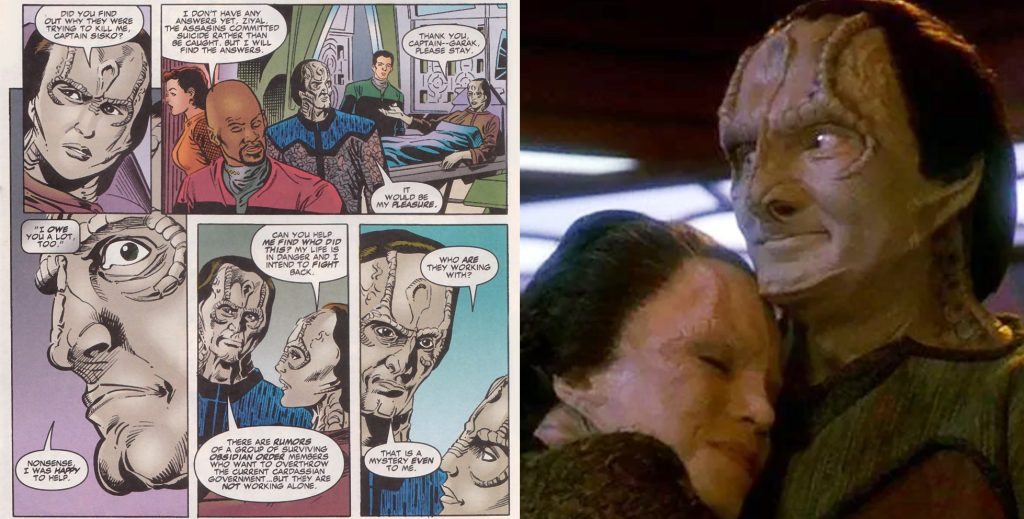
Ziyal, Garak, and Kira discover that the group is led by a terrorist named Zoal, with whom Kira had once served in the Bajoran resistance and who now works with the Alliance for Global Unity (a.k.a. the Circle), an extremist group featured in “The Homecoming,” “The Circle,” and “The Siege.” Members of the Circle have formed an unlikely alliance with former operatives of the Obsidian Order, Cardassia’s insidious intelligence agency, in an effort to provoke a war between the Federation and the Cardassian Union by staging terrorist attacks while posing as Maquis agents.
The Circle’s return is largely glossed over. In fact, it’s mentioned only in a single panel, so it’s easy to miss Zoal’s affiliation with that group if one is reading quickly. It’s a shame Marvel didn’t allot more issues to this story, as the concept of the Shadow Group—Bajoran radicals working alongside the very spies and assassins who’d once helped to oppress, enslave, and kill them by the millions—is compelling. The story would have benefitted from multiple issues in which the writer could have developed it more fully.
Concurrent with its Deep Space Nine title, Marvel became the first company to release comics based on Star Trek: Voyager. We’ll begin exploring that series next week, after which we’ll delve into Marvel’s Starfleet Academy, Early Voyages, and more. We’re trekking through the house of Stan Lee at warp one, so stay tuned.
Looking for more information about Star Trek comics? Check out these resources:
- My ongoing column for Titan Books’ Star Trek Explorer magazine
- The Complete Star Trek Comics Index, curated by yours truly
- The Star Trek Comics Checklist, by Mark Martinez
- The Wixiban Star Trek Collectables Portal, by Colin Merry
- New Life and New Civilizations: Exploring Star Trek Comics, by Joseph F. Berenato (Sequart, 2014)
- Star Trek: A Comics History, by Alan J. Porter (Hermes Press, 2009)
- The Star Trek Comics Weekly page on Facebook
Rich Handley has written, co-written, co-edited, or contributed to dozens of books, both fiction and non-fiction, about Planet of the Apes, Watchmen, Back to the Future, Star Trek, Star Wars, Battlestar Galactica, Hellblazer, Swamp Thing, Stargate, Dark Shadows, The X-Files, Twin Peaks, Red Dwarf, Blade Runner, Doctor Who, Buffy the Vampire Slayer, Batman, the Joker, classic monsters, and more. He has also been a magazine writer and editor for nearly three decades. Rich edited Eaglemoss’s Star Trek Graphic Novel Collection, and he currently writes articles for Titan’s Star Trek Explorer magazine, as well as books for an as-yet-unannounced role-playing game. Learn more about Rich and his work at richhandley.com.
One thought on “Star Trek Comics Weekly #51”
Comments are closed.