
An ongoing discussion of how the comics provide prequels, sequels, and tie-ins to the Star Trek episodes and films, soon to be a book from BearManor Media.
44: DC Comics, 1995–1996
When DC launched its first monthly Star Trek line in 1984, the franchise took an exciting step forward. The L.A. Times strips featuring James T. Kirk, other than a few off-kilter storylines, had done an admirable job of capturing the tone of The Original Series and the first two theatrical films. Other efforts from Gold Key Comics, Peter Pan Records, Marvel Comics, and the British publishers sometimes missed the mark, but DC’s creators produced something immediately wonderful that outshone them all. For the first time, the comics were truly doing justice to Jim Kirk and his crew.
So it’s bittersweet that this column’s discussion of Star Trek comics as sequels, prequels, and tie-ins has at last reached the closing installments of DC’s second Kirk-era book. From writer Mike W. Barr to Kevin J. Ryan, from artists Tom Sutton and Ricardo Villagrán to Rachel Forbes-Seese and Pablo Marcos, and from editor Marv Wolfman to Margaret Clark, DC’s efforts were nothing short of spectacular. DC’s successors (Malibu, Marvel [reborn], WildStorm, Tokyopop, and IDW) have all produced highly enjoyable Star Trek lore as well, but there was a consistent magic to DC’s approach. This week, we’ll examine monthly issues #76–80, along with Star Trek Special #3.

Kevin J. Ryan, the final writer on the series, had previously penned issues #62–64, as well as editing Pocket Book’s licensed novels. His last five issues, comprising standalone tales in #76 and 77 and a three-parter in #78–80, once again demonstrated Ryan’s knack for writing thought-provoking Star Trek fiction—and for mining episodes and films to create something both new and familiar.
This particular batch was set not in the movie era, but during the 1960s TV show. The cover to issue #76, from artist Jason Palmer, hinted at an appearance by Gary Mitchell (“Where No Man Has Gone Before”), whose return in flashbacks is always welcome in the comics. Gary’s presence among the crew, as well as the uniforms they wear, sets the narrative before Star Trek‘s second pilot, in which Mitchell was transformed into a godlike entity.

The Enterprise receives a first-contact invitation from the planet Tendar, where seven percent of the populace are jailed for life so the remaining citizens will never break laws. Kirk, Spock, and Mitchell are imprisoned without a trial or charges, but they escape back to their starship, where Kirk advises the Federation to declare the planet off-limits. If this concept sounds familiar, there’s a reason for it—and it involves the Edo. You see, the episode “Justice” had utilized a similar premise on Star Trek: The Next Generation.
In both tales, a civilization deemed suitable for first contact lives by draconian laws so absolute that all offenders receive the same harsh punishment in order to deter anyone else from breaking the rules. And when landing party members inadvertently violate a law, the Enterprise crew free their comrades, outrage the local government, and then leave the planet, intent on severing all contact. All that’s missing in the comic are a blonde, bland blend of wig-wearing nymphomaniacs and a cringeworthy portrayal of awkward teens playing catch while running only two feet apart from each other.

The next four issues each feature gorgeous covers by Peter Krause and Jerome K. Moore. The first story has no direct connections to any specific episodes or films, though it does involve a frequent nemesis of the Federation. The Enterprise investigates disrupted shipping lanes near the Neutral Zone, where a Romulan attack leaves each vessel disabled. When a third party is discovered invading both sides, Kirk and the Romulan commander cease hostilities and share resources.
Though standalone, the issue effectively serves as a preface for the final storyline, set three months later. The Enterprise answers a distress call from a Klingon colony on Tarnak II, which has been attacked by unknown forces bent on implicating Starfleet. Commander Kang (“Day of the Dove”) accuses Kirk of the deed, and the Enterprise‘s incursion into Klingon space sparks a diplomatic incident. The Klingons demand Kirk’s extradition, but Starbase 14 is seemingly attacked by Romulans, leaving 5,000 dead.
Romulan Commander Koram investigates the incident, which a Federation ambassador blames on the Tal Shiar, an elite intelligence agency introduced in The Next Generation‘s “Face of the Enemy.” However, the Romulans detect a transmission from the Enterprise to Meta IV, the ambassador’s home world, and her people are exposed as having tried to incite a three-prong war. Why? Due to their bizarre belief that only their planet contains life, meaning aliens cannot be real and are thus evil. Sure, that’s a wonky belief system that tosses observable facts out the window, but hey, that’s religious fundamentalism.
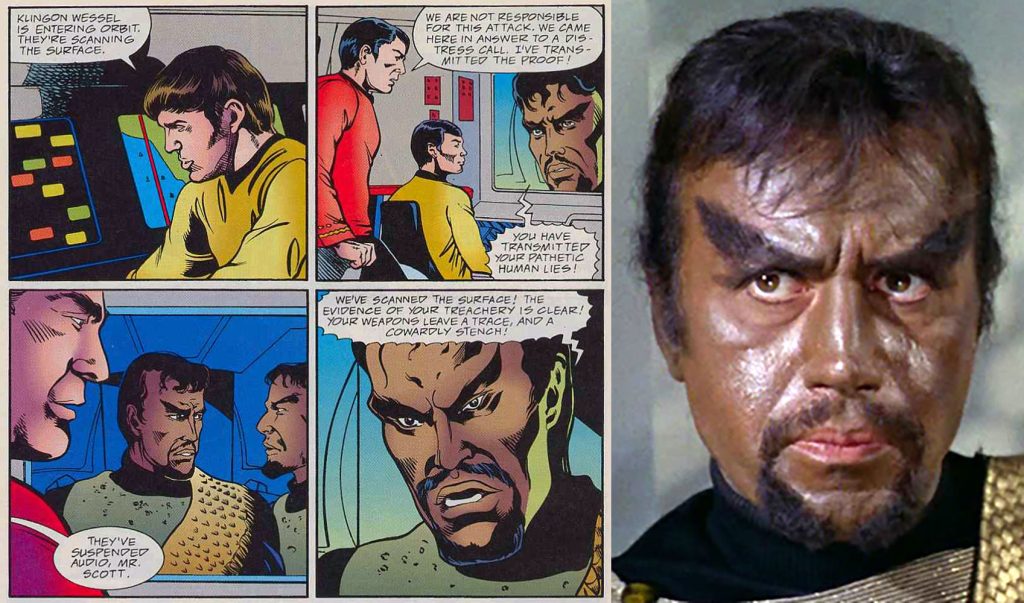
In “Day of the Dove,” a non-corporeal energy being had set Kirk’s and Kang’s crews against each other so it could feed off their emotions. Here, as during that prior meeting, an outside force manipulates both crews into battling by making each commander think the other has attacked a world in his territory. Once again, Kang halts activities when presented with evidence of a third party’s involvement, refusing to be manipulated into battling for the wrong reasons.
With war looming, McCoy suggests contacting the Organians, who’d interceded during a prior conflict in “Errand of Mercy.” Spock notes, however, that the Organians have not taken an active stance since that episode, making their response to the current situation unpredictable—and explaining why they never interceded in later onscreen conflicts. The story also calls back to The Animated Series‘ “The Counter-Clock Incident,” as Kirk recalls his cadet days when Robert April (the Enterprise‘s first captain, featured in that episode and now on Strange New Worlds) told him to “Go with your gut.”
There are also tie-ins to “The Tholian Web” and “Arena,” though neither stands up to close scrutiny. In attempting to determine who is trying to start a war, Spock suggests the Tholians or Gorns could be responsible. However, despite showing aggression when the Defiant entered their space, the Tholians were xenophobic and unlikely to wantonly attack others—at least, not until IDW’s Star Trek: Year Five, which we’ll get to in a later article. The Gorns, meanwhile, were not as aggressive as Kirk had initially thought (well, before Strange New Worlds‘ “Memento Mori” turned them into Aliens Xenomorphs). In “Arena,” they were merely protecting themselves against a perceived invasion. I guess Gold Key was right when it proclaimed that “to err is Vulcan.”

DC’s third Star Trek Special offered a pair of tales written by Michael Jan Friedman and Mark A. Altman, respectively, and it sported a stylish cover by Nicholas Jainschigg, showcasing Jim Kirk and his nephew Peter in peril. The first story, illustrated by Steve Erwin and Jimmy Palmiotti, is set during The Original Series, involving the three orphaned sons of Jim’s brother Sam (now a recurring character on Strange New Worlds) and his wife Aurelan.
When Sam was first mentioned in “What Are Little Girls Made Of?”, he was said to have three sons, but when he and his wife died in “Operation—Annihilate!”, only one son, Peter, was with the couple during the neural parasite invasion. Issue #74, published a few months before the Special, had named Sam’s other sons Brett and Robbie, but this comic identifies them as Jason (Jace) and Adam, and explains that they were living with their Aunt Riselle during the Deneva attack.
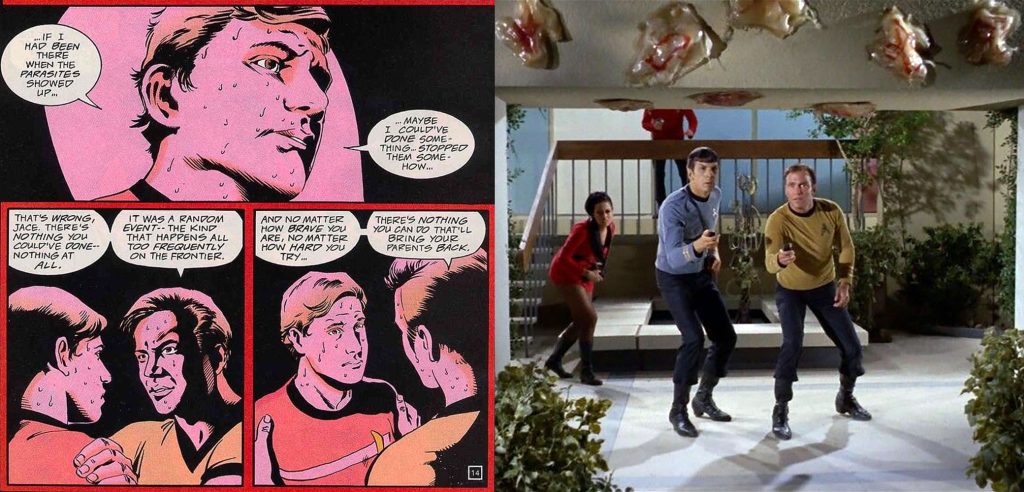
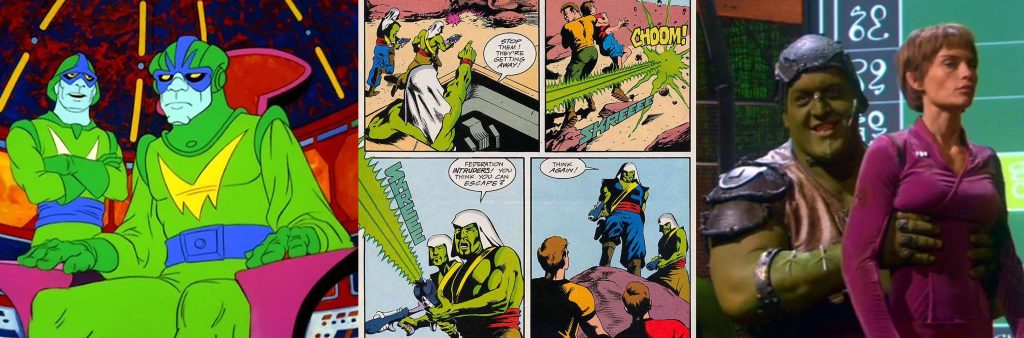
Despite the naming snafu, it’s a strong story. Kirk takes the boys on a camping trip, where Jace spots Orion pirates. These Orions look different than those introduced in The Animated Series‘ “The Pirates of Orion,” though by a fortuitous coincidence, they’re remarkably close to how Orion traders would be portrayed years later in Star Trek: Enterprise‘s “Borderland” and “Bound.” The four Kirks are captured but sabotage the pirates’ efforts, and Jason, in saving his brothers, puts aside the guilt he has harbored over having been away from Deneva when their parents perished.
Kirk’s nephews clearly idolize him, making this a charming tale. One asks about Jim’s first encounter with Romulans, and he describes the battle from “Balance of Terror,” recalling how he’d dealt with the Empire’s cloaking device and plasma weapon. He also touches on the events of “The Enterprise Incident” (skipping past classified aspects, of course), in which he and Spock stole a Romulan cloaking device.
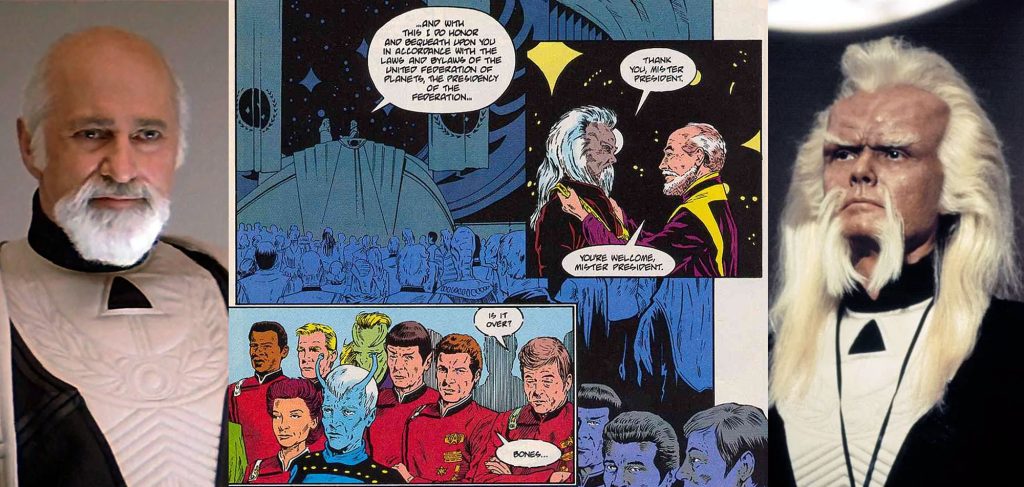
But it’s the second tale in the special, illustrated by Ken Save and Ron Boyd, that dives most deeply into onscreen lore. It once again involves Peter Kirk, with nearly 20 years having passed since Sam’s death. Sam perished in 2267, so the comic must occur circa 2287. Given the Presidential changeover from Star Trek IV: The Voyage Home‘s Hiram Roth to Star Trek VI: The Undiscovered Country‘s Ra-ghoratreii, the story evidently takes place between Star Trek IV and Star Trek V: The Final Frontier.
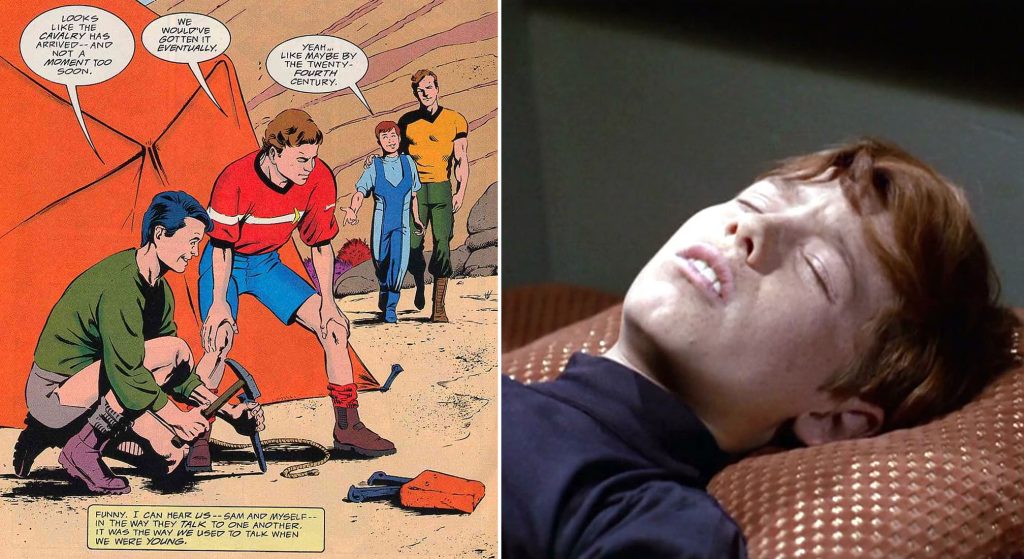
Peter, now an adult, accosts his Uncle Jim at the latter’s apartment. With him are two Sumellians, who extract the secret of time travel from Jim’s mind so Peter can save their people from extinction and stop the neural parasites from killing his parents. Starfleet orders the Enterprise crew to prevent Peter from altering history despite his noble motives, and Kirk’s nephew tragically dies without achieving either goal.
Present at the Presidential change of power is Admiral Cartwright, from Star Treks IV and VI. Ra-ghoratreii asks Cartwright whether he would allow history to remain unchanged if he knew billions could be saved from extinction. The question is a prescient one, given the admiral’s later efforts to eradicate the Klingon Empire when faced with the dilemma of whether to prevent a peace treaty or save the Empire from dying.

The story heavily mines other films and episodes as well—and things never end well for Kirk when it does. Sometime after Star Trek II: The Wrath of Khan, for example, Jim rekindles his physical relationship with Carol Marcus. While visiting San Francisco, he arranges a night alone with Carol, but the Sumellian plot forestalls any romance, leaving the admiral frustrated.
While visiting Sam’s grave in Iowa, Kirk is reminded of how many people he has lost throughout his career, including Captain Garrovick (“Obsession”), Gary Mitchell (“Where No Man Has Gone Before”), and his own son, David Marcus (Star Trek III: The Search for Spock). Moreover, in traversing time to stop the Sumellians, the Enterprise arrives shortly after the events of “The City on the Edge of Forever,” forcing Kirk to relive the pain he experienced while allowing Edith Keeler to die.

The tragedy doesn’t end there, though. To prevent his parents’ demise, adult Peter travels back to before their deaths. McCoy suggests letting Peter save them, but Kirk upholds his Starfleet oath, knowing his brother’s survival might damage history. Despite Peter’s efforts, Sam still dies—and this time, Peter is infected as well. He thus boards a small craft and flies into Deneva’s sun, dying free of parasitic control. This sad twist ending calls back to a scene early in “Operation—Annihilate!”, in which an unnamed Denevan—here revealed to be Peter—performs that desperate action. Jim Kirk never knows it’s his own nephew dying in that scene.
Next week, we’ll discuss some of the remaining Deep Space Nine tales from Malibu Comics. After that, we’ll wrap up not only that series, but DC’s titles featuring The Original Series and The Next Generation—including one final story for James T. Kirk.
Looking for more information about Star Trek comics? Check out these resources:
- My ongoing column for Titan Books’ Star Trek Explorer magazine
- The Complete Star Trek Comics Index, curated by yours truly
- The Star Trek Comics Checklist, by Mark Martinez
- The Wixiban Star Trek Collectables Portal, by Colin Merry
- New Life and New Civilizations: Exploring Star Trek Comics, by Joseph F. Berenato (Sequart, 2014)
- Star Trek: A Comics History, by Alan J. Porter (Hermes Press, 2009)
- The Star Trek Comics Weekly page on Facebook
Rich Handley has written, co-written, co-edited, or contributed to dozens of books, both fiction and non-fiction, about Planet of the Apes, Watchmen, Back to the Future, Star Trek, Star Wars, Battlestar Galactica, Hellblazer, Swamp Thing, Stargate, Dark Shadows, The X-Files, Twin Peaks, Red Dwarf, Blade Runner, Doctor Who, Buffy the Vampire Slayer, Batman, the Joker, classic monsters, and more. He has also been a magazine writer and editor for nearly three decades. Rich edited Eaglemoss’s Star Trek Graphic Novel Collection, and he currently writes articles for Titan’s Star Trek Explorer magazine, as well as books for an as-yet-unannounced role-playing game. Learn more about Rich and his work at richhandley.com.
One thought on “Star Trek Comics Weekly #44”
Comments are closed.