
An ongoing discussion of how the comics provide prequels, sequels, and tie-ins to the Star Trek episodes and films, soon to be a book from BearManor Media.
45: DC Comics, 1994–1995
Long-running comics typically present ongoing storylines punctuated by filler tales, allowing writers and artists to take a break. But some stories deserve special treatment and a different format. For many publishers, the solution is to offer extra issues outside the monthly numbering, marketed as annuals and specials. These can feature stories grander in scope than those suited to a monthly title, or they can take an anthology approach. For Star Trek: Deep Space Nine, Malibu Comics produced two annuals and several specials. This week, we’ll revisit Spectacular 64-Page Annual #1, as well as Lightstorm #1, Terok Nor #0, and Deep Space Nine Special #1.

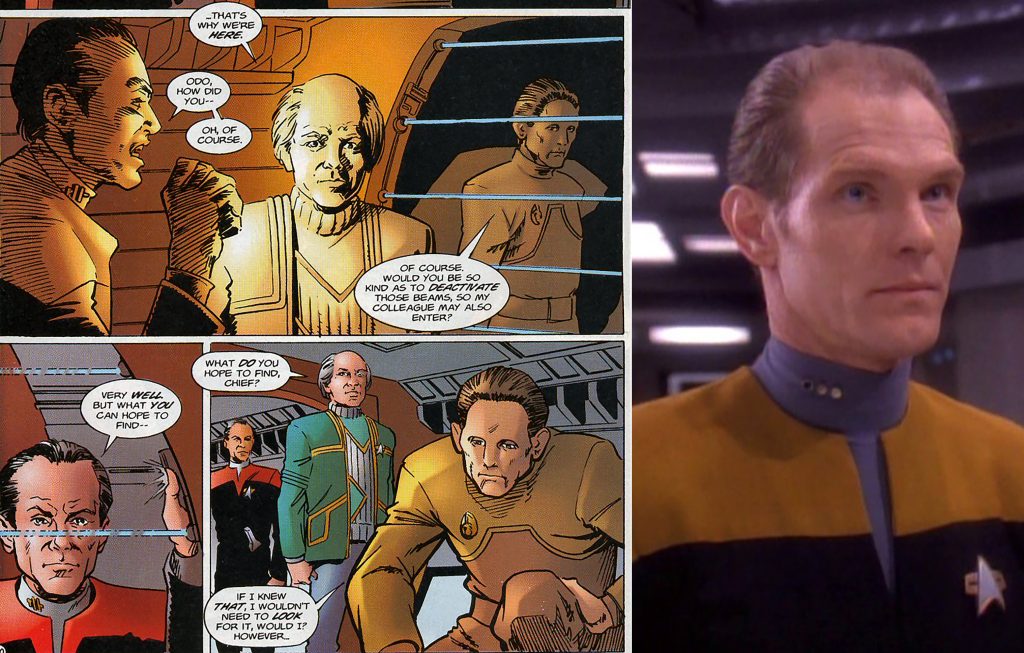
The Spectacular 64-Page Annual, released concurrent with monthly issue #18, was written by Mike W. Barr, with interior and cover art by Leonard Kirk and Rob Davis. The fan-favorite Trek author had previously penned Star Trek: The Motion Picture-era tales for Marvel Comics, followed by a highly revered Trek run for DC, the first seven issues of Malibu’s monthly Deep Space Nine line, and a Deep Space Nine crossover with DC’s The Next Generation. His annual, titled “The Looking Glass War,” presents an intriguing glimpse at what could have been.
Another Defiant arrives from a parallel dimension in which the Dominion have invaded Federation space. That universe’s Curzon Dax (“Emissary”) seeks Odo’s help in preventing a war, since the other Odo’s murder had triggered the onslaught. Ben Sisko refuses permission, citing the Prime Directive, so Curzon abducts Odo and returns to his own dimension. There, the two crews meet face to face and Odo poses as his counterpart to expose the murderer: the other Kira Nerys. (Disturbingly, Kira is capable of horrific deeds in multiple realities, as also shown in Deep Space Nine‘s mirror-universe episodes. Sisko and Odo would do well to keep an eye on her.)

The annual brings back several TV guest characters. While trapped in the other dimension, Odo meets an alternate version of the Jem’Hadar child-turned-soldier from “The Abandoned,” whom Quark had found in his casino. The two had the same encounter in this reality as well, but despite their close bond, the Jem’Hadar tries to kill the shapeshifter for aligning with Starfleet. Odo barely escapes, thanks to a gas compound that renders the soldier unconscious.

In addition, the comic features alternate analogues of Sub-Commander T’Rul, who’d been assigned to the USS Defiant in “The Search” to operate a cloaking device on loan from the Romulan government, and Michael Eddington, who would be revealed as a member of the Maquis in “For the Cause.” Neither character plays a large role, but it’s intriguing to meet these counterparts and wonder how their lives might have differed.

Lightstorm, from Mark A. Altman, Terry Pallot, and Rob Davis, served as a sequel to the publisher’s Hearts and Minds miniseries, by bringing back Kol and Koleth of the Klingon attack cruiser ‘Avwi. Following a prelude published in monthly issue #9, Hearts and Minds continued as a four-issue miniseries involving a Klingon warship, the K’Tang, seemingly destroyed by Cardassians in an area of the Gamma Quadrant called the Abyss. Lightstorm picks up sometime later.
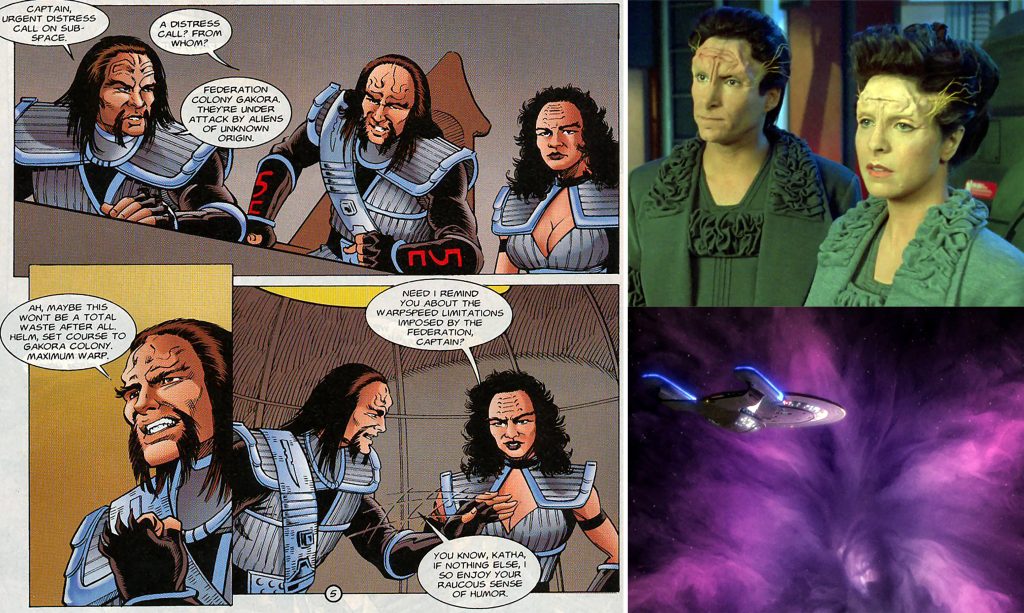
A Myvock fleet (not a mynock fleet—that’s Star Wars, and they just like to suck on power cables) levels the Federation’s Gakora Colony, and Kol brings the sole survivor to Deep Space Nine for medical attention, enabling Julian Bashir and Koleth (who’d connected as friends in Hearts and Minds) to reunite, and for Koleth to thank Julian for saving his life. Ben Sisko and Jadzia Dax work with Kol to investigate the attack, and they discover the Duras sisters, Lursa and B’Etor—with whom the crew clashed in “Past Prologue”—have manipulated the Myvocks into viewing humans as enemies.

In terms of connections to onscreen Star Trek, Lightstorm is relatively standalone, though it offers a few humorous tie-ins. After Koleth sacrifices his life to save others, Kol and Bashir honor the fallen warrior with alcohol. When Kol asks what Julian is drinking, the human replies “It’s green,” referencing Scotty’s line from The Original Series‘ “By Any Other Name,” as well as Data’s callback in The Next Generation‘s “Relics.” Amusingly, Kol tells a waitress, “Green for me as well.”

In addition, Bashir tries to entice a Klingon woman named Katha to dine with him, boasting that the station’s Klingon chef (“Melora” and “Playing God”) serves extraordinary g’agh. Katha declines his invitation, but the good doctor remains creepily enticed by her décolletage, illustrating yet again that Julian Bashir would not have fared well had the #MeToo movement occurred in the 24th century.
The issue’s funniest exchange goes to Kol and Katha, involving a good-natured ribbing at the expense of the warp-five speed limit imposed in The Next Generation‘s “Force of Nature”—a development not well-received by fans and largely ignored by the show’s writers, so it doesn’t matter anyway. When Kol orders his ship to maximum warp, Katha reminds him of the restriction (whether seriously or in jest), causing Kol (no doubt representing Altman’s view of the episode) to comment on how much he enjoys her “raucous sense of humor” while pointedly not reducing speed.
Terok Nor (which was packaged with The Maquis: Soldier of Peace as Deep Space Nine Special Hero Edition, polybagged with Hero Illustrated #20) features no direct connections to specific episodes. The one-shot reveals an untold chapter in the early history of the Cardassian-built station rechristened as Deep Space Nine. Throughout its seven seasons, the TV show explored many aspects of the Bajorans and Cardassians, but little was revealed about the base’s brutal beginnings. Altman and artist Trevor Goring pull back the curtain on Terok Nor’s origin as a mining and refinery base exploiting slave labor, as a Bajoran teacher tells her class about artist/terrorist Charna Sar, whom Cardassian architect Kotan Darek had forced to help design the station.
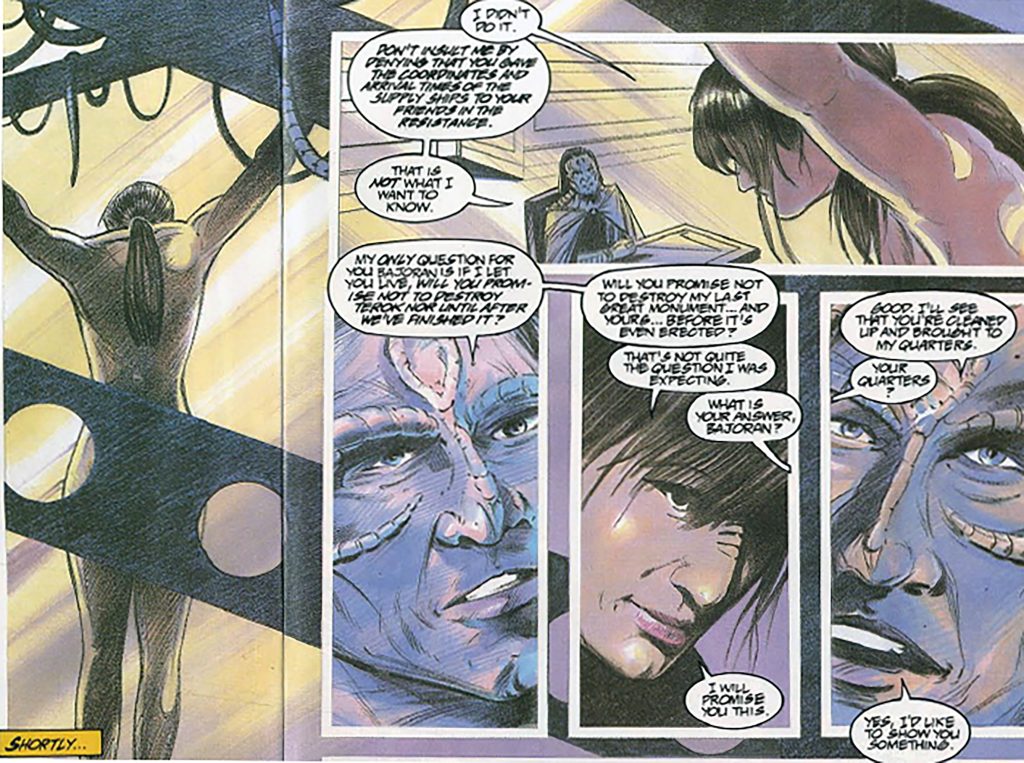
The result is a beautifully woven flashback tale in which an odd friendship forms between the two, based on their mutual love of architectural beauty, which transcends societal hatred and even Darek’s torture of her. In gratitude for Sar helping him create a lasting artistic legacy, Darek risks his career to spare the Bajoran workers who’d built the station, by helping Sar assassinate Gul Dukar before the latter can have them all killed. He still executes her because he must, but Sar accepts that fate and even, in a touching moment, calls him “my friend” before her death.
That same year, Malibu’s Deep Space Nine Special, featuring a beautiful cover by Scott Sava, offered a quintet of short tales spotlighting different characters from the show. In “Collision Course,” from Phil Crain, Rod Whigham, and Scott Reed, Quark and a Klingon named Klag launch a Gamma Quadrant tourism package as a front business for smuggling Cardassian weapons. The name Klag may ring a bell, but given the different head ridges, it seems unlikely this Klag is the same one from The Next Generation‘s “A Matter of Honor,” especially since TV’s Klag was a Klingon of honor, not someone you’d expect to become a smuggler. Still, life paths change (as do Klingon foreheads—just ask Kor, Kang, Koloth, and Kahless), so one never knows.

“Frozen Boyhood,” from Bruce Costa, Keith Conroy, and Aubrey Bradford, features no direct TV connections, though it plays off the Siskos’ oft-mentioned love of baseball. While having lunch with a vapid Bajoran named Su, Jake recalls an ancient CD player his father had given him, containing an old baseball game’s broadcast commentating. Ben had asked O’Brien to modify the player so it couldn’t be paused or deactivated, to make the listening experience like that of being in a ballpark. Tired of Su’s incessant talking, Jake rather cruelly hits “play,” causing the device to loudly drown her out, then laughs in her face as she erupts in anger at the insult. (Not every story ages well.)

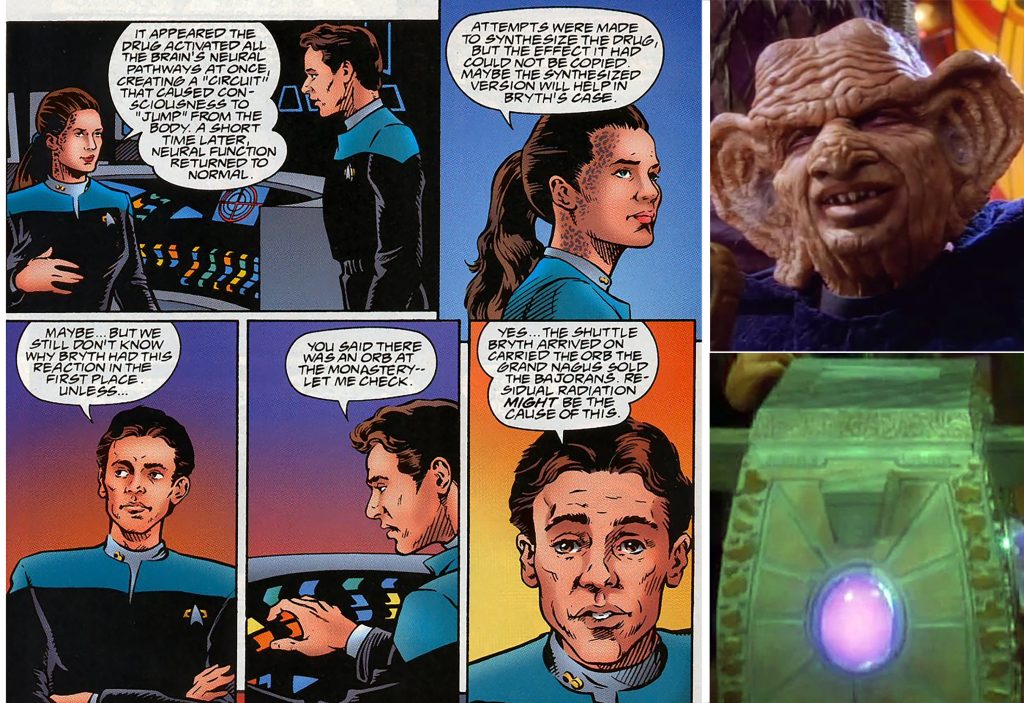
Artist Terry Pallot illustrates his own script in “Oaths,” co-illustrated by Jack Snider, in which a Bajoran youth collapses into a coma after coming into contact with residual radiation from an Orb of the Prophets. Thus, the story is a sequel of sorts to “Prophet Motive,” as the radiation is the result of the child traveling aboard the same shuttle with which Grand Nagus Zek had returned the lost Orb of Wisdom to Bajor.
Chris Pelton’s “Honor,” drawn by Moose Baumann, Anne Timmons, and Scott Reed, is built around Deep Space Nine‘s “Heart of Stone,” in which Nog persuaded Sisko to write a letter of recommendation so the Ferengi could attend Starfleet Academy. Nog now has second thoughts about that decision, so Rom and Jake have elicited Quark’s help in lifting Nog’s spirits. Quark tells his nephew to deliver a package containing a substance toxic to Cardassians, but Nog vows to hand it over to Sisko instead. The package is a fake, however, and in doing the right thing, Nog proves he is indeed a good fit for Starfleet.
Finally, in “Dangerous Times,” from Joe Fielder, Rob Davis, and Bruce McCorkindale, a man sets off an explosion on the Promenade, then tries to abduct Odo (that’s twice in this batch of stories that someone attempts to nab the shapeshifter). During questioning, he reveals he’s part of an extremist group determined to kill all Changelings. A freighter helps the man escape, leaving Sisko’s crew—and readers—with more questions than answers. Given the would-be kidnapper’s xenophobia and access to high technology, it seems likely the perpetrator may be connected with Section 31, and that Fielder may have been setting up a future story. We may never know.
Be here next week as Star Trek Comics Weekly takes a penultimate look at DC Comics’ Star Trek: The Next Generation line. After that, we’ll wrap up our visits to Deep Space Nine—but not for long, since Marvel will bring us right back to the wormhole again.
Looking for more information about Star Trek comics? Check out these resources:
- My ongoing column for Titan Books’ Star Trek Explorer magazine
- The Complete Star Trek Comics Index, curated by yours truly
- The Star Trek Comics Checklist, by Mark Martinez
- The Wixiban Star Trek Collectables Portal, by Colin Merry
- New Life and New Civilizations: Exploring Star Trek Comics, by Joseph F. Berenato (Sequart, 2014)
- Star Trek: A Comics History, by Alan J. Porter (Hermes Press, 2009)
- The Star Trek Comics Weekly page on Facebook
Rich Handley has written, co-written, co-edited, or contributed to dozens of books, both fiction and non-fiction, about Planet of the Apes, Watchmen, Back to the Future, Star Trek, Star Wars, Battlestar Galactica, Hellblazer, Swamp Thing, Stargate, Dark Shadows, The X-Files, Twin Peaks, Red Dwarf, Blade Runner, Doctor Who, Buffy the Vampire Slayer, Batman, the Joker, classic monsters, and more. He has also been a magazine writer and editor for nearly three decades. Rich edited Eaglemoss’s Star Trek Graphic Novel Collection, and he currently writes articles for Titan’s Star Trek Explorer magazine, as well as books for an as-yet-unannounced role-playing game. Learn more about Rich and his work at richhandley.com.
One thought on “Star Trek Comics Weekly #45”
Comments are closed.