
An ongoing discussion of how the comics provide prequels, sequels, and tie-ins to the Star Trek episodes and films, soon to be a book from BearManor Media.
46: DC Comics, 1995–1996
As Star Trek: The Next Generation‘s finale so powerfully reminded viewers, all good things eventually end. This truism didn’t apply only to the television show, but to DC Comics’ monthly spinoff as well. This week, we’ll consider the final issues, #76–80, as well as DC’s third The Next Generation Special, from the standpoint of how these stories presented prequels, sequels, and tie-ins to onscreen Star Trek.

In issue #76, from writer Michael Jan Friedman and artists Ken Save and Shephard Hendrix, a mysterious woman has murdered the Enterprise-D’s former chief engineers, and Geordi La Forge is the next target. The comic tied together multiple episodes of The Next Generation‘s first season, as it featured grim fates for Sarah MacDougal (“The Naked Now”), Argyle (“Where No One Has Gone Before” and “Datalore”), and Logan (“The Arsenal of Freedom”). The chief suspect: Lieutenant Farrell, a new engineer in La Forge’s engineering department, introduced in Star Trek: Generations.

The Enterprise had featured a revolving door of chief engineers before La Forge became the sole officer to hold that position. These characters have since returned in some of the novels and comics, but onscreen they were largely forgotten as of season two, other than occasional “blink and you’ll miss it” mentions on the ship’s interactive displays. An Okudagram in “Galaxy’s Child,” for example, revealed that Argyle and MacDougal had continued to serve aboard the Enterprise under La Forge. One can’t help but wonder how they must have felt about that, since it effectively meant they’d been demoted. (Maybe we should ask Doctor M’Benga, given his apparent demotion between Strange New Worlds and The Original Series.)

Argyle is given a first name, Terence, while Logan is dubbed Charles and is said to have become the chief engineer of the USS Bradbury (“Ménage à Troi”) after leaving the Enterprise. Missing from the list of murder victims is Leland T. Lynch (“Skin of Evil”), though it’s worth noting that Lynch is never actually identified as a chief engineer, despite his onscreen prominence; he may simply be a senior member of the engineering staff—luckily for him, since that keeps him out of the killer’s crosshairs.

Farrell, an Enterprise junior engineer, is accused of the murders since she’d served under each of the three victims. The comic is set prior to Generations, with the lieutenant having recently joined the crew with the secret goal of protecting La Forge from the actual killer, whom she helps to expose. (The real culprit turns out to be the murders’ investigator, whose father had been passed over for the job.) Farrell is then invited to remain aboard the starship, setting the stage for her big-screen debut.
Adding to the season-one nostalgia is a cameo by Captain Rixx, Star Trek‘s first Bolian character and commander of the USS Thomas Paine (“Conspiracy”), when Jean-Luc Picard contacts him to ask about Farrell, who’d once served in Rixx’s crew. Rixx is drawn not to resemble actor Michael Berryman (whose hypohidrotic ectodermal dysplasia gives him a rather distinctive look), but rather with the facial features and blue skin more typically associated with Bolians. In fact, he’s drawn with a two-tone face, similar to Lokai and Bele of Cheron (“Let That Be Your Last Battlefield”), though this may have been intended to merely convey a shadow rather than different skin colors.

A two-part tale in issues #77–78, from Friedman, Gordon Purcell, and Terry Pallot, provided a sequel to “Schisms,” in which mysterious aliens abducted members of the Enterprise crew for the purpose of experimentation. The story brought back James McRobb, a regular cast member in the first four issues before he and wife Ingrid vanished without explanation. McRobb now serves as the chief engineer of the USS Hornet, which took part in Starfleet’s armada against the Romulans in “Redemption,” and he and Ingrid have produced three children in the interim. With DC’s Trek comics nearing their imminent conclusion, McRobb’s return offered closure for that character, neatly wrapping up a loose end from the start of the run.

The Enterprise and the Hornet investigate an abandoned Promellian space station and discover that the solanogen-based lifeforms from “Schisms” have created another gateway into normal space. (The name “Promellian” might ring a bell; in “Booby Trap,” the Enterprise had encountered a derelict battle cruiser of Promellian design.) The Hornet‘s captain, Nora Hagler—whose brother Edward was killed in “Schisms”—vengefully engages the aliens in battle, but they return to their dimension, taking the ship with them.

The comic provides insight into the aliens’ society, which consists of two factions: one that experiments on other species and another that opposes such activities—kind of like the Shadows and the Vorlons on Babylon 5. The first faction (encountered in “Schisms”) has now set its sights on obtaining a starship’s computer data as a prelude to invasion, but the other intervenes by working with Picard to thwart their plans.

The final two issues provided a sequel to a prior tale as well—this time, to DC’s own issues #32–35, in which Q had transformed the Enterprise crew into Klingons. This time, the trickster riffs on his former prank, turning the crew into Soong androids (you might recall that Q once turned himself into such an android in “Hide and Q”). As with the prior tale, hijinks ensue due to Picard and company being unaccustomed to their new form. Though reminiscent of that earlier story’s plot, it contains strong character moments and ends the monthly title on a Data-centric note, aligning with his prominence in the feature films and more recently on Star Trek: Picard—in which Picard actually becomes an android.

Jean-Luc muses that he wishes everyone were as durable as Data, so the mischievous Q shows him what that might be like. This leaves the crew short on compassion, ill-equipped to perform their duties during an emergency. As androids, Beverly Crusher and Deanna Troi lack empathy for patients, while Picard is unable to make command decisions due to his lost intuition and emotional insight. There’s a method to Q’s madness, though—there usually is, no matter how ridiculous the situation—and Data realizes the sick and injured are not the victims here, but rather pirates and slavers.
During this story, the Enterprise responds to a distress call from a Federation mining colony on Aurelia VII. The animated episode “Yesteryear” had featured an Aurelian named Aleek-Om, but it’s unclear whether there’s a direct connection to be made in this instance. No members of Aleek-Om’s species show up, but the slavery revelation means such a tie-in cannot be ruled out—it could be that those enslaved included Aurelians, and that they’d been caged up offscreen for the tale’s duration.

The third Next Generation Special sported beautiful cover art by Sonia Hillios. (The covers to #76–80 were all drawn by Star Trek stalwarts Purcell and Pallot.) The first tale, from writer Michael DeMerritt and artist Ricardo Villagrán—who’d illustrated almost all issues of DC’s inaugural Trek line, making him a fan-favorite—contained no direct connections to specific episodes. What makes this story noteworthy is that it was based loosely on an unused outline for the TV show.
The Enterprise mediates a trade dispute, while La Forge is reunited with Academy buddy David Dirvy, who has developed a new transporter system. Radicals plot to murder a delegate, inadvertently killing Dirvy. (A surprising number of La Forge-centric comics involve murder. Perhaps someone should be keeping an eye on Geordi.) Using the new technology, Geordi creates a transporter duplicate of his friend, who is horrified to learn he’s been replicated and thus abandons his research. No mention is made of Thomas Riker, so the comic likely occurs before the creation of Will’s transporter duplicate in “Second Chances.”
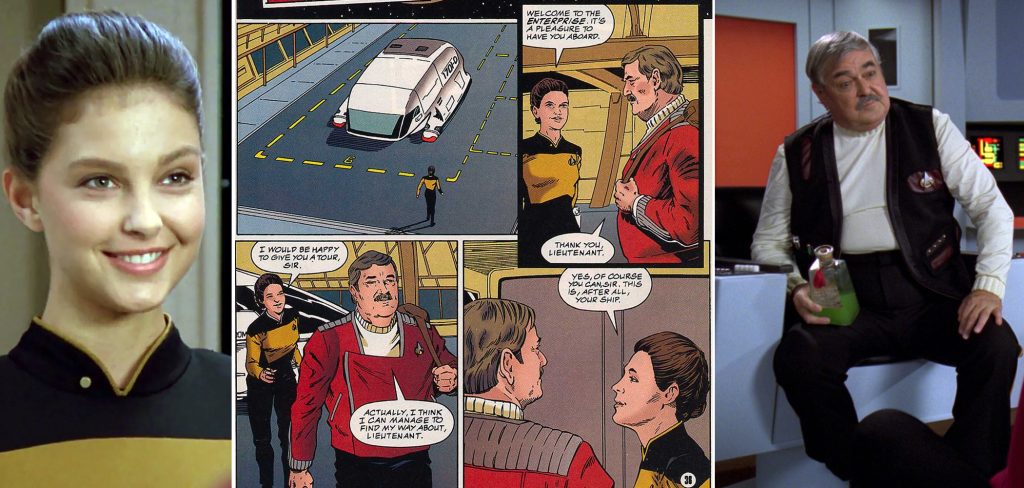
The second tale, penned by Kevin J. Ryan, with art by Hendrix and Save, is more deeply rooted in onscreen lore. Montgomery Scott visits a starbase museum, where Robin Lefler (“Darmok” and “The Game”) is assigned as his escort. Lefler now serves at the starbase, having left the Enterprise-D to pursue her career dreams. When Scotty tours the Enterprise-A, mothballed at the museum, he and Lefler bond over their shared love of engineering schematics. Their interactions are charming, as Robin holds Scotty in high regard and comes off as a bit of a groupie around the Starfleet legend—a far cry from the impatience and disrespect La Forge had shown him in “Relics.”
Lefler wistfully discusses her relationship with Wesley Crusher, saying she doubts she’ll see Wes again now that he’s become “a priest, or a shaman, or something.” This references his decision to leave Starfleet and team up with the Traveler in “Journey’s End,” a choice she’s been having trouble comprehending. (Imagine how she’d feel after the events of Star Trek: Picard‘s “Farewell.”) Robin had apparently expected to end up with Wes on a permanent basis, adding an element of poignance to his unexpected life change: he’s left not only Starfleet, his mother, and his friends behind, but a woman who loves him.

Scotty arrives in the shuttlecraft Goddard, which Picard had gifted him in “Relics,” and which he has since renamed the Romaine, honoring his ex-lover, Mira Romaine (“The Lights of Zetar”). Klingon Captain Koloth (“The Trouble With Tribbles”) tries to settle an old score with Scotty over the tribble incidents a century prior, though he only mentions the events of the live-action episode since “More Tribbles, More Troubles” and the rest of The Animated Series had briefly been deemed off-limits at the time of the comic’s release.
Koloth tries to blow up the old starship, but the two engineers thwart his plans and he concedes defeat. Bested fairly in battle, the Klingon calls off his Scotty vendetta so he can focus on the Albino, his nemesis in Deep Space Nine‘s “Blood Oath.” In fact, the comic takes place on the eve of Koloth’s death in that episode. This unlikely teaming up of Scotty, Lefler, and Koloth, in a tale simultaneously sequelizing The Original Series and prequelizing Deep Space Nine, adeptly illustrates why the DC era remains so popular among readers.

In two weeks, we’ll wrap up DC’s efforts with an examination of the Ill Wind miniseries, as well as the two-part story spanning the sixth annuals of both The Next Generation and the original Star Trek. First, though, we’ll shine a spotlight next week on more stories from Malibu’s Deep Space Nine line—and after our DC dissection concludes, we’ll reach Malibu’s swan song as well. Then, four weeks from now, Marvel Comics will make its Star Trek comeback. There’s much to discuss, so don’t change that channel.
Looking for more information about Star Trek comics? Check out these resources:
- My ongoing column for Titan Books’ Star Trek Explorer magazine
- The Complete Star Trek Comics Index, curated by yours truly
- The Star Trek Comics Checklist, by Mark Martinez
- The Wixiban Star Trek Collectables Portal, by Colin Merry
- New Life and New Civilizations: Exploring Star Trek Comics, by Joseph F. Berenato (Sequart, 2014)
- Star Trek: A Comics History, by Alan J. Porter (Hermes Press, 2009)
- The Star Trek Comics Weekly page on Facebook
Rich Handley has written, co-written, co-edited, or contributed to dozens of books, both fiction and non-fiction, about Planet of the Apes, Watchmen, Back to the Future, Star Trek, Star Wars, Battlestar Galactica, Hellblazer, Swamp Thing, Stargate, Dark Shadows, The X-Files, Twin Peaks, Red Dwarf, Blade Runner, Doctor Who, Buffy the Vampire Slayer, Batman, the Joker, classic monsters, and more. He has also been a magazine writer and editor for nearly three decades. Rich edited Eaglemoss’s Star Trek Graphic Novel Collection, and he currently writes articles for Titan’s Star Trek Explorer magazine, as well as books for an as-yet-unannounced role-playing game. Learn more about Rich and his work at richhandley.com.
One thought on “Star Trek Comics Weekly #46”
Comments are closed.