An ongoing discussion of how the comics provide prequels, sequels, and tie-ins to the Star Trek episodes and films, soon to be a book from BearManor Media. Click here to view an archive of this article series.
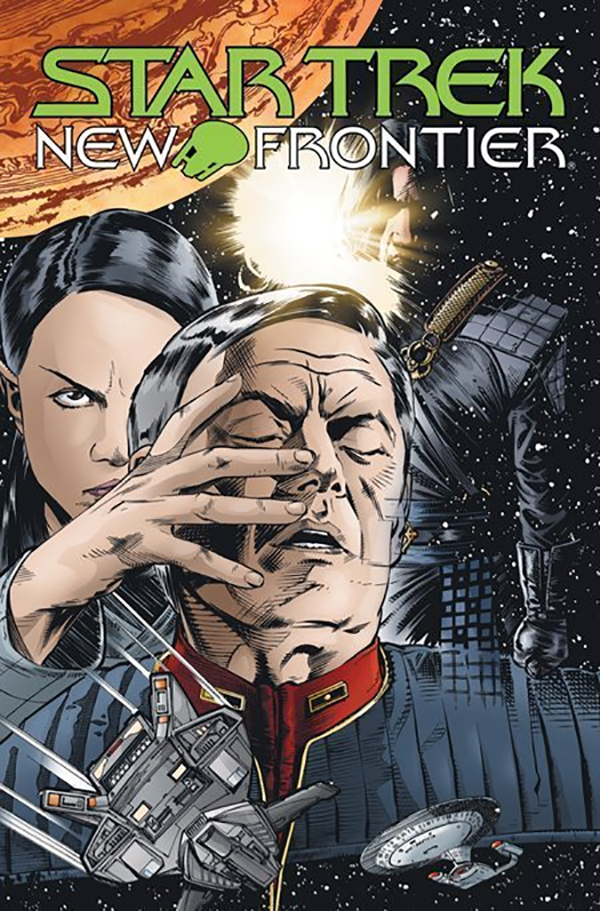
78: IDW Publishing, 2008
When WildStorm published Peter David’s Star Trek: New Frontier—Double Time in 2000, it did something the franchise has rarely attempted: producing a comic designed specifically to connect with Pocket Books’ novels and short stories. DC had done this with its adaptation of William Shatner’s The Ashes of Eden, and WildStorm itself had produced N-Vector to connect with Pocket’s Deep Space Nine relaunch line. Double Time was unique, though, as it was an original story written by the same author who’d penned the novels to which it connected.

Star Trek: New Frontier focused on the adventures of Captain Mackenzie Calhoun and the crew of the USS Excalibur. Working with Pocket editor John Ordover, David built out his New Frontier storyline knowing he’d likely have a wider latitude from Paramount since his cast would not be appearing onscreen. This enabled him to take greater risks than other Star Trek writers, since without Jim Kirk, Jean-Luc Picard, or other main characters from the films and TV shows, he wouldn’t be required to maintain the status quo at the end of each tale—his original cast could change and they could even die.

David introduced a host of new characters in New Frontier, including Morgan Primus and Burgoyne 172, and he revisited his original creations from Pocket’s Starfleet Academy line of young-adult novels, such as Zak Kebron, Mark McHenry, and Tania Tobias. What’s more, David utilized such popular television characters as Elizabeth Shelby (“The Best of Both Worlds”), Robin Lefler (“Darmok” and “The Game”), and Edward Jellico (“Chain of Command”), along with The Animated Series’ M’Ress and Arex, who’d both ended up in the 24th century after being time-displaced.

IDW incorporated all of these characters in its own New Frontier tie-in, a five-issue miniseries illustrated by Stephen Thompson, with covers from Thompson and J. K. Woodward. Subtitled “Turnaround,” the miniseries was originally announced under the title “Slingshot” and it was set between the books Missing in Action and Treason. The first issue was branded as Star Trek: Second Stage, representing IDW’s second set of announced Trek titles, though “Second Stage” was dropped for subsequent chapters, making its appearance on issue #1’s cover a bit of an anomaly. As with IDW’s other titles, the first two issues were offered with multiple cover variants—including one featuring Peter David himself in the captain’s chair.
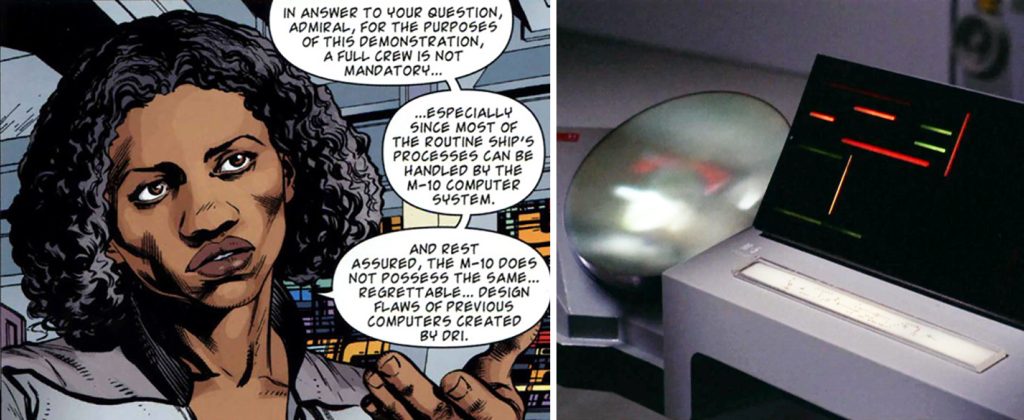
The premise? The Daystrom Institute (mentioned repeatedly on The Next Generation and Voyager before finally appearing onscreen in Star Trek: Picard’s “Remembrance”) announces the shunt drive, its new prototype starship drive that bends time rather space to achieve propulsion. The starship Paradox tests the device, controlled by M-10, a future generation of Richard Daystrom’s M-5 Multitronic Unit. According to the Institute, M-10 possesses none of the prior models’ “design flaws” demonstrated in The Original Series’ “The Ultimate Computer,” in which misunderstood genius Daystrom and his misunderstood electronic genius creation both suffered nervous breakdowns.

Things go awry thanks to an incursion from the mirror universe (“Mirror, Mirror”), when the Excalibur crew’s counterparts infiltrate the prime reality to steal the Paradox, presaging mirror-Gabriel Lorca’s infiltration on Star Trek: Discovery. The other Edward Jellico (The Next Generation’s “Chain of Command”) commandeers the ship so Calhoun can travel back in time and alter history by preventing the rise of the Klingon-Cardassian Alliance (Deep Space Nine’s “Crossover”)—making the duplicates both good guys and villains, depending on one’s perspective. This provides one of the comic’s most memorable moments, for neither the audience nor Starfleet have yet discovered that the story involves the mirror universe by this point, so it’s a shock when Jellico inexplicably pulls out a phaser, shoots everyone in the room, and steals the ship.

As with the WildStorm New Frontier one-shot, IDW’s chapter requires a certain amount of foreknowledge to follow its plot. David’s script assumes readers are familiar with the novels, so anyone new to the saga might be confused by the miniseries’ premise and the characters’ personal journeys. Robin Lefler, for instance, is no longer in Starfleet—she’s gone from being Wesley Crusher’s witty gal-pal to the leader of a vast former empire, following the death of her husband who is now a ghost living inside his own sister’s body. Plus, she’s pregnant by her deceased husband… and her mother is a computer. Without the novels’ context, any and all of these plot points might leave readers scratching their heads.

The comic contains other tie-ins to onscreen Star Trek as well, which even those who haven’t read the novels will appreciate. The Daystrom Institute, for instance, describes its new drive as “the first fundamental rethinking of propulsion since Zephram[sic] Cochrane conceived the warp drive,” referencing “Metamorphosis” and Star Trek: First Contact. The system is designed to allow instantaneous travel across space, eliminating the environmental damage caused by warp drive, as established in The Next Generation’s “Force of Nature.”

It’s amusing to see a comic book present a sequel to one of Star Trek’s lesser episodes, but the new drive is an intriguing concept and it’s a shame the Paradox ends up destroyed. This unexpected “Force of Nature” tie-in is exactly the sort of thing that inspired this column as a platform illustrating how many episodes have had comics call back to them. Given how weakly received that episode tends to be, few would expect licensed writers to use it as the basis for a comic or novel. That Peter David did so illustrates the author’s commitment to mining every corner of the franchise.

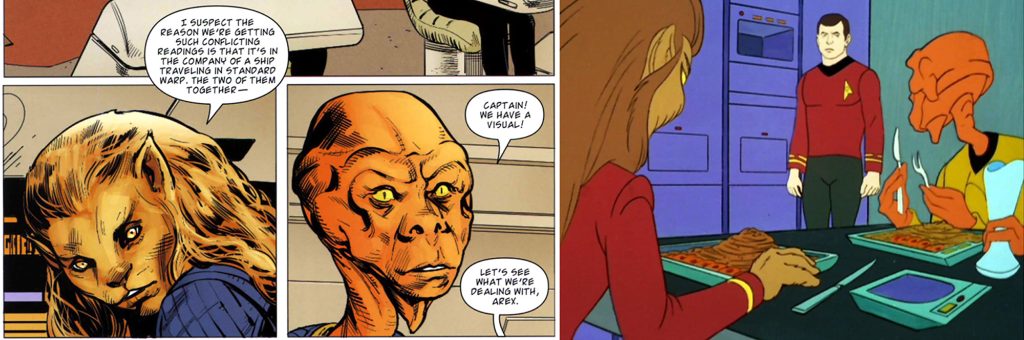
Among those evaluating the shunt drive is a Caitian Starfleet officer, drawn more like the Caitians featured in Star Trek IV: The Voyage Home than like M’Ress’s depiction in The Animated Series. After seeing the cartoon deemed off-limits for years following DC Comics’ removal of Arex and M’Ress in the 1980s, it’s gratifying that IDW’s early Trek tales regularly mined that show. And it’s no surprise Peter David was among the writers utilizing these characters, as it was his DC run that featured them most prominently. In next week’s column, we’ll look back at DC Fontana’s Year Four: The Enterprise Experiment—starring none other than Arex.
Looking for more information about Star Trek comics? Check out these resources:
- My ongoing column for Titan Books’ Star Trek Explorer magazine
- The Complete Star Trek Comics Index, curated by yours truly
- The Star Trek Comics Checklist, by Mark Martinez
- The Wixiban Star Trek Collectables Portal, by Colin Merry
- New Life and New Civilizations: Exploring Star Trek Comics, by Joseph F. Berenato (Sequart, 2014)
- Star Trek: A Comics History, by Alan J. Porter (Hermes Press, 2009)
- The Star Trek Comics Weekly page on Facebook
Rich Handley has written, co-written, co-edited, or contributed to dozens of books, both fiction and non-fiction, about Planet of the Apes, Watchmen, Back to the Future, Star Trek, Star Wars, Battlestar Galactica, Hellblazer, Swamp Thing, Stargate, Dark Shadows, The X-Files, Twin Peaks, Red Dwarf, Blade Runner, Doctor Who, Buffy the Vampire Slayer, Batman, the Joker, classic monsters, and more. He has also been a magazine writer and editor for nearly three decades. Rich edited Eaglemoss’s Star Trek Graphic Novel Collection, and he currently writes articles for Titan’s Star Trek Explorer magazine, as well as books for an as-yet-unannounced role-playing game. Learn more about Rich and his work at richhandley.com.
One thought on “Star Trek Comics Weekly #78”
Comments are closed.