An ongoing discussion of how the comics provide prequels, sequels, and tie-ins to the Star Trek episodes and films, soon to be a book from BearManor Media. Click here to view an archive of this article series.
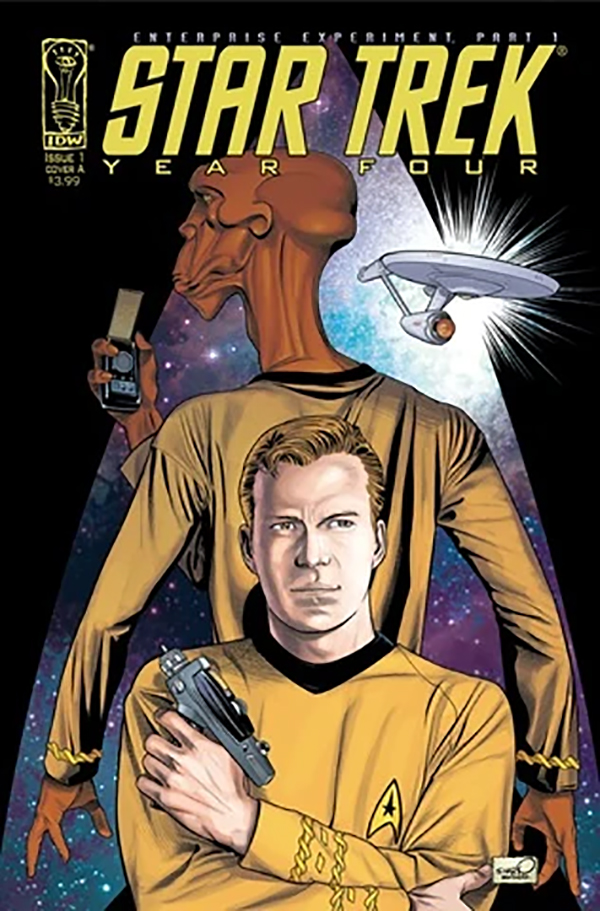
79: IDW Publishing, 2008
Dorothy “D.C.” Fontana is a name Star Trek fans should know. The script editor and writer, who passed away in 2019, worked not only on The Original Series and The Animated Series, but also on The Next Generation and Deep Space Nine. To say she was instrumental to the franchise’s success would be an understatement, as her credits include such standout episodes as “Charlie X,” “Tomorrow Is Yesterday,” “This Side of Paradise,” “Journey to Babel,” “The Enterprise Incident,” “Yesteryear,” “Encounter at Farpoint,” “Too Short a Season,” “Heart of Glory,” “Dax,” and more.
Fontana worked as Gene Roddenberry’s assistant, contributed to the fanzine Inside Star Trek, penned the Pocket novel Vulcan’s Glory, associate-produced The Animated Series and The Next Generation, and cowrote (with Derek Chester) the video games Bridge Commander, Legacy, and Tactical Assault. So when IDW published Year Four: Enterprise Experiment, cowritten by Fontana and Chester, it was no surprise that the comic—illustrated by Gordon Purcell, Terry Pallot, Drew Geraci, José Marzan Jr., Tom Nguyen, Bob Almond, and Bob Smith, with covers by Joe and Rob Sharp—would be chock-full of tie-ins and sequels to televised Trek.This five-issue miniseries was the second title released under IDW’s “Second Stage” banner.

Enterprise Experiment provides a sequel to “The Enterprise Incident,” in which James T. Kirk and Spock staged an elaborate ruse to get their hands on a Romulan cloaking device. Actor Joanne Linville’s Romulan commander became a fan favorite, though her character never received a name onscreen. This led to licensed writers giving her a variety of designations—not to mention conflicting backgrounds and fates—including Di’on Charvon, Thea, Nevesa, and Liviana Charvanek. The commander returns in Fontana’s Enterprise Experiment, once again unidentified by name.

The Enterprise tests a prototype cloaking device based on the Romulan design from “The Enterprise Incident,” as well as on theoretical technologies derived by scientists studying the Guardian of Forever (“The City on the Edge of Forever”), but the vessel and its crew end up out of phase with normal space, similar to what happened to Geordi La Forge and Ro Laren in “The Next Phase.” Linville’s character tries to destroy the Enterprise while it’s vulnerable, and readers learn that she and Sub-Commander Tal (also from the TV episode) are lovers, but that his lower societal station tragically prevented them from bonding in marriage.
Stranded in a shuttlecraft when the Enterprise becomes phased, Kirk and Spock board the starship and find a ghostly Lieutenant Arex, from The Animated Series, who helps them build a transporter-based solution to restore the phased crew. Arex features prominently throughout, which is a delight since he and M’Ress, in their rare appearances on the printed page, tend to be relegated to sitting at consoles and saying “Aye, sir.” Here, Arex is vital in disengaging the cloaking device and saving the crew.
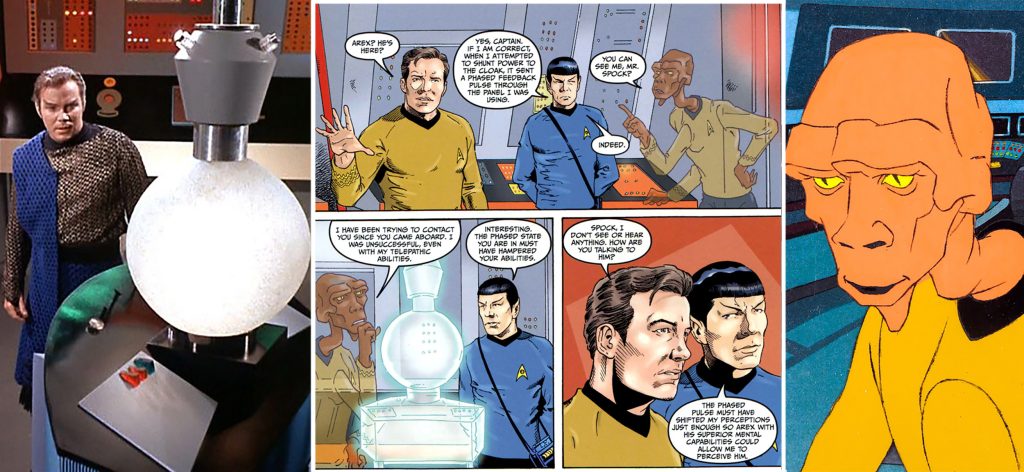
Fontana reveals that Arex’s species, the Edosians (not the Triexians, as some of the novels have incorrectly claimed), are formidable telepaths destined to travel a special, albeit unspecified path in the future. This trait of his people seems to come out of nowhere since their telepathy had not been previously established and is otherwise not part of their profile in other licensed lore. However, this is D.C. Fontana, so the judges will allow it.
The story sets up the status quo of Star Trek: The Motion Picture. V’Ger has yet to absorb Epsilon IX, and the Klingons are spying on the station’s communications with Starfleet. In a twist, the movie’s Admiral Nogura seems attached to Section 31—and is apparently colluding with the Romulans. Meanwhile, Sarek (“Journey to Babel”) observes that his son has become more outwardly emotional since joining Starfleet, inspiring Spock to study kolinahr. According to the comic, Sarek has undergone the emotion-purging ritual as well, though he must have utterly failed his kolinahr, given how emotional and angry he tends to get with regard to all of his children.
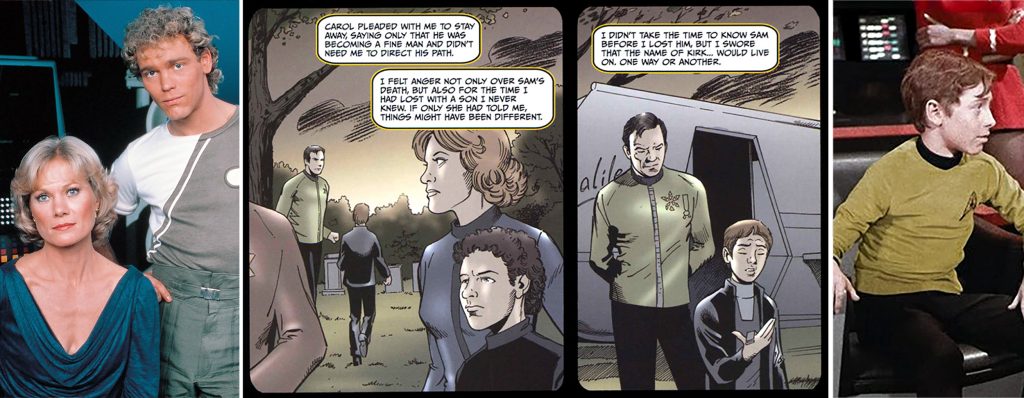
Carol and David Marcus (Star Trek II: The Wrath of Khan) factor into the story, briefly and in flashbacks. Carol and young David attend the funeral for George and Aurelan Kirk (“Operation—Annihilate!”). A few years later, Jim sends her a subspace letter asking about their son, and she apparently requests that he not be part of David’s life. Oddly, his orphaned nephew Peter is said to be the only chance of continuing the Kirk family line, despite Aurelan and Sam having had three sons, per “What Are Little Girls Made Of?” Licensed authors sometimes overlook the other two boys, but Fontana was well-versed in Trek trivia and worked on The Original Series, so it’s surprising to see her do so.
As all of this is going on, Commander Kor (“Errand of Mercy”) seeks to restore the honor he’d lost thanks to the dual defeats he’d suffered in that episode and in “The Time Trap,” and he still commands the Klothos, his cruiser from the latter tale. Kor bombards a Federation mining facility and a space station to test whether the Organians are still enforcing the peace treaty—which, he learns, they are not. By story’s end, Fontana dissolves the treaty that had kept the Federation and Empire from going to war, leaving the two governments to forge their own path once more.

Ayelborne reveals that while many older civilizations departed the galaxy, the Organians stayed behind to shepherd the younger ones, much like the Vorlons and Shadows on Babylon 5, but had vowed not to interfere in their natural evolution. His people thus regret foisting a peace treaty on the two galactic powers, and he decrees they shall do so no longer. This is a logical development, and it explains the Organians’ lack of response to the Klingons’ aggressive actions in the films, the 24th-century shows, and Marvel’s post-The Motion Picture comics, though it does contradict other licensed stories, particularly DC’s first series, which depicted the treaty as still in effect years later.

The miners have unearthed a vast, abandoned underground city containing an obelisk built by the Preservers, identical to the one that had protected Miramanee’s people (“Paradise Syndrome”). The console is missing, as the Klingons, in typical fashion, have removed the unit in the hope of weaponizing it. Arex probes a prisoner’s mind with his heretofore unknown telepathy and learns Kor’s plan, then Sulu goes undercover as a Klingon to steal the device… which overloads and explodes.

Fontana ties “Errand of Mercy” and “The Paradise Syndrome” into a single narrative, as Ayelborne knows of the Preservers and forbids Kirk’s and Kor’s peoples from pursuing knowledge of that enigmatic species’ technology, deeming them too young to comprehend it. The author weaves in “Where No Man Has Gone Before” and “By Any Other Name” as well, as Spock learns the Preservers erected the energy barrier around the Milky Way to protect the galaxy and the primitive civilizations seeded within it from an outside threat. Kirk suspects that threat may have been the Kelvans, whose extragalactic vessel had been crippled by the barrier. Intriguing!

Finally, Spock escorts Sarek home to Vulcan and accompanies his father to the family’s place of koon-ut-kal-if-fee (“Amok Time”), where Sarek tells him T’Pring is with child and her husband Stonn is distinguishing himself at the Vulcan Science Academy. Unlike the Organian Peace Treaty discrepancy, this jibes nicely with DC’s continuity, in which Stonn and T’Pring had produced a child before separating. It’s worth noting that Stonn was an ambassador in the DC tale, which means he and Spock have taken remarkably similar paths: betrothment to the same woman who ended up leaving them, with careers first in the sciences and then in diplomacy. To paraphrase a different Romulan commander, in another reality these two might have been friends.
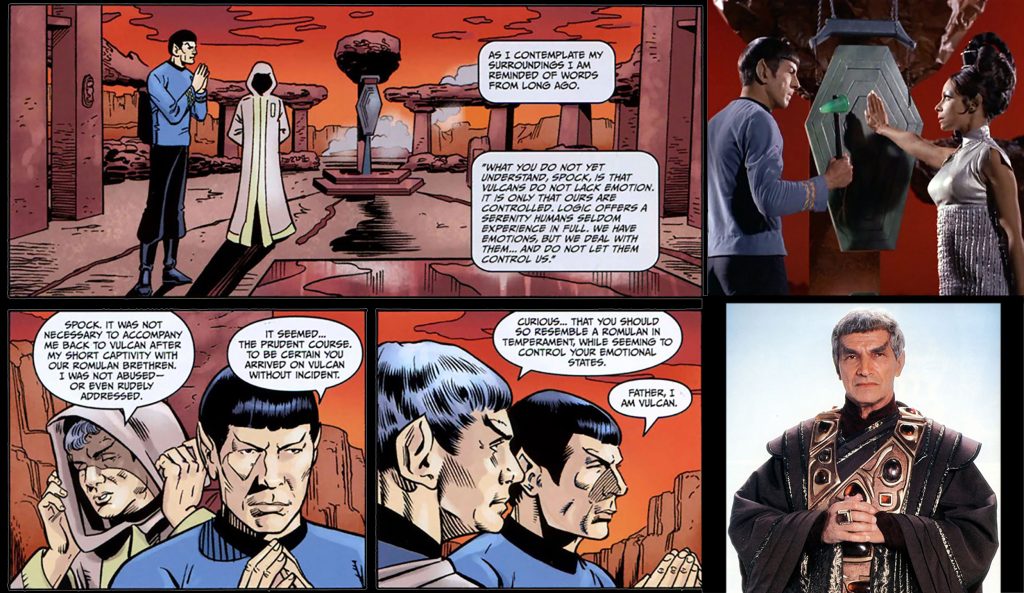
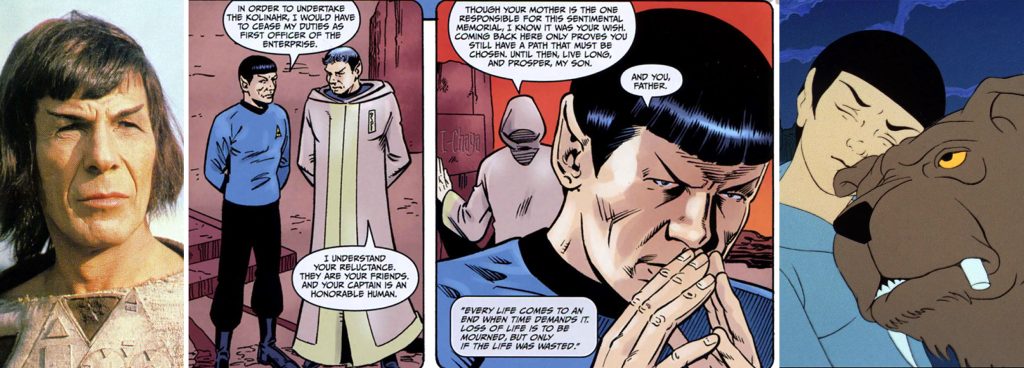
Other TV tie-ins are peppered throughout. Ayelborne says his people and the Metrons (“Spectre of the Gun”) once fought as enemies before learning to live in peace, while Captain Koloth (“The Trouble with Tribbles” and “More Tribbles, More Troubles”) has a cameo as he and Kor forge an alliance between the Klingon and Romulan governments. The series also references The Animated Series’ “Yesteryear,” with Spock recalling advice he’d given his younger self regarding Vulcan emotions in the cartoon, as well as visiting a memorial to his deceased sehlat, I-Chaya.
Meanwhile, McCoy recalls his pride at seeing his daughter Joanna graduate at the top of her class from Starfleet’s medical specialist evaluation course. He gives Joanna a medal he’d earned for his work on Dramia II (“Albatross”), and she claims his expedition to that world is required Academy reading. (So many works are required Academy reading on Star Trek, it’s a wonder any cadets graduate in fewer than 20 years.) Fontana’s story outline “Joanna” had been heavily reworked as the episode “The Way to Eden,” much to her dissatisfaction, so it’s fitting that the writer who’d almost given us Joanna McCoy in the Sixties would at last feature the character in her comics work.

Year Four: Enterprise Experiment is a testament to Fontana’s storytelling skills and importance to Star Trek, and it’s a shame she never wrote more comics. Next week, we’ll continue to navigate IDW’s “Second Stage” with John Byrne’s Assignment: Earth miniseries. From a tie-in standpoint, it’s in a class by itself: a sequel not just to a classic episode, but also to a backdoor pilot for a spinoff show that never aired. NBC passed on the proposed series, but Byrne showed readers what might have been for Gary Seven and Roberta Lincoln had it been greenlighted, proving something students and teachers have long known: assignments turned in late can still have great value.
Looking for more information about Star Trek comics? Check out these resources:
- My ongoing column for Titan Books’ Star Trek Explorer magazine
- The Complete Star Trek Comics Index, curated by yours truly
- The Star Trek Comics Checklist, by Mark Martinez
- The Wixiban Star Trek Collectables Portal, by Colin Merry
- New Life and New Civilizations: Exploring Star Trek Comics, by Joseph F. Berenato (Sequart, 2014)
- Star Trek: A Comics History, by Alan J. Porter (Hermes Press, 2009)
- The Star Trek Comics Weekly page on Facebook
Rich Handley has written, co-written, co-edited, or contributed to dozens of books, both fiction and non-fiction, about Planet of the Apes, Watchmen, Back to the Future, Star Trek, Star Wars, Battlestar Galactica, Hellblazer, Swamp Thing, Stargate, Dark Shadows, The X-Files, Twin Peaks, Red Dwarf, Blade Runner, Doctor Who, Buffy the Vampire Slayer, Batman, the Joker, classic monsters, and more. He has also been a magazine writer and editor for nearly three decades. Rich edited Eaglemoss’s Star Trek Graphic Novel Collection, and he currently writes articles for Titan’s Star Trek Explorer magazine, as well as books for an as-yet-unannounced role-playing game. Learn more about Rich and his work at richhandley.com.
2 thoughts on “Star Trek Comics Weekly #79”
Comments are closed.