
An ongoing discussion of how the comics provide prequels, sequels, and tie-ins to the Star Trek episodes and films, soon to be a book from BearManor Media. Click here to view an archive of this article series.
54: Gold Key/Whitman, 1967–Present
The first Star Trek comic book was released 53 years ago last month, bearing a cover date of October 1967. It’s thus fitting, after 53 installments, that this column should revisit that historic series produced by Whitman Publishing’s Gold Key Comics imprint. So grab your Red Angel time-travel suit, prepare your engine cold-start and light-speed breakaway factor calculations, open up the Orb of Time, and step through the Guardian of Forever or the Atavachron (your choice!), as we jump back in time to consider the various formats in which Gold Key’s 61 issues have been presented in the United States and abroad.

Concurrent with the monthly U.S. comic, Whitman recycled its stories for the British reading audience in the form of thirteen hardcover annuals released between 1969 and 1985, each collecting multiple issues. Most were sold by World Distributors, though the 1983 edition was handled by Stafford Pemberton. Although the first three presented issues #1-9 in chronological order, three at a time, story selection became increasingly chaotic thereafter, with the remaining books collecting issues #11–13; #14–16; #17, 21, and 24; #27 and 30; #10 and 34; #38–39; #54–56; #36 and 40; #59 and 61; and #27 and 40. It’s a good thing the comics were episodic, or else readers would have been quite confused!
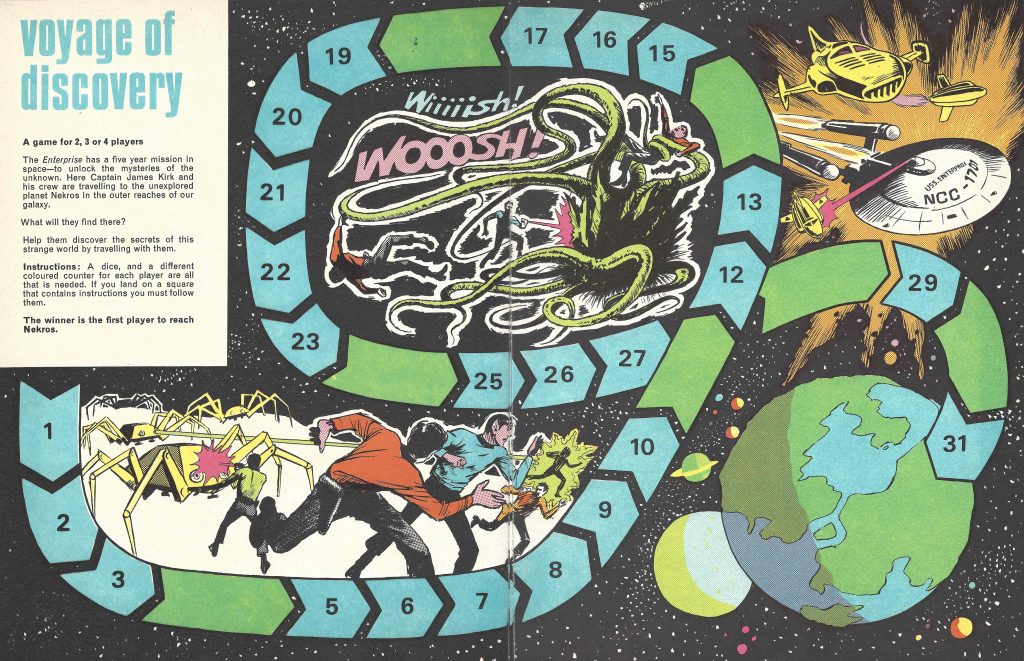
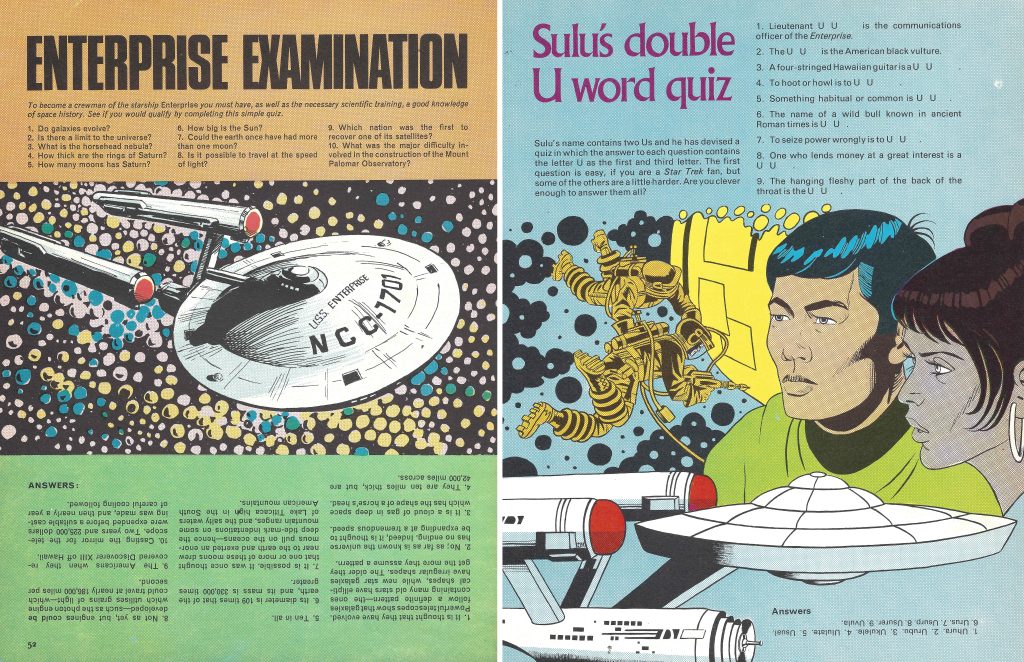
Along with the comics, the annuals contained feature articles and factoids related to space travel and astronomy, as well as board games and trivia quizzes peripherally connected to Star Trek, each aimed at entertaining that era’s juvenile reading audience. None of them offered new in-universe material, but there’s something charming and nostalgic about the simplistic articles and games that makes these books a joy to peruse. Plus, each book’s endpages were lined with beautiful original artwork thematically and aesthetically consistent with Gold Key’s style.
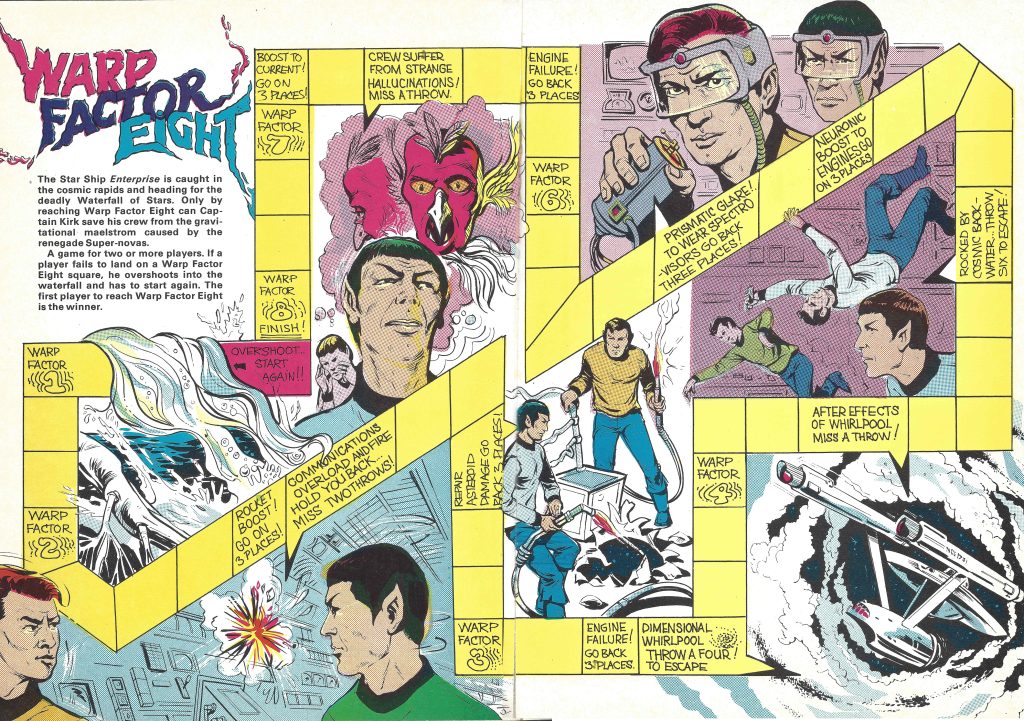
Amassing a complete set of annuals would be neither easy nor inexpensive in today’s collecting market, and since all copies purchased would be used—likely by multiple past owners—there’s a good chance the available books will contain children’s handwriting. The trivia quizzes will perplex no adult readers, the board games are the type one might find on a breakfast cereal box or in a kids magazine, and the astronomy articles are woefully out of date by today’s standards. But that’s all part of their charm, and for those able to put a full set together, they look mighty nice sitting on a bookshelf.
In addition to the hardcover annuals, Gold Key’s stories were packaged in a half-dozen softcover books and newsprint magazines between 1971 and 1977. These included the Star Trek Television Picture Story Book (combining issues #1 and 10), a pair of Star Trek Comic Albums (#2–3 and #7–9), the Star Trek Picture Book (#6—a premium gift handed out at Total gas stations), the Star Trek Winter Special (#2–3 yet again), and the Star Trek Special (#47–48). As with the annuals, a few space-based articles were sprinkled into the mix, with some comics printed in black and white.
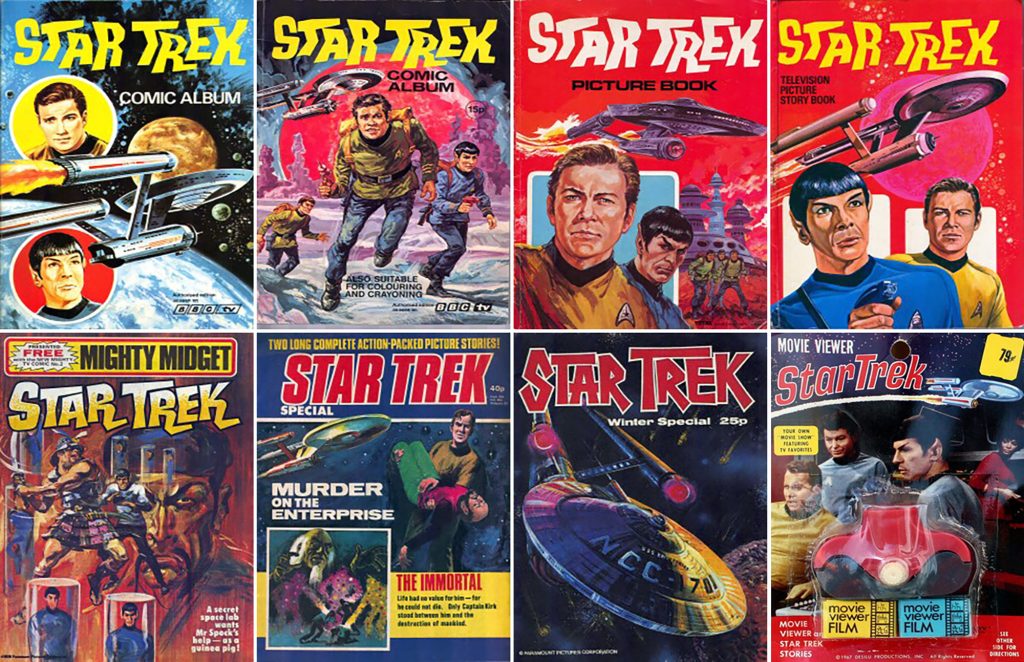
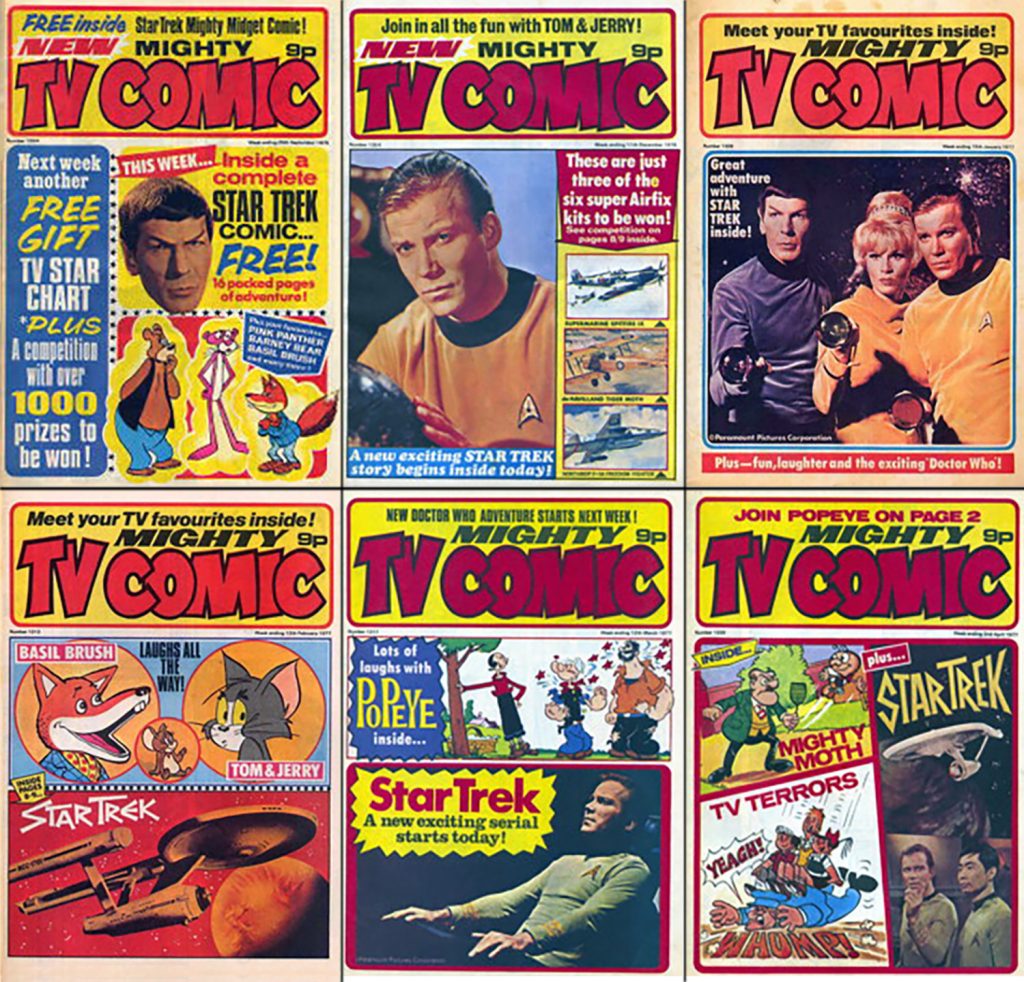
Several of Gold Key’s Trek tales appeared in British comic book magazine Mighty TV Comic (issues #1292–1352) and its successor, TV Comic (#1353–1381). In the course of these 90 newsprint issues, Polystyle Publications serialized Star Trek #1 and 4–9, while the Star Trek Mighty Midget, presented as an insert in Mighty TV Comic #1293, summarized the first half of issue #26 in prose, then reprinted the story’s second half in black-and-white. Chemtoy’s Star Trek Movie Viewer, meanwhile, adapted the first half of issue #1 as two black-and-white 16-millimeter filmstrips. (If kids wanted to know how that story ended, they were apparently out of luck.)
Back in the United States, Gold Key offered a quartet of trade paperbacks titled Star Trek: The Enterprise Logs. The idea was to collect the entire Gold Key run for those unable to find (or uninterested in buying) the individual monthlies, at a time when comic books were often treated as disposable commodities, making back-issue gaps more challenging to fill than they are in the current online marketplace. As a bonus, three of the four books contained original, exclusive mini-stories not released in the monthly comic.
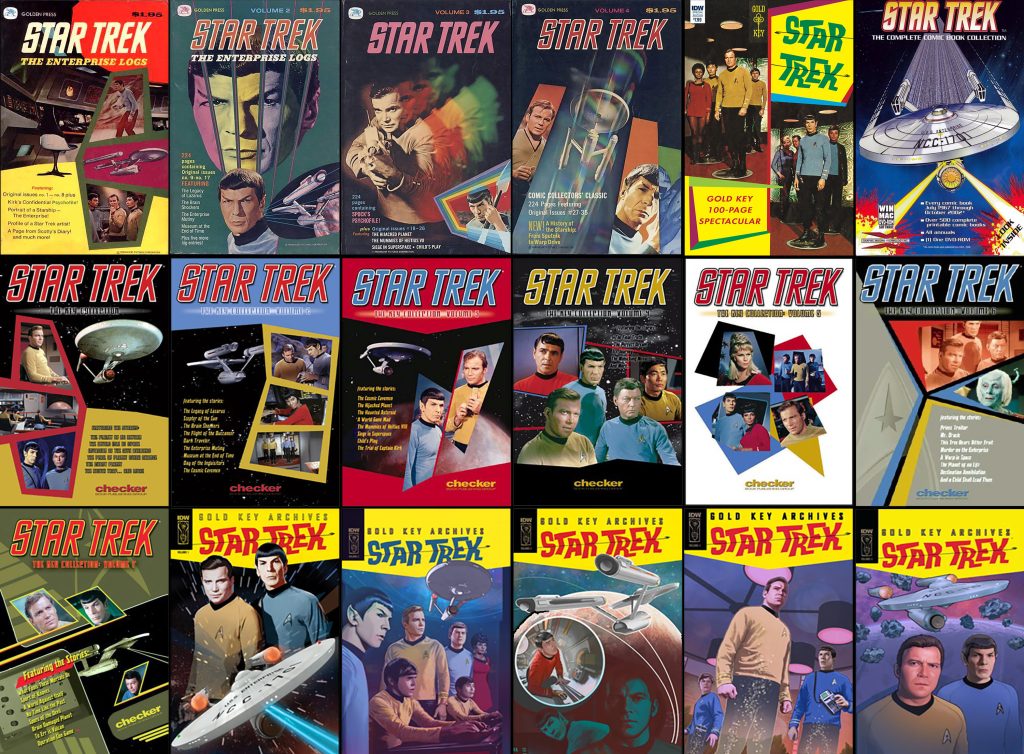
Unfortunately, only the first 38 issues were collected in these four volumes, and the publisher never continued the line. History would repeat itself years later when Checker Publishing and then IDW each announced plans to reprint the four Enterprise Logs books and pick up where Gold Key had left off. Both publishers gave up after only five volumes, though covers were made public for Checker’s never-released sixth and seventh volumes, with Checker getting as far as issue #43 and IDW stopping ten issues before that point. IDW’s Star Trek: Gold Key 100-Page Spectacular contained issues #1, 8, and 14, along with a retrospective Star Trek essay by Joseph F. Berenato, the editor of Sequart’s anthology New Life and New Civilizations: Exploring Star Trek Comics.
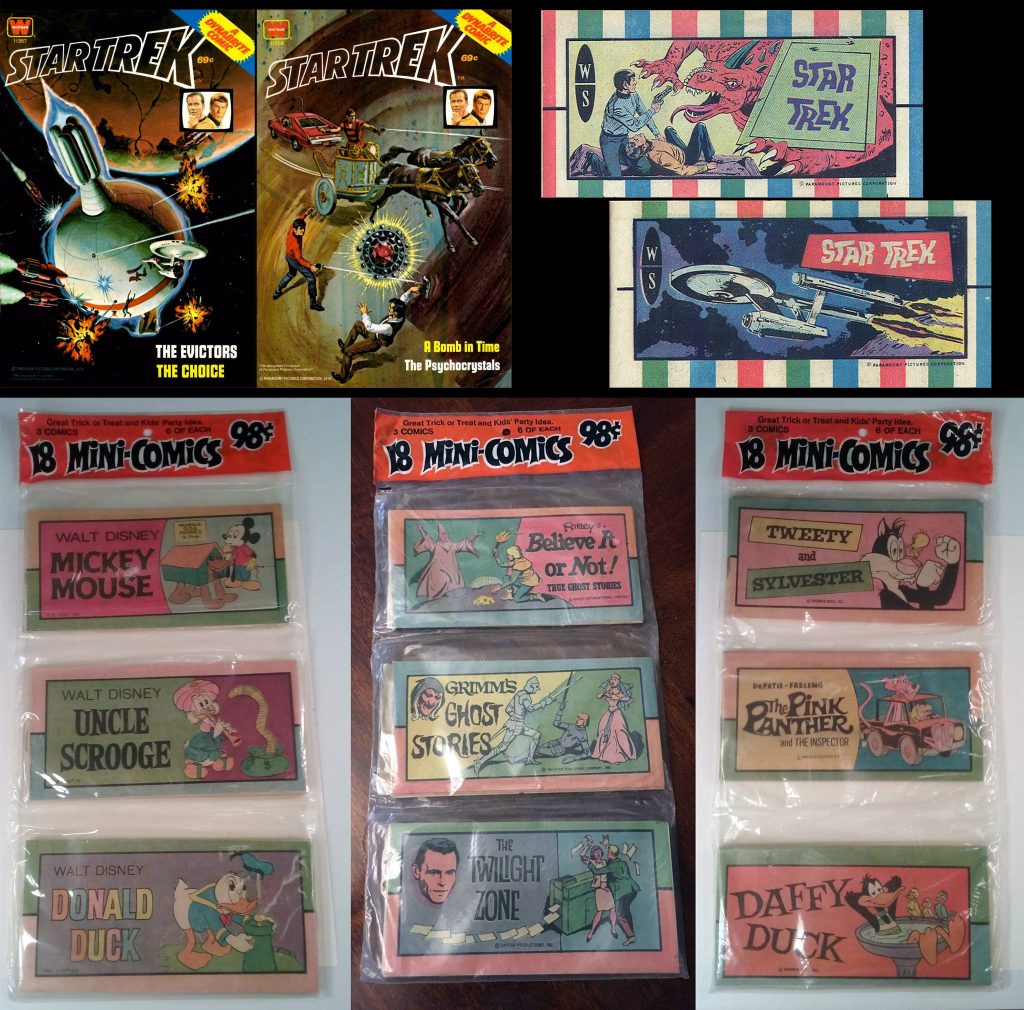
Western also published a pair of books under its Dynabrite label. Each featured two stories from the mid-range of the run, packaged within a durable cardboard cover. The stories were seemingly chosen at random, though they were among Gold Key’s better offerings. Issue #11357 reprinted #33 and 41, while #11358 offered #36 and 34. The printing quality was higher on these specials than in the regular comic, and they seem to have been printed in high volume, given the relative ease with which each can be procured to this day.

Issues #13 and 14, meanwhile, were abridged for reproduction in a pair of rectangular minicomics. You might have heard these issues described as “Dan Curtis Giveaways,” despite Dan Curtis Productions, which created the ABC soap opera Dark Shadows, having had no connection to Star Trek. This has long been a source of confusion—including for this column’s author—and it turns out the comics were not even giveaways since they were sold in vending machines. A header card used to advertise them simply called the line “Mystery Comics,” which may have been the intended title.
According to a discussion thread at the ComicBase User Community, this confusion stemmed from both the Overstreet Price Guide and the Grand Comics Database having incorrectly applied this designation, despite the comics having been produced by Western Publishing, not Dan Curtis. Only two of the nine 6-inch by 3-inch comics were Trek-related, with the others repurposing Gold Key’s tie-ins to Dark Shadows, The Twilight Zone, Ripley’s Believe It or Not!, Turok Son of Stone, The Occult Files of Doctor Spektor, Dagar the Invincible, and Grimm’s Ghost Stories. A similar minicomic set featured Ripley’s Believe It or Not!, Grimm’s Ghost Stories, and The Twilight Zone, as well as several cartoon characters, but Star Trek was not included in that grouping.
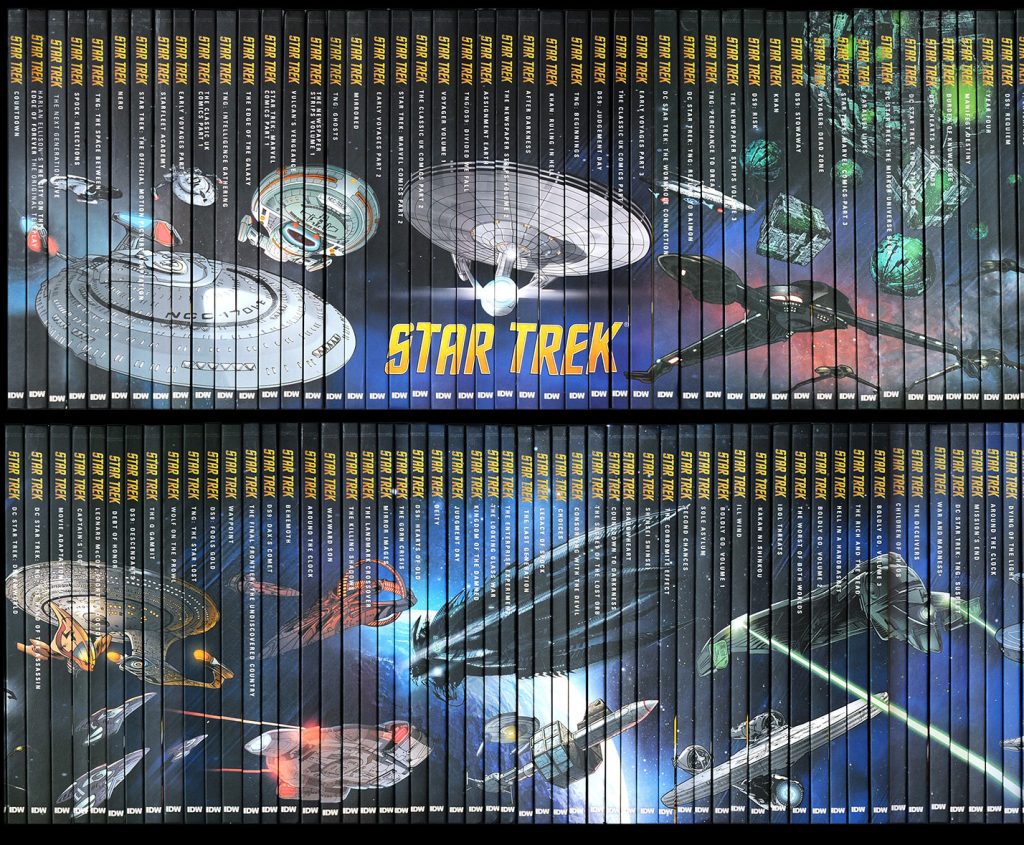
In recent years, Eaglemoss succeeded in doing what no other publisher has managed to do: reprinting the entire Gold Key line—not only the 61 monthly issues and four Enterprise Logs tales, but also John Warner’s unpublished 62nd issue, “Trial By Fire”—in the pages of the Star Trek Graphic Novel Collection. Between the Eaglemoss books, the editions discussed above, and GIT Corp.’s Star Trek: The Complete Collection CD-ROM, it’s not difficult these days to obtain the full Gold Key library (which, in the pre-Internet years, would have been a cost- and time-prohibitive venture).
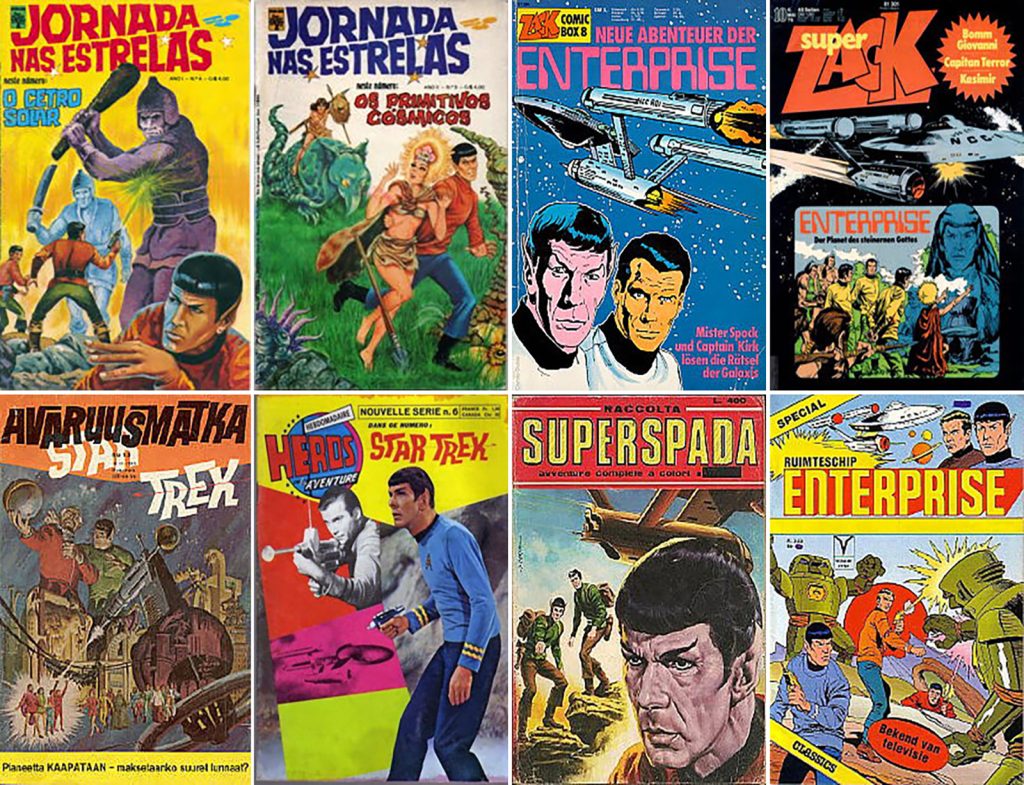
For those unsatisfied with merely reading the stories in English, hundreds of reprints have been published around the world, the covers of which can be viewed at Mark Martinez’s Star Trek Comics Checklist. Among them was a comic from Brazil’s Editora Abril titled Jornada Nas Estrelas, which (as discussed here) presented not only Gold Key reprints but also two original licensed stories in Portuguese that served as pretty faithful Gold Key-styled pastiches—and these, too, were presented in the Graphic Novel Collection, translated into English by journalist Edson Perin.
Western Publishing’s Gold Key imprint introduced the world to Star Trek comics. Although other companies have since picked up the mantle, producing comics inarguably better written and more accurately illustrated than what Western produced during its dozen-year span, there’s no denying that the series holds a special place in fans’ hearts. Thankfully, there’s also no shortage of ways in which to read those classic tales from the days when the franchise was young.
Looking for more information about Star Trek comics? Check out these resources:
- My ongoing column for Titan Books’ Star Trek Explorer magazine
- The Complete Star Trek Comics Index, curated by yours truly
- The Star Trek Comics Checklist, by Mark Martinez
- The Wixiban Star Trek Collectables Portal, by Colin Merry
- New Life and New Civilizations: Exploring Star Trek Comics, by Joseph F. Berenato (Sequart, 2014)
- Star Trek: A Comics History, by Alan J. Porter (Hermes Press, 2009)
- The Star Trek Comics Weekly page on Facebook
Rich Handley has written, co-written, co-edited, or contributed to dozens of books, both fiction and non-fiction, about Planet of the Apes, Watchmen, Back to the Future, Star Trek, Star Wars, Battlestar Galactica, Hellblazer, Swamp Thing, Stargate, Dark Shadows, The X-Files, Twin Peaks, Red Dwarf, Blade Runner, Doctor Who, Buffy the Vampire Slayer, Batman, the Joker, classic monsters, and more. He has also been a magazine writer and editor for nearly three decades. Rich edited Eaglemoss’s Star Trek Graphic Novel Collection, and he currently writes articles for Titan’s Star Trek Explorer magazine, as well as books for an as-yet-unannounced role-playing game. Learn more about Rich and his work at richhandley.com.
One thought on “Star Trek Comics Weekly #54”
Comments are closed.