
An ongoing discussion of how the comics provide prequels, sequels, and tie-ins to the Star Trek episodes and films, soon to be a book from BearManor Media. Click here to view an archive of this article series.
58: DC, Marvel and IDW, 1988–Present
It’s been more than three decades since John de Lancie first portrayed the omnipotent Q in Star Trek: The Next Generation‘s 1987 pilot, “Encounter at Farpoint.” The exuberant gusto with which he threw himself into the role won fans over, and Q emerged as a beloved recurring antagonist, in much the same way Tom Hiddleston’s Loki has in the Marvel Cinematic Universe. The actor would play Q twelve times by 2001, plaguing not only Jean-Luc Picard, but also Benjamin Sisko and Kathryn Janeway.
Q’s antics, at times malevolent but often playful in nature, were entertaining when he pitted himself against Janeway and Sisko, but it was as a foil to Picard that the character was truly in his glory. De Lancie’s pitch-perfect performances (even in episodes whose scripts failed to match the brilliance of the actor or the character) inspired appearances in various licensed Star Trek novels, short stories, audio adventures, and video games—and, of course, in the comics.

On Lower Decks, de Lancie resumed the role onscreen after a two-decade absence. The character’s return had been teased in several episodes, and when he finally showed up in “Veritas,” clad in the judge’s robes he’d sported in “Encounter at Farpoint” and “All Good Things…,” it provided some of the cartoon’s funniest moments. “Veritas” revealed that Q has hassled the Cerritos multiple times, which could suggest future appearances on that show since we now know he’s a nemesis to Carol Freeman’s crew. More significantly, it led to Q becoming a regular character on Star Trek: Picard. With that in mind, let’s look back at Q’s comic book adventures, courtesy of DC Comics, Marvel Comics, and IDW.
Q’s first comic appearance was in DC’s inaugural Next Generation miniseries, published in 1988. Issues #3–5 (“Q Factor,” “Q’s Day,” and “Q Affect”), written by Michael Carlin, with art by Pablo Marcos, Carlos Garzon, and Arne Starr, sees Q recruiting Tasha Yar’s former tormentor, Reglech D’Pru, to test whether the Enterprise crew would attack an unknown enemy. This seems an odd test in retrospect, as Q had already witnessed, in “Encounter at Farpoint” and “Hide and Q,” how much Starfleet personnel value life. But the DC team began writing the comics before a single episode even aired, so it’s to be expected that the fit wouldn’t be a seamless one.

Picard realizes Q is being tested by the Continuum, and the resultant tale is presciently similar to “Déjà Q,” with a suicidal Q, stripped of his powers and unable to handle mortality, sacrificing himself to save Picard’s crew, causing the Continuum to restore his omnipotence. “Déjà Q” is the better story thanks to de Lancie’s commanding presence and the meme-worthy scene of Data uncontrollably laughing, but it’s a credit to Carlin that the TV writers would utilize almost the exact same plot two years later.
DC launched a monthly The Next Generation title in 1989, penned primarily by the prolific Michael Jan Friedman. As a testament to Q’s popularity, four storylines featured the character, one cowritten by de Lancie himself. DC also adapted “All Good Things…” as a special one-shot titled The Series Finale, written by Friedman and illustrated by Jay Scott Pike and José Marzan Jr., with a sterling cover by Sonia R. Hillios.

Issues #33–35 (“The Way of the Warrior,” “Devil’s Brew,” and “The Dogs of War”) were scripted by Friedman and drawn by Kenneth Penders and Pablo Marcos, with Jerome K. Moore and Jason Palmer providing covers. After wishing he had a hundred officers like Worf, Picard soon regrets this sentiment when Q turns the Enterprise crew into Klingons—all except Worf, who is already Klingon; Data, who is artificial; and Guinan, who can resist Q’s powers. A Klingon Guinan does sound intriguing, though. Klingons don’t make the best listeners… they’re more likely to lose their patience and destroy a friend’s mandolin, as Geordi La Forge would discover in “Qpid.”
Q’s actions create instant havoc for a visiting alien delegation with an instinctively violent reaction to other warrior species. When they find not Picard’s mostly human crew awaiting their arrival, but rather a thousand belligerent Klingons, the aliens are outraged, for although their berserker instincts have been triggered, they’re genuinely looking to avoid a fight. Why does Q do this, you ask? The same reason he makes Picard a Robin Hood, Will Riker a wannabe god, Tasha Yar a popsicle, Worf a Merry Man, and Wesley Crusher a hunky heartthrob hero: because it’s funny and makes the Enterprise crew look like idiots. What more reason does he need?

Another three-parter spans issues #52–54 (“The Rich and the Dead,” “Reductions & Deductions,” and “Hidden Agendas”), also by Friedman and solo-illustrated by Marcos. Once again, Q is his trickster self, making Picard’s crew jump through hoops for the sake of his amusement. This time, the hoops are literal ones since the story takes place at a circus. Such events are a quaint concept in the 24th century, it seems, which makes sense. When kids can look out their front door and watch hundreds of aliens walking around, a monkey riding an elephant while a clown sprays seltzer probably isn’t all that exciting.
Picard and Beverly Crusher try out a new Dixon Hill adventure, but Q interrupts the program dressed like a 1940s gumshoe—an image that alone justifies the cover price, as a trenchcoated private eye is exactly the sort of character Q would revel in portraying. He mischievously shrinks Deanna Troi and Worf down to the size of dust motes, then places them in the folds of a circus performer’s costume. To save them, Picard must finish the holo-program before his officers die in a cannonball routine. Fittingly, Jean-Luc solves the mystery thanks to his knowledge of wines!
Never let it be said that Q is above repeating the same trick twice if it worked well the first time. In issues #79–80 (“Artificiality” and “The Abandoned”), he pulls the “change the crew into something non-human” gag once more—though this time he makes them androids instead of Klingons. Picard, having apparently learned nothing from the previous fiasco, wishes everyone were as durable as Data. So naturally, Q (a fan of the maxim “Be careful what you wish for”) turns the crew into a thousand Datas. As with the Klingon incident, widespread havoc ensues.
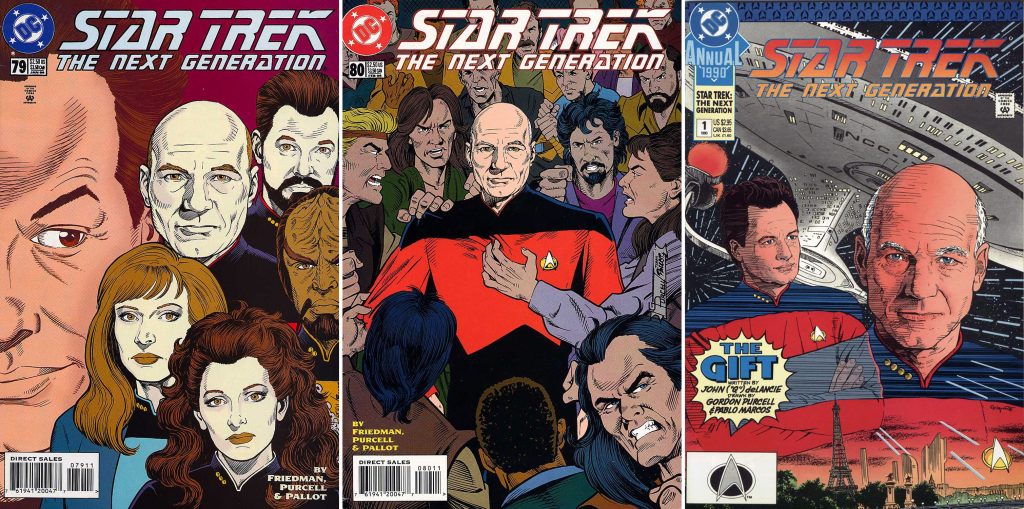
Becoming newly minted androids leaves the crew ill-equipped to respond to a distress call, as they lack the compassion that Data has had decades to develop. Android Crusher and Android Troi fail to muster empathy for their patients, while Android Picard cannot make command decisions (which, interestingly, he can as a golem-style android on Star Trek: Picard). Basically, the story implies that in Data’s formative years, he must have been rather useless; thankfully, he’s gotten better with age. In fact, it’s Data who figures out the rules of Q’s game, after which the prankster restores the crew’s biological forms. This being the final storyline, Q never has a chance to turn the crew into Bolians, Hortas, Pakleds, Gormaganders, or giant Phylosian Spock clones. A shame, that last one.
What’s interesting about Q is that his tests sometimes have a lesson to impart. Why throw the Enterprise at the Borg in “Q Who”? To force mankind to prepare for dangers they can’t imagine. Why make Picard re-experience his cardiac injury in “Tapestry”? To help him let go of a long-held regret. DC’s first Star Trek: The Next Generation Annual is in that category, and its purpose is quite similar to that of “Tapestry.” (Presumably, he has a reason for turning the Cerritos crew into chess pieces and making them play soccer with a living deck of playing cards, but I’ll be damned if I know what it is. It’s probably the same reason he killed Worf and Wesley with bayonet-wielding Napoleonic pig-soldiers.)
Cowritten by Friedman and de Lancie, “The Gift” was illustrated by Marcos and Gordon Purcell, with an outstanding cover by Jerome Moore. Q creates a timeline in which Picard’s brother Claude, who’d died at age six—and who would be christened Robert on TV—survives to become a sociopathic Hitler-like dictator who corrupts Starfleet, conquers many worlds, and executes the Enterprise crew. Jean-Luc realizes the universe is better off without Claude and, freed from the guilt he’d harbored regarding that childhood tragedy, allows Q to return his brother to the grave.
“The Gift” is a poignant, satisfying tale, despite the TV show having overwritten Picard’s family origins following the annual’s publication. Amusingly, Picard hits Q several times in the comic, even though when Sisko knocked Q to the ground in “Q-Less,” Q claimed Picard never hit him. That Deep Space Nine episode aired after this comic’s release, but it’s moot anyway since Q has all the credibility of a 21st-century politician during a global pandemic, so it’s easy to believe he’s lying when he denies the beat-down.
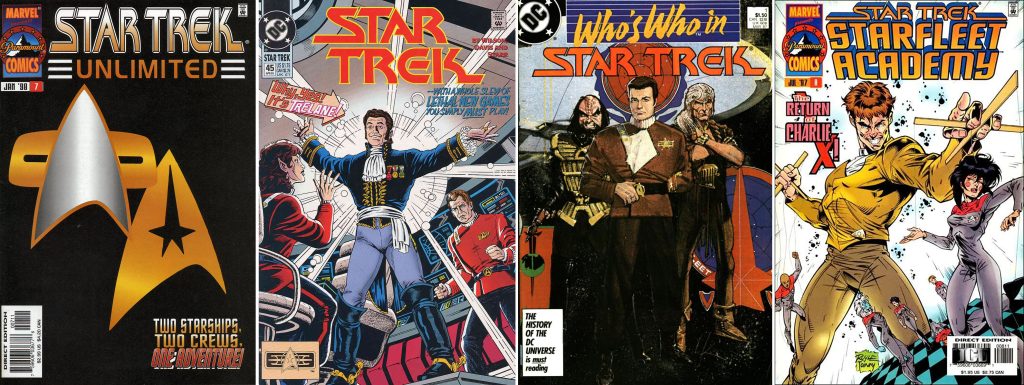
No matter how many Star Trek series have aired, Kirk, Picard, and their crews have remained the franchise’s most revered casts. In the 1990s, Marvel Comics celebrated both shows with Star Trek Unlimited. For issue #7, writers Dan Abnett and Ian Edginton contributed “An Infinite Jest,” illustrated by Ron Randall, Tom Morgan, Art Nichols, and Scott Hanna. The story bought back not only Q but also fellow trickster Trelane, the immature child god from “The Squire of Gothos,” after whom Gene Roddenberry patterned Q while conceiving The Next Generation‘s pilot.
The two entities have made a friendly wager for the right to rewrite Creation, because that’s what bored gods do. This entails swapping Picard with Kirk and watching what transpires as the two captains attempt to make sense of their fish-out-of-water scenarios. Peter David’s novel Q-Squared had previously established Trelane as a member of the Continuum, so the two beings matching wits in the comics was a natural development, albeit one that threatens to unravel existence. Such dire consequences don’t stop Edginton and Abnett from playfully mocking both captains, as Kirk flirts inappropriately with Counselor Troi, much to her discomfort, while Picard discovers in dismay that the older starship doesn’t have a captain’s ready room.
Trelane, incidentally, shows up in issue #45 of DC’s second monthly Trek series, “A Little Man-to-Man Talk,” from writer Steven H. Wilson and artists Rob Davis and Arne Starr, and he also has an entry in Allen Asherman’s Who’s Who in Star Trek #1. If one accepts the premise that Trelane is a Q (the licensed lore is inconsistent on this point), then that makes these two DC issues Q-related comics as well.
Q was set to make another Marvel appearance in Starfleet Academy #22, but that series was canceled before writer Chris Cooper could make it so. The issue would have also revisited Charles Evans, from “Charlie X” (hence, the clever equation of a title, “Q=X”). In Cooper’s outline for ten issues that never were, Q makes Charlie an offer he can’t refuse: “join the Q Continuum or die.” This dilemma recalls Amanda Rogers’ plight in “True Q,” and it’s a shame it never came to pass. Charlie would have avoided becoming a Q—but had he accepted the offer, that would have retroactively made Cooper’s Starfleet Academy #8 (“X2“), also featuring Charlie, a Q comic as well!

Since entering the Star Trek arena in 2007, IDW has published five Q stories: 2009’s Alien Spotlight: Q one-shot, 2011’s Star Trek/Legion of Super-Heroes, 2014’s “The Q Gambit” (published in Star Trek #35–40), 2018’s Waypoint Special #1, and 2019’s The Q Conflict #1–6. These stories will be discussed in greater detail once this column reaches the IDW era, but in the meantime, let’s consider how each utilized the Continuum.
For the tenth issue of Alien Spotlight, IDW turned to the writing duo of Scott and David Tipton. Illustrated by Elena Casagrande, this comic was set a month after Star Trek: First Contact. Q decides to gain a better understanding of humanity by possessing Jean-Luc Picard and taking an active role in his own game instead of watching from the sidelines. Naturally, he finds that being a human starship commander is not as easy as he’d assumed from his perspective as an all-knowing celestial overlord.
It’s a refreshingly humbling use of Q, and it’s surprising that no other comic writers have done this. Putting the trickster in Picard’s shoes offers a change of pace for a being whose modus operandi has been to force humans into admitting their own inadequacy by playing absurd mind-games, then harrumphing when they inevitably outsmart him. There’s a symmetry to Q choosing to do this right on the heels of the theatrical showdown with the Borg, since he’s responsible for the cyborgs taking notice of the Federation in the first place.
The Waypoint anthology offers an out-of-the-box use of Q that is quite unlike other tales involving the Continuum, yet it’s reminiscent of “True Q” since it sees Q helping a young entity cope with godhood. In “Consider Eternity,” writer Brandon Easton and illustrator Josh Hood present a meeting between Q and the trinity comprising Will Decker, Ilia, and V’Ger, from Star Trek: The Motion Picture. V’Ger has so rarely been revisited in any incarnation of Star Trek, but this unique and thoughtful tale goes a long way toward rectifying that oversight.
Q instructs the newborn god on how to exist omnipotently, and in so doing becomes fascinated with humanity, inspiring the obsessive need to pester Starfleet that Q will manifest during Picard’s era. De Lancie’s sarcastic, smarmy performance rings true in every line of dialogue, and the interactions between Q and Decker/Ilia/V’Ger offer an absorbing glimpse at the sorts of godlike tasks to which Q might attend when he isn’t biding his time creating chaos for puny organic life forms.

IDW’s Star Trek/Legion of Super-Heroes, from writer Chris Roberson and artists Jeffrey and Philip Moy, featured an unusual use of Q. In an alternate universe matching up Star Trek with DC Comics’ superhero continuity, a combined immortal comprising Flint (“Requiem for Methuselah”) and immortal Vandal Savage (DC) keeps Q trapped in a magical globe for millennia, forcing the trickster to obey him as his own personal genie. Naturally, Q is less than pleased with this arrangement, but he’s helpless to escape until the arrival of the Enterprise crew and the Legionnaires.
The heroes devise a plan to free Q from his prison, save both universes, send both crews home, and prevent this strange timeline from happening in the first place—which, naturally, wipes the 1960s crew’s memories of meeting Q a century before Jean-Luc Picard, neatly avoiding continuity problems. In the final issue, Q visits Flint on Holberg 917G wearing an outfit like the one Trelane sported in “The Squire of Gothos,” a clever nod at the stories which have made Trelane a Continuum member.

“The Q Gambit,” by Mike Johnson and Tony Shasteen, takes place in the Kelvin timeline introduced in JJ Abrams’ 2009 film and its sequels. It’s not only one of the best stories set in that alternate universe, but also one of the best Q tales ever told in the comics medium. In the months since Star Trek Into Darkness, Spock’s incursion into the other reality sets into motion events that will have catastrophic consequences, with the Pah-wraiths and the Dominion forming an unholy alliance and eliminating the Prophets’ existence. Only Q can stop this, but he needs some human help.
With the stakes so grave, it’s believable that Q would uncharacteristically step in to fix the problem. But when prime Picard refuses to help, Q visits the Abramsverse and elicits aid from Chris Pine’s Kirk in thwarting the disaster. To accomplish this goal, he propels the Enterprise gang across time and space to that reality’s analogue of Deep Space Nine. It’s not often that a Trek comic features Kirk’s, Picard’s, and Sisko’s crew in a single tale. Throw in Kurn, Gul Dukat, and multiple realities, and you have one hell of a tale that makes excellent use of Q and adeptly captures the feel of Deep Space Nine.
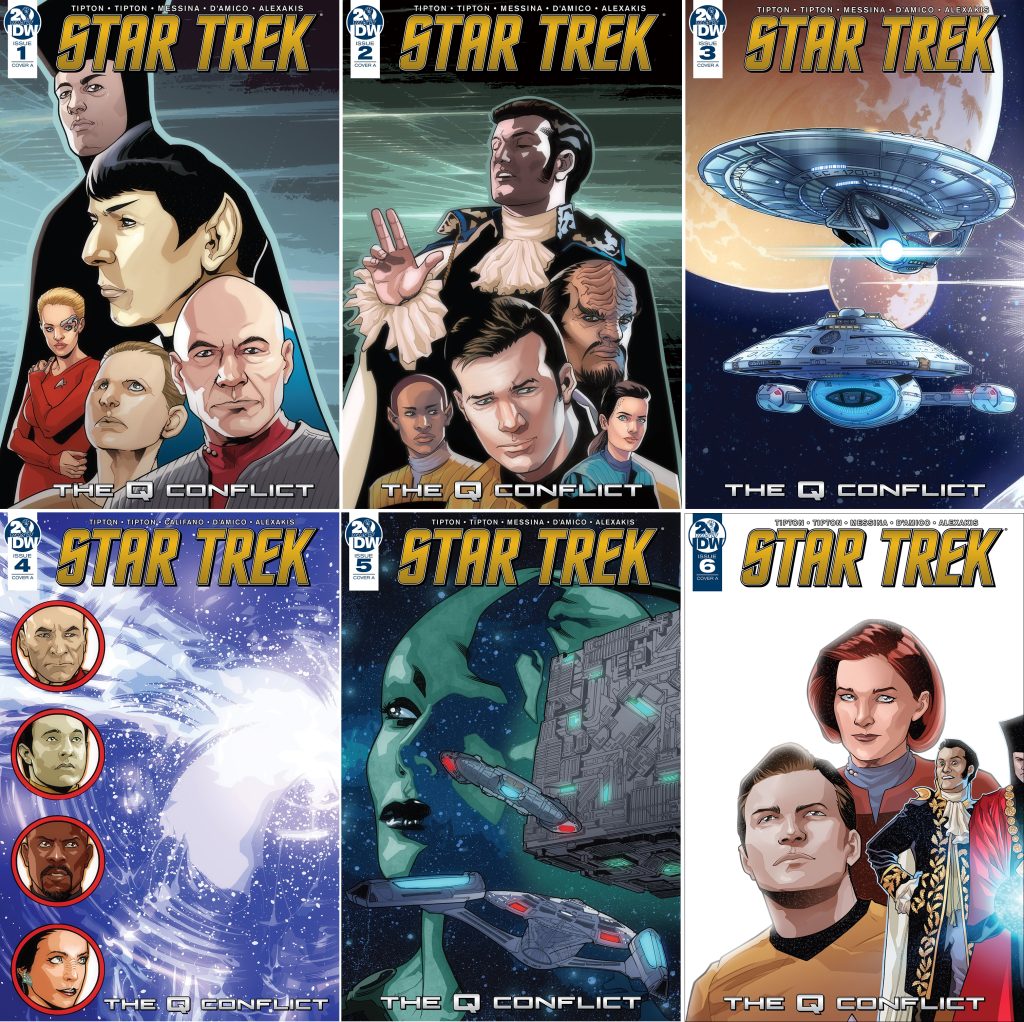
Finally, The Q Conflict, illustrated by David Messina and Elisabetta D’Amico, revisits not only Q, but several superior beings from The Original Series. Starring Kirk, Picard, Sisko, and Janeway, it brings together nearly every cast at the time; the only characters missing are Arex and M’Ress from The Animated Series, and the NX-01 crew from Star Trek: Enterprise. The miniseries reunites Trelane and Q (who are of different species here, contradicting the above stories), adding Ayelborne the Organian (“Errand of Mercy”) and an unnamed Metron (“Arena”) to the mix. It seems the four antagonistic entities, in taking out their aggressions on each other, have endangered the universe by triggering multiple supernovae.
Once again, Q turns to humanity to solve his problems—a premise often utilized in Star Trek, despite how unlikely it is that omnipotent beings would require assistance from mere mortals. It would be like us seeking help from chipmunks not named Alvin, Simon, or Theodore. But c’est la vie. As Q explains, other advanced species periodically challenge the Continuum’s supremacy, and when this happens, all-out war can result. Picard rightfully objects to such irresponsible behavior on the part of supposed gods, so Q conscripts the four crews to serve as champions for the divine in a galactic proxy war. When will Picard learn to shut up when Q is around?
It’s a shame Yarnek of Excalbia wasn’t included, as that would have enabled Jonathan Archer and company to join the contest. The Excalbians did something similar back in DC’s first Star Trek arc, in fact, when they posed as leaders of the Federation and the Klingon Empire, incited a galactic war to test whether good or evil was stronger, and challenged the Organians to settle the question in a battle on a higher plane. Sometimes, the franchise’s early voyages resonate with those that come later—and as it happens, Marvel’s Star Trek: The Early Voyages is what we’ll return to in next week’s column.
Looking for more information about Star Trek comics? Check out these resources:
- My ongoing column for Titan Books’ Star Trek Explorer magazine
- The Complete Star Trek Comics Index, curated by yours truly
- The Star Trek Comics Checklist, by Mark Martinez
- The Wixiban Star Trek Collectables Portal, by Colin Merry
- New Life and New Civilizations: Exploring Star Trek Comics, by Joseph F. Berenato (Sequart, 2014)
- Star Trek: A Comics History, by Alan J. Porter (Hermes Press, 2009)
- The Star Trek Comics Weekly page on Facebook
Rich Handley has written, co-written, co-edited, or contributed to dozens of books, both fiction and non-fiction, about Planet of the Apes, Watchmen, Back to the Future, Star Trek, Star Wars, Battlestar Galactica, Hellblazer, Swamp Thing, Stargate, Dark Shadows, The X-Files, Twin Peaks, Red Dwarf, Blade Runner, Doctor Who, Buffy the Vampire Slayer, Batman, the Joker, classic monsters, and more. He has also been a magazine writer and editor for nearly three decades. Rich edited Eaglemoss’s Star Trek Graphic Novel Collection, and he currently writes articles for Titan’s Star Trek Explorer magazine, as well as books for an as-yet-unannounced role-playing game. Learn more about Rich and his work at richhandley.com.
One thought on “Star Trek Comics Weekly #58”
Comments are closed.