
An ongoing discussion of how Star Trek comics provide prequels, sequels, and tie-ins to the episodes and films…
134: IDW Publishing, 2018
Thanks for being patient as our journey through the long history of Star Trek comic books took an unscheduled but much-needed three-month period of R&R at the fringes of the final frontier. (Ever notice that every single R&R stop on Star Trek is described as “much needed”? These people work hard and apparently play even harder.) I’m back now, so let’s return to where this column left off back in July: the mirror universe.

There’s clearly something about the mirror universe (introduced in The Original Series‘ “Mirror Mirror”) that appeals to Star Trek authors. Not only have many comic writers and novelists revisited that reality, but it formed the basis of numerous episodes of Star Trek spinoffs Deep Space Nine, Enterprise, and especially Discovery. This week’s column will focus on a Star Trek: The Next Generation miniseries from a few years ago, IDW’s Through the Mirror, written by Scott and David Tipton.

The Tipton brothers first began exploring the mirror counterparts of Jean-Luc Picard and the Enterprise-D crew in a single issue of Star Trek: Mirror Images, then delved more deeply into that reality’s 24th century in the miniseries The Next Generation: Mirror Broken. Through the Mirror picks up shortly after Mirror Broken, with Picard and his comrades preparing for an incursion into the prime reality. The miniseries was illustrated by Marcus To, Chris Johnson, Josh Hood, Carlos Nieto, Débora Caritá, James Kenneth Woodward, Peter McKinstry, and Marc Laming.
By raiding ships in the prime universe, mirror Picard has been rebuilding the Imperial fleet—quite successfully, in fact. As the series opens, the prime Enterprise inspects a mining facility on Naia VII, a world introduced in the Tiptons’ Star Trek: The Next Generation/Doctor Who: Assimilation2 (though the planet is inconsistently named here—sometimes it’s Naia VII, other times Naia IV). Worf notices doppelgängers of Will Riker and Geordi La Forge returning to their own reality, after which the Enterprise answers a distress call from an Andorian vessel attacked by the mirror alternates.

Mirror Deanna Troi and Reginald Barclay infiltrate the prime Enterprise to fake a priority message from Admiral Owen Paris (Tom Paris’s father, portrayed by Richard Herd in Voyager‘s “Pathfinder”). They also fake a ship-wide radiation leak to force an evacuation so their Picard can steal the starship. Unlike the passive Barclay and the peaceful Troi of the prime universe, these two are formidable and dangerous. The prime crew notices their sabotage, however, resulting in a corridor firefight before the doubles retreat to plunder another day. The other Barclay opts to remain behind, disgusted by how our Reg has failed to live up to his potential—which mirror Reg vows to fix.
Through the Mirror provides a nice callback to The Next Generation‘s “Hollow Pursuits,” Barclay’s Star Trek franchise debut. In that episode, Reg was addicted to holodeck programs as a means of avoiding reality—and in this issue, the other Reg uses holodeck programs to train him for invading a reality. It also references another Barclay-centric episode, “The Nth Degree,” in the form of the Martorelles Array, drawn to resemble the episode’s Argus Array.

Ruthless and arrogant, Barclay’s other-dimensional analogue is outraged when someone calls him “Broccoli,” causing him to tie up prime Reg, takes his place, and force others to show his double respect. It’s kind of hilarious, actually. Dwight Schultz’s Barclay was always a delightful character on The Next Generation and Voyager, as well as in the film Star Trek: First Contact, so it should come as no surprise that his mirror double gets all the best scenes in the Tiptons’ mirror universe tales. This will pay off nicely in later stories published after Through the Mirror.
Mirror Troi also gets some amusing screentime, particularly when she and Barclay beam aboard the prime Enterprise wearing uniforms from The Next Generation‘s pilot episode, “Encounter at Farpoint,” due to outdated information gathering. Several seasons have passed since the pilot by this point, and Troi’s skirt only ever showed up in that episode, making it stand out like a sore non-regulation thumb. Seeing her in it again draws notice from a confused Riker, but she covers for the flub by flirtatiously claiming to be feeling nostalgic—about both the skirt and him. Flustered, Will makes a hasty exit.

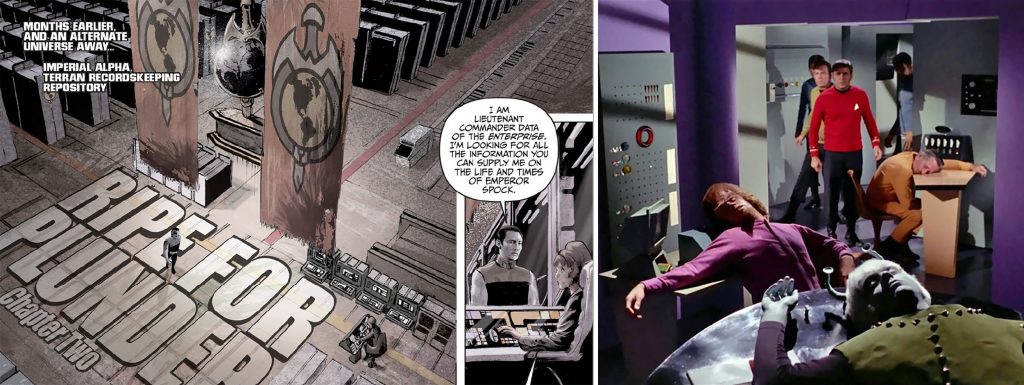
A backup tale, “Ripe for Plunder,” spans all five issues of Through the Mirror. Set months prior to the main story, it sees mirror Data searching for Emperor Spock, secretly living out his retirement on a remote world protected by Tellarite bodyguards. Data’s mission is to obtain the secret of interdimensional travel from the deposed ruler. As the sole surviving person to experience the events of “Mirror, Mirror,” the elderly Vulcan ends up tortured by an android with Borg upgrades and no compunction about inflicting pain. It’s a gruesome fate for such a beloved character, and quite a different interaction than their prime-universe encounter in The Next Generation‘s “Unification.”

Through the Mirror—both its main story and “Ripe for Plunder”—largely adheres to the Empire’s post-“Mirror, Mirror” history as outlined in Deep Space Nine‘s “Crossover,” with Emperor Spock having instituted major reforms to make the Empire less aggressive. His efforts were successful, but his timing not so much, as this left Earth vulnerable to conquest by the Klingon-Cardassian Alliance. From there, the comic reveals fascinating tidbits not covered in the episode: After Spock’s reign ended, the Empire altered records to minimize his historical significance, illustrating a universal truth—that the disastrous actions of failed space-politicians attempting to foster democracy are often swept under the space-rug. (The same is also true of disastrous Earth politicians attempting to subvert democracy, by the way. Ahem.)

As with most Tipton tales, Through the Mirror contains numerous continuity nods for the trivia-minded. The mirror Enterprise crew visits Imperial Alpha, a Terran Empire records-keeping repository. This facility would presumably be the mirror counterpart to Memory Alpha, a Federation central library featured in the 1960s episode “The Lights of Zetar” (and the namesake of the invaluable Star Trek Wikia page).
While searching for information about Emperor Spock, mirror Data peruses Imperial files and comes across an image of Spock’s parents, Sarek and Amanda, resembling their counterparts from the episode “Journey to Babel”—though, naturally, Sarek has a beard. Men in the mirror universe do seem to love their facial hair. It’s a wonder Data hasn’t added some to his face as well.

It’s Data’s information hunt that provides the motherlode of episode and movie ties-ins. The android consults with a pair of Bynars (“11001001”), as well as two hooded guys who look like Lawgivers from the classic episode “The Return of the Archons”… but aren’t, according to David Tipton. (Still, it’s fun to speculate, isn’t it?) Data also visits a disreputable drinking establishment that should be familiar to fans of the movies, as it appears to be the same one Leonard McCoy visited in Star Trek III: The Search for Spock while chartering an illegal space flight to the Genesis Planet.

While there, Data approaches a patron who seems to be the same backward-talking alien McCoy had met. What’s more, a human waitress (dubbed Kendra in Star Trek III‘s novelization) and another alien patron also appear to be the same ones from McCoy’s visit. Of course, the miniseries is set more than 80 years after the movie, so either both aliens and the waitress are all long-lived, or they each had identical counterparts who hung out at that bar a century ago, or the bar utilizes time travel. In any case, the scene also contains a subtle homage to a similar scene in Star Trek V: The Final Frontier, for a feline dancer performs seductively in the background.

For next week’s installment, this column will remain connected to the alternate reality with Terra Incognita, the third chapter of the Tiptons’ interdimensional tetralogy that began with Mirror Broken, continued with Through the Mirror, and recently concluded with The Mirror War, which we’ll get to soon. If you stuck by this column during my hiatus, then I offer my hearty thanks and hope to see you back here for that discussion. We’re deep in mirror Terra-tory at the moment, and there’s nothing Terra-ble about it.
Looking for more information about Star Trek comics? Check out these resources:
- The Complete Star Trek Comics Index, by yours truly
- The Star Trek Comics Checklist, by Mark Martinez
- The Wixiban Star Trek Collectables Portal, by Colin Merry
- New Life and New Civilizations: Exploring Star Trek Comics, by Joseph F. Berenato
- Star Trek: A Comics History, by Alan J. Porter
Rich Handley has written books about Planet of the Apes, Back to the Future, and Watchmen, as well as licensed Star Wars and Planet of the Apes fiction, and he edited 70 volumes of Eaglemoss’s Star Trek Graphic Novel Collection. Rich co-edited Titan’s Scribe Award-nominated Planet of the Apes: Tales from the Forbidden Zone; nine Sequart anthologies discussing Planet of the Apes, Star Wars, Battlestar Galactica, Hellblazer, Stargate, and classic monsters; and four Crazy 8 Press anthologies about Batman and (now) the Joker. He has contributed essays to DC’s Hellblazer: 30th Anniversary Celebration; IDW’s Star Trek and Star Wars comic-strip reprint books; BOOM! Studios’ Planet of the Apes Archive hardcovers; Sequart anthologies about Star Trek and Blade Runner; ATB Publishing’s Outside In line exploring Star Trek, Buffy the Vampire Slayer, Angel, The X-Files, Twin Peaks, and Babylon 5; and a Becky Books anthology covering Dark Shadows.
2 thoughts on “Star Trek Comics Weekly #134”
Comments are closed.