
Everyone knows the first interracial kiss on television took place during Star Trek‘s third season, in the episode “Plato’s Stepchildren,” in which telepathic aliens forced Captain James T. Kirk, the Caucasian commander of the USS Enterprise, to passionately kiss his African-American communications officer, Nyota Uhura. Everyone knows this, right? It’s common knowledge, yes?
Star Trek challenged many 1960s preconceptions, and when it came to the rule of not showing those of different skin colors or nationalities locking lips on TV, the Enterprise crew boldly went where no network had gone before, changing television forever. Little fanfare was built around it at the time, but the kiss has since been well-documented in books, articles, essays, and interviews, and the creators, cast, and crew have often expressed their pride at having been a part of such a societal milestone. That first kiss is the stuff of legend, and it’s one of the franchise’s most significant claims to fame.
Everyone knows this.
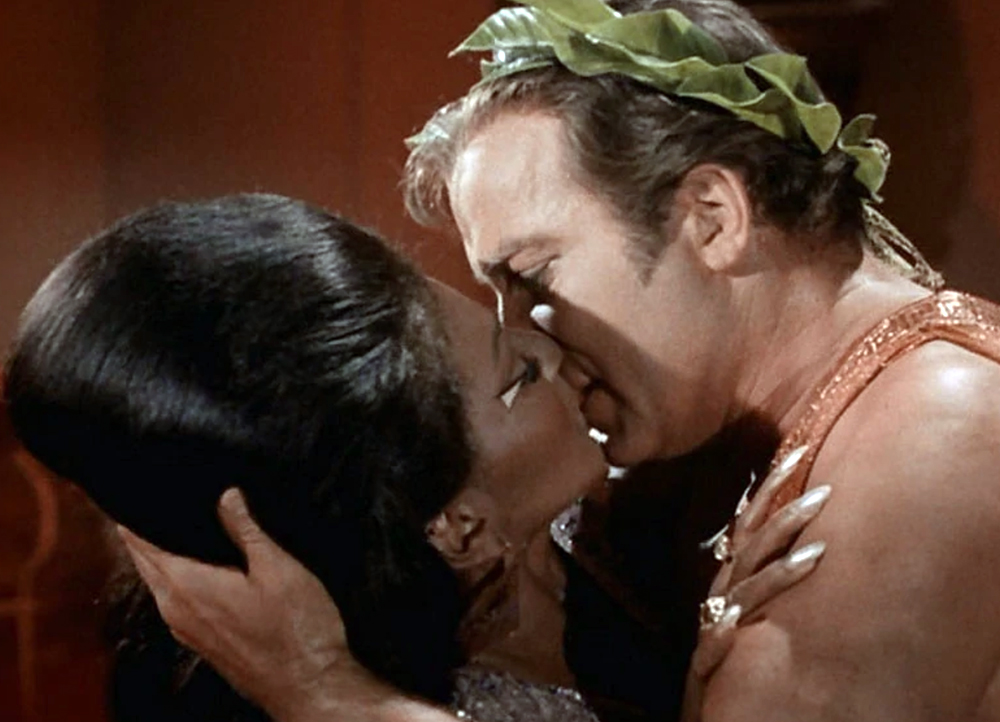
There’s only one slight problem: it’s not true. You see, in the race on TV regarding, well… race on TV… several other series had beaten Star Trek to the finish line.
To be clear, Star Trek‘s creators deserve a lot of credit for having Nichelle Nichols and William Shatner engage in that kiss in 1968, knowing full well the episode would air in Southern U.S. states and other racially charged areas of the world in which ignorant bigotry could potentially elicit viewer and sponsor outrage. It was a daring move that could have backfired for the network, so the fact that it aired is impressive. But the first such kiss? The truth is, that oft-touted title rightfully belongs to others.
To preserve Star Trek‘s accolades, one could try to narrow the criteria down to “first interracial kiss on U.S. television,” thereby ruling out any non-American programs that featured such kisses prior to “Plato’s Stepchildren.” However, that still wouldn’t be accurate, since a few American-made shows had predated Star Trek in breaking the multicultural romance barrier. Perhaps “first interracial kiss on scripted U.S. television”? Or maybe narrowed further to “first interracial kiss on scripted prime-time U.S. television”? Again, no, because there are earlier examples of shows in both categories.
In fact, as astonishing as it may be to realize, the Uhura-Kirk smooch wasn’t even the first interracial kiss on Star Trek. It wasn’t even the second—or the third!
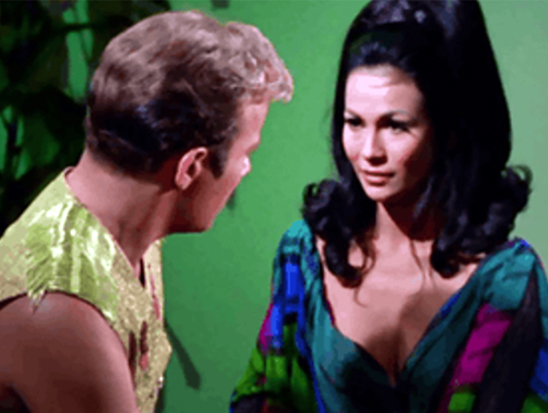
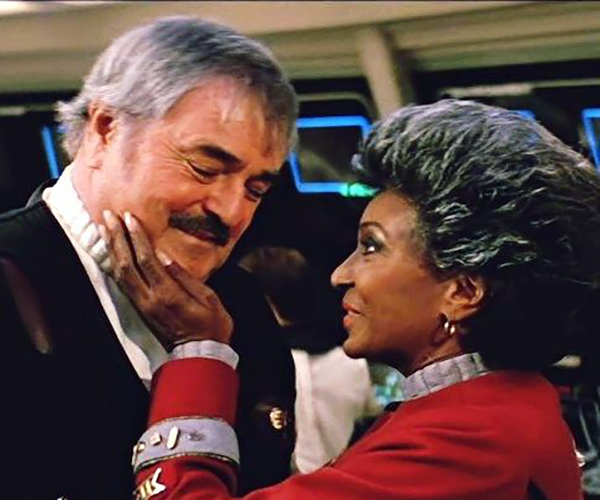
During the show’s second season, 32 episodes before the Platonians reared their telepathic Grecian heads and forced Uhura and Kirk (and Christine Chapel and Spock) to perform live-action porn for their amusement, “Mirror, Mirror” had featured a passionate kiss between Kirk and mirror-Marlena Moreau. That same episode saw Uhura seducing mirror-Hikaru Sulu, an Asian man, who lustfully kissed her neck while pulling her half-naked torso close to his and caressing her.

Fans and journalists often overlook both examples, forgetting that actress Barbara Luna (Moreau) is Filipino and Spanish. Since Nichols, a black woman, was shown kissing Shatner, a white man, during the U.S. Civil Rights movement (which ended the same year that “Plato’s Stepchildren” hit the airwaves), that tends to get all the press. And with Nichols and George Takei both being non-white, their sexually charged scene rarely raises eyebrows. But as an Asian-Hispanic woman, Luna qualifies as a prior interracial kissing partner for Shatner, and the Sulu-Uhura love scene also meets the criteria.
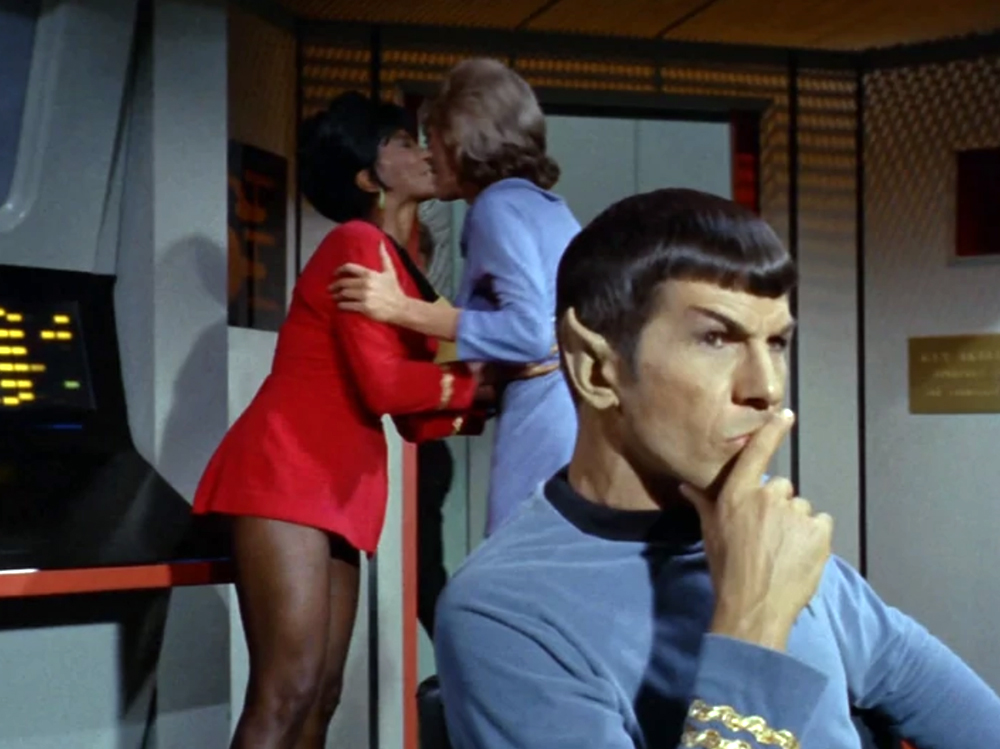
Technically, even “Mirror, Mirror” wasn’t Star Trek‘s first such kiss. That occurred in the first season’s “What Are Little Girls Made Of?” When Chapel’s presumed-dead fiancé Roger Korby was found alive, the nurse joined a landing party to reunite with her missing love. As she headed for a turbolift, Uhuru kissed her cheek, providing not only an interracial kiss, but one between two women. Granted, it was purely platonic; Uhura has shown interest in both Spock (she flirts with him in “The Man Trap” and “Charlie X,” and she’s in love with him in J.J. Abrams’ films) and Montgomery Scott (in Star Trek V: The Final Frontier), but never has she expressed romantic intentions toward Nurse Chapel (who, per Strange New Worlds‘ “Spock Amok,” is bisexual).
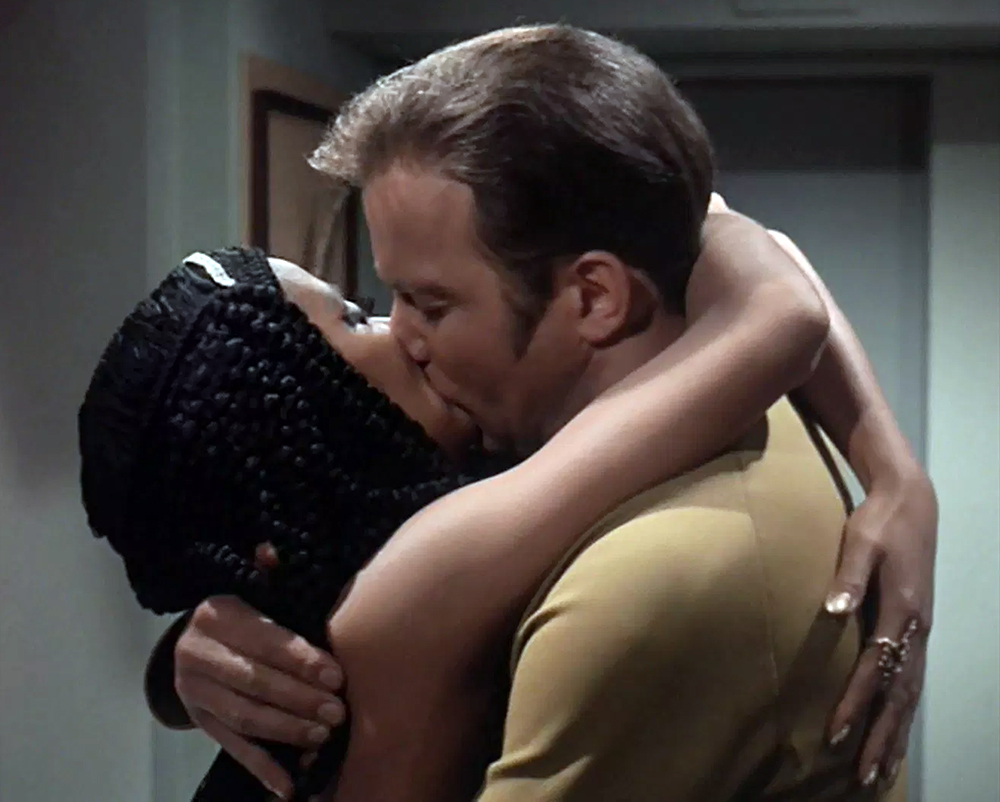
Then there was “Elaan of Troyius,” which was filmed before “Plato’s Stepchildren” despite airing afterwards. In that episode, Kirk fell in love with Elaan, the Dohlman of Elas, portrayed by French-Vietnamese actress France Nuyen. This brings the original Star Trek‘s multicultural kisses to five, four of which predated the one between Kirk and Uhura.
So what other TV shows preceded Trek in featuring interracial kisses on television? There are a surprising number of known examples.
I Love Lucy
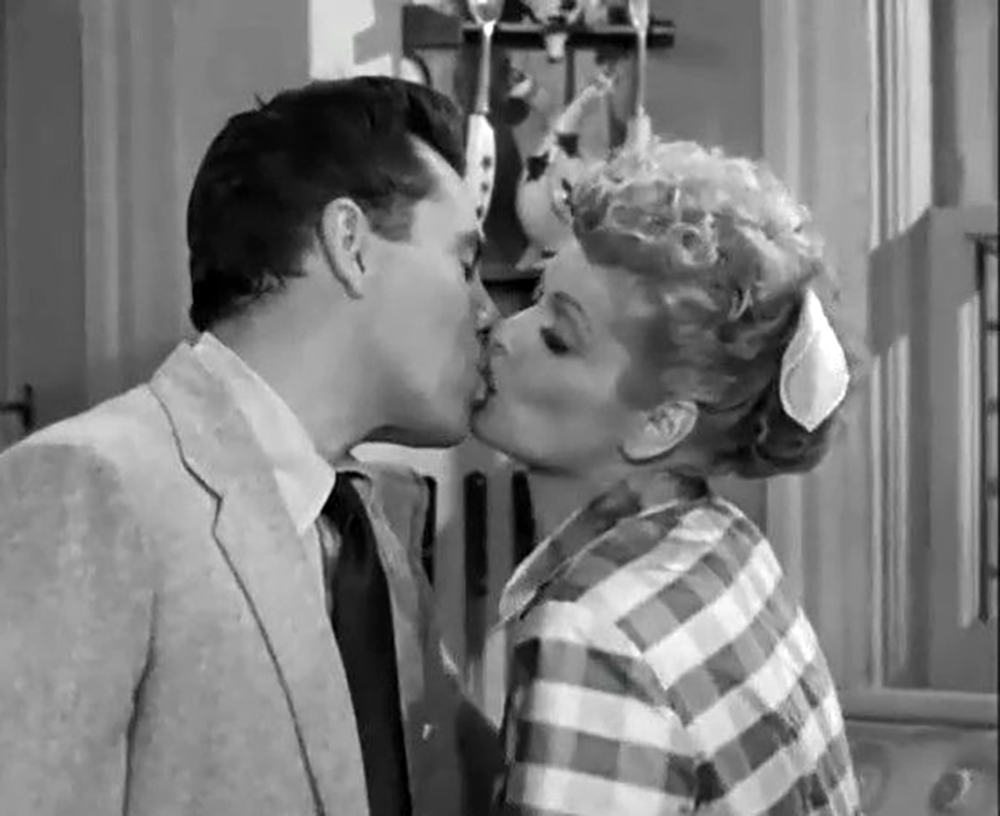
It’s fascinating to consider that one of the earliest interracial kisses on TV—possibly the very first—occurred on a show starring Lucille Ball, who would later champion Star Trek‘s continuation despite budget problems and the failure of the pilot episode, “The Cage,” to sell the series. Ball, the co-owner of Star Trek‘s production company, Desliu, had starred with her husband and business partner, Desi Arnaz, on I Love Lucy from 1951 to 1957. She was of European descent, while he was Cuban-born. The two played white housewife Lucy Ricardo and her Hispanic nightclub-owning husband Ricky—and the audience fell in love with them.
The couple’s love was fiery, passionate, and tumultuous, both onscreen and off. Though Lucy and Ricky slept in separate beds, as was common for 1950s television, they produced a child together, and Lucy’s announcement of her pregnancy was a major moment in the show’s history. Like Gomez and Morticia Addams, the Ricardos had a healthy love life (likely make-up sex, since they bickered a lot), which included frequent onscreen kissing and caressing. Why was this acceptable, given the era’s sensibilities? Well, Arnaz tended to be regarded as a white male of Cuban ancestry due to the cultural norms of that era, so the marriage’s multicultural nature was overlooked by both censors and the adoring public alike.
Hot Summer Night
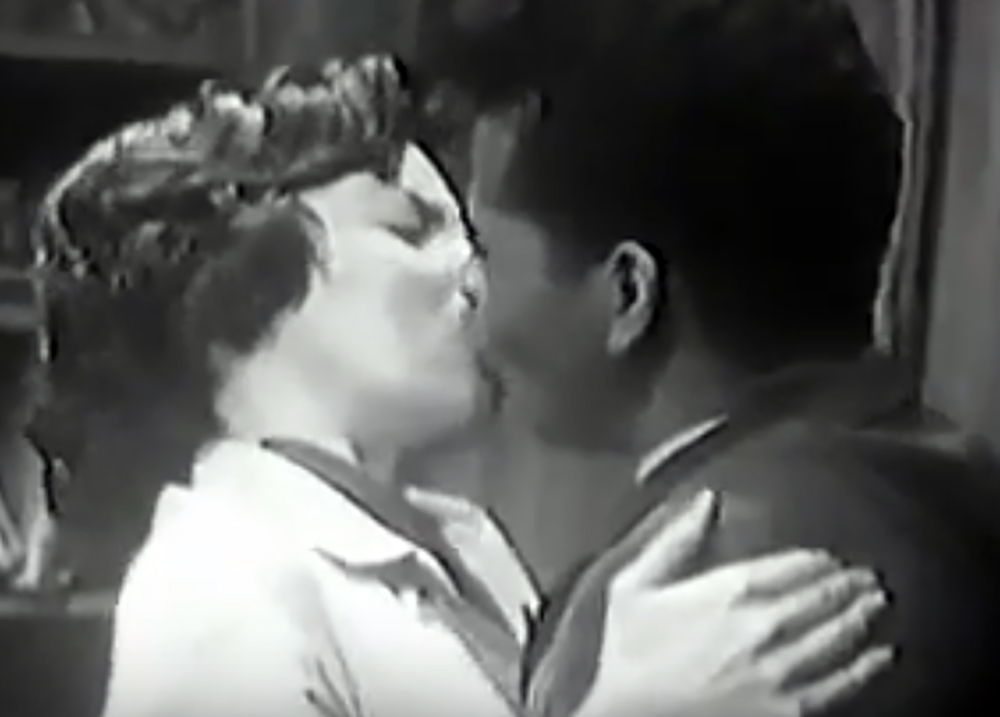
In September 1958, the play Hot Summer Night, written by Ted Willis and directed by Peter Cotes, debuted at London’s Bournemouth Pavilion. After 53 performances, the play—which starred John Slater, Joan Miller, Andrée Melly, and Lloyd Reckord—closed in January 1959. The following month, it aired on the British drama anthology TV series Armchair Theatre. For decades, this performance was thought lost, but its recovery was announced in 2015 during a British Film Institute (BFI) panel discussion titled “Race and Romance on TV,” moderated by BBC journalist Samira Ahmed.
The story involved union leader Jack Palmer (Slater), a white man whose daughter Kathie (Melly) loved a Jamaican fellow named Sonny Lincoln (Reckord), causing Jack’s wife Nell (Miller) to react with horrified racial prejudice. Sonny and Kathie kissed during a pivotal scene, which elicited an uncomfortable reaction during one night’s stage performance when a member of the audience called out a racial slur in protest, and it also garnered a smattering of hate mail. Nonetheless, the kiss was retained when Hot Summer Night made its television debut.

Pension Hommeles
If you’re scratching your head and asking yourself “What’s that?”, you’re probably not from the Netherlands. Pension Hommeles, reportedly the first Dutch-made television series, was a musical comedy written by Annie MG Schmidt, involving a boarding house, its domineering landlady, and the various residents who lived there.
In an April 1959 episode, actors Donald Jones (a black man from the United States) and Roekie Aronds (a white Dutch woman) shared a moment of affection, during which Jones’s character kissed Aronds’ cheek while the two cuddled on a floor. It was a non-romantic gesture, but it’s one of the earliest-known examples of a black man kissing a white woman on television, anywhere in the world, and it predated “Plato’s Stepchildren” by nearly a decade.
Sea Hunt
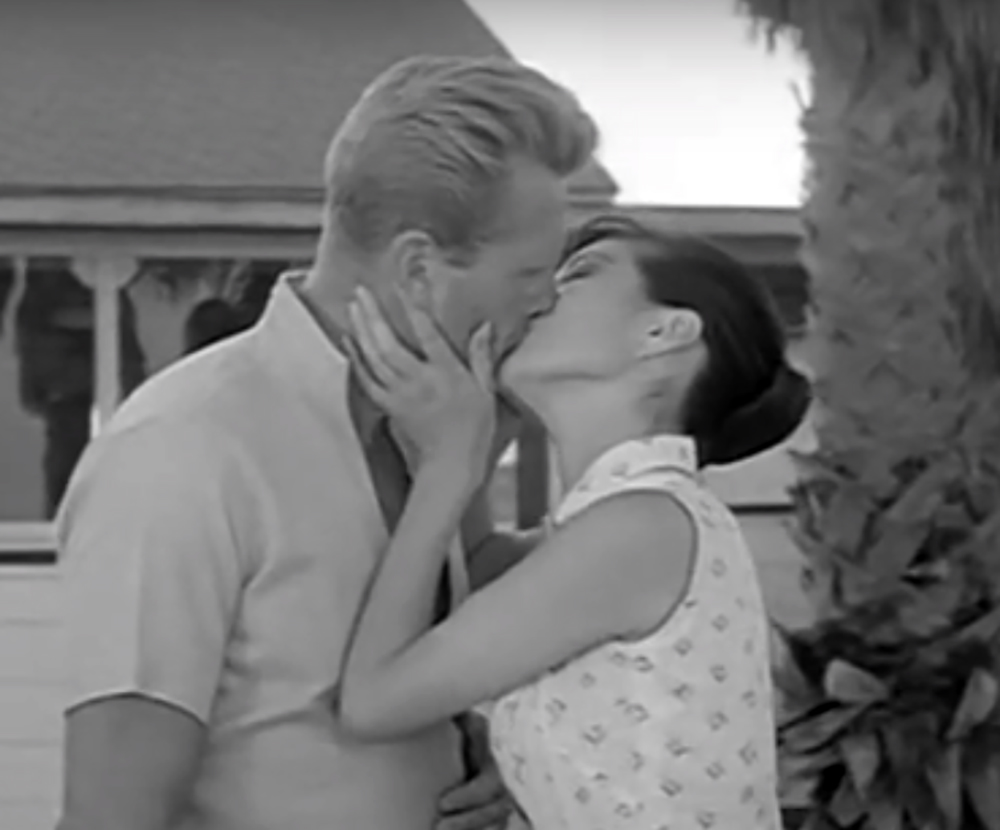
Sea Hunt was an American action-adventure show starring Lloyd Bridges (whom Gene Roddenberry would later approach to play Christopher Pike and Gary Seven on Star Trek, though both roles would go to other actors) as former U.S. Navy frogman Mike Nelson. Aboard the good ship Argonaut, Nelson battled diabolical villains, performed salvage duties, and rescued those in need of assistance. In the August 1959 episode “Proof of Guilt,” Nelson met Sandra Chung, a Hawaiian woman fighting to protect pearl beds from poachers, played by Japanese-Canadian actress Nobu McCarthy.
Granted, when people talk about interracial TV kisses, they are generally referring to black and white actors, and it was more common at the time to see romance scenes involving white actors and those of Asian descent, particularly in movies. Still, such multiculturalism should not be omitted from the discussion, and in that regard, the kissing on Sea Hunt beat Star Trek to the integrated finish line by almost a decade as well.

Mickey Spillane’s Mike Hammer
“Siamese Twinge,” a September 1959 episode of private-detective show Mickey Spillane’s Mike Hammer, featured a kiss between white actor Darren McGavin’s title character of Mike Hammer and Sondi, played by Thailand-born actor and dramatic arts teacher Sondi Sodsai. In this story, Asian nightclub singer Sondi received an offer of $5,000 from her boyfriend’s bigoted mother to exit their lives. Complicating matters, Sondi’s abusive husband showed up and refused to leave unless she paid him a lot of money, leaving her no choice but to shoot him. After she was accused of attempted murder, Hammer worked to clear her name. Naturally, a love story—more to the point, an interracial one—ensued.
Adventures in Paradise
In 1960, an episode of Adventures in Paradise, titled “Makaha Surfing” (also known as “The Big Surf”), featured scripted kisses between Filipino-American actress Pilar Seurat (who would later play Sybo in Star Trek‘s “Wolf in the Fold”) and two white actors: Robert Sampson (Sar 6 in Trek‘s “A Taste of Armageddon”) and Gardner McKay. The latter starred as Captain Adam Troy of the Tiki III, who sailed his schooner across the South Pacific, seeking new passengers and new thrills. A veteran of the Korean War, Troy enjoyed a variety of romantic encounters during his escapades, and his love scene with Seurat occurred several years prior to “Plato’s Stepchildren.”

Naked City
Pilar Seurat had another interracial kiss in “Without Stick or Sword,” an episode of the 1960s police drama Naked City. Moreover, the kiss was shared with Star Trek‘s William Shatner, who portrayed Maung Tun, a Burmese Buddhist sailor seeking revenge on Captain Russel Barris (played by Martin Balsam), whose refusal to help Tun’s brothers at sea resulted in their deaths.
Shatner shared a love scene with Seurat’s character, Gloria Chan, making him one of the few actors (along with Seurat, Reckord, Nuyen, and McCarthy) to have been a part of more than one of the earliest known televised interracial kisses. Unfortunately, he did so in yellowface (a term describing the regrettably racist makeup used by non-Asian actors to portray Asian characters by approximating their facial characteristics), which pretty much negated any social progress the characters’ kiss might otherwise have represented.

Laramie
Nobu McCarthy had another interracial kiss on Laramie, an American Western series that aired on NBC, starring John Smith, Robert Fuller, Hoagy Carmichael, Robert L. Crawford Jr., and Spring Byington. On the series, Fuller played drifter Jess Harper, who helped brothers Slim and Andy Sherman run a stagecoach stop following the murder of their father.
In the episode “Dragon at the Door,” which aired in September 1961, Fuller acted opposite McCarthy’s character of Haru, a member of a Japanese entertainment troupe traveling throughout the Old West. Haru, the oldest of several sisters in the troupe, drew Harper’s romantic attention, culminating in a tender kiss. Alas, she spoke in stereotypically broken Japanese, undermining their love story’s significance.
You in Your Small Corner
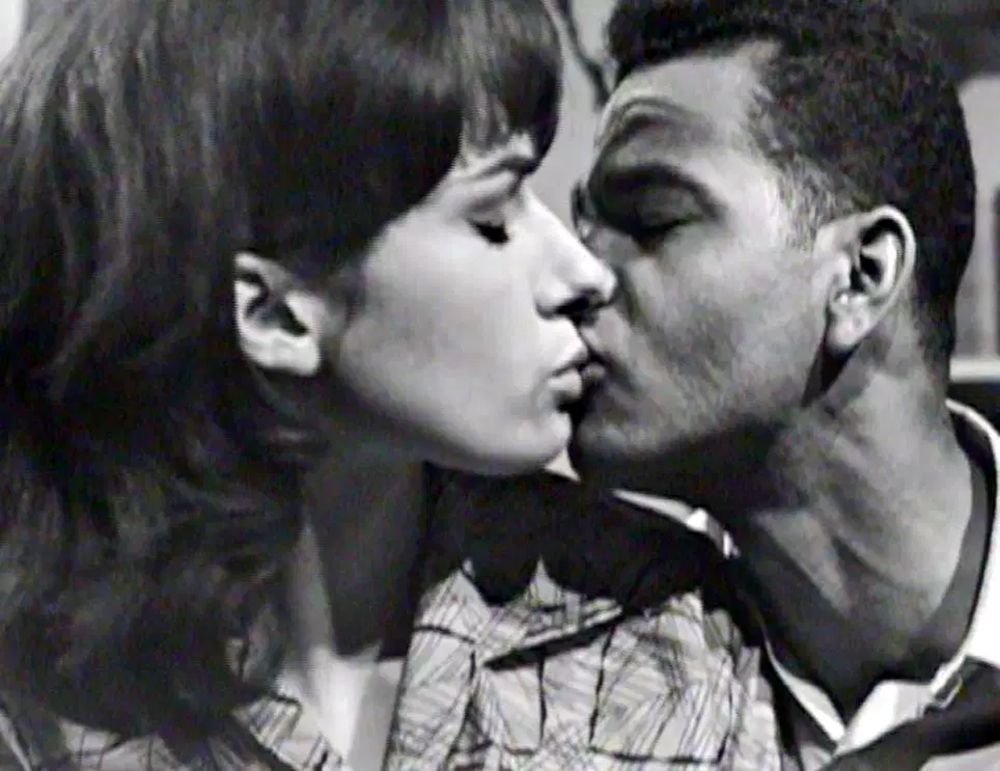
June 1962 saw the televised broadcast of a live performance of the play You in Your Small Corner, written by Lloyd Reckord’s brother, Barry Reckord. The production aired on ITV Play of the Week, a British anthology series produced by Granada Television and other production houses. The story revolved around a romantic relationship between a middle-class Jamaican man named Dave (Lloyd Reckord) and a working-class white woman called Terry (Elizabeth MacLennan), who lived in London’s Brixton district.
You in Your Small Corner is notable for featuring a kiss between MacLennan and Reckord at a time when such things were not widely accepted in the United Kingdom (or in the United States, for that matter). Terry and Dave also shared a scene that rather strongly implied the two had just finished enjoying sexual relations. Like Hot Summer Night, You in Your Small Corner was thought lost for decades until being rediscovered in time for BFI’s “Race and Romance on TV” panel.
Emergency–Ward 10
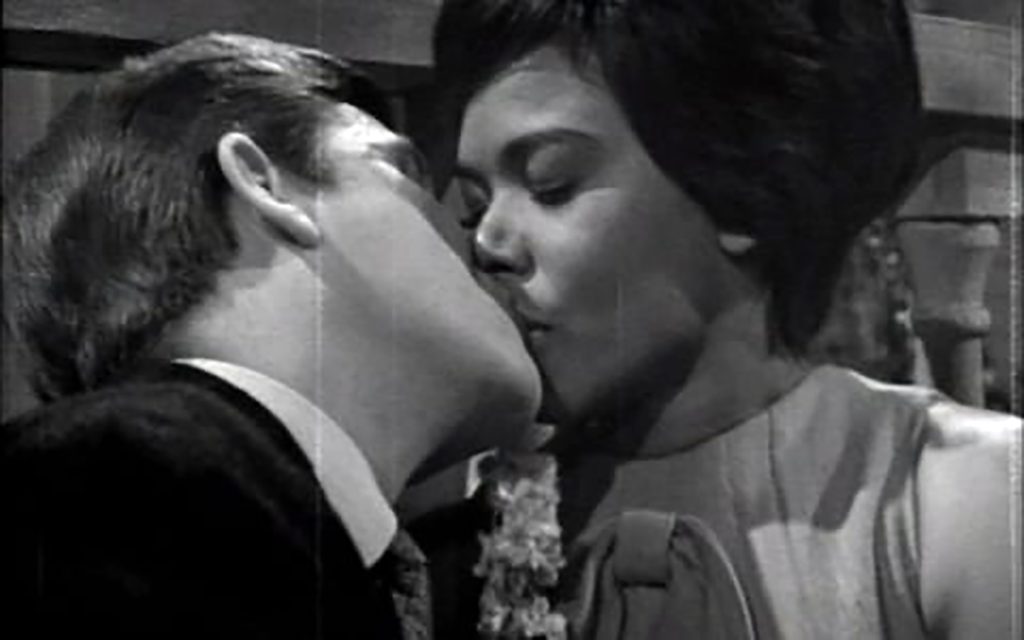
Another early multicultural TV kiss took place in July 1964, during an episode of ITV’s Emergency—Ward 10. In this episode of the British medical soap opera, Doctor Louise Mahler (played by Jamaican actress Joan Hooley) kissed fellow surgeon Giles Farmer (Caucasian actor John White). Soon after the episode aired, though, the show’s producers relocated Mahler to Africa, after which they killed her off via a fatal snake bite.
The kissing scene, as originally scripted, took place in Mahler’s bedroom, but studio concerns about this being deemed too risqué for television resulted in the encounter being moved outdoors. Despite such concerns, the interracial romance generated no viewer outrage, and Hooly, during a July 2015 interview with BBC World Service, expressed dismay at the notion that anyone would have had a problem with it.
The Dean Martin Show
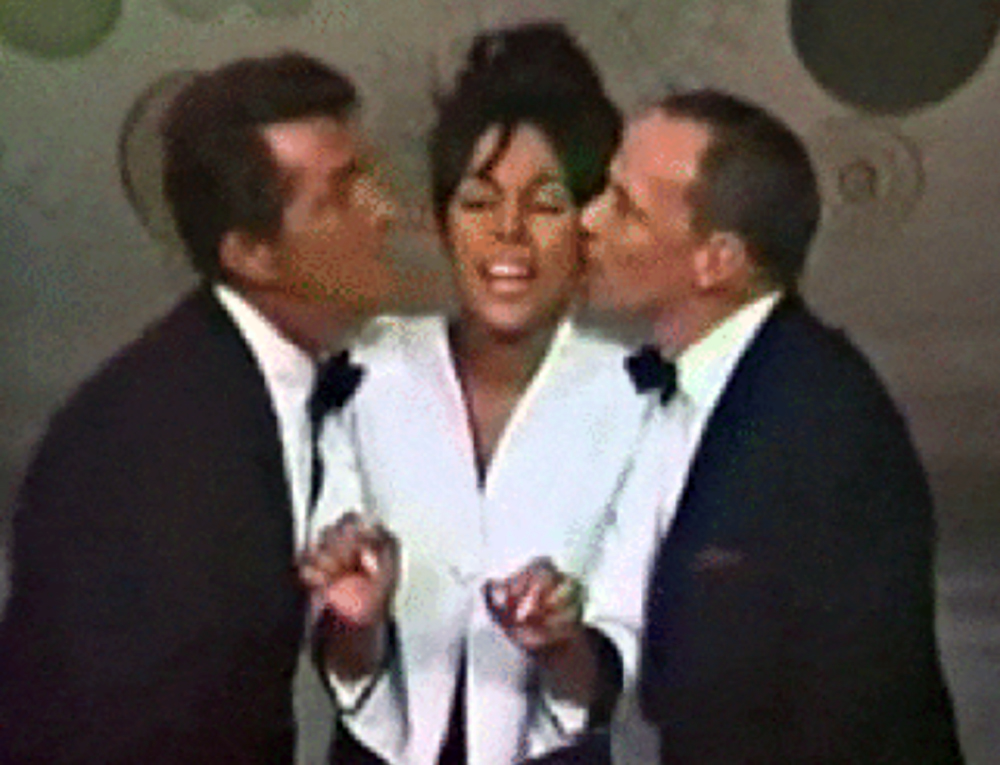
In 1965, white Rat Pack singers Dean Martin and Frank Sinatra performed Sinatra’s song “Witchcraft” with Diahann Carroll on an episode of The Dean Martin Show. At the end of the musical number, Sinatra and Martin simultaneously kissed Carroll, an African-American woman, on her face. These were not romantic kisses, of course—merely jovial cheek pecks, which the three clearly found amusing—but the encounter was televised three years before “Plato’s Stepchildren,” making it worth noting.

I, Spy
“The Tiger,” a January 1966 episode of Desilu secret-agent series I, Spy, showcased a scripted kiss between France Nuyen and white actor Robert Culp (whose son Joseph would portray Raimus in Deep Space Nine‘s “Honor Among Thieves”). The show starred Culp as Kelly Robinson, a U.S. undercover intelligence agent, and Bill Cosby as his partner Alexander Scott, who posed as traveling “tennis bums” while hunting down spies, thwarting evil-doers, and romancing many women. (Amusingly, Cosby’s character was called “Scotty,” just like Star Trek‘s jovial engineer. Not amusing at all is having Cosby’s name attached to this article’s topic.)
Nuyen’s character, Sam Than Maclean, was among Robinson’s love interests. The episode took place in Vietnam, which most TV shows of that era avoided due to the then-ongoing Vietnam War (The Twilight Zone tackled the subject in multiple episodes, however, as would Star Trek‘s own “A Private Little War” a few years later). The onscreen romance between Culp and Nuyen transferred offscreen as well, and the two married the following year, with the actress returning for three more episodes—and raising Joseph Culp as her stepson.
The Wild Wild West
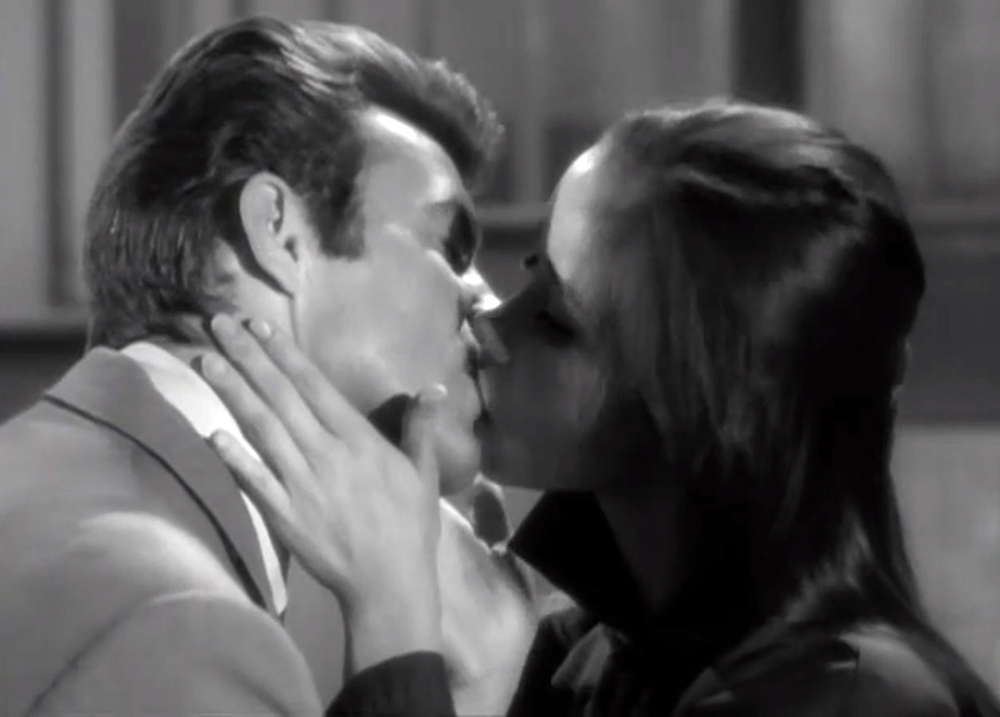
Another multicultural kiss occurred in “The Night the Dragon Screamed,” a January 1966 episode of The Wild Wild West. The series starred Robert Conrad (whose son Christian would play three characters on Deep Space Nine and Voyager) as Secret Service agent James T. West, with Ross Martin portraying his partner, Artemus Gordon. Throughout the show’s run, the agents protected President Ulysses S. Grant and thwarted the over-the-top schemes of villainous fiends. The series is notable for its steampunk-like use of fantastical tech more typically seen in a Jules Verne novel than in a TV Western.
In this particular story, West was tasked with returning Princess Ching Ling (sadly, the show often relied on stereotypical character naming), played by Pilar Seurat (from the above-noted Adventures in Paradise and Naked City), to the Chinese throne, while Gordon battled opium-smuggling rings. West and the princess shared a kiss—several, in fact, even when West should probably have stopped focusing on Ling’s lips long enough to rescue his partner from the smugglers’ deadly clutches.
Mission: Impossible
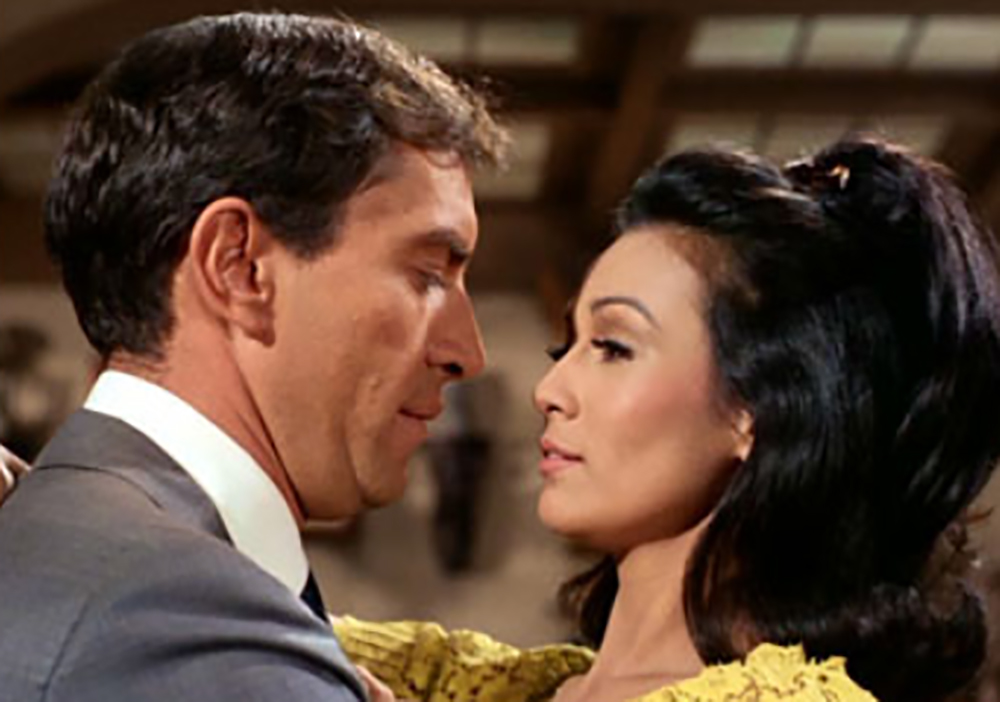
The year 1966 was a big one for televised multicultural kissing. A year before Barbara Luna portrayed Marlena Moreau on Star Trek, she appeared with Martin Landau in “Elena,” an episode of Desilu’s Mission: Impossible, playing fellow IMF agent Elena Del Barra. Landau’s Rollin Hand character was assigned to investigate Del Barra’s suspicious activities and determine whether she had defected to an enemy organization, as well as if she had lost her mind.
Mission: Impossible is well-known among Trek fans, of course—not only due to its popularity and longevity, the fact that the two shows were on the air simultaneously, or their having shared a long list of guest actors, but also because its main cast members included Leonard Nimoy as The Great Paris. Nimoy was brought in to replace Landau after the latter left the series, which is ironic, since Landau claimed to have been initially offered the Spock role on Star Trek (D.C. Fontana has denied this was the case).
The Man From U.N.C.L.E.
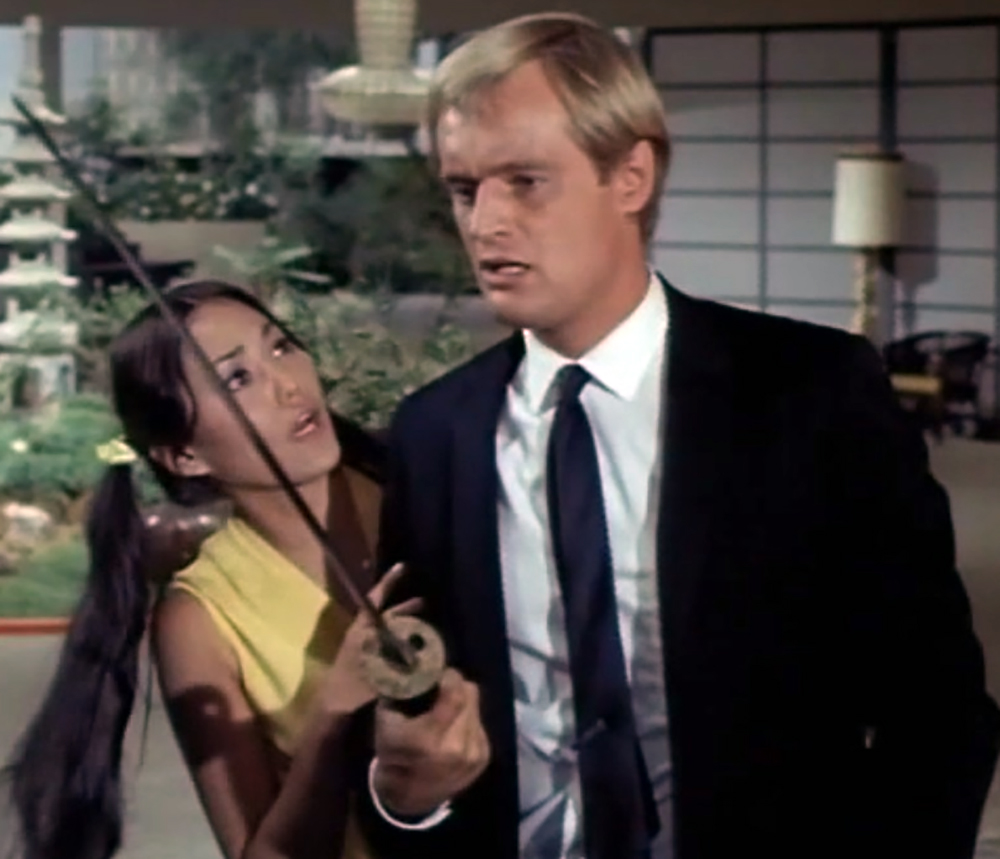
In September 1966, an episode of the American spy-fiction series The Man From U.N.C.L.E. featured a kiss between David McCallum’s Illya Kuryakin and Hawaiian-born guest star Victoria Young’s Miki Matsu. The show followed the adventures of Russian agent Kuryakin and his American partner, Napoleon Solo (Robert Vaughn), for a top-secret international counterespionage agency.
In the episode “The Her Majesty’s Voice Affair,” U.N.C.L.E.’s arch-nemesis THRUSH controlled a Long Island school and programed the students to steal their parents’ secrets. Kuryakin served as the bodyguard for Matsu, a scientist’s teenage daughter, and the two shared some tender moments together. Let’s ignore the age implications here, which are another subject entirely.
Movin’ with Nancy
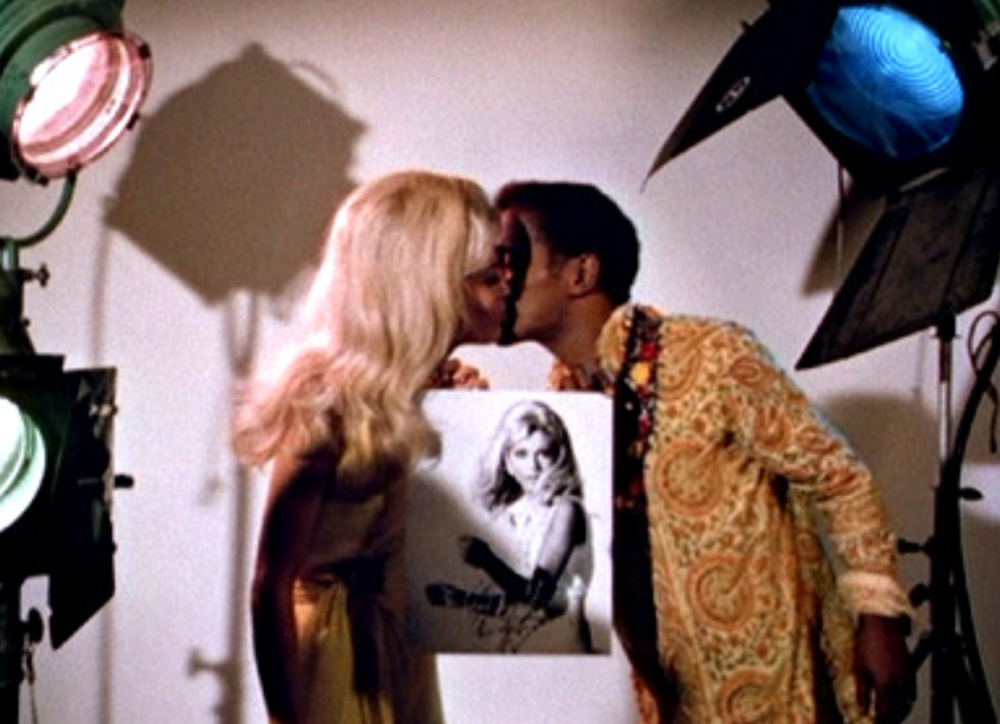
On December 11, 1967, Nancy Sinatra starred in an outdoor television special titled Movin’ with Nancy, featuring Frank Sinatra’s daughter in musical vignettes with other popular artists of the 1960s. While strolling through a countryside, driving along a highway, and riding in a hot-air balloon, the younger Sinatra performed dream-like duets with guest stars she seemingly encountered in the course of her travels.
Among the show’s memorable moments was a supposedly spontaneous cheek kiss between Sinatra, a white woman, and African-American entertainer Sammy Davis Jr. Despite how off-the-cuff it seemed onscreen, though, the kiss was entirely planned. According to Sinatra (in a commentary she recorded for the special’s DVD release), the duo purposely held off filming their performance until the last minute, knowing Davis would be leaving to perform another gig and would thus be unavailable to reshoot their song-and-dance duet. In that way, the two ensured their daring moment of interracial affection could not be edited out.
Petula
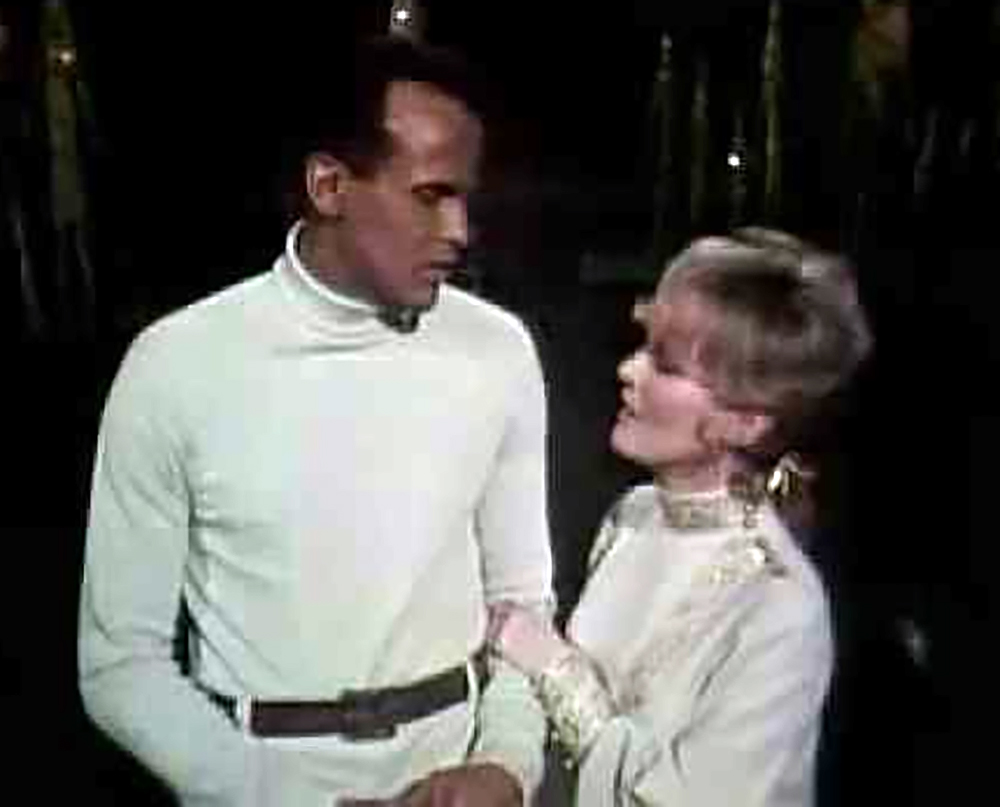
There was no interracial kiss in Petula Clark’s April 1968 NBC-TV special Petula, but the show is worth mentioning nonetheless because of a duet the British singer performed with Jamaican-American entertainer Harry Belafonte. While singing her anti-war song “On the Path of Glory,” Clark took friendly hold of Belafonte’s arm for what Vanity Fair described as “the first time a white woman touched a black man’s arm on primetime television,” in a 2018 article titled “50 Years Ago, a White Woman Touching a Black Man on TV Caused a National Commotion.”
The show’s sponsor, Chrysler Corp., was not pleased, as it worried the network might face a racial backlash from Southern U.S. viewers. A representative of the auto maker demanded the duo refilm their performance while standing apart, but Clark and husband Claude Wolff, the show’s executive producer, destroyed all other takes and delivered the program to NBC with the arm-touch intact. Petula aired four days after the murder of Martin Luther King Jr., achieving critical acclaim and excellent ratings, while the Chrysler representative was reportedly fired from his job.
The Smothers Brothers Comedy Hour
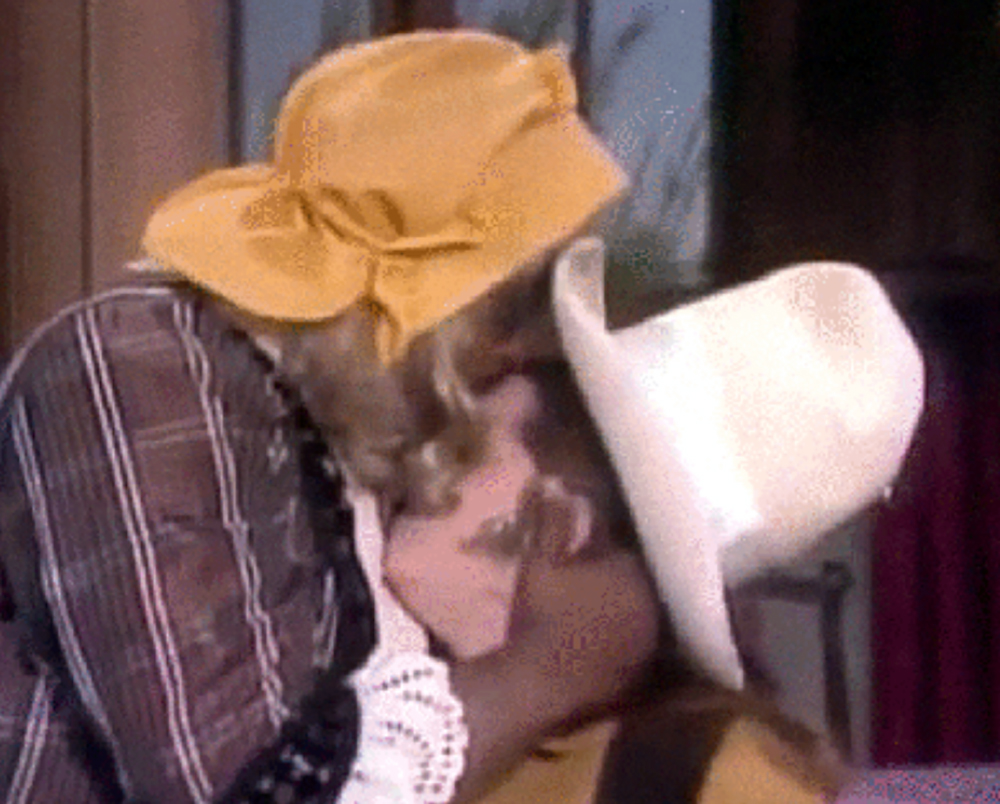
Finally, not long before “Plato’s Stepchildren” debuted, a satire of Western drama Bonanza aired on this popular comedy sketch show. During the skit, African-American football player Rosey Grier playfully kissed the forehead of white singer Cass Elliot (“Mama Cass” of folk-rock vocal group The Mamas and the Papas, also featuring Michelle Phillips, who’d go on to portray Jenice Manheim in The Next Generation‘s “We’ll Always Have Paris”). Petula‘s Harry Belafonte appeared in the sketch, which featured the exploits of the Cartwrong clan (a spoof of Bonanza‘s Cartwrights, get it?).
So… What About Star Trek?
In the above examples, the kisses occurred in full view of the camera, and thus cannot be disputed—they definitely happened, and they were all before Star Trek. Moreover, they were moments of mutual consent, shared among individuals choosing to kiss each other. This sets them apart from Star Trek. For one thing, the kiss in “Plato’s Stepchildren” was an involuntary act, the result of extraterrestrial telekinesis—in essence, a form of third-party sexual assault perpetrated on both characters—neatly sidestepping the question of any sexual tension existing between a white man and a black woman.
Forced to burrow into Kirk’s arms, Uhura admitted she often found herself frightened but would take comfort, at those moments, in Kirk’s confident presence on the bridge. However, she never professed either attraction or love for him—merely admiration—nor he for her. The Chris Pine version of Kirk, in J.J. Abrams’ movies, would quite openly express attraction to Zoe Saldaña’s Uhura, but her feelings for him in that reality ranged from revulsion to grudging respect—never romantic. That Uhura had eyes only for Spock.

Contrast the Kirk-Uhura kiss with that between Chapel and Spock, given the nurse’s unrequited passion for the Vulcan first officer. Unlike Uhura with Kirk, Chapel recalled how she had longed for such a moment with Spock for years (now playing out on Star Trek: Strange New Worlds) before the Platonians humiliatingly forced them to become lovers. Apparently, interspecies lust and forced pornography were both considered more acceptable to 1960s network censors than interracial coupling!
The question here, though, is whether or not Uhura’s kiss with Kirk even happened. Despite the acclaim Star Trek has received for featuring said kiss, the answer isn’t so clear-cut, as the camera angle showed the two actors turning their heads, obscuring viewers’ ability to ascertain whether they’d truly locked lips. As had happened with the Petula Clark special, NBC executives feared they might anger Deep South bigots and alienate Southern television stations, and thus assigned censors to closely monitor the filming of the Platonian-induced smooching.
Some sources say the censors’ job was to make sure no genuine kissing took place, providing deniability in the event of complaints. But it’s unclear if that was truly the case. Even the actors themselves disagreed in their recollections of this moment. In his autobiography Star Trek Memories, Shatner claimed NBC refused to let them kiss, insisting their lips were not in contact despite how it appeared on TV. Nichols, on the other hand, maintained in her book, Beyond Uhura, that the kiss was authentic.
According to some accounts, the notion was floated around of having Spock kiss Uhura instead, since the character’s half-alien nature somehow made him less Caucasian, but Shatner insisted the original script be adhered to. Ultimately, as Nichols explained in Beyond Uhura, NBC mandated that the actors film two versions of the scene, one with a real kiss and another with a carefully staged fake one. However, Nichols and Shatner were unsatisfied, as they believed Star Trek, which purported to promote equality, should follow through with the kiss. Therefore, she claimed, the actors flubbed every fake kiss on purpose, leaving the studio with no choice but to air the authentic take.
If true, this might account for why “Plato’s Stepchildren” has been so often touted as the first kiss, even though it wasn’t—because the actors had to fight to keep it on the air. Either way, it’s comforting to know that despite NBC’s disappointing stance, the airing of “Plato’s Stepchildren” resulted not in a backlash, but rather, as Nichols recalled, “one of the largest batches of fan mail ever, all of it very positive, with many addressed to me from girls wondering how it felt to kiss Captain Kirk, and many to him from guys wondering the same thing about me.”
No one called the kiss offensive, Nichols noted, other than a single letter from a white Southerner, saying: “I am totally opposed to the mixing of the races. However, any time a red-blooded American boy like Captain Kirk gets a beautiful dame in his arms that looks like Uhura, he ain’t gonna fight it.” (One can’t help but wonder why a bigot would even have interest in a show like Star Trek in the first place, as Star Trek would never have any interest in bigots.)
The Final Verdict
So as we see, Star Trek did not feature the first interracial kiss, despite what many believe. What it DID do is feature the first scripted and sexual kiss between a white man and a black woman on prime-time American television… assuming the kiss even happened, since Shatner has said that it didn’t.
It wasn’t the first black-white kiss on American TV, as both Movin’ with Nancy and the Smothers Brothers beat them to it, and it wasn’t the first sexual black-white kiss, as other countries proved more progressive in that regard. But in the end, it doesn’t matter whether “Plato’s Stepchildren” featured TV’s first interracial kiss—or even an actual kiss at all. What matters is that the episode played a vital role in fostering the conversation. Star Trek, along with I Love Lucy, Hot Summer Night, You in Your Small Corner, Emergency–Ward 10, and all the other shows discussed above, each contributed to a much-needed societal climate change.
Without such a groundwork having been set in the 1960s, later Star Trek TV shows might never have featured the wide range of interracial couplings they did. That kiss set the stage for the Uhura-Scotty scenes in Star Trek V. It led to Geordi La Forge and Leah Brahms, Miles O’Brien and Keiko Ishikawa, Worf and Deanna Troi, Worf and Jadzia Dax, Tom Paris and B’Elanna, Paul Stamets and Hugh Culber, Michael Burnham and Ash Tyler, Seven of Nine and Raffi Musiker, and Beckett Mariner and Jennifer Sh’reyan, among others. It led to T’Pring being played by Indian-Canadian actress Gia Sandhu on Strange New Worlds, opposite white actor Ethan Peck as Spock. And it enabled the 21st-century Star Trek films to feature love scenes between Saldaña’s Uhura and Zachary Quinto’s Spock. In sparking TV’s interracial revolution, these integrated programs helped the television landscape to truly transition from black and white to color.
