
I recently had the pleasure of reading Late Star Trek: The Final Frontier in the Franchise Era, by Adam Kotsko, a review copy of which University of Minnesota Press graciously sent me. There was a time when I read every single Star Trek book that hit shelves, both fiction and non-fiction. I was an avid reader of all things Star Trek, though quite a few years back, I largely stopped reading everything and instead began picking and choosing which titles I spent my time with. It was never that I stopped being interested. Rather, it was that the sheer number of publications, as well as the expense involved in purchasing and displaying them, because enormous and prohibitive. Instead, I started focusing my reading habits on what specifically piques my interest (as well as, ahem, any Star Trek books with my writing in them).
I own every Star Trek comic story from 1967 to present, so any book that focuses on the comics, I will pick up, whether it’s Alan J. Porter’s wonderful Star Trek: A Comics History (Hermes Press, 2009) or Joseph F. Berenato’s equally brilliant New Life and New Civilizations: Exploring Star Trek Comics (Sequart, 2014). So when Kotsko reached out to let me know about his book, I was happy to receive a copy. Anything that promotes the comics is aces in my view, as there are a staggering number of licensed stories told in that medium, yet not enough fans are aware of them.
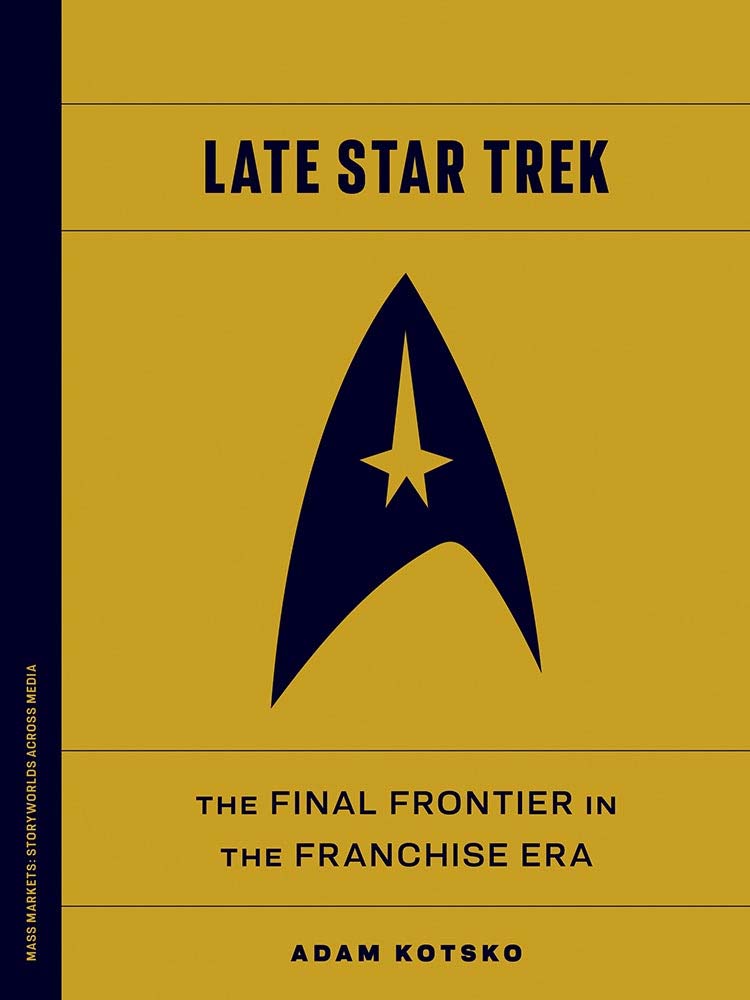
The focus of Kotsko’s book is on how “…Star Trek’s twenty-first-century reinventions illuminate the unique challenges and opportunities of franchise-style corporate storytelling.” With shows like Star Trek: Discovery and Star Trek: Picard altering continuity, the writers of the novels, comics, and short stories have had to adapt how they approach licensed lore. It can be difficult to keep up with everything established on TV and film, and to avoid contradicting it. Writing stories can be challenging enough when the franchise is approaching a thousand aired chapters, but that challenge increases when new shows overwrite what came before. And with the world and audience drastically changing in the past couple of decades, the challenges have become compounded, since our real-world experiences and perceptions very much define our expectations.
I am someone who can find something to love about every iteration of Star Trek, even those I find weaker than others, and when new episodes don’t jibe with older episodes, I can find ways to make it all fit. Conversely, I am not someone who gets hung up on canon, which is why I’ve been able to enjoy the comics so much. It doesn’t matter to me whether Paramount, CBS, or the fans count the old DC run as occurring between the classic movies, or whether the ongoing IDW line is quote-unquote canon (an overused term I dislike, since it stifles creativity). All that matters to me is whether I enjoy them. I wanted to make that clear up front, because it colors how I view any discussion of Star Trek. It’s a multiverse, so all of it happened—even the Gold Key comics, the British comic strips, and the Peter Pan tales. Even Whitman’s Mission to Horatius. Even Very Short Treks.
Well… maybe not Very Short Treks. That didn’t happen. I have spoken.
In a description of Kotsko’s book, University of Minnesota Press notes, “Late Star Trek explores the beloved science fiction franchise’s repeated attempts to reinvent itself after the end of its 1990s golden age. Beginning with the prequel series Enterprise, Adam Kotsko analyzes the wealth of content set within Star Trek’s sprawling continuity—including authorized books, the three ‘Kelvin Timeline’ films, and the streaming series Discovery, Picard, Lower Decks, Prodigy, and Strange New Worlds—along with fan discourse, to reflect on the perils and promise of the franchise as a unique form of storytelling.”
OK, my interest is piqued. This is the sort of discussion I enjoy. If there’s a way to smooth out the differences between the first four live-action shows, the prequel era of Enterprise, the Kelvin reboot movies, the modern-day TV shows, and the licensed stories told by the various publishers, I’m in. A lot of people get caught up in debating Spock having a never-mentioned sister, or the Klingons having a new look, or Khan’s timeline being pushed up to the twenty-first century. The franchise has been redefined with each new show and each new showrunner, and while there have been bumps along the way, most of it has been quite enjoyable. Despite the often unsourced and inaccurate articles that tend to crop up on clickbait sites like ScreenRant, I do think a good discussion about this topic can be held when those involved, like Kotsko, know what they’re talking about.
Unlike a lot of unauthorized publications which focus entirely on the aired and theatrical adventures to the exclusion of the licensed lore, Kotsko includes an examination of the novels and comics. He looks back at Mike Johnson’s fantastic comics based on the J.J. Abrams films (I immediately thumbed through the book looking for that discussion), as well as on the long-running novel universe that has had to course-correct in recent years as the CBS All-Access (now Paramount-Plus) shows have changed the narrative. For those who revel in reading or writing for the expanded universe (to borrow a term from Star Wars), it’s a delight to see someone taking such oft-overlooked material into account.
As the publisher notes, “By taking the spin-offs and tie-ins seriously as creative attempts to tell a new story within an established universe, Late Star Trek highlights creative triumphs as well as the tendency for franchise faithfulness to get in the way of creating engaging characters and ideas.” That’s a fair statement, because it’s all too easy for storytelling to be stifled by a need to adhere to all that came before. The recent Section 31 telefilm illustrated what can happen when a desire to connect to canon (Georgiou, Garrett, Cherons, Chameloids, Deltans, Control, the overused mirror universe, the equally overused Section 31, etc.), just to appease fans of old, becomes more important than telling a good story, a new story, with a competent script and direction. It’s great to revisit the old, don’t get me wrong, but James T. Kirk never set out to explore strange old worlds. The times, they are a’changin’, and Star Trek should change right along with it.
Thankfully, Kotsko’s focus is not entirely on the canon/non-canon debate, or on whether the new shows are part of the same timeline as the old. Rather, he delves into how modern Star Trek producers have become constrained by cultural shifts, specifically in how and when the stories have been presented to viewers and readers. The streaming era is a strange new world for Star Trek, one that has had its ups and downs as CBS has tried to figure out how to navigate that arena. So much Star Trek is already in the rear-view mirror: around 940 episodes and counting, across a dozen TV shows and counting, comprising nearly fifty seasons and counting, plus thirteen movies and counting. (But, hey, who’s counting?) Remaining consistent with all of it becomes not just an uphill battle, but a vertical one.
With all that in mind, Kotsko suggests that today’s Star Trek producers should measure their success not just on how fans react to the changes being made, but also on how well it adapts to changes in the culture in which new Star Trek is being introduced. Star Trek: Enterprise was the first post-9/11 series, so it’s no surprise that it focused heavily on terrorism with the Xindi arc. But think about what has happened since then: Discovery has tackled terrorism. Picard has tackled terrorism. Strange New Worlds has tackled terrorism. All three Kelvin-era films have tackled terrorism. Section 31 has tackled terrorism. And there’s a good bet that won’t be the end of it as new shows come down the (Christopher) pike.
Kotsko treats all of Star Trek after Voyager as a single era, which is a unique perspective I’ve never seen anyone else take. It’s a fascinating idea. Generally, the cutoff tends to be The Original Series to Enterprise, and then the Kelvin movies to the present, or at least The Original Series to Enterprise, and then the Kelvin movies, and then Discovery to the present. But he does have a point with his preferred grouping. Enterprise really is more akin to what we are getting now than to what we once got before, and 9/11 is the reason why. The entire plot of Star Trek Beyond was a continuation of Enterprise’s third season, in fact.
Star Trek has changed since the 2001 terrorist bombings of the World Trade Center. The Original Series and The Animated Series were made in the years following World War II, the Korean War, the Vietnam War, and the hippie movement, just as The Next Generation to Voyager were made in the post-Cold War and Reaganomics era. All those shows and their licensed spinoff stories represented the cultural values of the eras in which they were made. Likewise, the shows that we are receiving now, as well as the current spinoff novels and comics, were bred during the post-9/11 era of fear, bigotry, xenophobia, and fascism.
With all that is going on in the United States at the moment, we may even be on the verge of the next big cultural shift for Star Trek. Any shows made herein will need to contend with Donald Trump, J.D. Vance, Elon Musk, and the rise of fascism, oligarchs, suspended civil rights, and Sovereign Citizen nonsense in the United States. The odds of Earth ever becoming like the world of Star Trek are becoming increasingly slimmer by the day, so it’ll be interesting and depressing to see how tomorrow’s Star Trek writers will adapt to this scary new paradigm shift in U.S. politics. Kotsko may need to write a second volume someday.
All of this is to say that reading Late Star Trek: The Final Frontier in the Franchise Era, by Adam Kotsko, has given me a lot to think about. Late Star Trek offers a quick but substantiative read, thanks to Kotsko’s easy-flowing writing style, impressive knowledge level, and sense of humor. The discussion is approachable, insightful, and thoughtful, and the book is worth picking up. I’m glad to add it to my no-longer-complete shelves, and you should, too.