An ongoing discussion of how the comics provide prequels, sequels, and tie-ins to the Star Trek episodes and films.
141: Bild und Funk Magazine, 1979
Yeah, so… my so-called “brief” hiatus on this column lasted, er… a year and a half. (Perhaps I should rename it Star Trek Comics Weakly.) But, hey, a funny thing happened on the way from Star Trek Comics Weekly #140 to #141: I wrote an entire book. It’s about the Dark Shadows franchise, not Star Trek, and I can’t say much about it at this point since the project has yet to be announced, but it turned out to be one of the most time-consuming, research-intensive books on which I have ever worked, sapping all my free time and even some of my non-free time. I also helped to create a Planet of the Apes role-playing game. As a result, I had to put Star Trek comics on hold for a lot longer than I had anticipated.
I’m still catching up with my Star Trek comic reading, but now that the Dark Shadows project is done, I have returned to writing this column once more. It’s good to be back, though please excuse me if it’s not weekly at first, as I need to ease my way into the pool again after an extended period of not swimming at all. I’m wearing my inflatable swimmies, though, so I’ll eventually make it back to the deep end.


Let’s start things off right by examining a comic strip you might not even have known existed. It was published in Germany’s Bild+Funk magazine, and I’ve translated it into English so that you don’t have to. It’s a fair bet that most fans have never heard of it. In fact, I only found out about this series in the past couple of years, thanks to my friend and fellow completist Mark Martinez, the proprietor of the Star Trek Comics Checklist.
The strip was published in 1979, which is not surprising since that was a unique year for Star Trek. I’m not referring to the release of Star Trek: The Motion Picture, though that was certainly a big part of why. In that year, you see, Star Trek stories were published by Gold Key (comic books), Power Records (comic-and-record sets), Marvel (comic books), the Los Angeles Times Syndicate (daily comic strips), and Gong magazine (fumetti-style comics), with additional comic strips produced for a pair of children’s toys: McDonalds’ Star Trek Video Communicator and Larami’s Star Trek Space Viewer. That’s seven different comic publishers in the same year, whereas historically there has usually been only one (sometimes two) at a time. Now we can add an eighth official comic publisher to the 1979 lineup: Bild+Funk.

If you’ve never heard of Bild+Funk, it’s a good bet you are not from Germany. This weekly television guide from Burda Verlag (now Gong Verlag), the same publisher behind the above-noted fumetti, debuted in 1951. The publication has gone through numerous iterations in the decades since, including its current online form, TV Direkt. Back in 1979, the print magazine offered television listings alongside articles, comics, and other features related to aired entertainment, kind of like a mixture of TV Guide, Pizzazz, and Look-In. Among the strips it ran was a Star Trek storyline titled Raumschiff Enterprise, which translates into English as Spaceship Enterprise.

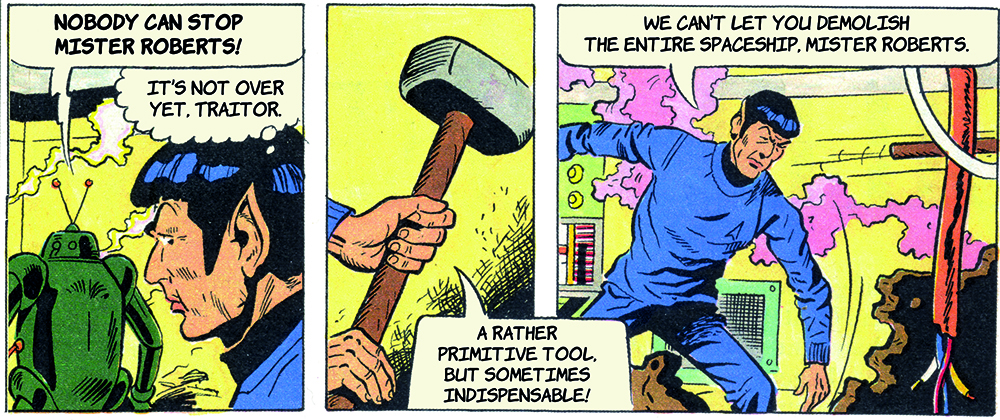
Raumschiff Enterprise ran for eighteen chapters, in issues #18 to #35 (May to September 1979) of Bild+Funk, with the entire story written and illustrated by the late Ludwig Fischer. The strip was officially licensed, according to its printed copyright information, yet it was not a typical Star Trek tale at all.
In the opening chapter, for example, Leonard McCoy was a grizzled, half-crazed chain-smoker, while Christine Chapel and Nyota Uhura were responsible for manually cleaning the crew’s laundry. Plus, in one panel, an Enterprise computer seemed utterly terrified of James T. Kirk for no apparent reason, as though his hands were doing something creepy offscreen. The crew sometimes sported uniforms reminiscent of The Original Series, and at other times from The Motion Picture. Oh, and the crew now included a huge robot named Mister Roberts… who tried to kill them.
This might seem like a daft approach to Star Trek, and it is, but it was by design. In an interview published in issue #249 of the German magazine Die Sprech Blas, Fischer told journalist Gerhard Förster:
“I am doing a bit of an anti-Enterprise thing. I said to myself that the characters, as I know them from television, and especially from the comics, are not human but sterile. They never eat or sleep, don’t go to the toilet, and never make love, yet there are pretty girls. Nobody drinks. No depression. The spaceship is also sterile; there aren’t even flower stands. Who would want to spend millions of years in a room like that? Well, if I were to fly on the Enterprise, it would be crazy. I’d hang pin-up girls in my room, etc. And because there isn’t any soap there, I’d have them in my room.”
Try not to think about the image in that last sentence too much. Eeuuww.

Now, even allowing for a mistranslation here and there, one can’t help but wonder if Fischer had ever watched Star Trek before writing his comic strip, because everything in his description of the show was factually incorrect. Many episodes featured the crew eating and sleeping. Kirk had numerous lovers, and so did Spock and other characters. Drinking happened on a frequent basis—so much so that one could make a good argument for McCoy and Montgomery Scott being alcoholics. Several stories dealt with depression. There was an entire botany lab filled with flowers. There were toilets, even if we didn’t see anyone using them. And I’m positive there was soap, too, since no one walked around looking like the cast of The Walking Dead. The crew did not spend millions of years aboard the Enterprise, either. They spent five. It’s right there in the opening narration.

In short, Fischer’s comments were baffling, though his comment about pin-ups has had an amusing resonance in recent years, thanks to Lower Decks’ Brad Boimler keeping a pin-up of Una Chin-Riley in his bunk. Still, they do shed light on the bizarre nature of the series. It’s no wonder the strip did not go over well with German readers at the time. Fischer told Förster that the Munich Enterprise Club had complained vociferously, describing his depictions of the crew as “layabouts in uniform.” They weren’t wrong.

Apparently, Burda Verlag agreed, for Fischer added, “The publisher didn’t want the scenes either, but apparently they appreciated my shockingly anti-authoritarian attitude.” (It’s worth noting that the strip was not anti-authoritarian, shockingly or otherwise. It was just silly.) The writer defended his approach, calling it “dramaturgically motivated,” and told Förster that he faced prohibitive deadlines and inadequate pay for the work involved in producing each week’s single page. “It’s just a shame that I can’t draw the pages as I would like,” he lamented. “The deadlines are too short, and the payment should also be in proportion to the effort. So Enterprise is nothing outstanding in terms of drawing.”
Frankly, Fischer was being kind to his own work. The quality went well below “nothing outstanding.” It was kind of trippy, really, and not in a good way—a non-funny satirical Star Trek pastiche combining the off-kilter aesthetics of Gold Key’s Star Trek and the British strips. Hence, there were primitive bald humans helpless without the Enterprise crew, incorrect uniform colors, the Enterprise landing on a planet, and so forth. Meanwhile, Kirk, Spock, and McCoy were drawn as though they were deranged villains lifted from Chester Gould’s Dick Tracy.

It would appear the editors may have forced Fischer to correct his course early on. The opening arc about a malfunctioning robot ended abruptly with a rushed resolution, and the goofy shenanigans with McCoy smoking and Chapel and Uhura cleaning everyone’s clothes ceased entirely after the first four chapters, with the tone suddenly becoming non-satirical in nature and instead more in synch (kind of) with typical Star Trek plots. Pavel Chekov and Hikaru Sulu appeared in a single panel in chapter five that provided the final bit of satire, after which the strips left the Enterprise’s slapstick antics behind and focused on Kirk and Spock undertaking a more traditional planetary mission.
For the remainder of the short-lived series, the duo were trapped on a weird planet where circles and globes were outlawed and the population made everything out of squares, cubes, and triangles. Why? No idea, because the strip ended without explaining any of it, right after introducing a naked priestess who seemed to have all the answers. Raumschiff Enterprise was abruptly canceled midstream, replaced in issue #36 by the French comic strip Asterix. Never has the term “mercy killing” been more apropos, because even by “bad Star Trek” standards, Fischer’s work was in a class by itself.

With regard to this column’s focus (prequels, sequels, and tie-ins to onscreen Star Trek), it’s pretty simple: there are none. It’s so not Star Trek, in fact, that it’s instead Land of the Giants in reverse, with Kirk and Spock visiting a colony of micro-people (think Superman’s Bottle City of Kandor) and then shrinking down small enough to interact with them. Why? Again, no idea. Yet for Star Trek comic collectors, the existence of this strip is an incredible find, because it’s astounding that in 2025, with the Internet decades old and with the U.S. and U.K. strips all reprinted in their entirety, it’s still possible to unearth an officially licensed Star Trek comic series that no one seems to remember!
This past year, Mark and I tried to convince IDW to collect the strip as a one-shot, but alas, it wasn’t meant to be. Granted, purposely publishing a badly written comic might seem like folly, but hey, IDW published The Scheimer Barrier, so it was worth a shot. It may be stupid, but it’s part of the franchise, so it’s glorious. Since a printed one-shot was off the table, Mark and I translated and re-lettered it in PDF format, which those interested can download here. (IDW, I stand ready if you ever change your mind.)

For all the prior installments of this column, check out the index. Next time, we’ll return to our discussion of the IDW years, with a long-delayed look at the ambitious Star Trek: Year Five. See you then.
Looking for more information about Star Trek comics? Check out these resources:
- The Complete Star Trek Comics Index, curated by yours truly
- The Star Trek Comics Checklist, by Mark Martinez
- The Wixiban Star Trek Collectables Portal, by Colin Merry
- New Life and New Civilizations: Exploring Star Trek Comics, by Joseph F. Berenato (Sequart, 2014)
- Star Trek: A Comics History, by Alan J. Porter (Hermes Press, 2009)
- The Star Trek Comics Weekly page on Facebook
Rich Handley has authored, edited, or contributed to numerous books and magazines for IDW, BOOM! Studios, DC Comics, Topps, Dark Horse, Lucasfilm, Paramount/CBS, Titan Books, and more. His anthology Musings on Monsters: Observations on the World of Classic Horror was nominated for a 2021 Rondo Award for Book of the Year; he was an editor of IDW’s Eisner Award-winning Star Wars: The Classic Newspaper Strips collection; and he contributed to IDW’s Eisner-nominated Star Trek #400. Rich’s words have appeared in 160 books to date. He edited Eaglemoss’s Star Trek Graphic Novel Collection; co-created Magnetic Press’s Planet of the Apes Role-Playing Game; and has penned licensed Star Trek, Star Wars, and Planet of the Apes fiction. Rich has written about other pop-culture franchises as well, including Dark Shadows Swamp Thing, Hellblazer, Watchmen, Battlestar Galactica, Stargate, Red Dwarf, Batman, Godzilla, and more. He has 25 years’ experience as a magazine editor and currently works in academia.