
An ongoing discussion of how comics provide prequels, sequels, and tie-ins to Star Trek episodes and films. Read the past installments.
142: IDW Publishing, 2019–2020
The Enterprise’s five-year mission under Captain James T. Kirk was cut short after three seasons and seventy-nine episodes. Following the cancelation of Star Trek: The Original Series, viewers gained two seasons more with The Animated Series, but at only twenty-two episodes, those stories were hardly enough to account for years four and five. The two years after “Turnabout Intruder” have been fleshed out by various publishers, including in IDW’s Star Trek: Year Four and Year Four: Enterprise Experiment, though the nature of Kirk’s final voyage as captain has depended on the source.
Concluding missions have been portrayed in J.M. Dillard’s The Lost Years; DC Comics’ second annual, by Mike W. Barr; Christopher Bennett’s Department of Temporal Investigations: Forgotten History; David DeLee’s “Empty,” in Strange New Worlds #10; and DC’s Star Trek #75, by Howard Weinstein, with other accounts offered in David R. George III’s Star Trek: Crucible and David A. Goodman’s The Autobiography of James T. Kirk. Meanwhile, Sonni Cooper’s Black Fire and other novels have chronicled events leading up to the final voyage, without showing the actual decommissioning. In recent years, IDW Publishing added yet another account to the growing list.

This week we’ll begin to explore IDW’s powerful maxiseries, which, like the above tales, wrapped up the five-year-mission and put Kirk’s crew on their respective paths toward their status quo in Star Trek: The Motion Picture. That series, Star Trek: Year Five, was edited by Chase Marotz, Anni Perheentupa, Denton J. Tipton, and Megan Brown. It was among the publisher’s most ambitious Trek projects to date, spanning an entire year of in-universe storytelling, from shortly after the two Year Four minis until Kirk gave up his captaincy and returned to Earth.
With a rotating lineup of writers and artists, Year Five incorporated Lieutenants Arex and M’Ress from the 1970s cartoon, thankfully without overwriting the crew’s animated adventures. Modiphius published an accompanying role-playing game book written by Fred Love, titled Star Trek Adventures IDW Year Five Tie-In, which is a must-read for those who enjoy this saga. The 26-issue series comprised multiple two-chapter arcs, a pair of single-issue tales, a lone three-parter, and a Valentine’s Day-themed one-shot. We’ll get to those stories in later installments. For now, let’s focus on the first six issues and discuss how those three two-part arcs provided sequels, prequels, and tie-ins to onscreen Star Trek. These issues were written by Jackson Lanzing, Collin Kelly, Brandon Easton, and Jody Houser, with interior art by Stephen Thompson, Martin Coccolo, and Silvia Califano, and covers by Thompson, Greg Hildebrandt, and J.J. Lendl.
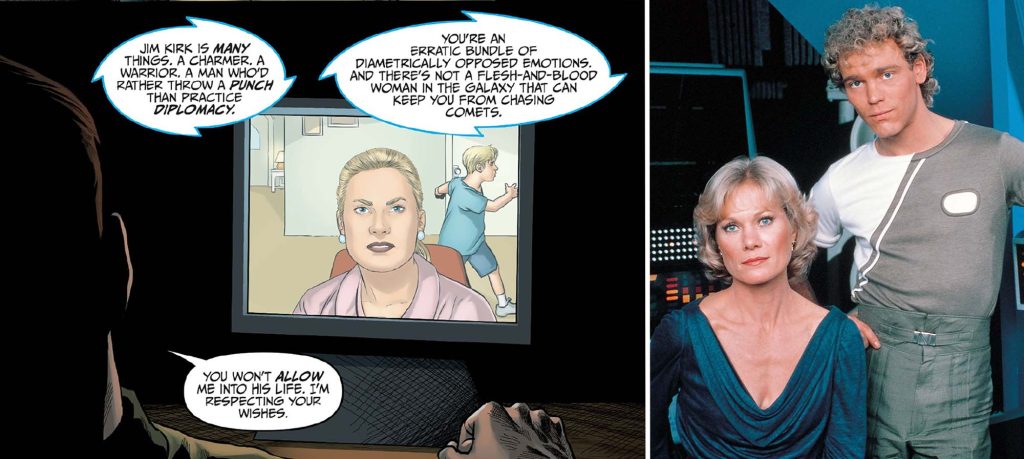
“Odyssey’s End” (issues #1–2) begins four years into the five-year mission, with Kirk receiving a promotion to the admiralty, leaving only one more year before he’ll be recalled home to face desk duty. Carol Marcus (Star Trek II: The Wrath of Khan) asks him to stay away once he gets there, preferring to protect their son David from the dangers of Starfleet—a wise precaution, considering Star Trek III: The Search for Spock. Carol refuses even to let Jim talk to David on the boy’s birthday, and though he honors her wishes, Kirk suffers great sadness as a result. A similar scene had previously played out in Year Four: Enterprise Experiment.
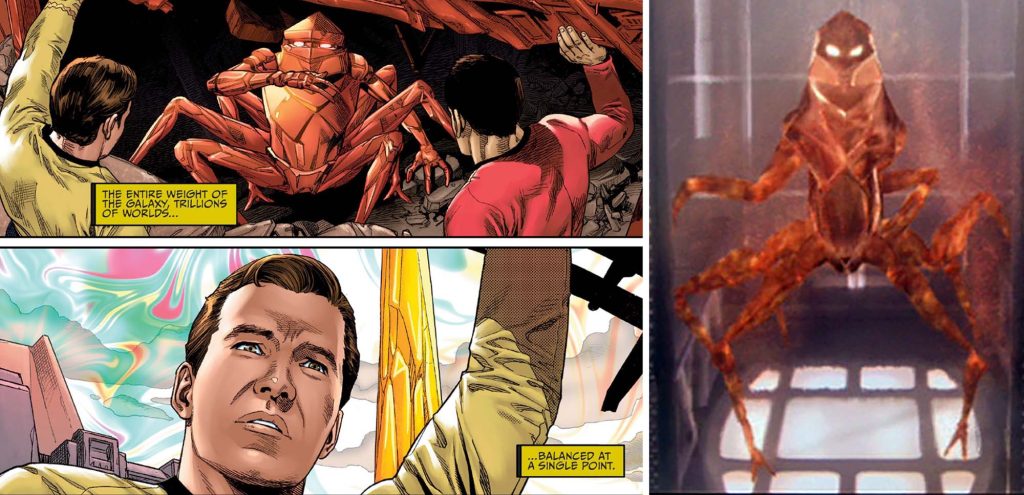
The crew answers a distress call from a colony world littered with the crystal corpses of many Tholians (“The Tholian Web”). Among them is a lone surviving Tholian child, whom the landing party brings aboard the Enterprise for the refugee’s protection. The Tholians had appeared in several prior comics, notably in DC’s Star Trek Special #2 and Star Trek: The Next Generation #71–75, as well as in IDW’s Star Trek: Captain’s Log: Sulu and Star Trek: 5-Year Mission #46–47. Year Five, though, was the first to delve deeply into the species’ society and psyche, depicting them as a compelling, formidable, and multifaceted people.

The young survivor is immediately endearing, despite basically being an orange-tinted crystal cricket, thanks to charming interactions with Kirk, Montgomery Scott, and especially Nyota Uhura. At first, the frightened child is unable to understand human languages, until Uhura manages to facilitate interspecies communication. Though confined, the non-aggressive child, whom Uhura nicknames “Bright Eyes,” witnesses and is grateful for the crew’s compassion. This will pay off to extraordinary lengths, with Bright Eyes playing a major role as the series progresses. For now, the crew must simply learn how to coexist with this refugee from Starfleet’s most xenophobic enemy.

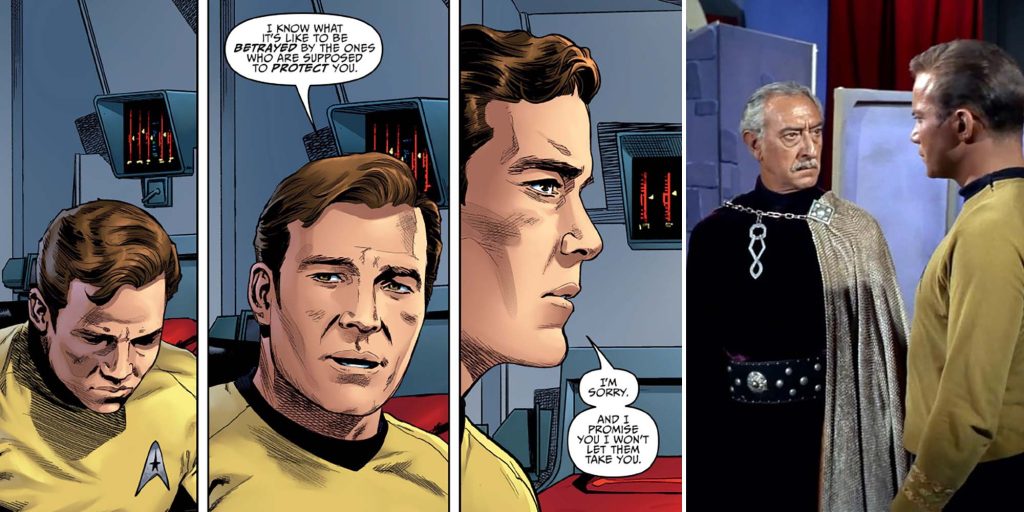
These early issues lay the groundwork for Kirk’s evolving bond with Bright Eyes, whose colony was slaughtered by another Tholian faction. Relating to the child’s plight, Kirk recounts the tragic events of Tarsus IV (“The Conscience of the King”) that he witnessed during his own youth, when Governor Kodos betrayed that world’s colonists. He recalls how he and his mother spent months traveling to Tarsus IV aboard a warp-two vessel captained by an old man named Mayweather, who had lived among the stars his entire life. Kirk doesn’t mention the man’s first name, but the writers’ intention is clear: this was either a member of Travis Mayweather’s spacefaring family (Star Trek: Enterprise’s “Horizon”) or possibly even Travis himself in his twilight years.
“Communication Breakdown” (issues #3–4) provides another sequel to a classic episode, this time “A Piece of the Action.” The Enterprise crew returns to Sigma Iotia II and learns that the highly imitative Iotians have analyzed the language database in McCoy’s lost communicator and studied Earth’s history from 1929 to the present, including details about Khan Noonien Singh (“Space Seed”), Zephram Cochrane (Star Trek: First Contact), and Jonathan Archer (making a very rare comics appearance). As a result, they have discovered the concept of representational democracy, though rather ineffectively due to their flare for over-simplifying complex ideas. Presidential elections are held every six weeks on this world, preventing any meaningful changes since each administration’s tenure is mostly spent campaigning.
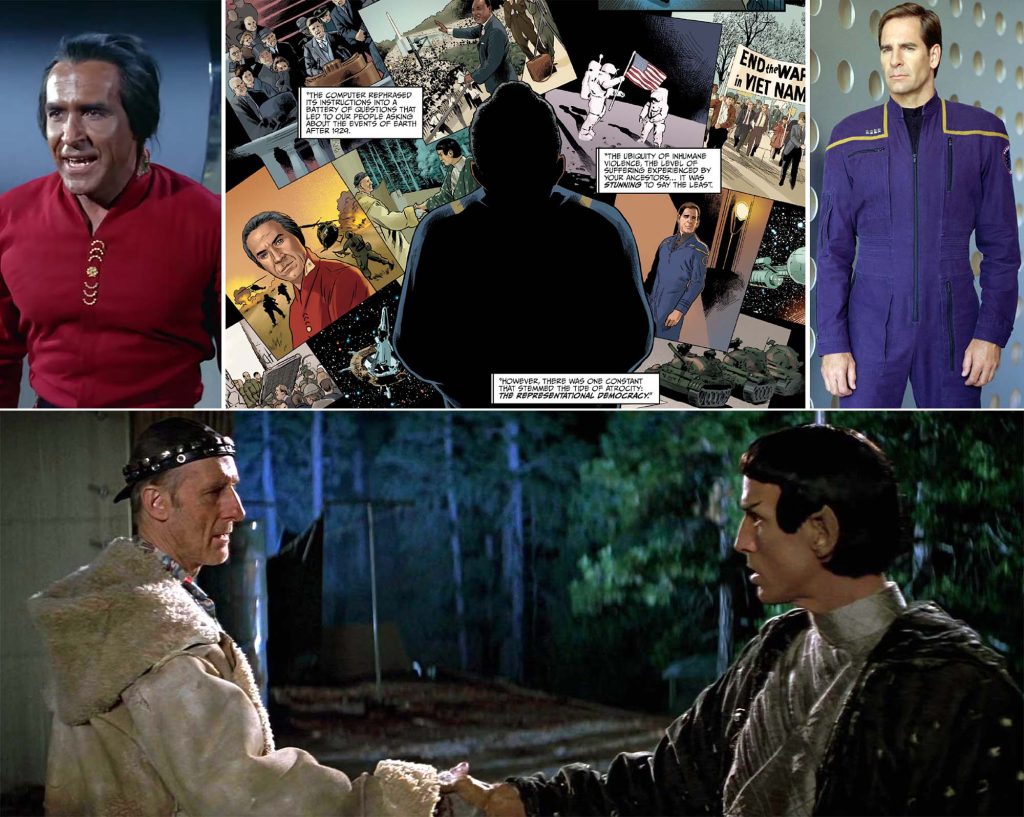
The result is legislative gridlock, a slew of half-completed public service projects, and self-serving leaders unconcerned with those who lack the basic necessities. Jojo Krako thus abducts Spock and coerces his assistance in fixing the Iotian government. Their solution: Spock runs for President and then steps down after winning by a landslide. He names Krako as his successor and urges the people to read The Teachings of Surak (The Original Series’ “The Savage Curtain” and Enterprise’s “Awakening” and “Kir’Shara”), hoping they’ll embrace its espoused philosophies. It’s a suspect move on Spock’s part, one that arguably violates the Prime Directive, though since that law has already been obliterated with the Iotians, it doesn’t matter much at this point, does it?
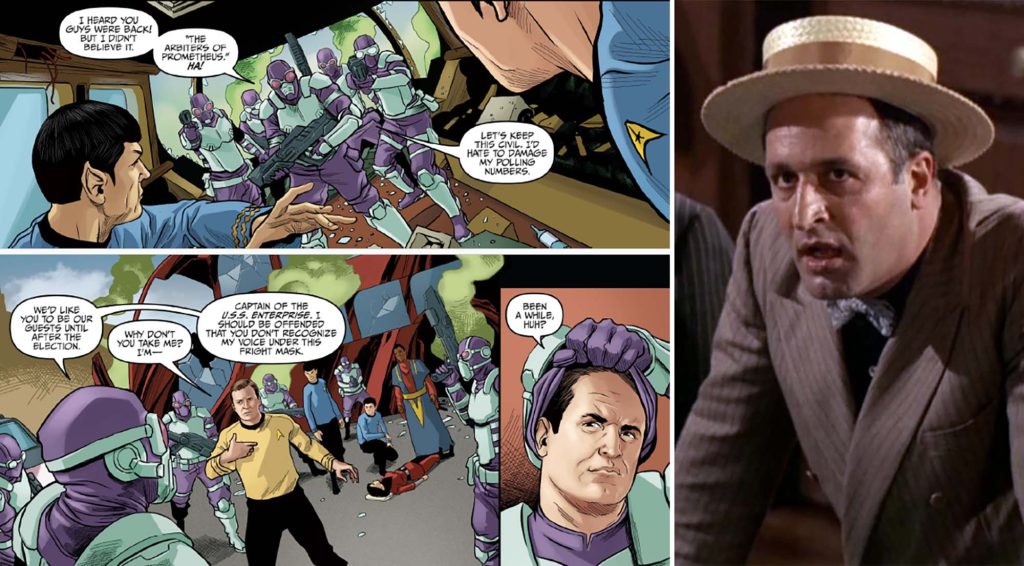
As Iotian stories go, this one is a lot of fun—and, as with the Tholians, it was not their first appearance in the comics. The episode had been adapted in the Star Trek Fotonovel line. Bela Okmyx returned in issue #11 of DC’s second Star Trek line to hilarious effect. And Jean-Luc Picard’s crew visited Sigma Iotia II in Marvel’s Star Trek Unlimited 10 to learn what had become of the gangster civilization by the twenty-fourth century. Yet unlike these prior sequels, which leaned heavily into the Ioitians’ imitative nature, Year Five focused instead on planetary politics—both the Iotians’ and ours.
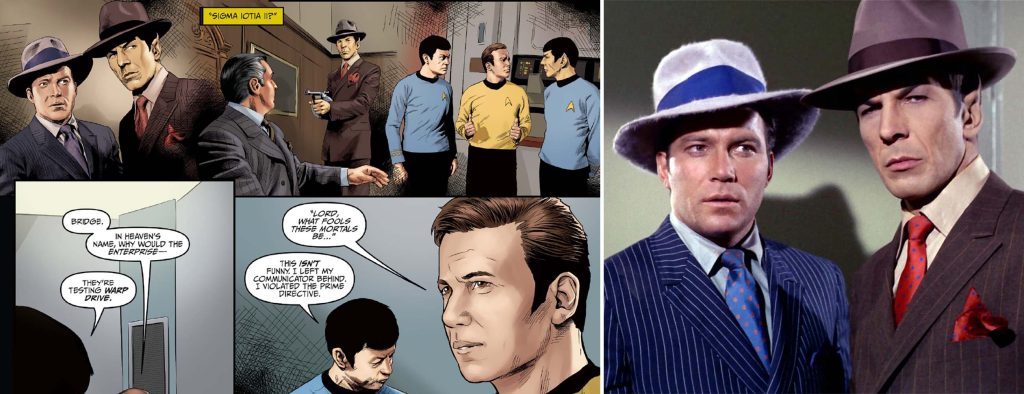
Considering when this series was published, near the end of Donald Trump’s tumultuous first Presidency, it’s no wonder the writers chose to comment on his administration’s political corruption, ineptitude, and inhumanity. They would do so again, more pointedly, in a later arc positioning Harry Mudd as a Trump surrogate. Perhaps IDW will revisit this concept someday. It would be fascinating to find out what happened due to Surak’s book supplanting Chicago Mobs of the Twenties, and to see how the writers might continue the story in the wake of Trump’s far more harmful second Presidency.

On television, the Iotians emulated Chicago mobsters, while in Star Trek Unlimited, they modeled themselves after Kirk’s crew. This time, their societal restructuring is based on Earth’s space programs. Armed with data stored in McCoy’s communicator, they created a rudimentary warp drive, an orbital space station, and a warp-capable ship resembling Cochrane’s Phoenix (First Contact). The vessel’s radioactive byproduct levels even match those of Cochrane’s rocket, proving yet again that for such a fast-learning people, the Iotians are staggeringly prone to emulating the worst aspects of whatever they imitate. Let’s hope no one leaves them a copy of The Art of the Deal.

McCoy is understandably troubled that his communicator carelessness contaminated an entire planetary population, and this makes him question whether he should remain in Starfleet. The good doctor wonders if he might be more effective treating colonists on rustic fringe planets, setting up his bearded retirement from Starfleet service in Star Trek: The Motion Picture, while providing a subtle tie-in to his vocation in John Byrne’s brilliant Leonard McCoy, Frontier Doctor miniseries.
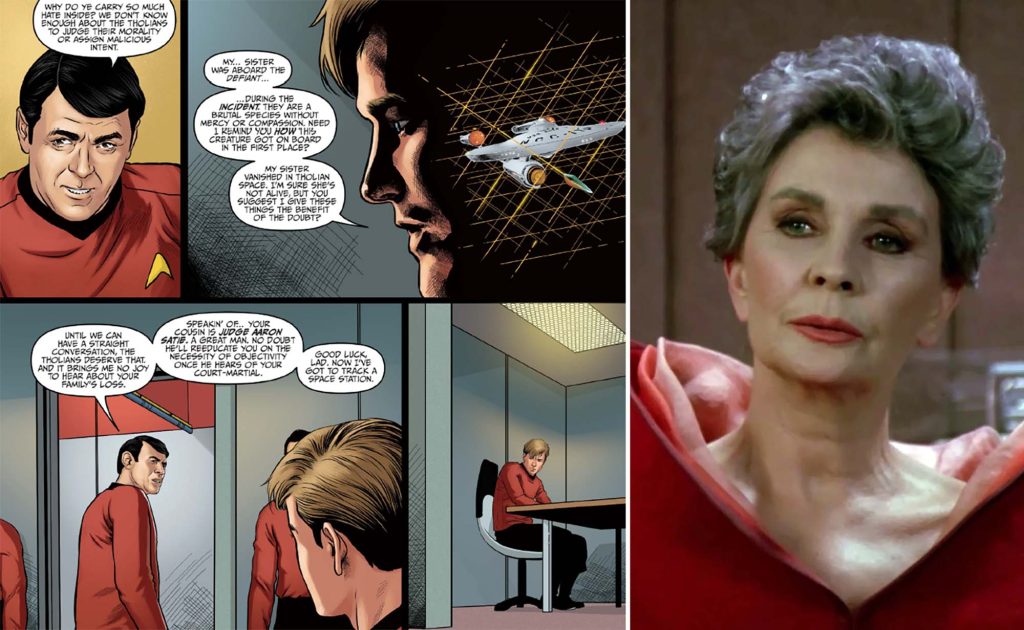
Bright Eyes’ storyline also continues in this arc, with a tie-in to Star Trek: The Next Generation’s “The Drumhead.” Ensign Satie, an engineer in Kirk’s crew, leads a mutiny to destroy the Tholian child. The ensign is a cousin of Aaron Satie and an ancestor of the episode’s well-meaning but dangerous antagonist, Norah Satie. Mirroring her paranoia regarding Romulan infiltration in Starfleet, Ensign Satie displays extreme racial hatred toward the Tholians, stemming from his sister having died aboard the USS Defiant in “The Tholian Web.” The Satie line is overflowing with xenophobes, it would appear, making the mutinous ensign more like the Tholians than he might admit.
The final arc, “The Truth Artifact” (issues #5–6), is a straightforward Trek tale with no direct episode tie-ins. Artifacts from an archeological dig cause ship-wide arguments due to crewmembers telepathically hearing what others are thinking rather than the actual words they speak. For example, if one were to say “That robe looks great on you,” but was really thinking “That robe makes you look like Gorgan the Friendly Angel,” everyone would hear the latter. As you can imagine, some amusing scenarios result.
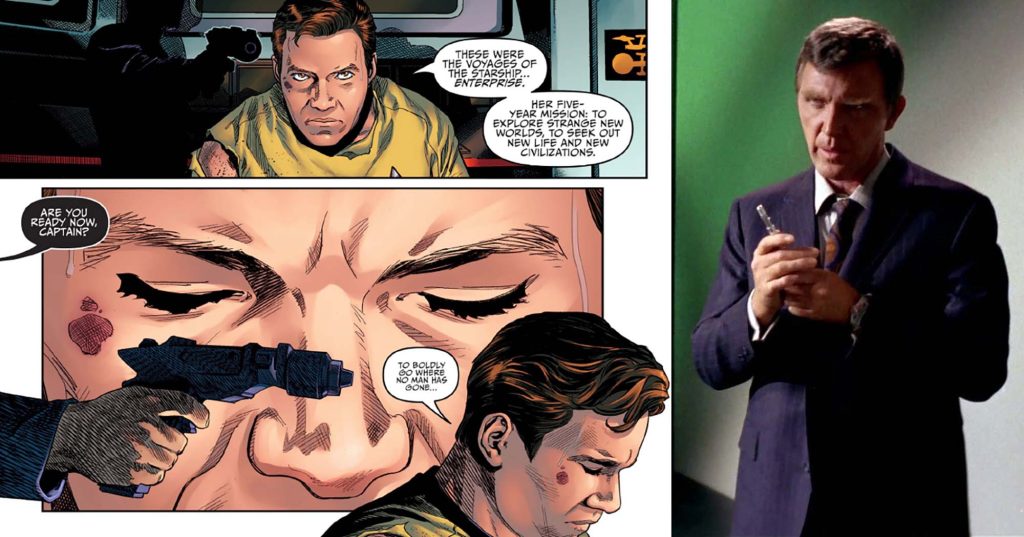
One tense plot thread introduced in issue #1 is never referenced again within the first half-dozen issues, though it will prove vital to the overarching plotline. An unseen individual holds a weapon to Kirk’s head and prepares to execute him, with much of Year Five serving as a flashback leading to that moment. Later issues would reveal the assassin to be none other than Gary Seven, from “Assignment: Earth,” taking the series in unpredictable directions that we’ll explore as time goes on. In the meantime, we’ll next examine IDW’s Star Trek: Discovery—Aftermath miniseries, along with its Captain Saru, Mirrors & Smoke, and Hell’s Mirror one-shots. Stay tuned!
Looking for more information about Star Trek comics? Check out these resources:
- The Complete Star Trek Comics Index, curated by yours truly
- The Star Trek Comics Checklist, by Mark Martinez
- The Wixiban Star Trek Collectables Portal, by Colin Merry
- New Life and New Civilizations: Exploring Star Trek Comics, by Joseph F. Berenato (Sequart, 2014)
- Star Trek: A Comics History, by Alan J. Porter (Hermes Press, 2009)
- The Star Trek Comics Weekly page on Facebook
Rich Handley has authored, edited, or contributed to numerous books and magazines for IDW, BOOM! Studios, DC Comics, Topps, Dark Horse, Lucasfilm, Paramount/CBS, Titan Books, and more. His anthology Musings on Monsters: Observations on the World of Classic Horror was nominated for a 2021 Rondo Award for Book of the Year; he was an editor of IDW’s Eisner Award-winning Star Wars: The Classic Newspaper Strips collection; and he contributed to IDW’s Eisner-nominated Star Trek #400. Rich’s words have appeared in 160 books to date. He edited Eaglemoss’s Star Trek Graphic Novel Collection; co-created Magnetic Press’s Planet of the Apes Role-Playing Game; and has penned licensed Star Trek, Star Wars, and Planet of the Apes fiction. Rich has written about other pop-culture franchises as well, including Dark Shadows Swamp Thing, Hellblazer, Watchmen, Battlestar Galactica, Stargate, Red Dwarf, Batman, Godzilla, and more.