
An ongoing discussion of how comics provide prequels, sequels, and tie-ins to Star Trek episodes and films. Read the past installments.
143: IDW Publishing, 2019–2020
Star Trek: Discovery debuted on television in 2017, and it wasn’t long before IDW offered spinoff tales, including the miniseries The Light of Kahless and Succession, and the one-shot Discovery Annual. The publisher then released a third miniseries, Aftermath, as well as another one-shot, Captain Saru. This week, we’ll examine how both titles provided prequels, sequels, and tie-ins to onscreen Star Trek, and we’ll look back at a quartet of non-Discovery specials: The Next Generation: IDW 20/20, Voyager: Mirrors & Smoke, Star Trek: Sky’s The Limit, and Star Trek: Hell’s Mirror.
With the classic shows, from The Original Series to Enterprise, identifying specific episode tie-ins was an easy task. If Nils Baris showed up, it was a sequel to “The Trouble with Tribbles.” Berlinghoff Rasmussen’s arrival would mark a tie-in to “A Matter of Time.” And so on. But starting with Discovery, which ushered in the current trend of season-long story arcs, that process became a bit more challenging.

Take Captain Saru, for instance, written by Kirsten Beyer and Mike Johnson, with art by Angel Hernández and Paul Shipper. This story takes place following the first-season finale, “Will You Take My Hand?”, yet it’s a sequel not to that episode but to the entire Klingon War and mirror universe story arcs. With the war concluded and Gabriel Lorca’s mirror counterpart defeated, Saru hopes to be named Discovery’s next captain. Orions commandeer the science vessel USS Dorothy Garrod and attempt to take the Discovery as well, but Saru outsmarts the pirates and saves both Starfleet vessels.
If we’re being honest, not much happens in this comic (though it is enjoyable), with most panels featuring characters seated in chairs and talking. There are a lot of headshots of Saru, which is to be expected since the story is about his desire to be the captain… which he isn’t by the issue’s end, since Starfleet chooses someone else. Presumably, it’s the never-seen captain whom Discovery was slated to pick up on Vulcan at the end of “Will You Take My Hand?”, before Starfleet screwed over said captain by assigning the ship to Christopher Pike. Somewhere on Vulcan, a lonely starship captain awaits an escort starship that will never arrive and drowns his sorrows in plomeek soup.

Aftermath, again written by Beyer and Johnson, with art by Tony Shasteen, Angel Hernández, and George Caltsoudas, contains more direct tie-ins to televised Star Trek. Mirroring Captain Saru’s placement at the end of season one, Aftermath takes place at the conclusion of season two, right before Spock shaves his beard and returns to active duty aboard the Enterprise.
With Kol-Sha’s death in “Point of Light,” the House of Kor is now led by Rynar, whom Deep Space Nine fans might remember as Kor’s father, referenced in “Once More Unto the Breach.” Rynar resents L’Rell having been named Chancellor and refuses to call her by her preferred title, “Mother,” since he views her as a usurper. This is where the story gets interesting, for he plots with his son to arrange her assassination.

Kor is depicted as a human-like Klingon, as he was in The Original Series’ “Errand of Mercy,” yet Rynar sports cranial ridges, indicating the Augment virus (see Star Trek: Enterprise) did not affect him like it did his son. It’s good to meet Rynar at last, though his scenes are rather limited, and it’s fascinating how the differences in appearance between father and son are never mentioned, indicating the various types of Klingons coexist side by side.
Kor assembles a terrorist group, the Shadows of Kahless, to murder L’Rell during a peace summit attended by Chrisopher Pike and Spock (who becomes L’Rell’s temporary advisor). The attempted coup fails, however, and although L’Rell recognizes Kor’s complicity, she lets him live, because Klingon leaders work in mysterious ways. Spock and Kor briefly meet, though the Klingon will not recognize him in “Errand of Mercy,” perhaps due to Spock having shaved in the nine-year interim.

Aftermath contains a potent flashback to the childhood of Spock and Michael Burnham, deftly cementing the oft-overlooked connection between The Animated Series’ “Yesteryear” and the 2009 Star Trek film. Both onscreen stories feature a young Spock being bullied by a trio of Vulcan children who denounce his half-human nature. In each case, the conflict ends with a physical altercation, and Sarek even gives similarly worded advice to his son. From the animated episode: “Logic offers a serenity humans seldom experience in full. We have emotions, but we deal with them and do not let them control us.” And from the 2009 film: “Logic offers a serenity humans seldom experience: the control of feelings, so that they do not control you.”
The combination of the two comes with Spock’s bullies in the prime reality resembling those from the Kelvin timeline, but with a Discovery-esque twist, in that Spock witnesses Michael using a neck pinch to protect her brother from the bigots. He cautions her that children are forbidden from attempting the maneuver, yet in “Yesteryear,” Spock did exactly that as a show of force to his tormentors—and Sarek didn’t try to stop him, signifying approval. We can thus infer that Michael, in between animated sequences, taught Spock how to master that technique. Hindsight is 20/20.

Meanwhile, IDW 20/20 celebrated the publisher’s twentieth anniversary, with its licensed titles telling stories set two decades prior to their respective “present.” These included not only Star Trek, but also Ghostbusters, Jem and the Holograms, My Little Pony, and Teenage Mutant Ninja Turtles. The Star Trek entry was written by prolific novelist Peter David, with art by James Kenneth Woodward and Gabriel Rodriguez. While not every detail synchs up perfectly with Jean-Luc Picard’s established history, it’s a solid entry in The Next Generation’s lore.
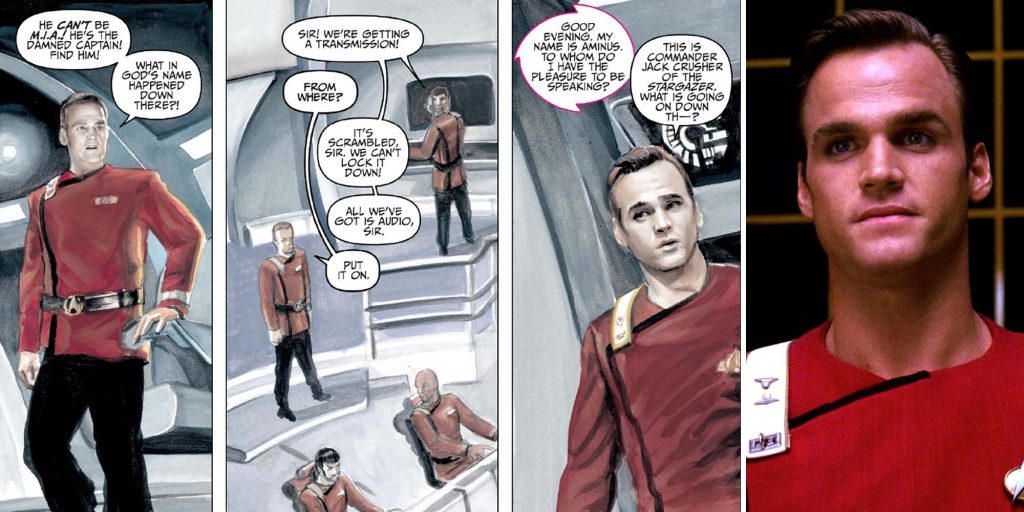
Twenty years before commanding the Enterprise-D, Picard meets Beverly Howard when she visits her fiancé, Jack Crusher, aboard the USS Stargazer. The two dislike each other initially, until Beverly saves his life during a planetary coup, earning Picard’s respect, and he later officiates at their wedding. Jack is drawn how he appeared in the episode “Family,” while Beverly’s cadet uniform provides an amusing callback to Playmates’ 1996 Starfleet Academy line, her outfit matching that of Beverly’s action figure.

Picard also features prominently in Sky’s The Limit, a comic packaged exclusively with 2019’s Star Trek: Picard Movie & TV Collection Blu-ray. Written by Thomas F. Zahler and illustrated by Carlos Nieto, this twelve-page mini-comic centers around the Maquis. The Enterprise responds to a hostage situation on Akavan III, where the Maquis threaten to unleash a toxic compound that will kill a billion colonists unless the Federation reclaims settlements lost to the Cardassians. The conflict was introduced in Deep Space Nine’s two-parter, “The Maquis,” and formed the basis of Voyager’s pilot, “Caretaker.”
Despite its shorter length, Sky’s the Limit offers a surprising number of episode tie-ins. The Maquis cell leader, for instance, is Rhona Barrows. Although it’s not directly stated, it’s a good bet she may be a descendant of Yeoman Tonia Barrows, from The Original Series’ “Shore Leave,” since licensed Star Trek writers often reuse characters’ last names to indicate lineage. If so, she greatly differs from her genial ancestor Tonia, for Rhona is said to be among the terrorist organization’s most extreme members.
Picard bluffs the Maquis into standing down rather easily, due to the comic’s short length necessitating story brevity. He threatens to enact General Order 24 (from “A Taste of Armageddon” and “Whom Gods Destroy”) and destroy all life on Akavan III, rather than letting the terrorists subject the colonists to a slow, agonizing death. Horrified by the idea of mass extermination, Barrows immediately surrenders—which undermines her stated reputation for extremism, especially since mass extermination is exactly what she had threatened moments earlier.
Picard refuses to back down, citing multiple examples of the many times when he was tormented yet prevailed. He recalls DaiMon Bok subjecting him to a Ferengi thought maker in “The Battle,” the Borg transforming him into Locutus in “The Best of Both Worlds,” the Cardassins making him miscount lights in “Chain of Command,” and a Nausicaan stabbing his heart in “Tapestry.” Barrows is suitably impressed, for the cerebral Picard can be one bald badass when he wishes to. Yet the rushed nature of the conflict’s resolution is a bit anticlimactic. One gets the feeling that had the writer been given more pages to work with, this could have been a tense standoff.

IDW continued its longstanding tradition of traversing the mirror universe with the one-shots Mirrors & Smoke and Hell’s Mirror. Paul Allor’s Mirrors & Smoke, sporting gorgeous artwork by James Kenneth Woodward and George Caltsoudas, has the distinction of being the first—and, to date, only—comic book to star the Voyager cast’s mirror counterparts. Previous mirror-centric comics had focused on the casts of Kirk, Picard, and Benjamin Sisko.

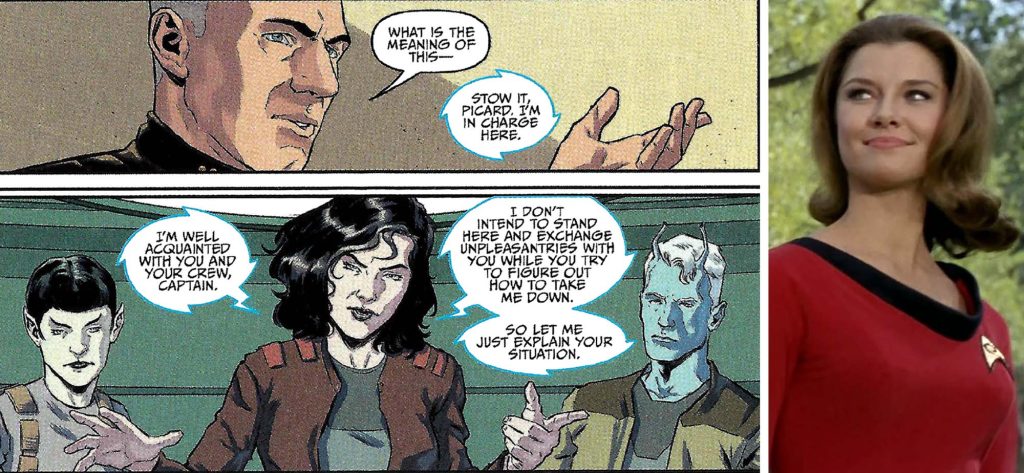
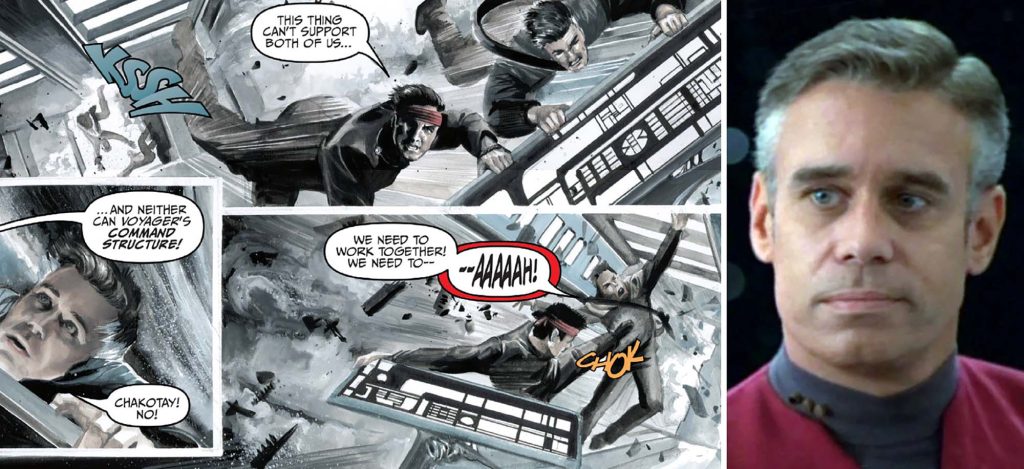
This time, Kathryn Janeway and her crew take center-stage. Tuvok’s mirror self (Deep Space Nine’s “Through the Looking Glass”) had already appeared in Malibu Comics’ Deep Space Nine #29–30 as a member of Sisko’s rebellion, but here he returns with the rest of the Voyager team. In this reality, the Voyager is a slave vessel built by the Terran Empire, which has been repurposed by Janeway’s Rebel faction. Commander Cavit, Janeway’s first officer in “Caretaker,” is still alive in this universe… at least, he is until Chakotay tosses him into space and assumes his position. Alas, poor Cavit.
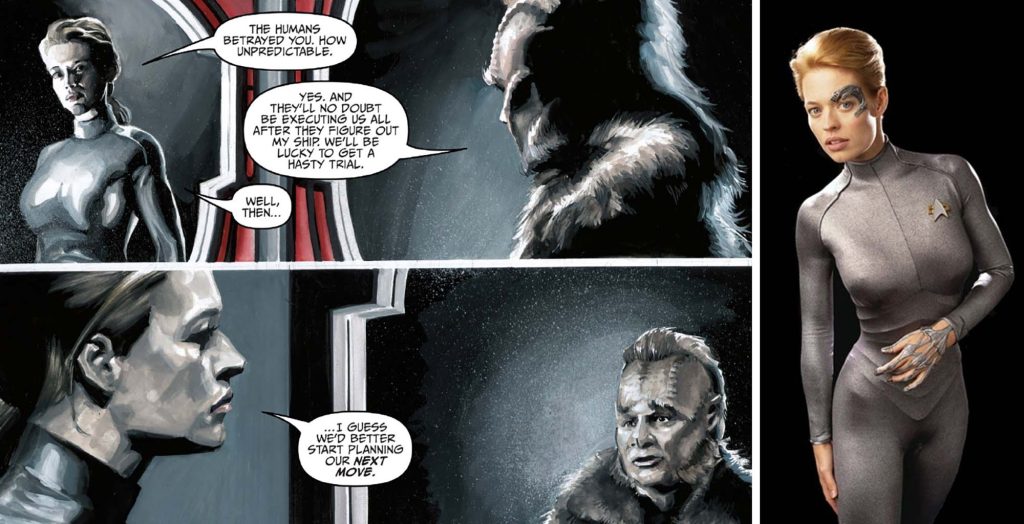
After being stranded in the mirror Delta Quadrant, Janeway engages in widespread plunder and piracy, making a great many enemies along the way, including Neelix and Kes. She rescues Annika Hansen from the Borg before they can turn her into the drone Seven of Nine, then makes Annika a prisoner facing execution. Annika thus allies with her only friend aboard ship, the mistreated Doctor, and the two plot to kill everyone.
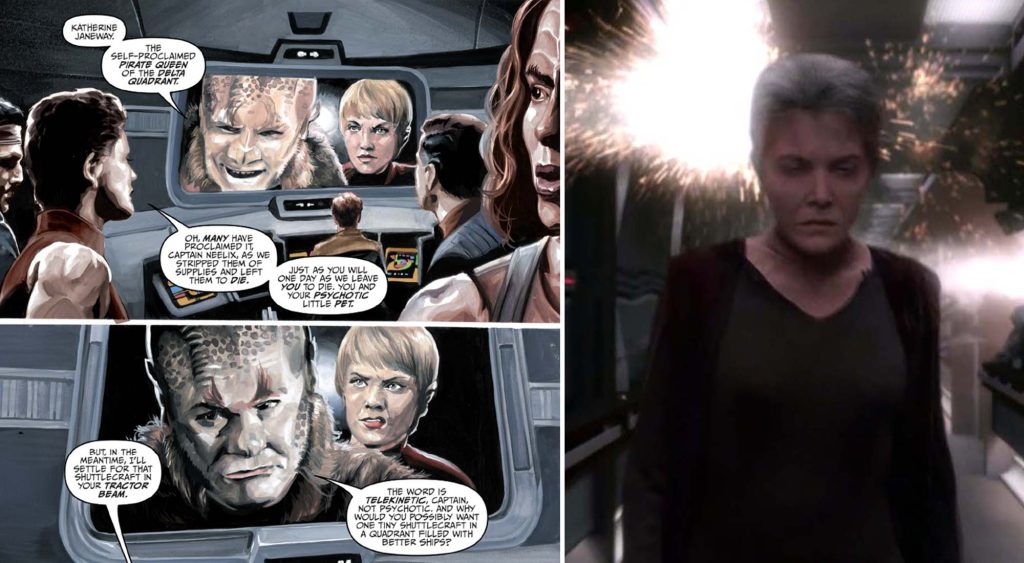
In the midst of the mutiny, Kes and Neelix try to steal the Voyager. The two travel together aboard the Baxial, their prime counterparts’ freighter from “Caretaker.” Kes exhibits the same destructive telekinetic power that she wielded in “Fury,” and Janeway’s counterpart describes the Ocampa as “psychotic.” Kes uses her abilities to help Neelix commandeer the Rebel vessel, but the attempt fails, and the lovers find themselves imprisoned in Voyager’s brig, with Chakotay now commanding the Baxial.
After thwarting both plots, Janeway decides to attack the Borg, whom she first learns about from Annika Hansen. The implication is enormous: the Empire has no knowledge of the Borg! Apparently, Q never forced Picard’s Enterprise to meet the Borg, who thus never visited the Alpha Quadrant, meaning that all the episodes and films in which they appeared did not take place in the alternate reality. Yet if that’s the case, then the events of “Scorpion” also would not have occurred… so why was Annika in the Delta Quadrant in the first place, requiring a rescue? (In any case, this story contradicts IDW’s Mirror Broken and its sequels, in which Data sports Borg implants.)
Mirrors & Smoke would have made a great episode, its ending clearly setting up intended sequels, with Annika, Kes, and Neelix allying to stage a prison break and seek retaliation. There was more story to tell here, including the reason for Annika being in the other quadrant, as well as Janeway’s no-doubt disastrous Borg encounter. It’s a shame the story wasn’t continued… though perhaps it’s just as well.
Despite great storytelling, IDW has dipped into that reality a few too many times (see Star Trek: New Frontier, Star Trek: Mirror Images, Star Trek #15–16, Star Trek #50–52, Star Trek: New Visions 1, ST:TNG: Mirror Broken, Discovery: Succession, ST:TNG: Through the Mirror, ST:TNG: Terra Incognita, and the above-noted Mirrors & Smoke). Since its debut in “Mirror, Mirror,” the alternate reality has played a prominent role on television as well, in numerous episodes of Deep Space Nine, Enterprise, Discovery, and Prodigy, and IDW is hardly the only publisher to keep that trend going. Frankly, the mirrorverse has become a tad overkill.
The same can be said regarding Khan Noonien Singh and the Augments, featured in “Space Seed,” Star Trek II: The Wrath of Khan, Star Trek Into Darkness, and in episodes of Enterprise, Strange New Worlds, and Prodigy, with the supermen’s creators featured on The Animated Series and Picard. IDW has brought back the superior intellect as well, in its Star Trek II: The Wrath of Khan adaptation, Star Trek: Khan, Khan—Ruling in Hell, Star Trek #50–52, Star Trek: Boldly Go #13–18, and Star Trek/Green Lantern: Stranger Worlds, and he has also returned in the novels. Khan has been inaccurately described by the media as Kirk’s metaphorical Joker, and that misconception has led to his overuse. Yet despite that fact, J.M. DeMatteis’s Hell’s Mirror, featuring art by Matthew Dow Smith and George Caltsoudas, is a breath of fresh air.

Hell’s Mirror simultaneously ranks among IDW’s best tales for both the mirror universe and Khan, offering the same level of excellence that comic readers have long come to expect from DeMatteis. If you haven’t read his Moonshadow, do so—and he also wrote the best issue of Marvel’s first Star Trek run. There’s an intriguing catch: Khan is the good guy. This is not the first time that IDW has flipped the script with a version of Khan in another universe. It did the same with the Kelvin timeline in Star Trek #50–52, which introduced the peace-loving mirror counterpart of Benedict Cumberbatch’s terrorist superman. DeMatteis’s story is undeniably the better of the two, though, for it features Ricardo Montalbán’s Khan, not his white-washed successor.
In this telling, Rebels find the Botany Bay and awaken Khan, who becomes their leader and plots to replace the Terran Empire with a democratic Federation of worlds. His plan is to spread a computer virus that will disseminate thousands of banned books throughout the Empire, restoring access to lost knowledge around the galaxy and thereby inspiring widespread resistance. Anyone who has read DeMatteis’s wonderful Star Wars #46, Marvel’s “The Dreams of Cody Sunn-Childe,” will notice a thematic resonance with his approach to Khan, and it works very well.
Khan’s people are said to have been created to save mankind in this reality. Humans feared them, however, and waged war rather than accepting their benevolent leadership, so the peaceful supermen sadly fled to space aboard the Botany Bay. After witnessing Terran brutality following his resuscitation, Khan vows to save the universe from fascism, and he builds the fractured Rebellion into a formidable fighting force.
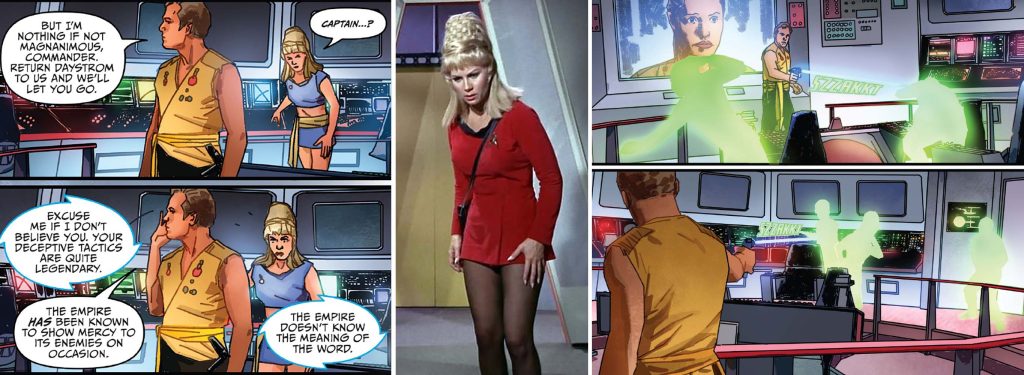
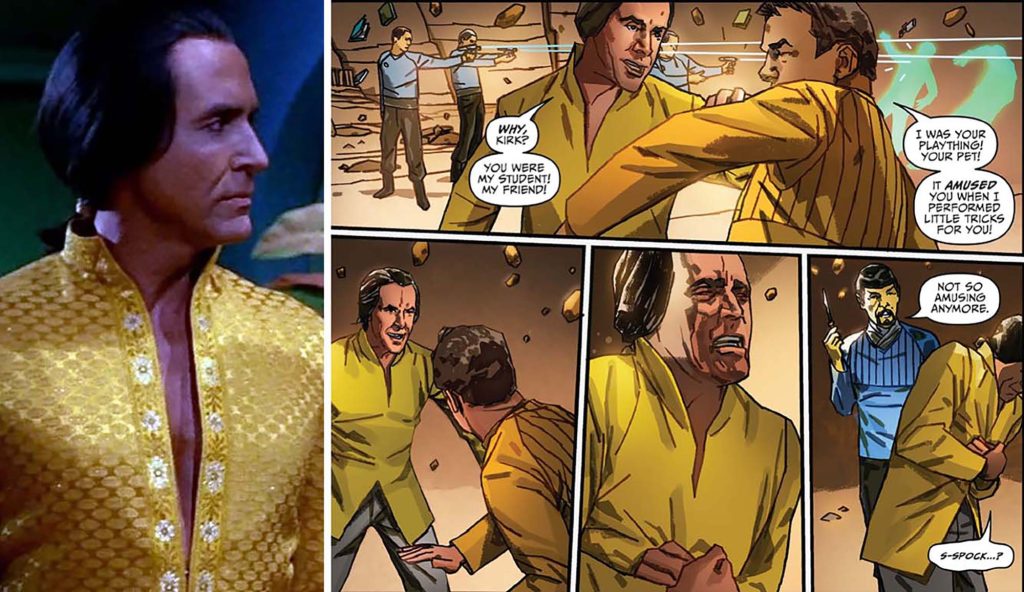
Mirror Spock and Kirk pretend to defect to his cause so they can destroy the Rebels from within. To convince Khan (and the readers) of his sincerity, Kirk murders his entire bridge crew, including Uhura, Rand, Chekov, and Sulu, then destroys the ISS Enterprise. It’s an effectively shocking moment, culminating in a neat twist ending, even though it ignores other stories in which the crew and starship exist further down the timeline. After spending months gaining his confidence, the two men finally locate his secret library—housed, of course, on Ceti Alpha V—after which Spock fatally stabs Khan.
In the course of the story, readers learn some tantalizing bits about the mirror universe, proving that DeMatteis knows his Trek trivia. George and Winona Kirk (from the 2009 film) are said to have lived in poverty under the Empire’s tyrannical rule. They raised their sons with compassion and love, urging them to stand for what was right. But the couple were dragged away during the night, their Iowa farm was burned, and young Jim Kirk was sent to a reconditioning camp to be reprogrammed as a murderous monster. It’s unclear whether his brother Sam Kirk (“Operation—Annihilate!” and Strange New Worlds) was also sent to such a camp, but it’s a good bet he was. Perhaps there’s an evil Sam out there, without facial hair.

Deep Space Station K-7 (“The Trouble with Tribbles”) serves as a prison planet, and among the inmates is treasonous scientist Richard Daystrom (“The Ultimate Computer”), who joins the rebellion. Meanwhile, among the books banned by the Empire are the works of Surak (“The Savage Curtain”) and Flint the Immortal (“Requiem for Methuselah”). The latter has intriguing ramifications, since it indicates that Flint did not hide his true nature in the mirror universe. One can’t help but wonder if this Flint also has sixteen beautiful Rayna Kapec androids… and if they’re evil Fembots in this reality.
Next time, we’ll continue our discussion of IDW’s brilliant Year Five maxiseries. In the weeks upcoming, stay tuned as Star Trek Comics Weekly explores Picard: Countdown, Deep Space Nine: Too Long a Sacrifice, Voyager: Seven’s Reckoning, and more.
Looking for more information about Star Trek comics? Check out these resources:
- The Complete Star Trek Comics Index, curated by yours truly
- The Star Trek Comics Checklist, by Mark Martinez
- The Wixiban Star Trek Collectables Portal, by Colin Merry
- New Life and New Civilizations: Exploring Star Trek Comics, by Joseph F. Berenato (Sequart, 2014)
- Star Trek: A Comics History, by Alan J. Porter (Hermes Press, 2009)
- The Star Trek Comics Weekly page on Facebook
Rich Handley has authored, edited, or contributed to numerous books and magazines for IDW, BOOM! Studios, DC Comics, Topps, Dark Horse, Lucasfilm, Paramount/CBS, Titan Books, and more. His anthology Musings on Monsters: Observations on the World of Classic Horror was nominated for a 2021 Rondo Award for Book of the Year; he was an editor of IDW’s Eisner Award-winning Star Wars: The Classic Newspaper Strips collection; and he contributed to IDW’s Eisner-nominated Star Trek #400. Rich’s words have appeared in 160 books to date. He edited Eaglemoss’s Star Trek Graphic Novel Collection; co-created Magnetic Press’s Planet of the Apes Role-Playing Game; and has penned licensed Star Trek, Star Wars, and Planet of the Apes fiction. Rich has written about other pop-culture franchises as well, including Dark Shadows Swamp Thing, Hellblazer, Watchmen, Battlestar Galactica, Stargate, Red Dwarf, Batman, Godzilla, and more.