
An ongoing discussion of how the comics provide prequels, sequels, and tie-ins to the Star Trek episodes and films, soon to be a book from BearManor Media. Click here to view an archive of this article series.
92: IDW Publishing, 2009–2010
Adaptations of popular films were once quite common in the comic book industry, especially regarding science fiction movies. From 2001: A Space Odyssey, Dune, and Battlestar Galactica to Star Wars, Blade Runner, and Close Encounters of the Third Kind, the 1970s and 1980s saw a lot of great sci-fi films (and some not so great) adapted for the four-color realm, often with beautiful results.
Star Trek has a long history of comic adaptations, with Marvel tackling Star Trek: The Motion Picture and later First Contact; DC handling The Search for Spock, The Voyage Home, The Final Frontier, The Undiscovered Country, Generations, The Next Generation’s “All Good Things,” and the novel The Ashes of Eden; and IDW adapting the 2009 movie. The other two Next Generation films (Insurrection and Nemesis) never appeared in the comics, as such adaptations had largely become a thing of the past by the time those movies were produced, but one classic film remained conspicuously absent for decades, despite it being widely hailed as the best movie in the series.

IDW rectified that oversight when it brought 1982’s Star Trek II: The Wrath of Khan to the comics world in 2009, more than a quarter-century after its release. The Wrath of Khan’s omission was never intended as a slight. Rather, it was a matter of unfortunate timing: Marvel’s tenure had ended months before the second movie hit theaters, while DC’s wouldn’t begin until almost two years afterward. Nicholas Meyer’s directorial masterpiece thus slipped through the cracks and remained there until the release of J.J. Abrams’ first Trek film, when IDW published an omnibus edition collecting the first six movie tie-ins. The editors discovered a gap existed and realized they had to fill it.
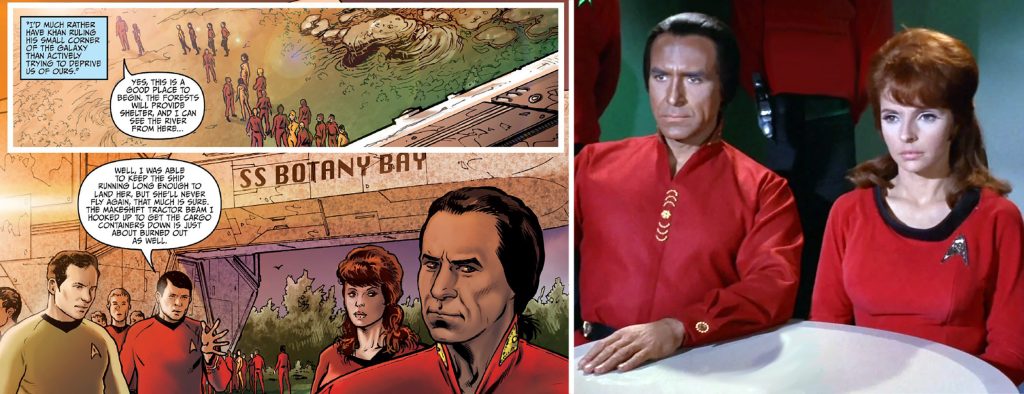
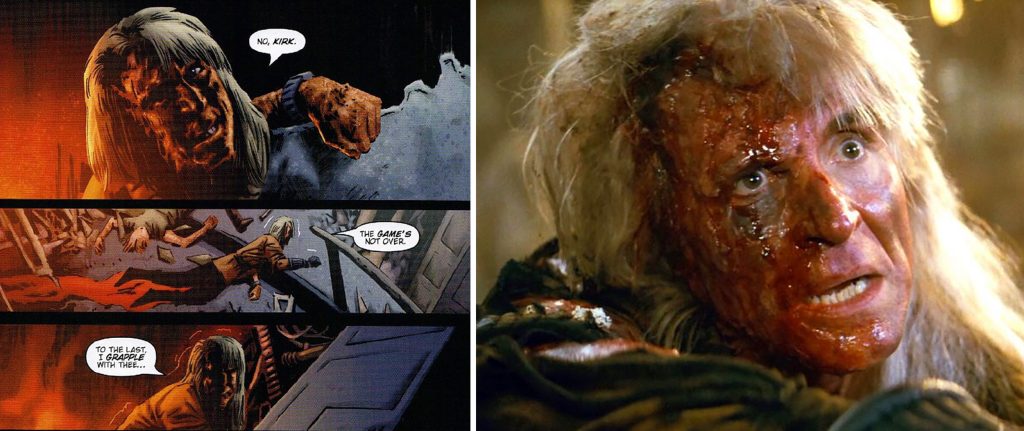
The three-issue miniseries, written by Andy Schmidt, was lavishly illustrated by Chee Yang Ong, with Chee, Bob Peak, and David Dietrick creating a trio of covers for each issue. Like the film itself, the adaptation provides a sequel to The Original Series’ “Space Seed” by picking up that episode’s storyline more than fifteen years later. Khan Noonien Singh and the “Augments” of the SS Botany Bay, awakened after centuries of suspended animation, had been exiled to Ceti Alpha V along with Marla McGivers for attempting to commandeer the USS Enterprise. Now, like a spacefaring Captain Ahab, Khan seeks to avenge his people by destroying James T. Kirk.

The artwork is sterling, with character likenesses captured remarkably well. Particularly effective is a scene depicting the gruesome moments leading up to Khan’s death. Sadly, with only sixty pages or so with which to work, Schmidt had to streamline the screenplay down to three short chapters. Thus, he had little choice but to jettison some of the more memorable scenes, such as Spock gifting Kirk with a copy of A Tale of Two Cities, and he had to tweak or condense other moments here and there. It’s no fault of Schmidt, of course—it’s just the reality of adapting a film to another medium.
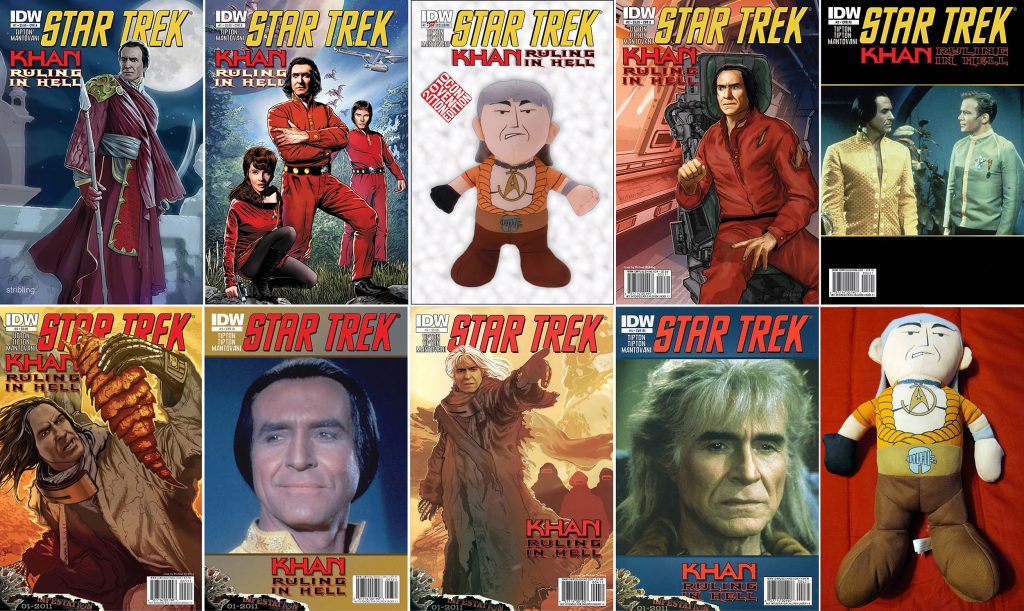
The choice to adapt The Wrath of Khan would prove fortuitous for IDW, since the second Abrams film, Star Trek Into Darkness, would effectively reimagine Meyer’s movie. The adaptation was followed a year later by the four-issue miniseries Khan: Ruling in Hell, written by Scott and David Tipton, with interior art by Federica Manfredi and covers from Michael Stribling and Joe Corroney. One cover features a plush Khan doll released by IDW in partnership with Toy Factory, which is amusing when you consider that mass-murdering dictators are not typically the subject of children’s toys.
Ruling in Hell explores the motivations of the character made famous on the small and large screens by actor Ricardo Montalban: his love for his wife Marla, his bond with his second-in-command Joachim (more on that in a moment), the surprising faith he puts in the Enterprise crew, and the high price he places on loyalty. This story, which begins soon after Khan’s hearing, explores the span of time between the Augments’ exile in “Space Speed” and the USS Reliant’s arrival at Ceti Alpha V in The Wrath of Khan.
The miniseries explains how the explosion of Ceti Alpha VI laid waste to Khan’s colony, how his people survived the cataclysm, how Marla and others were killed by Ceti eels, and how Khan grew obsessed with seeking revenge against Starfleet and Kirk. It’s still unclear how Starfleet and Doctors Marcus could have completely overlooked a missing planet while evaluating the system’s suitability for Project: Genesis—or why anyone would ever consider terraforming a world located next to a colony of steroidal uber-Hitlers, for that matter—but we can blame that on the filmmakers, not the Tiptons.
As the story opens, the Enterprise escorts the Augments, the Botany Bay, and several supply-filled cargo containers to the paradisiacal planet. Kirk and Khan depart on gentlemanly terms, which works well. Kirk had earned the latter’s grudging respect, after all, by besting him and his crew of supermen. Rather than despairing over his exile, Khan thanks the captain for setting his people free instead of imprisoning them. In fact, it seems future relations between the colony and Kirk/Starfleet might actually be amicable, and not at all a hell-heart’s stabbing of wrath.
With McGivers and Joachim at his side, Khan sets out to tame the paradise and build an empire, but then Ceti Alpha VI explodes, playing havoc with their plans. Khan holds out hope his frenemy Kirk will return to check on the colony’s progress, but neither Jim nor anyone else from Starfleet bothers to do so, much to the Augments’ frustration, because sometimes the Federation can be alarmingly myopic. Plagued by deadly sandstorms, Khan’s people build shelters from the cargo containers, establishing the metal hovel seen onscreen.
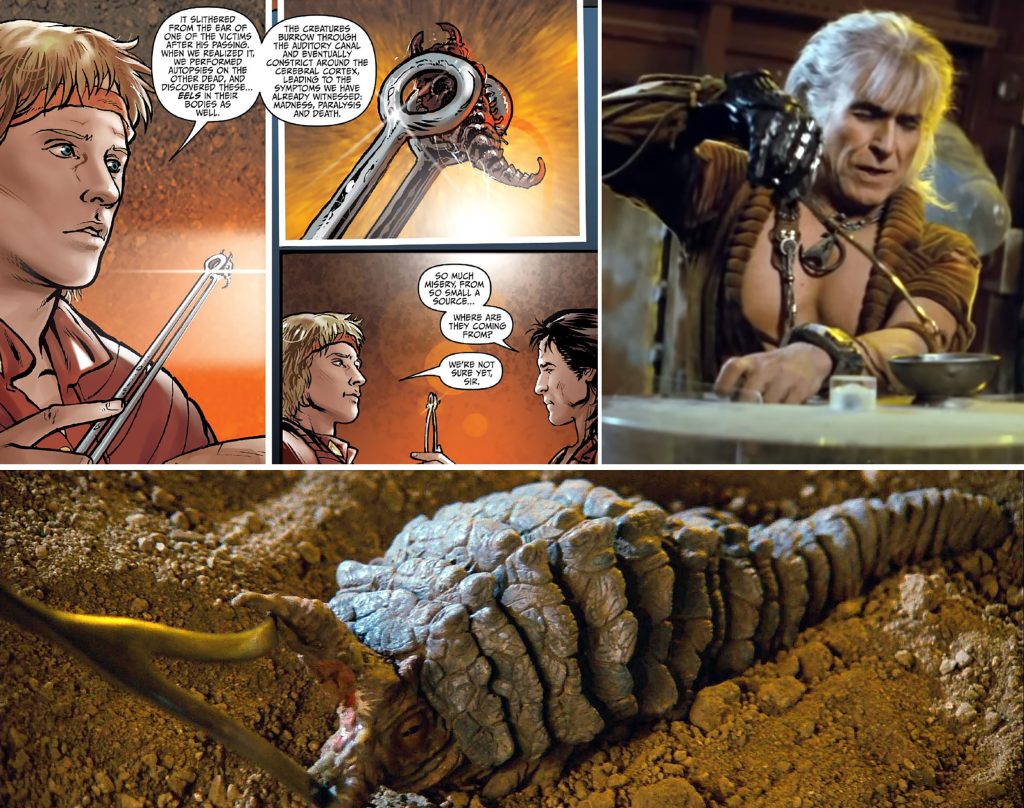
A new problem arises as members of the group bizarrely succumb to mental instability and paralysis. Anyone who has watched The Wrath of Khan—and it’s hard to imagine someone reading this column who hasn’t—will immediately recognize that the culprits are the movie’s slithery Ceti eels. The last surviving indigenous species of Ceti Alpha V, the burrowing creatures enter the ear of their victims and wrap themselves around the cerebral cortex, causing excruciating pain, rendering them susceptible to suggestion, and bestowing madness and death upon anyone not named Pavel Chekov. (Incidentally, I’ve always wondered how they could be the last surviving indigenous species. What did they feed on before “Space Seed” provided them with Aryan lunch?)
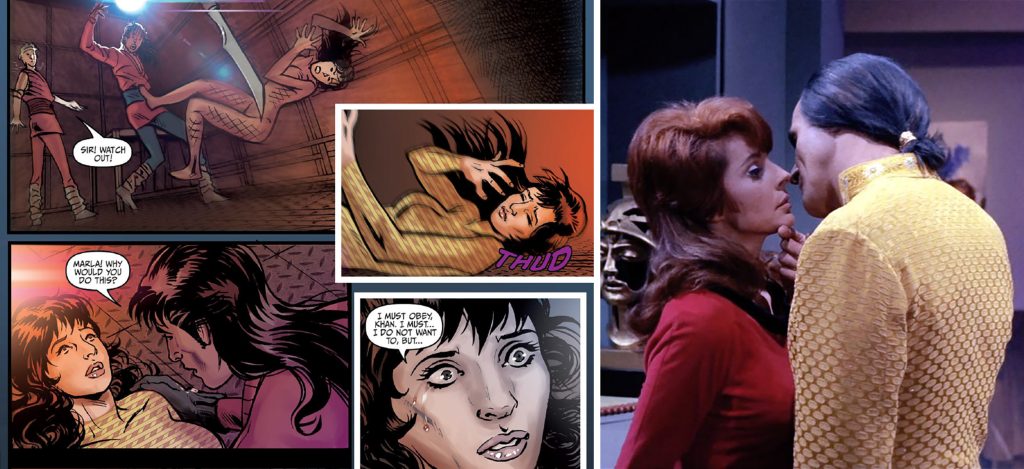
One especially hot-tempered Augment, Tamas, finds Khan’s leadership lacking and mounts a coup. He uses an eel to force McGivers to stab her own husband against her will, and when she tries to resist it ultimately kills her. As one might imagine, this does not sit well with the superior intellect, for despite his blatant sexism, problematic abusiveness, and tyrannical cruelty, Khan… well… really loves her. And so he and Joachim slaughter Tamas and his fellow mutineers, reducing the Augments’ numbers to the dozen or so Scandinavian catalog models from the film.
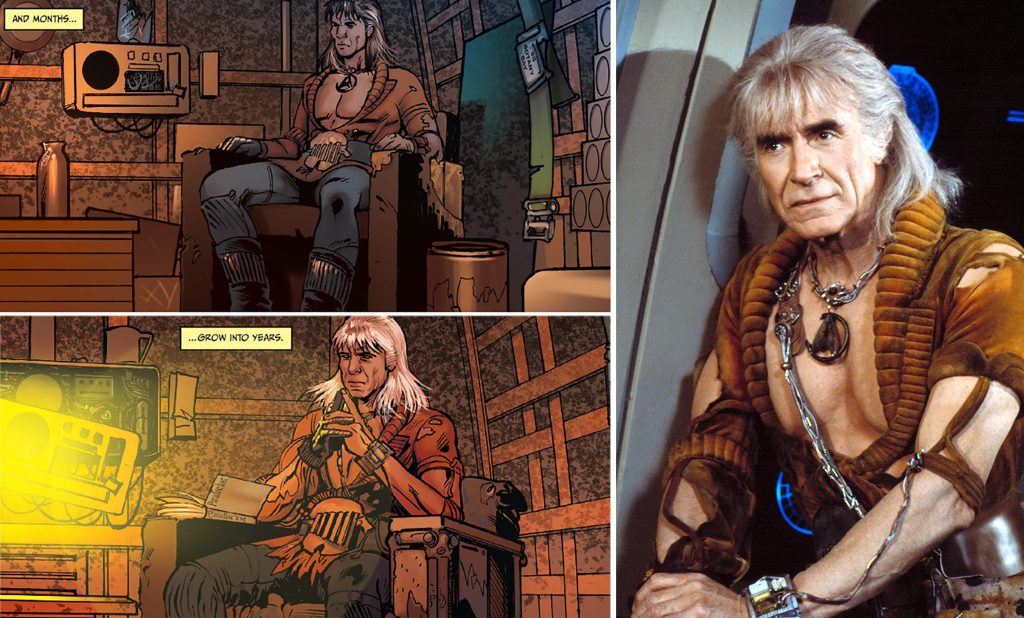
The survivors move into underground caves offering shelter, water, and food, explaining how they survived for almost two decades on a planet ravaged by sandstorms, a shifting orbit, and the extinction of the local ecosystem: they lived on mushrooms! There, Khan spends years descending into obsessed madness, determined to lead his people off-planet and seek revenge. He gets his chance in the final scene, set during The Wrath of Khan, when the Reliant scouts the planet as a Genesis candidate, conveniently delivering Chekov and Clark Terrell to his doorstep as soon-to-be dutiful slaves.

Other than Joachim, none of Khan’s followers mentioned in “Space Seed”—Kati, Ling, McPherson, Otto, and Rodriguez—are name-checked in Ruling from Hell. With several dozen colonists, that can be explained, but it’s interesting that Tamas’s key conspirators are drawn to resemble beautiful Kati and muscular Otto. It’s unclear whether or not this was the Tiptons’ intent, but since a flashback scene aboard the Botany Bay clearly depicts Kati, it seems logical to assume that’s her among the rebels, proving the inherent flaw in creating a race of Machiavellian supermen, then expecting them to remain subservient.

This brings us back to Joachim. In “Space Seed,” Khan’s lieutenant was a dark-haired man named Joaquin, portrayed by Mark Tobin. In The Wrath of Khan, his loyal second was Joachim, played by blonde actor Judson Scott—who was around the same age as Tobin, despite the film being set two decades later. The naming similarity and the age discrepancy have been a source of confusion ever since, with some sources treating the two men as separate supermen, yet others assuming “Joachim” to have been a simple misspelling on the filmmakers’ part—in other words, they’re both Joaquin.

Star Trek Encyclopedia co-author Michael Okuda, during a commentary track for Star Trek II, claimed the latter to be the case, whereas other sources, including StarTrek.com, list Joachim and Joaquin as different people. In novelist Greg Cox’s trilogy The Rise and Fall of Khan Noonien Singh, Volumes One and Two, and To Reign in Hell: The Exile of Khan Noonien Singh, Joachim is presented as Joaquin’s son. That trilogy presents a different history for the Augments than the one in Ruling in Hell, but it’s a gripping read and highly recommended (and it’s all been overwritten by Strange New Worlds—see It’s Been a Long Road Getting from There to Here). The comic has Joachim already serving Khan as of “Space Seed,” so the jury’s still out on the licensing side of things.

Coinciding with the 2013 release of Star Trek Into Darkness, IDW would publish another Khan-centric miniseries titled Star Trek: Khan, from writer Mike Johnson. We’ll get to that tale soon, but in the meantime, the next stop on our continuing voyage to explore how comics offer prequels, sequels, and tie-ins to onscreen Star Trek will look back at IDW’s Star Trek: Captain’s Log. See you then.
Looking for more information about Star Trek comics? Check out these resources:
- My ongoing column for Titan Books’ Star Trek Explorer magazine
- The Complete Star Trek Comics Index, curated by yours truly
- The Star Trek Comics Checklist, by Mark Martinez
- The Wixiban Star Trek Collectables Portal, by Colin Merry
- New Life and New Civilizations: Exploring Star Trek Comics, by Joseph F. Berenato (Sequart, 2014)
- Star Trek: A Comics History, by Alan J. Porter (Hermes Press, 2009)
- The Star Trek Comics Weekly page on Facebook
Rich Handley has written, co-written, co-edited, or contributed to dozens of books, both fiction and non-fiction, about Planet of the Apes, Watchmen, Back to the Future, Star Trek, Star Wars, Battlestar Galactica, Hellblazer, Swamp Thing, Stargate, Dark Shadows, The X-Files, Twin Peaks, Red Dwarf, Blade Runner, Doctor Who, Buffy the Vampire Slayer, Batman, the Joker, classic monsters, and more. He has also been a magazine writer and editor for nearly three decades. Rich edited Eaglemoss’s Star Trek Graphic Novel Collection, and he currently writes articles for Titan’s Star Trek Explorer magazine, as well as books for an as-yet-unannounced role-playing game. Learn more about Rich and his work at richhandley.com.
One thought on “Star Trek Comics Weekly #92”
Comments are closed.