
An ongoing discussion of how the comics provide prequels, sequels, and tie-ins to the Star Trek episodes and films, soon to be a book from BearManor Media. Click here to view an archive of this article series.
75: IDW Publishing, 2007–2008
Early in IDW’s Star Trek tenure, the publisher boldly took James T. Kirk and the USS Enterprise where they’d never gone before: a fourth season. The Original Series had been canceled after season three despite a planned fourth year on the air, but IDW chronicled new voyages set during that missing year, showing what might have been had NBC not prematurely pulled the plug. The result was appropriately titled Star Trek: Year Four.
The six-issue miniseries hit shelves following a prequel tale presented in IDW’s Focus On… Star Trek special, which also provided artist sketches, creator interviews, and other behind-the-scenes materials. Written by David Tischman (IDW’s Star Trek: The Next Generation—The Space Between), with art by Steve Conley, Gordon Purcell (a popular Trek artist for both DC and Malibu), Joe and Rob Sharp (credited as the Sharp Brothers), and Leonard O’Grady, Year Four featured beautiful cover art by Conley and Joe Corroney. The Focus On special’s cover was provided by Kelsey Shannon.
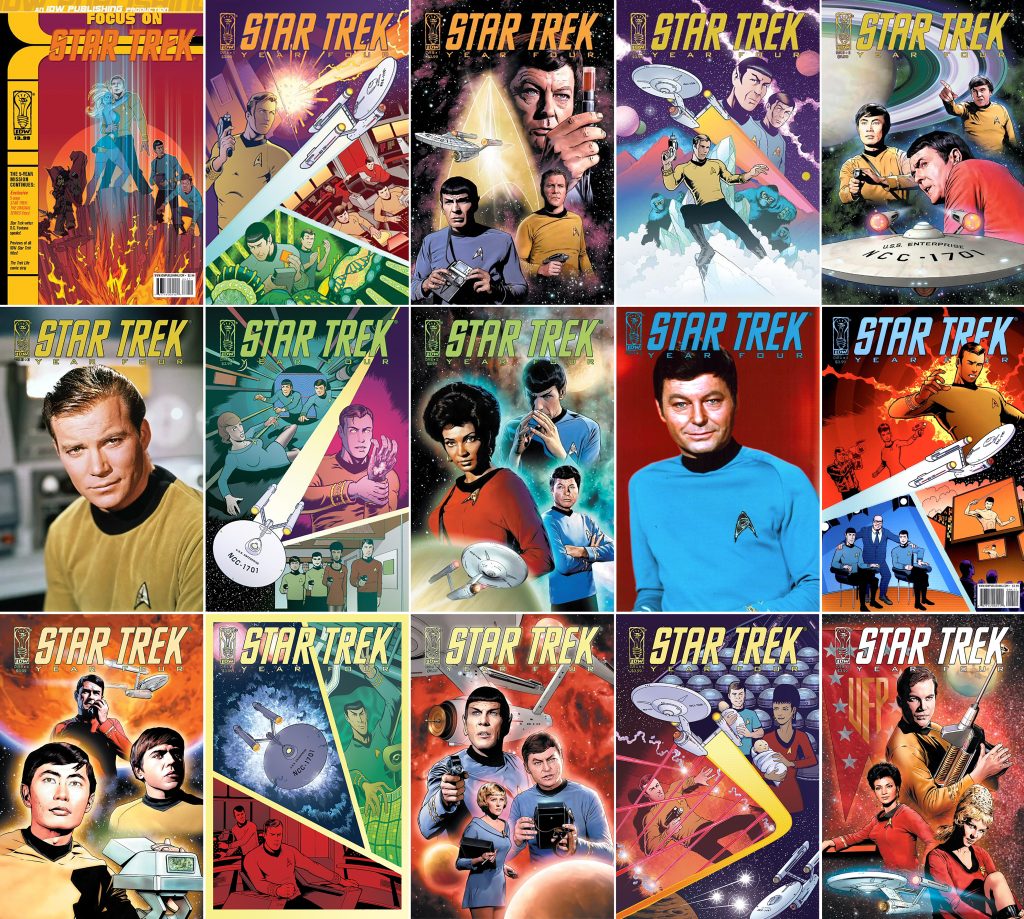
In keeping with The Original Series‘ motif, Year Four discusses topical issues relevant to the time of its release, including the Iraq War, reality television, the oil crisis, and the ethics of cloning. It’s also notable for bringing Arex and M’Ress, from The Animated Series, back into the fold. The characters had rarely appeared since the 1970s, other than in a few DC Comics and Power Records tales, as well as in a novel here and there. Year Four marked their return to the four-color realm for the first time since DC was ordered to remove them in the late 1980s, so it’s too bad they weren’t given more to do. Their involvement largely amounts to minor cameos, even though the series is set during their TV show, which basically comprised the five-year mission’s fourth season.
Arex has an amusing exchange regarding the danger of using a particle accelerator, gently ribbing those in the real world who at the time had worried the Large Hadron Collider might destroy Earth with a micro black hole. Otherwise, he merely sits at the navigation console. M’Ress gets even less screen-time. Given how well-written and illustrated this miniseries is, not giving them more to do feels like a missed opportunity. The publisher has since granted them meatier roles in follow-up titles Year Four: The Enterprise Experiment and Year Five, as well as in Star Trek vs. Transformers, all of which will be discussed in upcoming columns.
Nonetheless, Tischman’s familiarity with the franchise is evident in Year Four, just as it was in The Space Between, with references to Enterprise‘s Doctor Phlox, Deep Space Nine‘s Bajor, and more. Considering that IDW has largely eschewed Enterprise-based comics, it’s fascinating that its first three miniseries all referenced that show—two by including Phlox callbacks.
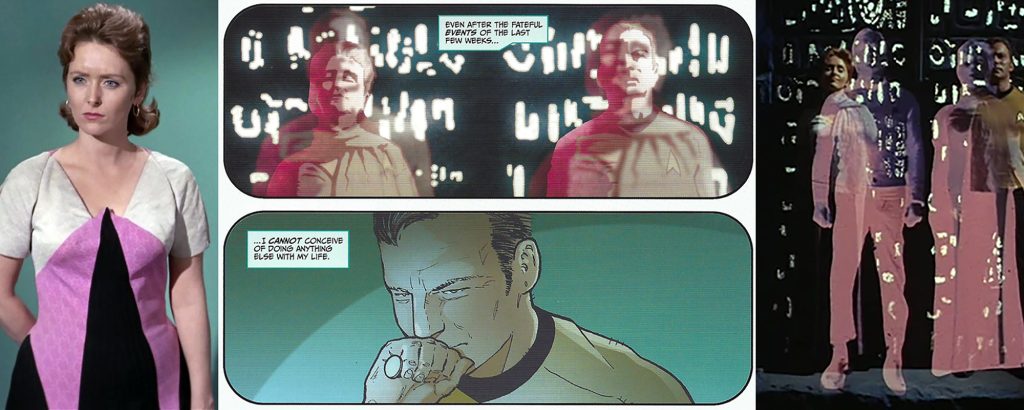
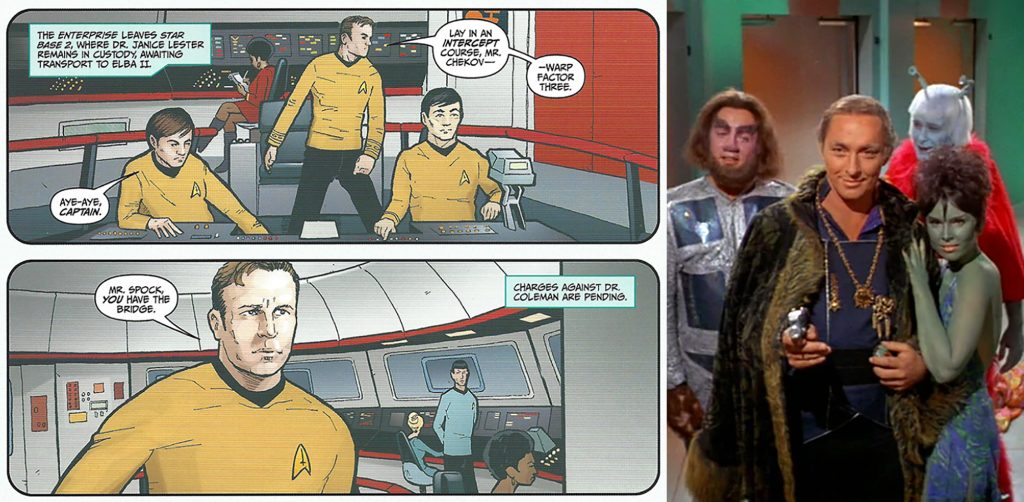
Year Four opens with a five-page tale in the Focus On… Star Trek special, set shortly after “Turnabout Intruder,” with Janice Lester awaiting transport to the Elba II asylum (“Whom Gods Destroy”). As the Enterprise heads out to rendezvous with the USS Potekmin at Beta Aurigae, Kirk considers his life as a starship captain and ponders whether he could see himself doing anything else—which, of course, the theatrical films have shown time and again that he cannot.
Year Four is smartly written and highly enjoyable, and each full-length issue plays out like an episode of the 1960s show, with M’Ress and Arex adding a 1970s vibe. It’s surprising how few tie-ins to specific episodes can be found, but perhaps that was by design. By setting this miniseries after “Turnabout Intruder,” IDW brought the Enterprise into an era infrequently explored outside the cartoon. Rather than focusing on callbacks or sequels to televised adventures, Tischman returned to Star Trek‘s primary premise of exploring strange new worlds, seeking out new life and new civilizations, and boldly going where no one had gone before.
In issue #1, the Enterprise discovers a mass of 46 planets and moons in a single orbit shaped like a DNA strand (an entire miniseries could be built around that concept), where a genius scientist uses an ancient laboratory to create genetic hybrids he calls B’Nai, in a failed effort to cure his Vulcan wife’s illness. When the B’Nai fire nuclear missiles at the starship, the scientist murders all of his creations, then commits suicide. This standalone issue contains no direct episode connections, but it’s compelling and unnerving.

The next issue sees the starship visiting a dilithium-rich planet. (Ever since Discovery‘s third season, I’ve not been able to read Trek novels or comics featuring dilithium-rich planets without thinking “Well… THAT world blew up during the Burn.”) Negotiating for mining rights, an away team is attacked by fundamentalists opposed to modernization, and then by the government as well. With both sides plotting against the Federation, Kirk leaves the planet to its own internal troubles, an amusing twist on the Prime Directive formula. The issue contains a single episode tie-in, and it’s to The Next Generation‘s regrettable “Code of Honor,” with a throwaway reference to Starbase 14.
Traveling to the galactic edge for issue #3, the Enterprise crew investigates a colony’s disappearance and discovers the populace’s brains were overloaded by a communal sentience that infects its carriers via sound. The alien infects Kirk’s crew, and he and Christine Chapel are the last to succumb to its influence. There are no direct tie-ins here, though the issue is one of Year Four‘s most effective chapters, aligning well with Trek‘s core ideals. What starts out as a story seemingly about an entity possessing the crew evolves into a plea for assistance from a being that means no harm but is desperate to find passage back to its own world.
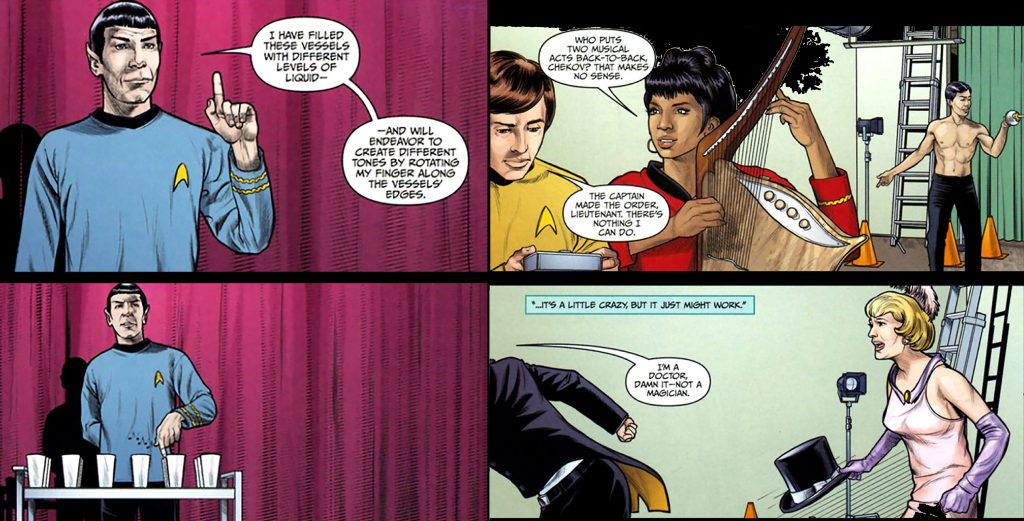
My nomination for the best issue goes to #4, which offers a witty dressing-down of the media and entertainment sector, particularly of NBC’s cancelation of Star Trek. On a world obsessed with television, Kirk witnesses a teen being shot for breaking his network contact—a capital offense on this planet. It’s Jim Carrey’s The Truman Show, but in space. The Starfleet personnel become media sensations and the network-run government refuses to let them leave until Kirk produces a TV series about life aboard the Enterprise. After trying a variety-show approach, with crew members auditioning their talents on stage, he outsmarts the execs by causing the ratings to plummet, simply by boring the viewers. It’s hilarious and it’s classic Jim Kirk.
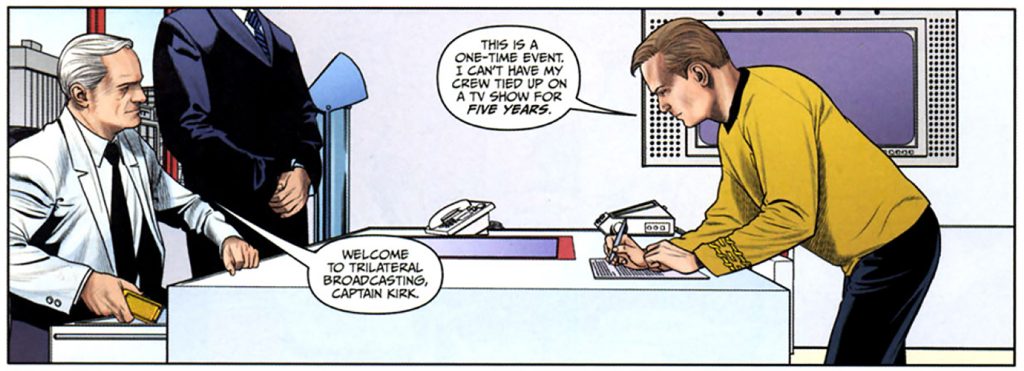
Charles Evans (“Charlie X”) has a cameo, though his presence is without explanation. Otherwise, the tie-ins are not in-universe but rather to Star Trek‘s real-world history. The crew are treated like celebrities and their cell guard asks for an autograph. When Kirk makes the network deal to earn their freedom, he refuses to let his officers be “tied up on a TV show for five years.”
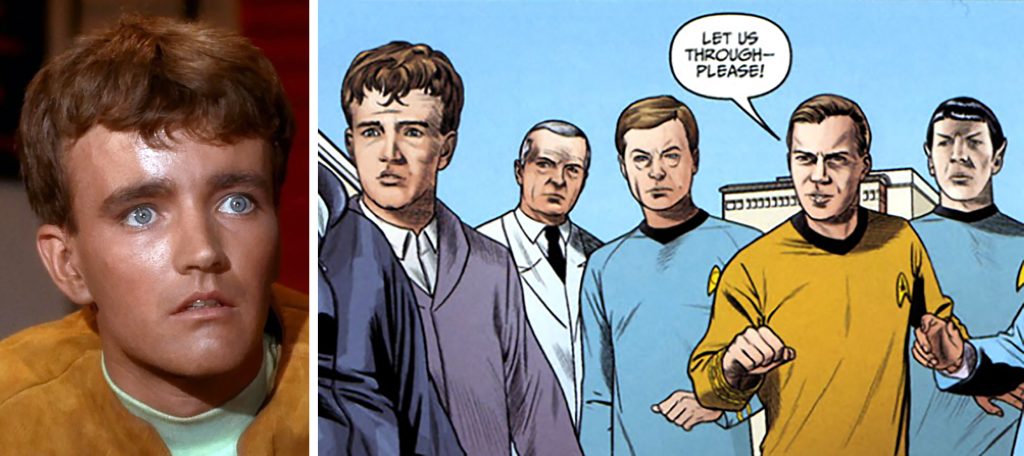
Network executives Ted Tinker and Brandon are clearly named after NBC CEO Grant Tinker, who helped Gene Roddenberry sell the original show, and Paramount chairman Brandon Tartikoff, who was instrumental in developing Deep Space Nine. And in the end, the network launches the science-fiction show Starfleet Academy, the pilot of which is attributed to Scott Tipton (a prolific Star Trek comic scribe).
In issue #5, the crew employs the above-noted particle accelerator to reproduce the conditions of the universe’s birth. Fluctuations create a massive black hole (again, poking fun at the Large Hadron Collider conspiracists), which swallows the Gemini research station with Spock aboard. A solar flare destroys Gemini, but Spock transports to the ship in time, thanks to quick thinking on Pavel Chekov’s part.
The crew investigates the disappearance of the USS Pasteur in issue #6, providing callbacks to onscreen lore. A landing party finds a facility run by a robot nanny that creates hybrid babies by harvesting the DNA of many species. These include the usual humans, Andorians, and Vulcans, along with Benzites (“Coming of Age” and other episodes), Gorns (“Arena” and Strange New Worlds), and even Phylosians (“The Infinite Vulcan,” “The Time Trap,” and Lower Decks‘ “Cupid’s Errant Arrow”). The Gorn child looks quite different here than those featured on Strange New Worlds, though that is of course not the fault of the comic’s creative team since the show didn’t yet exist.
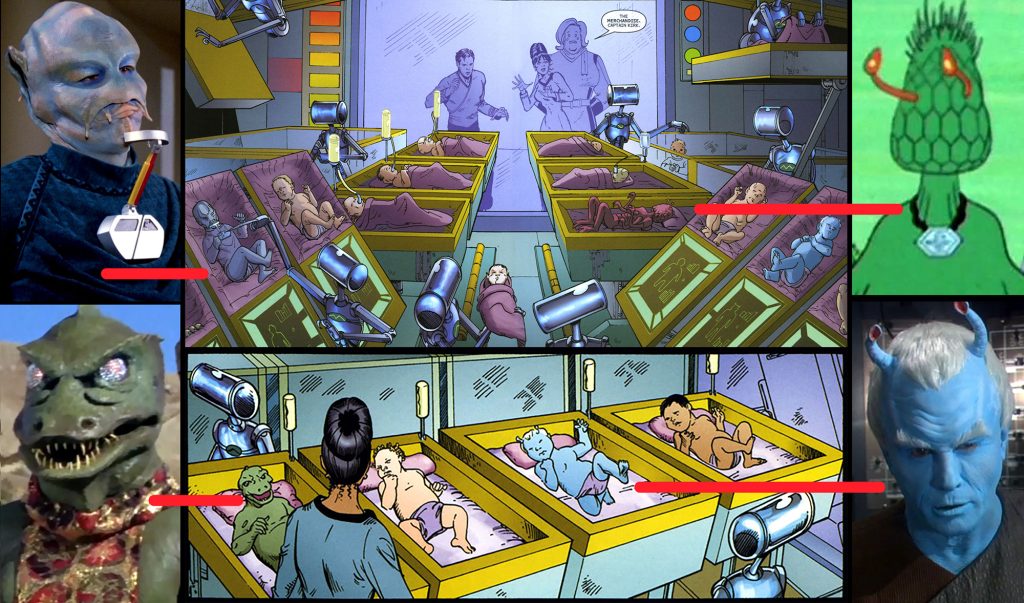
The purpose for such bizarre experiments? To repopulate a world whose citizens became infertile and went extinct a thousand years prior. The crew thus finds homes for each child, including on the planet Pacifica (“Conspiracy” and “Manhunt”), providing a warm, cozy, eminently Trek-like ending to a satisfying miniseries.
Despite its relative lack of prequels, sequels, and tie-ins, and despite Arex and M’Ress being relegated to background players in their own title, Year Four was a highlight of IDW’s early years. It deserves credit for acknowledging The Animated Series‘ place in history after decades of undeserved ridicule, and it’s a far better celebration of that show than the dreadfully misfiring Very Short Treks. The publisher hit the ground running when it assumed the franchise’s comics license, and next week we’ll examine IDW’s Alien Spotlight, in which the tie-ins flow fast and furious.

Looking for more information about Star Trek comics? Check out these resources:
- My ongoing column for Titan Books’ Star Trek Explorer magazine
- The Complete Star Trek Comics Index, curated by yours truly
- The Star Trek Comics Checklist, by Mark Martinez
- The Wixiban Star Trek Collectables Portal, by Colin Merry
- New Life and New Civilizations: Exploring Star Trek Comics, by Joseph F. Berenato (Sequart, 2014)
- Star Trek: A Comics History, by Alan J. Porter (Hermes Press, 2009)
- The Star Trek Comics Weekly page on Facebook
Rich Handley has written, co-written, co-edited, or contributed to dozens of books, both fiction and non-fiction, about Planet of the Apes, Watchmen, Back to the Future, Star Trek, Star Wars, Battlestar Galactica, Hellblazer, Swamp Thing, Stargate, Dark Shadows, The X-Files, Twin Peaks, Red Dwarf, Blade Runner, Doctor Who, Buffy the Vampire Slayer, Batman, the Joker, classic monsters, and more. He has also been a magazine writer and editor for nearly three decades. Rich edited Eaglemoss’s Star Trek Graphic Novel Collection, and he currently writes articles for Titan’s Star Trek Explorer magazine, as well as books for an as-yet-unannounced role-playing game. Learn more about Rich and his work at richhandley.com.
One thought on “Star Trek Comics Weekly #75”
Comments are closed.