
An ongoing discussion of how the comics provide prequels, sequels, and tie-ins to the Star Trek episodes and films, soon to be a book from BearManor Media. Click here to view an archive of this article series.
73: IDW Publishing, 2007
Mere months after Tokyopop launched its Star Trek manga line, a second company entered the arena: Idea and Design Works, more commonly known as IDW. Founded in 1999, IDW is known for its licensed comics based on popular TV, film, and video game franchises, including Doctor Who, CSI, 24, Angel, G.I. Joe, Ghostbusters, and Transformers, so it was no surprise when it added Star Trek to its lineup. IDW’s line debuted with writer David Tischman’s The Space Between, celebrating The Next Generation‘s 20th anniversary. The six-issue miniseries was illustrated by Casey Maloney and Stacie Ponder, with gorgeous covers by Dennis Calero, Joe Corroney, Jeremy Geddes, Zach Howard, Ken Kelly, and Thompson Knox.
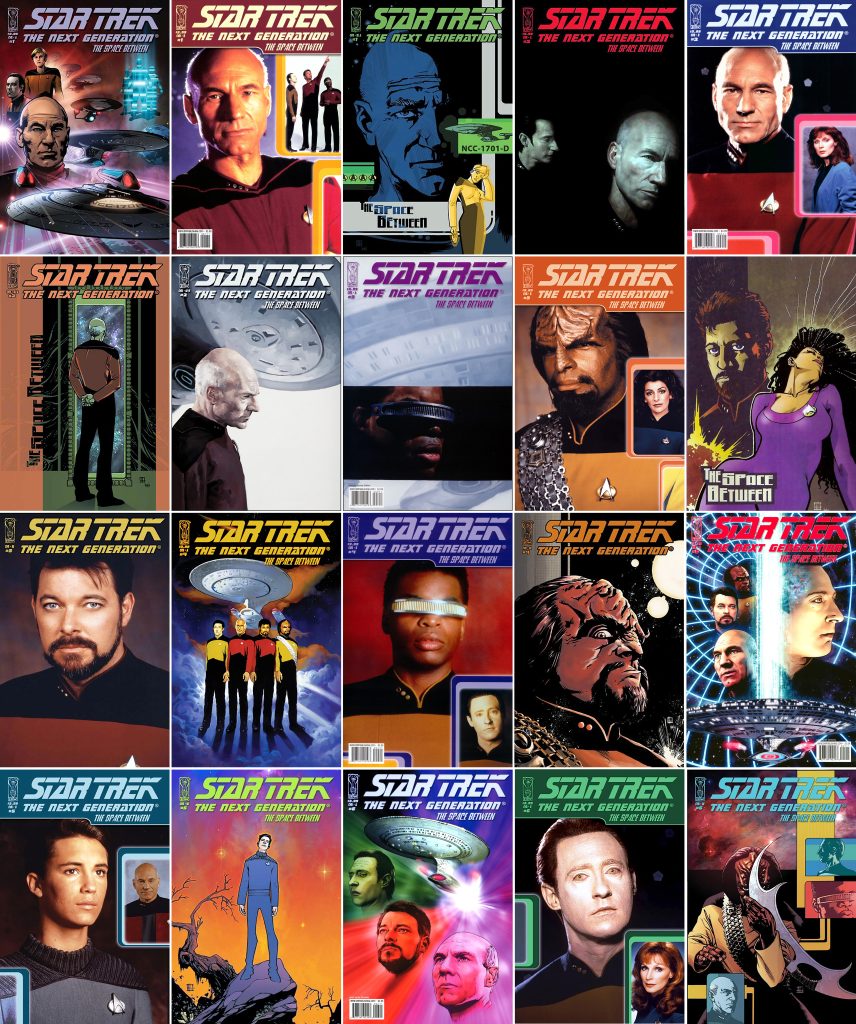
IDW holds the record for the most Trek comics published to date. DC reached 300 issues (including WildStorm), while Marvel produced 113, and the British strips spanned 265 magazines and annuals. As of mid-2023, IDW has released or announced more than 460 issues, under the editorial leadership of Scott Dunbier, Andrew Steven Harris, Chris Ryall, Andy Schmidt, Dan Taylor, Denton J. Tipton, Chase W. Marotz, Megan Brown, and now Heather Antos, with Dean Mullaney running the show at the company’s Library of American Comics imprint. And most of them have a lot of cover variants, as you’ll see when we navigate our way through all the various titles in the months ahead.
The Space Between occurs at various points throughout The Next Generation‘s timeline, with each issue telling a self-contained tale that is part of a larger whole. The first five issues proved entertaining, and the multiple settings allowed the writers to bring back characters who’d left the show, like Tasha Yar and Kate Pulaski. Alas, the story didn’t truly come together in the end, with the sixth issue providing a vague, insufficient resolution.
In issue #1, the Enterprise crew evaluates the planet Tigan for Federation membership. All citizens have brain implants connecting them to a central computer, enabling the chancellor to rewrite people’s thoughts and memories to her advantage. She even attempts to rewire Data’s positronic brain, just as others (notably the Borg Queen in Star Trek: First Contact) have tried and failed to do.
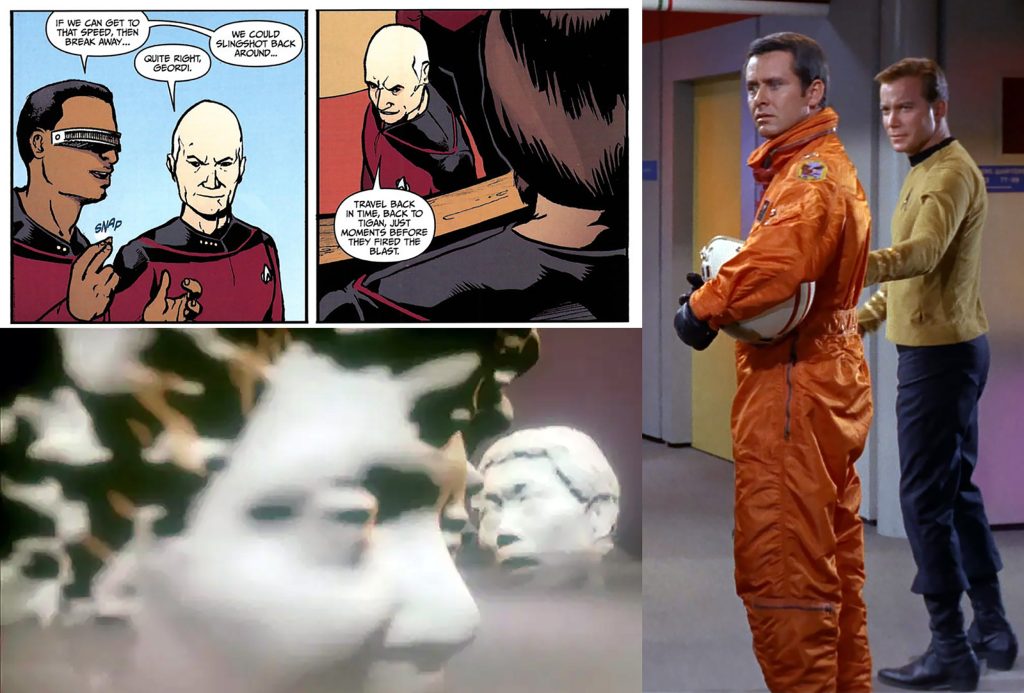
A gravimetric pulse propels the starship across the galaxy, but Geordi La Forges uses the light-speed breakaway factor to slingshot back in time and prevent the blast. It’s a fun callback to “Tomorrow Is Yesterday” and Star Trek IV: The Voyage Home, in which James T. Kirk’s crew used the slingshot effect. (If you’re thinking “Wait, what about ‘The Naked Time?'” then you’ve got your temporal technobabble cross-circuited. That episode’s time travel was due to a cold-restart with a controlled matter-antimatter implosion. So there.)
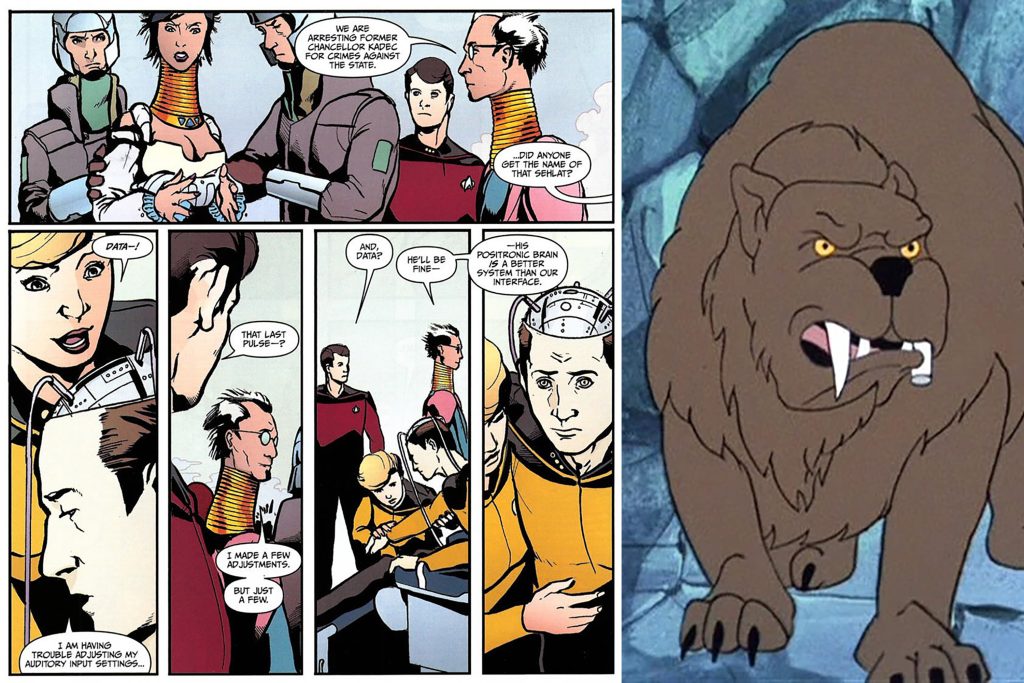
A wacky reference to The Animated Series‘ “Yesteryear” is a bit less effective. After having his brain rewritten, Data awakens and asks “Did anyone get the name of that sehlat?” A common gag of 20th-century cartoons was to have a character be knocked senseless with a boxing glove, a wooden plank, or some other object, then sputter “Did anybody get the number of that truck?” For Looney Tunes‘ Foghorn Leghorn, it was hilarious. For Data? Not so much.
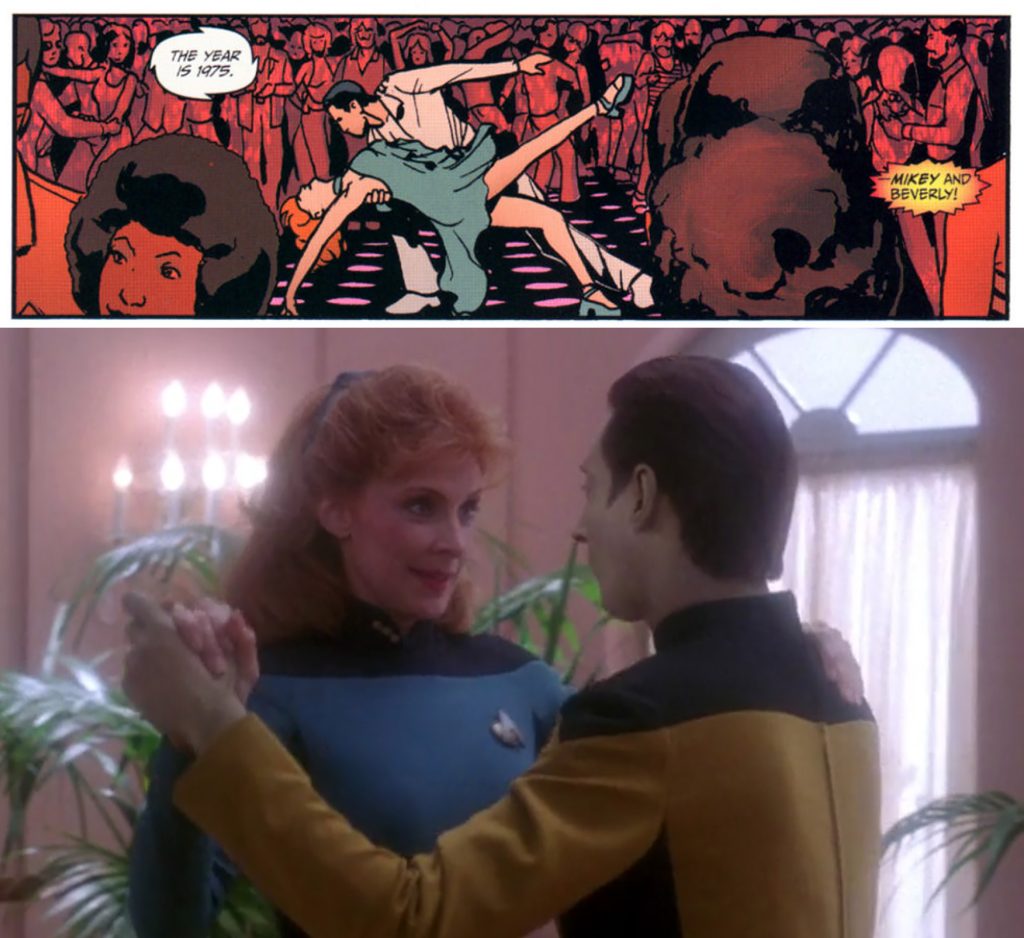
Issue #2 sees Jean-Luc Picard joining an archeologist friend in exploring ancient ruins. After the team finds five priceless diamonds, greed takes hold and one team member begins killing the others for possession of the gems. Meanwhile, in a callback to The “Data’s Day,” Beverly Crusher lives up to her “Dancing Doctor” nickname by enjoying a holodeck program in which she is part of a disco dance team in 1975. The program is called Crusher 54, with the disco presumably based on Manhattan’s famed Studio 54, even though the real-world nightclub didn’t open until 1977.
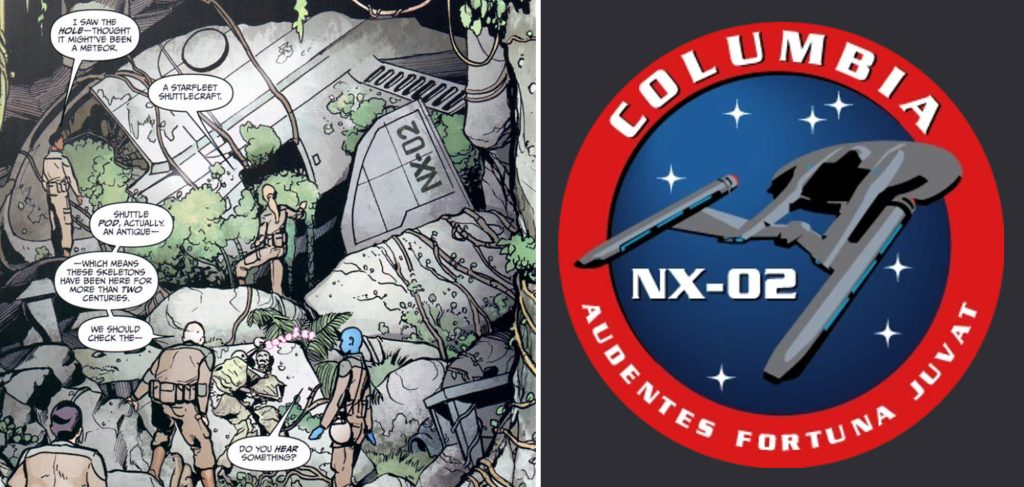
During the expedition, Picard discovers the ruins of a Starfleet shuttle pod marked NX-02, indicating it originated aboard the Columbia, featured in the Star Trek: Enterprise episode “The Expanse.” The crew learns the pod had been reported stolen from that same starship two centuries prior. He then arranges for the diamonds to be donated to the Daystrom Institute, which, per Deep Space Nine‘s “Q-Less,” has a council devoted specifically to funding archeological expeditions.
No direct tie-ins occur in issue #3, other than the existence of a remote-controlled Romulan-Starfleet-Borg hybrid vessel—a fascinating concept that should have been further developed—which attacks the Enterprise, causing Deanna Troi to nearly die from cranial trauma. (Poor Troi. Only The X-Files‘ Dana Scully ends up near death in a hospital more often than she does.) After Data disrupts the signal with a subspace beacon network, the other ship self-destructs before the crew can determine who sent it or why. It’s a setup for the sixth issue… which, as noted, doesn’t entirely answer those questions.
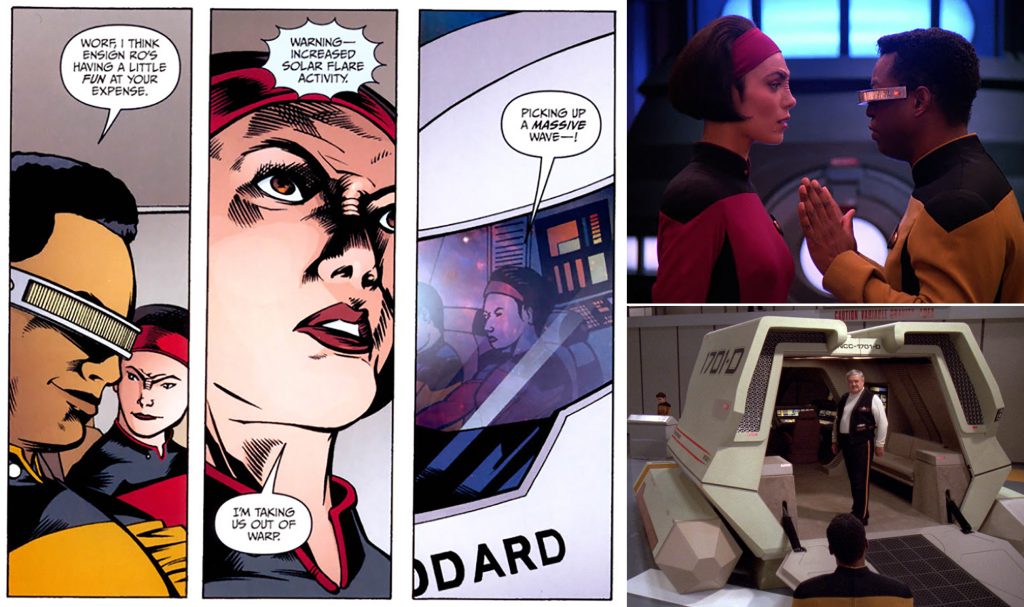
In the fourth issue, Worf, La Forge, and Ro Laren travel back to the Enterprise aboard the shuttle Goddard following a mission, only to have an energy beam cause them to crash on a snowy world. The three had previously traveled aboard this same shuttle in “The Next Phase,” and the result was equally disastrous. Perhaps Picard should stop sending this group of officers together on missions. It’s no wonder La Forge saw Montgomery Scott off when he left with the Goddard in “Relics”—Geordi was just glad to see that damn shuttle go.
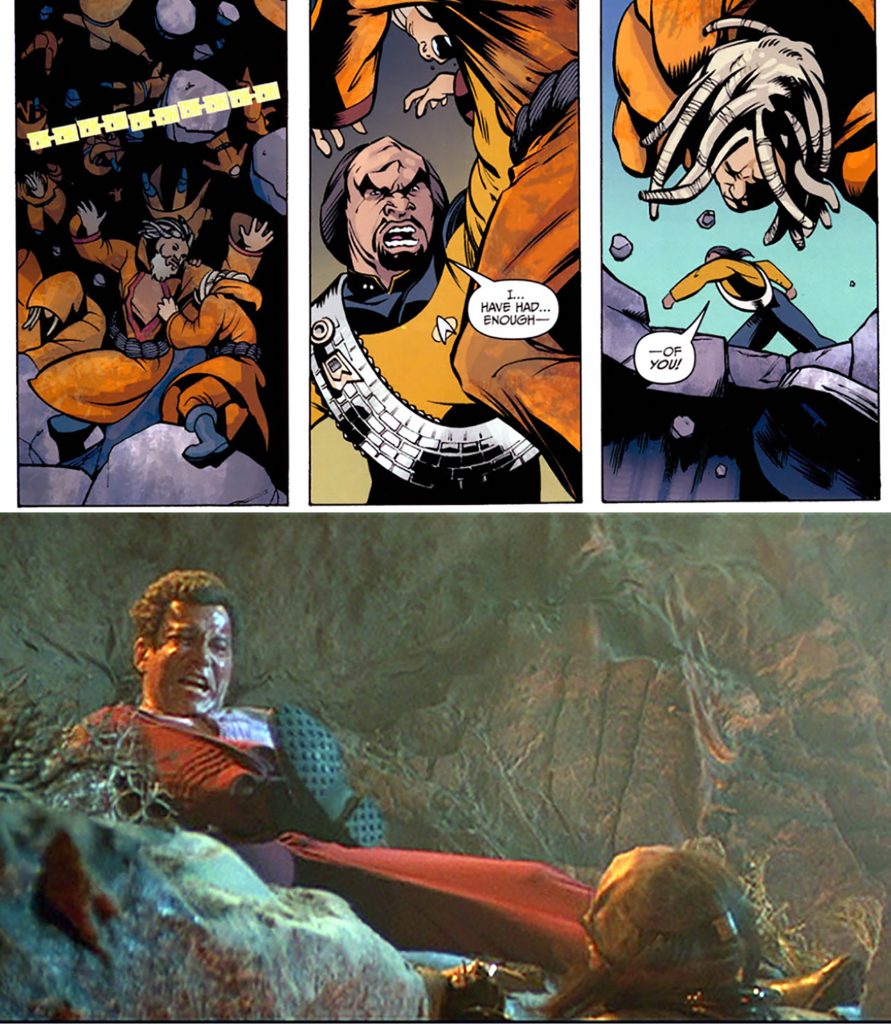
The trio take refuge at a Dracon monastery, where radiation has driven the monks insane. In a great allusion to Kirk’s fight with Commander Kruge in Star Trek III: The Search for Spock, Worf battles a crazed monk, then tosses him from a high precipice, announcing “I… have had… enough… of you!” It’s a gentle jab, of course, at William Shatner’s unique brand of “pause acting” (to borrow comedian Kevin Pollak’s term), and unlike the Looney Tunes humor, it hits its mark well.
For issue #5, the Enterprise investigates crop failures at an agricultural colony, and Data determines the farmers are using chroniton radiation to grow their crops at an accelerated rate. That’s a clever use of chronitons—subatomic particles with temporal properties, introduced in “The Next Phase”—but it doesn’t work. Five years later, Picard recalls this incident and realizes an unknown adversary is accessing Starfleet logs to create offensive weapons. And this enemy’s identity is left for the sixth issue to… er… not reveal.
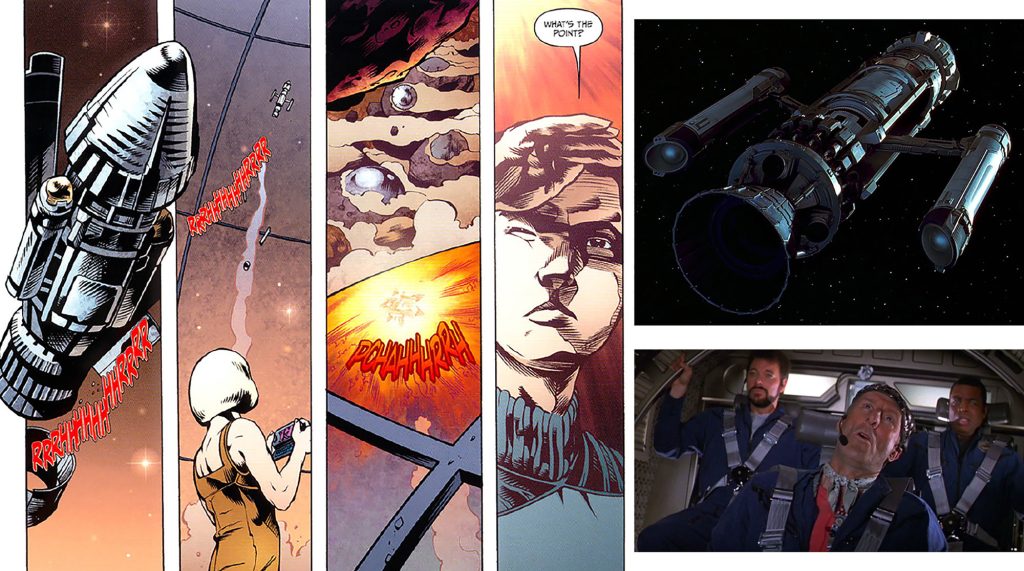
The damaged crops provide tie-ins to several episodes, including plomeek (“Amok Time”), uttaberries (“Ménage à Troi”), and quadrotriticale (“The Trouble With Tribbles,” misspelled in the comic as both “quatrotriticale” and “quatratiticale”). The funniest tie-in involves the farmers, as Wesley befriends some teen farmhands who launch a remote-controlled model of Zefram Cochrane’s Phoenix rocket from Star Trek: First Contact just to watch it explode—because on a farming world, there’s not much else to do.
All of this sets up issue #6, in which Picard uncovers a conspiracy among Starfleet brass to circumvent the Prime Directive. When he’s nearly assassinated while investigating the group at Starfleet Headquarters, Admiral Nechayev (“Chain of Command”) saves his life by beaming him to an office run by a Starfleet shadow division—which she herself seems to be a part of, so it’s unclear what her motives are here. Jean-Luc fails to identify the perpetrators but learns they’ve been operating independently for centuries.
If this sounds familiar, it’s because he’s likely discovered Section 31 without realizing it. However, at no point is that group mentioned, so readers who haven’t watched Deep Space Nine, Enterprise, Star Trek Into Darkness, and Discovery might be left scratching their heads at the lack of resolution. This shadow division that may or may not be Section 31 (of course it is) has disturbing artifacts in its headquarters. Among them are an Iconian gateway (The Next Generation‘s “Contagion”) and a Xindi particle-beam superweapon (Enterprise‘s “The Xindi”), as well as an occupied Borg drone alcove. It makes you wonder what Nechayev and her secret pals are up to—which we don’t know since the final issue doesn’t mention it.
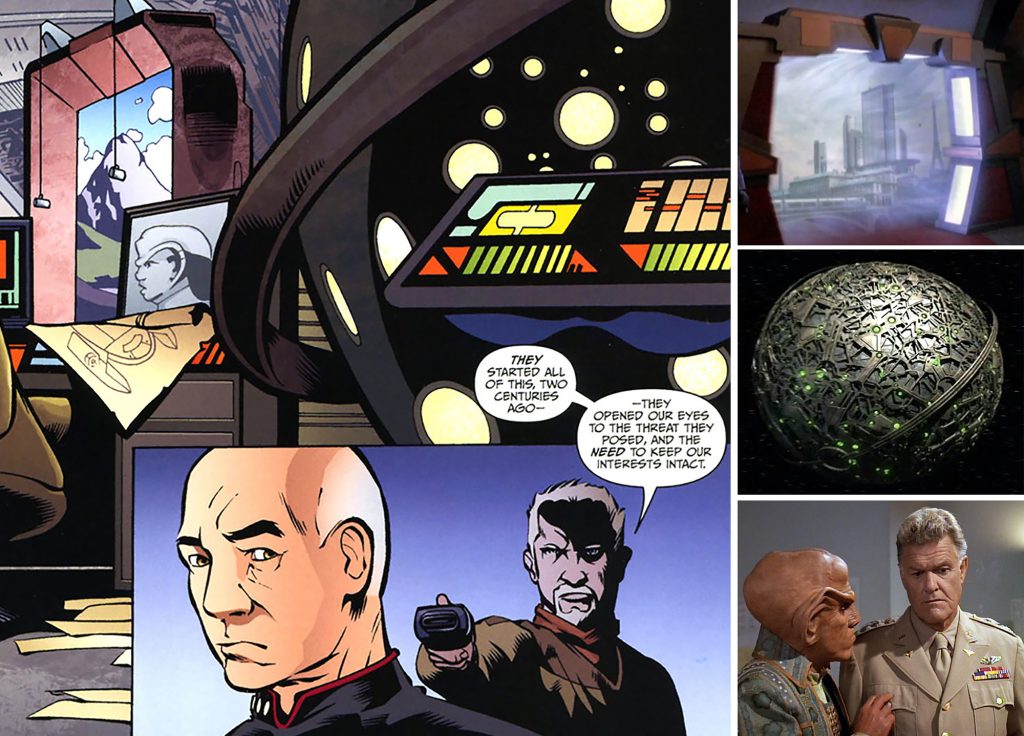
They also have photos of several Ferengi—apparently Quark, Nog, and Rom from during their visit to the past in Deep Space Nine‘s “Little Green Men.” Picard learns the group was formed after the 1947 Roswell incident to keep an eye on the Ferengi and other threats. This makes sense, as cameras existed at the time so Starfleet could easily have come across images of Ferengi from the 20th century and wondered what the heck was going on. However, the timing doesn’t add up since the incident is said to have happened two centuries prior, whereas four centuries would have passed since Roswell.
We’ll be spending the next several months exploring the IDW years, and there’s a lot to unpack. Next week, we’ll examine Klingons: Blood Will Tell, an engaging five-parter built around the original crew’s adventures on both the small and large screens, penned by the brother team of Scott and David Tipton. See you then.
Looking for more information about Star Trek comics? Check out these resources:
- My ongoing column for Titan Books’ Star Trek Explorer magazine
- The Complete Star Trek Comics Index, curated by yours truly
- The Star Trek Comics Checklist, by Mark Martinez
- The Wixiban Star Trek Collectables Portal, by Colin Merry
- New Life and New Civilizations: Exploring Star Trek Comics, by Joseph F. Berenato (Sequart, 2014)
- Star Trek: A Comics History, by Alan J. Porter (Hermes Press, 2009)
- The Star Trek Comics Weekly page on Facebook
Rich Handley has written, co-written, co-edited, or contributed to dozens of books, both fiction and non-fiction, about Planet of the Apes, Watchmen, Back to the Future, Star Trek, Star Wars, Battlestar Galactica, Hellblazer, Swamp Thing, Stargate, Dark Shadows, The X-Files, Twin Peaks, Red Dwarf, Blade Runner, Doctor Who, Buffy the Vampire Slayer, Batman, the Joker, classic monsters, and more. He has also been a magazine writer and editor for nearly three decades. Rich edited Eaglemoss’s Star Trek Graphic Novel Collection, and he currently writes articles for Titan’s Star Trek Explorer magazine, as well as books for an as-yet-unannounced role-playing game. Learn more about Rich and his work at richhandley.com.
One thought on “Star Trek Comics Weekly #73”
Comments are closed.