
An ongoing discussion of how the comics provide prequels, sequels, and tie-ins to the Star Trek episodes and films, soon to be a book from BearManor Media. Click here to view an archive of this article series.
72: Tokyopop, 2006–2009
In 2006, Tokyopop celebrated Star Trek‘s 40th anniversary with the franchise’s first official manga (I say “official” since Antarctic Press’s Star Trekker had been unlicensed). As a publisher and distributor of black-and-white manga comics modeled after a style developed in late 19th-century Japan, as well as the similarly styled animation known as anime, Tokyopop has offered stories based on Star Wars, Battlestar Galactica, Dark Crystal, Buffy the Vampire Slayer, and more. Star Trek, therefore, was a natural fit.
By 2009, Tokyopop had produced three volumes set during The Original Series and a single editionbased on The Next Generation, with each anthology featuring the works of multiple creative teams. This week, we’ll look at how these four books offered prequels, sequels, and tie-ins to onscreen Star Trek. Cover art was contributed by Makoto Nakatsuka, E.J. Su, Bettina Kurkoski, Felipe Smith, and Chrissy Delk, and the initial volume, Shinsei Shinsei (“New Life, New Star”), sported a trio of cover variants.

Shinsei Shinsei brought back Mike W. Barr, who’d penned nearly 40 Trek comics for Marvel, DC, and Malibu. A second volume, Kakan ni Shinkou (“To Boldly Go”), featured Trek scribe Diane Duane and actor Wil Wheaton, and the latter returned for the third digest, Uchu (“Universe”), along with tribble creator David Gerrold. Uchu was initially advertised under the title Aratanaru Michi He (“To a New Path”). The company also spotlighted the cast of The Next Generation, but delays prevented that volume, Boukenshin (“Adventurous Spirit”), from hitting stores until after the other digests.
Shinsei Shinsei‘s first tale, “Side Effects” by Chris Dows and Makato Nakatsuka, is among Tokyopop’s best and it provides an origin story for the Borg Queen, who was introduced in Star Trek: First Contact before menacing the USS Voyager crew as a recurring nemesis. The story takes place in the era of James T. Kirk rather than Jean-Luc Picard, but since it avoids naming the Borg or the Queen, it neatly sidesteps continuity problems since no one learns the zombie-like cyborgs’ identity.
The Enterprise finds a space station located near a black hole, its inhabitants half-mechanical, and readers quickly realize what this represents: they’re the first generation of Borg! A female cyborg named Danzek infects Pavel Chekov with a nanovirus, which Leonard McCoy manages to cure—and that’s astounding, all things considered. Had Starfleet checked the records a century later, they could have cured every drone and prevented trillions of deaths. Naturally, Danzek tries (and fails) to assimilate the crew, after which she escapes into a wormhole, becoming the Borg Queen.
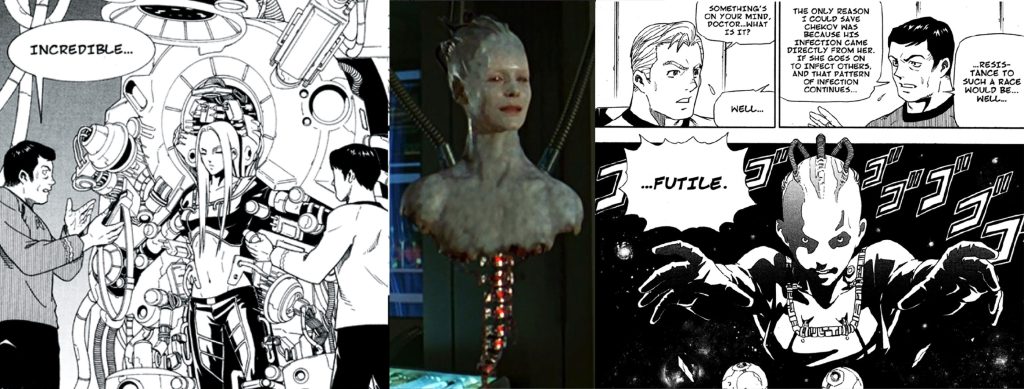
So what’s her origin? Well, Danzek’s body is a mixture of mechanical implants and the organs of nine species, and the base is a living laboratory where scientists hope to boost her immune system and thus cure a devastating plague. Her father, Doctor Mynzek, leads the experiments, making him the Borg’s Victor Frankenstein, but Danzek grows beyond his work and vows to save their people by evolving them to a state of perfection (hence, the Borg’s tactics of adaption and assimilation). The comic even sets up the Borg’s time-traveling capability, as Danzek’s people have harnessed the gravitational effects of the black hole’s event horizon to speed up their work by centuries.
“Anything But Alone,” by Joshua Ortega and Gregory Giovanni Johnson, sees the starship responding to a planetary distress call, only to discover its inhabitants are holographic simulations of a dead civilization. The only onscreen connection is to “The Galileo Seven,” as the Enterprise once again ferries medical supplies to Makus III.
In Barr’s “‘Til Death,” illustrated by Jeong Mo Yang, Kirk presides over the marriage of crewmembers Becky Randall and Tom Markham, and the ceremony takes place in the same chapel used for the wedding of Angela Martine and Robert Tomlinson in “Balance of Terror.” When an automated weapons system fires missiles at the starship, a landing party beams aboard sarcophagi of the planet’s hateful co-rulers, whose telepathic minds cause the men and woman in the crew to turn against each other in a battle of the sexes that has not aged quite as well as the rest of the stories in this volume.

McCoy rigs up a neural neutralizer (“Dagger of the Mind”) to lessen the hostility aboard ship, indicating Tristan Adams’ innovation has continued to be used for treatment purposes despite his crimes. When the situation becomes too volatile, Kirk separates the Enterprise in two—a capability of 24th-century vessels first demonstrated in “Encounter at Farpoint,” also featured in the Kirk-era fan film series Star Trek Continues—then isolates the men and women in the stardrive and saucer sections. One can only hope that when he splits up the crew by gender, he treats transgendered officers with the same respect shown by the writers of Star Trek: Discovery.
“Oban,” by Jim Alexander and Michael J. Shelfer, has no connections to specific episodes. Kirk’s crew transports a reptile that emits relaxing pheromones, along with an artifact containing microbes that form images reflecting others’ emotions, predictably transforming the creature into a savage beast. Then, in “Orphans,” from Rob Tokar and E.J. Su, the starship is attacked by mechanoid raiders. Kirk cleverly magnetizes the hull to draw them in, then reverses the polarity (much to the delight of Doctor Who fans), expelling them into space.
One mechanoid thrusts a giant sword through the viewscreen, nearly impaling the bridge crew. This may sound over the top and more Transformers or Pacific Rim than Star Trek, but it’s pure manga and it’s fun. The crew realize the raiders are orphaned children raised as elite warriors who have little purpose remaining in their lives. This leads to a tie-in with Star Trek II: The Wrath of Khan, for after bonding with one child, Kirk recalls how he almost gave up his career for Carol Marcus, and how he considered being a father to young David.

Kakan ni Shinkou‘s first tale, “Cura Te Ipsum,” penned by Wil Wheaton with art by E.J. Su and Chow Hon Lam, offers no direct TV connections. A dilithium crystal experiment gone awry, causing an engineering accident that cripples the Enterprise near Romulan space. Mike Wellman wrote the second tale, “The Trial,” with Nan Kim, Matt Dalton, A.J. Ford, Ben Harvey, and Sang S. Kim illustrating.
In that story, Kirk is imprisoned on the bureaucratic planet Kos, where inmates from multiple species, including Klingons, Andorians, Gorns (“Arena”), and Breen (Deep Space Nine‘s “Indiscretion”), have awaited trial for years. Jim is accused of perpetrating treachery on numerous worlds, but he’s summarily set free upon pleading guilty. McCoy oddly likens the trial to Spock’s koon-ut-kal-if-fee (“Amok Time”), though it’s unclear why since there’s little similarity here; the koon-ut-kal-if-fee is not a trial, and Kirk’s situation on Kos does not involve a mating urge or a fight to the death.

“Communications Breakdown,” from Christine Boylan and Bettina Kurkoski, provides an engaging sequel to “The Changeling.” Twelve days have passed since the Nomad probe erased Nyota Uhura’s mind onscreen, and as she returns to work, Kirk and Spock express reservations about her fitness for duty. She proves them wrong, despite having learned how to say “The dog has a ball” only two weeks prior. The comic explains that her mind-wiping apparently targeted only her first language, English, while her second language, Swahili, remained intact, as did her training and expertise, making a quick retraining possible. It’s a credibility stretch that she could relearn fluent English in twelve days, but hey, maybe she used the Teacher from “Spock’s Brain.”
A lone Nomad survivor issues a distress call, and Starfleet’s Section 8 orders Kirk back to the Malurian System to investigate. Section 8 is unique to this tale, but the designation is clearly inspired by Section 31. The survivor is a former prisoner, the last of his kind, and he holds an estate sale to auction off his civilization. The Malurian’s appearance is consistent with how the species was portrayed in Star Trek: Enterprise‘s “Civilization,” which had aired several years prior.

Diane Duane’s “Scaean Gate,” featuring art by Don Hudson and Steve Buccellato, sees the Enterprise crew facilitating a planetary truce by ferrying Elethia’s Queen Apathei to live on Alsand. She and McCoy fall in love, recalling his affair with Natira in “For the World Is Hollow and I Have Touched the Sky,” but he nonetheless exposes her as a spy. The story shares strong plot similarities with “Elaan of Troyius,” though none of the characters seem to notice.
The final tale in this collection, “Forging Alliances” by Paul Benjamin and Steven Cummings, is steeped in connections to onscreen lore. McCoy and Kirk accompany Spock to Vulcan to honor the birth of philosopher-savior Surak (The Original Series‘ “The Savage Curtain,” and later Enterprise‘s “Awakening” and “Kir’Shara”). When a pack of wild le-matyas (The Animated Series‘ “Yesteryear”) disrupts the ritual, Sarek (introduced in “Journey to Babel”) and others turn into murderous savages, while Spock becomes arrogant, rude, and judgmental, and he insults McCoy a lot… which, really, isn’t all that different from his usual persona.

Bones and Spock determine that a feral Vulcan, raised by the le-matyas after having several species’ DNA grafted onto his own, is telepathically projecting bestial madness onto those around him. The youth had vanished on Vulcan’s Forge during his kahs-wan maturity test—the test Spock underwent in “Yesteryear”—and a mother le-matya had protected him from a wild sehlat, then had raised him among her pups. Basically, he’s a Vulcan Tarzan. (How cool is that concept? You’re right, it’s very cool.) Oddly, Spock claims no cure for le-matya poison exists, even though he’d procured an antidote for his dying pet I-Chaya in that very same episode.
Wheaton next pens Uchu‘s “Art of War,” illustrated by E.J. Su, Chow Hon Lam, and Mara Aum. It’s refreshing to see a Star Trek actor writing stories about a different crew and generation. Typically, cast members who contribute licensed tales tend to focus on their own characters. Wheaton is a talented scribe, and it’s clear from the mangas that he doesn’t need to write for Wesley Crusher to prove that. In this tale, the Enterprise responds to a distress call and finds a Klingon vessel whose commander, Kring, intends to raid a planet’s ores. The crews fight until both captains become trapped in a collapsed mine, possibly riffing on the Planet of the Apes TV show’s “The Trap.”

After cooperating to survive, they each stand trial with their respective governments—Kirk for aiding the enemy (for which he’s exonerated), and Kring for cowardice (he’s executed, because Klingons like to take everything too far). Kirk’s trial pertains to his having violated Starfleet Directive 72, which prohibits “willing failure to capture an enemy commander and freeing enemy prisoners without cause” during wartime. Thanks to the Organian Peace Treaty (“Errand of Mercy”), the Federation and the Empire are not in an active state of war at this time, so it’s unclear why Starfleet puts him on trial.
Gerrold’s “Bandi” was drawn by Don Hudson and Steve Buccellato, and it’s no surprise that the tribble creator would craft a tale involving a cute critter creating chaos. A teddy bear-like creature called a bandi stows aboard the starship, where it radiates a field of intense emotion to defend against predators, causing the crew to empathetically react to its mood swings. The officers mutiny to protect the animal, until Kirk disarms its hostility with (I kid you not) feelings of unadulterated love.
Gerrold based this story on the first script he’d pitched to The Original Series, before writing “The Trouble with Tribbles,” as revealed in his must-read behind-the-scenes book The Trouble with Tribbles. The name “Bandi” was also given to the natives of Deneb IV in “Encounter at Farpoint,” the concept of which Gerrold helped Gene Roddenberry and D.C. Fontana develop. The comic briefly connects to both “Arena” and “A Private Little War” as well, for the bandi, upset at being caged, subjects Jim to nightmares involving a Gorn, a mugato, and other belligerent aliens.

“The Humanitarian,” from Luis A. Reyes, Nate Wilson, and Chow Hon Lam, is a standalone story with a vast scope. With Kirk on medical leave, the Enterprise is ordered to help a planet establish a peaceful society following decades of war, but a nuclear explosion kills twenty percent of the starship’s crew. Great Bird of the Galaxy! Despite his logical façade, even Spock finds this emotionally distressful. The only connection to TV is that Kirk receives treatment at Starbase 47, which debuted in The Next Generation‘s “Parallels,” though its design differs in the comic.
Nathanial Bowden’s “Inalienable Rights,” with art by Heidi Arnhold and Dominic Prestera, calls back to Star Trek: First Contact. After the Enterprise crew initiates first-contact protocols with a planet new to warp flight, Kirk finds the civilization’s leadership unlikable and recalls the poor condition Earth was in when the Vulcans met Zefram Cochrane. Since the oppressive leaders engage in slavery, with scientists caged as second-class citizens, Kirk opts not to admit them into the galactic community. The story also references Star Trek II: The Wrath of Khan, as Spock cites Nibia as the nearest world with warp technology.
Among the writers invited to pitch for the Kirk-era mangas was Alan J. Porter, author of Star Trek: A Comics History (Hermes Press, 2009), who proposed four stories, none of which made the cut, as Porter discussed at his blog. Tokyopop’s Star Trek—The Manga: Ultimate Edition collected selected stories from the first three digests, with a foreword by David Gerrold and cover art by Michael Kelleher, while Pocket Books reprinted several tales in Star Trek: Constellations, ST:TNG—The Sky’s the Limit, and Myriad Universes: Infinity’s Prism.

The publisher also explored the 24th century. Returning for Boukenshin with E.J. Su, Gerrold contributed “Changeling,” in which Wesley Crusher has his first mission as a full ensign, setting the story soon after his “Ménage à Troi” promotion. He’s assigned to study the Labyrinth of Wisdom on Cawley IV, presumably named after actor James Cawley of the fan-film series Star Trek: New Voyages/Phase II. The planet is also mentioned in “Bandi,” so it’s a fair bet Cawley and Gerrold are pals. Wesley acts uncharacteristically arrogant here, whereas on TV he’s brilliant but rarely a jerk (well, after season one, at least). This is a season-three story, so Wes annoyingly boasting like he did in “Encounter at Farpoint” is out of character.
Alien machines transform Wes’s body to match those of Geordi La Forge, Worf, and Deanna Troi. The ensign freaks out about resembling La Forge and Worf, yet quickly accepts being a Troi lookalike after a brief crying fit. It’s unnerving to see Wesley in what amounts to blackface as Worf, then crying while female as though that’s what girls do, and it’s cringe-inducing when walking hormone Will Riker calls the newly bosomy Wesley “a very pretty girl.” Thankfully, it all turns out to be a holodeck test, so we can all pretend Wes never spent the day exhibiting racism, sexism, and cultural appropriation while disrespecting his superiors, and that Riker never ogled his curves.
Still, that begs the question of how he gains Troi’s empathic skills, since the holodeck cannot boost an occupant’s mental abilities. The same goes for the computer giving him Geordi’s engineering insight and Worf’s Klingon strength and bravery. Somehow, the technology transforms both his body and mind—which, of course, holodecks don’t do. In the process, Wes learns how to use his brain, courage, and heart, making his journey a parallel to that of Dorothy Gale and friends in The Wizard of Oz. By story’s end, he even jokes, “There’s no place like home.” I guess that makes Picard the man behind the curtain. Or is that Riker, quietly leering at Wesley’s Betazoid cleavage? :::shudder:::

In Duane’s “Sensation,” illustrated by Chrissy Delk, Picard’s crew responds to a distress call from an archeological expedition plagued by nightmares. After Enterprise personnel become affected as well, Troi makes contact with a noncorporeal being’s mind and realizes the affliction is the alien’s attempt to request help for his dying crew. It’s a strong story without direct TV or film connections. The final two tales, on the other hand, are intricately tied to the show, as they deal with the aftermath of Jean-Luc’s experiences in “Sarek” and “The Best of Both Worlds,” respectively.
The cleverly titled “The Picardian Knot,” from Christine Boylan and Don Hudson, sees the captain recovering from his mind-meld while the Enterprise confronts a Romulan warbird encroaching on the Neutral Zone, commanded by Tomalak (“The Enemy” and other episodes). This includes a rare reference to the forgettable “Angel One,” as Tomalak claims his vessel is aiding a wrecked shuttle near one of the planet’s moons.

It isn’t, of course. In fact, the Romulans try to assassinate Picard, yet he shows no emotional response thanks to Sarek’s lingering influence. Crusher suggests administering lexorin, a drug Kirk gave McCoy in Star Trek III: The Search for Spock when Bones hosted Spock’s katra. Troi, meanwhile, urges the crew to express their feelings in order to elicit emotional responses from the captain. These scenes are amusing, with Miles O’Brien telling Picard he hates talking about feelings, and Jenna D’Sora (“In Theory”) still complaining at length about her ex-boyfriend Jeff Arton.
Tokyopop’s final tale is the clear standout, and it again involves the Borg. Written by F.J. DeSanto and illustrated by Bettina Kurkoski, “Loyalty” occurs during “Family,” with Picard visiting his brother in France while the starship undergoes repairs at Earth Station McKinley. Riker is called to a meeting with Starfleet brass, culminating in a cavalcade of returning characters—Chief of Starfleet Security Thomas Henry (“The Drumhead”), Vice Admiral Hayes (Star Trek: First Contact), and Phillipa Louvois (“The Measure of a Man”)—along with new character Admiral Bradish, who blames Picard for his children’s deaths when the USS Yamaguchi fought in the Battle of Wolf 359 (“Emissary”).

The flag officers deem Picard unfit for command because of his assimilation by the Collective—which jibes with Starfleet’s treatment of Seven of Nine in the years between Voyager and Picard. They worry that he hasn’t truly healed mentally (a well-founded concern, given his obsessive behavior in First Contact), that his recovery might be a Borg trick, and that the masses might be outraged if his role as Locutus were public knowledge. Thus, they vote to retire him and give the Enterprise to Riker, with Commander Elizabeth Shelby (“The Best of Both Worlds” and “Vox”) as his first officer. Shelby serves aboard the USS Chekhov; given the spelling, the starship appears to be named after author Anton Chekhov, not Walter Koenig’s Pavel Chekov.
The admirals play for Riker a log from Captain Amasov of the USS Endeavour, calling the Borg “as close to pure evil as any race we’ve ever encountered.” In the Voyager episode “Scorpion,” Janeway consulted this same tape when her vessel approached Borg space, though Tokyopo’s tale provides the first look at Amasov’s face. Despite his message’s powerful persuasiveness, the admirals reconsider their decision when both Shelby and Riker resign in protest—a satisfying coda to “The Best of Both Worlds,” as Shelby puts honor and friendship ahead of her abundant ambition.

A second Next Generation digest was slated to contain a “creepy space spider story” by Barr, a “holodeck story with Worf in feudal Japan” by Jake Forbes, a “Q story where he’s split into three personalities” by Chris Dows, a “Klingon battle story” by Jim Alexander titled “Skin Deep,” and a mirror-universe tale by Malibu writer-editor Mark Paniccia. However, this project never came to pass, and Tokyopop produced no additional manga editions, with IDW left to fly the comics flag solo. Next week, we’ll begin our discussion of IDW’s record-setting tenure with a fantastic pair of miniseries: The Space Between and Klingons: Blood Will Tell. See you then.
Looking for more information about Star Trek comics? Check out these resources:
- My ongoing column for Titan Books’ Star Trek Explorer magazine
- The Complete Star Trek Comics Index, curated by yours truly
- The Star Trek Comics Checklist, by Mark Martinez
- The Wixiban Star Trek Collectables Portal, by Colin Merry
- New Life and New Civilizations: Exploring Star Trek Comics, by Joseph F. Berenato (Sequart, 2014)
- Star Trek: A Comics History, by Alan J. Porter (Hermes Press, 2009)
- The Star Trek Comics Weekly page on Facebook
Rich Handley has written, co-written, co-edited, or contributed to dozens of books, both fiction and non-fiction, about Planet of the Apes, Watchmen, Back to the Future, Star Trek, Star Wars, Battlestar Galactica, Hellblazer, Swamp Thing, Stargate, Dark Shadows, The X-Files, Twin Peaks, Red Dwarf, Blade Runner, Doctor Who, Buffy the Vampire Slayer, Batman, the Joker, classic monsters, and more. He has also been a magazine writer and editor for nearly three decades. Rich edited Eaglemoss’s Star Trek Graphic Novel Collection, and he currently writes articles for Titan’s Star Trek Explorer magazine, as well as books for an as-yet-unannounced role-playing game. Learn more about Rich and his work at richhandley.com.
One thought on “Star Trek Comics Weekly #72”
Comments are closed.