
An ongoing discussion of how the comics provide prequels, sequels, and tie-ins to the Star Trek episodes and films, soon to be a book from BearManor Media. Click here to view an archive of this article series.
94: IDW Publishing, 2010
As the Star Trek episode “Mirror, Mirror” taught, characters who add beards are likely evil. Perhaps that’s why, when Leonard McCoy came out of retirement with full facial hairin Star Trek: The Motion Picture, he was at his downright surliest. Or maybe he just didn’t like being drafted. (That’s probably it.) McCoy had resigned from Starfleet during the span between The Original Series and the film, only to be called back to service for the V’Ger crisis via a little-known reserve activation clause—so take that, anyone who mistakenly claims Starfleet isn’t a military organization.
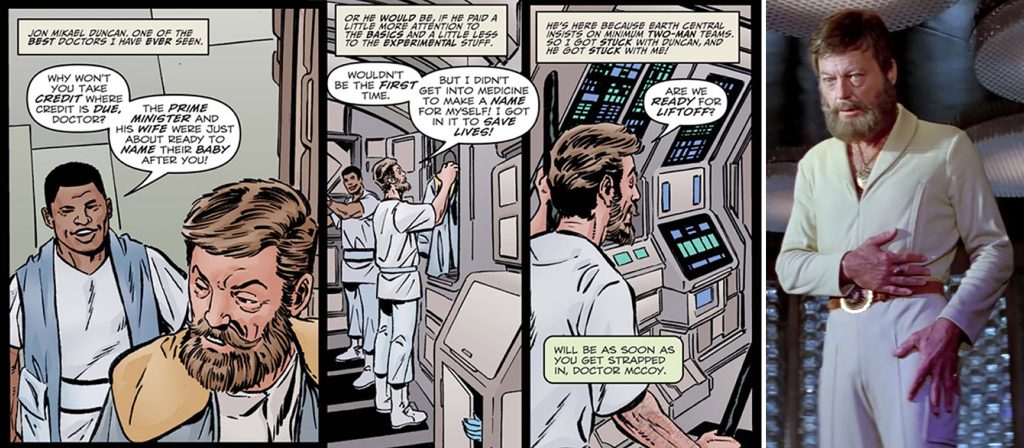
The curmudgeonly arrival of bearded Bones was among the movie’s standout moments, so it’s no wonder writer-artist John Byrne would choose to explore what the chief medical officer had been up to in the interim in the four-part Leonard McCoy, Frontier Doctor. This IDW miniseries, scripted and illustrated by Byrne, with Lovern Kindzierski coloring his interior and cover art, details hirsute McCoy’s solo adventures while Admiral James T. Kirk was overseeing a refit of the USS Enterprise.
The comic’s underlying premise is an intriguing one: After joining the Federation’s Frontier Medics Program, Mccoy works with Doctor Jon Duncan and a stowaway-turned-nurse (Andorian runaway Theela) aboard the starship Joanna, named after the good doctor’s daughter, mentioned in the Star Trek writers bible and referenced in the animated episode “The Survivor.” In five stories spanning four issues, the trio render assistance to worlds in need, with Bones writing letters to Kirk (real letters on paper, much to his friend’s amusement) recounting their missions. Naturally, Duncan and Theela fall in love.

A variant cover for each issue depicts McCoy treating an alien patient, with clever captions like “Take two q’ss’lvav’a and call me in the morning” (riffing on the “take two pills” cliché), “…then don’t do that” (referencing Henny Youngman’s “Doctor, it hurts when I do this” gag), “If I could walk that way, I wouldn’t need the brllictucc powder” (for vaudeville, Mel Brooks, and Monty Python fans), and “It only hurts when I polob’oltnop” (recalling the classic punchline “It only hurts when I laugh”). A Pierson’s Puppeteer, from Larry Niven’s Known Space mythos, graces one such cover—a fitting tribute, for in Niven’s short story “The Soft Weapon,” on which the author had based his script for “The Slaver Weapon,” a Puppeteer had served the same function that Spock would serve in the animated episode.
In issue #1, the team stem a plague caused by colonists on Ophiucus III inadvertently harming the local plant life. This calls back to “Mudd’s Women,” in which Harry Mudd had tried to sell wives to colonists on that world since few women were stationed there. Indeed, most of the colony’s inhabitants in this issue are male. As with many Star Trek tales, this one has no villain—the plants are acting on instinct, while the colonists are unaware of the damage they’re doing. (That in no way justifies Mudd’s attempted sexual trafficking, of course, nor the colonists’ willingness to take part in it.)
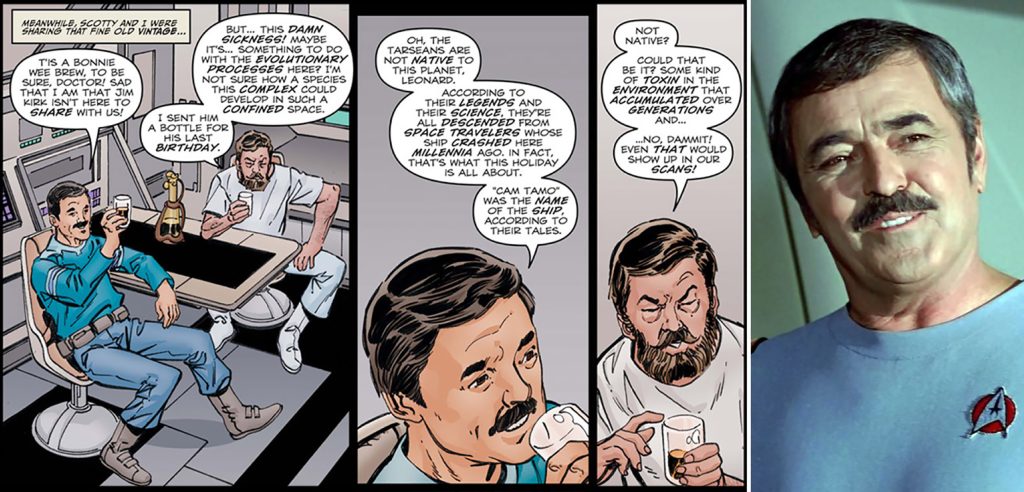
The second issue sees a mustached Montgomery Scott requesting the Joanna’s assistance in curing a civilization whose technology the engineer has been updating during his R&R away from the refit. McCoy violates local protocols in his efforts to find a cure, and he’s tried for heresy by the very people he’s assisting. The setup is reminiscent of The Animated Series’ “Albatross,” in which Bones was arrested for triggering a plague on Dramia II while inoculating the population against a deadly virus, proving yet again that no good deed goes unpunished. Dammit, Jim, he’s a doctor, not a felon.
The Joanna crew discovers that the citizens have been using transporters to achieve immortality by repeatedly placing their memories in younger versions of their bodies, ironically bringing about their own demise. This innovative application of the transporter trace is consistent with the technology’s use in “The Counter-Clock Incident” (The Animated Series), as well as in “Lonely Among Us” and “Unnatural Selection” (The Next Generation), to restore health-compromised crewmembers to their former, healthier state.

Aboard the Joanna, McCoy entertains his colleagues by recounting some of the more fantastical elements of the 1960s episodes, including “Who Mourns for Adonais?,” “Mirror, Mirror,” “The Immunity Syndrome,” “Patterns of Force,” “Bread and Circuses,” and “Spectre of the Gun.” An amused Duncan finds his friend’s stories rather farfetched—and honestly, one can’t blame him when they involve Bones meeting gods, Wyatt Earp, a giant amoeba, space-Nazis, and space-Romans.
Those who enjoy interconnected storylines should especially appreciate issue #3, which ties John Byrne’s various Star Trek comics together by concluding the saga he’d begun in Assignment: Earth #3 and Star Trek: Crew #4. Secret agents Gary Seven and Roberta Lincoln (“Assignment: Earth”) intervene when the Joanna is shot down in a war zone fought by the clone soldiers introduced in those earlier tales.
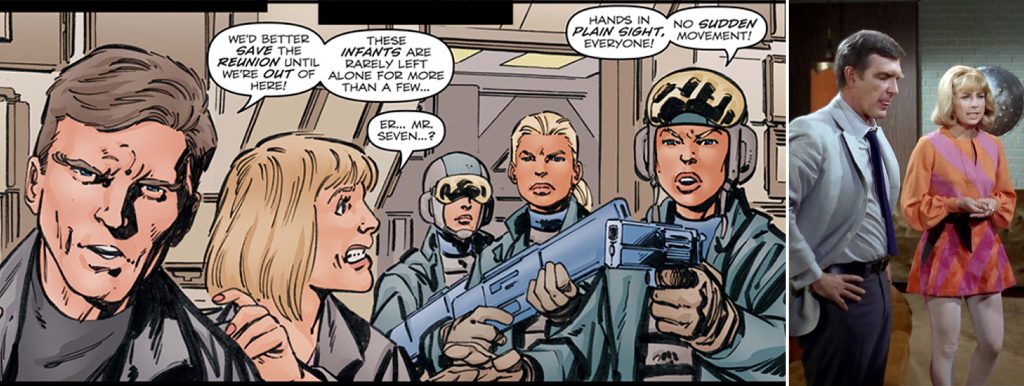
The story also features the return of Klingon warrior Kloor, who’d manipulated the Romulan Praetor in Byrne’s Romulans: The Hollow Crown and Schism. Having fallen out of favor, Kloor has now armed both sides of the clone conflict in an effort to regain his standing by creating unending war games for the bloodthirsty Klingon Emperor. The clones are the perfect participants, given their creation as Cold War-era super-soldiers, and Kloor has upped the ante by introducing female clones (and thus sex and breeding, kind of like Kirk did for the Vaalites in “The Apple”—and we saw how well that turned out). When this plot is exposed, Kloor tries to decimate the planet and hide the evidence.
The USS Yorktown, commanded by Admiral Una Chin-Riley (a.k.a. Number One, from “The Cage” and Strange New Worlds), disrupts that plan, then Theela and Duncan remain behind to offer medical aid. One Yorktown crew member strongly resembles Star Trek: Discovery’s Kelpiens (Saru’s people) despite the miniseries having been published seven years before that show’s debut. Had Discovery existed when Frontier Doctor hit stands, readers would likely have assumed this character to be a Kelpien, as Discovery’s early seasons occur before The Motion Picture. (Retroactively, they still can.)

The fourth issue contains two shorter tales and features Doctor Christine Chapel (her status in the films), as she and McCoy work side by side to investigate an illness causing Yorktown crewmembers to grow extremely smart before dying of brain disruption. Una and Chapel share a panel at one point, a fun nod at both characters having been portrayed by Majel Barrett-Roddenberry. In a true-to-Trek twist, the two doctors (not to be confused with “The Two Doctors”) realize the disease is a peaceful life form which had inhabited the crew with no ill intent, but that human brains had proven incompatible, causing the aliens to inadvertently hurt them.

It’s a delight to see Chapel and Bones collaborating as equals rather than as CMO and nurse, though her already being a physician contradicts the movie, as it renders McCoy’s line “I hear Chapel’s an M.D. now” nonsensical since her degree shouldn’t be news to him after this story. In any case, Byrne makes great use of Trek trivia to flesh out the plot. The virus enables crewmember Susan M’Benga (the niece of Joseph M’Benga from “A Private Little War,” “The Which Survives,” and Strange New Worlds) to read thousands of words within mere seconds and with perfect recall. And while searching for a cure, Chapel studies records of Gary Mitchell and Elizabeth Dehner, who’d attained similar abilities in “Where No Man Has Gone Before.”

In the final tale, Bones visits an old friend, Alex Hathaway. His former classmate has contracted a fatal disease, and McCoy urges Alex not to give up hope for a cure, recalling how he’d felt after euthanizing his dying father, only for a cure to then be found (Star Trek V: The Final Frontier). He learns that Hathaway’s daughter had died, despite her still being among the living. A millennia-old alien machine, it seems, had enabled Alex to manipulate a planet’s history via time travel, making that civilization more peaceful and thereby preventing the events that led one citizen to murder her. In other words, he’s potentially sacrificed millions to save his one daughter.
It’s a dilemma to which any parent can relate, and it’s one that Star Trek, with its Prime Directive, its Temporal Prime Directive, and other regulations, has wrestled with many times: is it ever acceptable to tamper with a planet’s evolution if one’s intentions are benevolent? Apparently, McCoy would argue it is not. (So, presumably, would Kathryn Janeway, given her actions in Voyager’s finale to save Seven of Nine at the sacrifice of countless others.) Horrified at what his friend has done, the physician remembers how Edith Keeler’s death devastated Earth’s history (“The City on the Edge of Forever”) and uses the alien equipment to set time aright, letting a young woman die to repair the timeline—in essence, reversing the role he’d played in Edith’s demise.

Leonard McCoy, Frontier Doctor provided a strong bridge between The Original Series and Star Trek: The Motion Picture, illustrating why Byrne was such a staple member of IDW’s Trek bullpen for a time. Kirk, McCoy, and the rest will return next week in another entertaining miniseries from the prolific writing duo of Scott and David Tipton. I hope to see you then as we revisit IDW’s Star Trek: Burden of Knowledge. Don’t worry, it’ll only hurt when you polob’oltnop.
Looking for more information about Star Trek comics? Check out these resources:
- My ongoing column for Titan Books’ Star Trek Explorer magazine
- The Complete Star Trek Comics Index, curated by yours truly
- The Star Trek Comics Checklist, by Mark Martinez
- The Wixiban Star Trek Collectables Portal, by Colin Merry
- New Life and New Civilizations: Exploring Star Trek Comics, by Joseph F. Berenato (Sequart, 2014)
- Star Trek: A Comics History, by Alan J. Porter (Hermes Press, 2009)
- The Star Trek Comics Weekly page on Facebook
Rich Handley has written, co-written, co-edited, or contributed to dozens of books, both fiction and non-fiction, about Planet of the Apes, Watchmen, Back to the Future, Star Trek, Star Wars, Battlestar Galactica, Hellblazer, Swamp Thing, Stargate, Dark Shadows, The X-Files, Twin Peaks, Red Dwarf, Blade Runner, Doctor Who, Buffy the Vampire Slayer, Batman, the Joker, classic monsters, and more. He has also been a magazine writer and editor for nearly three decades. Rich edited Eaglemoss’s Star Trek Graphic Novel Collection, and he currently writes articles for Titan’s Star Trek Explorer magazine, as well as books for an as-yet-unannounced role-playing game. Learn more about Rich and his work at richhandley.com.
2 thoughts on “Star Trek Comics Weekly #94”
Comments are closed.