
An ongoing discussion of how Star Trek comics provide prequels, sequels, and tie-ins to the episodes and films…
15: DC Comics, 1984–1985
Imagine you’re a top-two comic book publisher that has snagged the Star Trek license. You’ve received acclaim for your opening arcs, which organically bridged the gap between Star Trek II: The Wrath of Khan and Star Trek III: The Search for Spock without negating your own original stories—and you even managed to interweave sequels and tie-ins to several televised episodes, to boot. You’re off to a strong start.
Now imagine you find yourself constrained by the third film’s ending, which sees the USS Enterprise destroyed, its officers branded as fugitives, and Spock’s mind left in a confused blur. It’ll be two years before the fourth film will come out, which means you have no idea what Paramount will do next. How do you continue telling new Star Trek stories if you don’t know the fates of the main cast? Well, you give James T. Kirk a new starship, put the crew’s trial on hold, and send Spock on a separate mission until you have more information about everyone’s onscreen future, that’s how. And you start by launching a multi-part sequel to the classic episode “Mirror, Mirror” that features an all-out invasion from the alternate universe. In other words, you come on even stronger.

“New Frontiers,” published in DC’s issues #9-20, took eight months to unfold and brought back familiar faces not only from “Mirror, Mirror,” but also from “Journey to Babel” and the early feature films. As the story opens, Spock is recovering from his fal-tor-pan under the care of his parents, Sarek and Amanda. Kirk consoles Carol Marcus over the death of their son David, while the USS Excelsior is ordered to arrest Kirk’s crew for their actions in Star Trek III. However, an attack from the ISS Enterprise, enacted as a prelude to a full-on invasion from the other universe, puts Kirk’s trial on indefinite hold. For staving off that invasion, Kirk and company are rewarded with reassignment to the Excelsior, while Spock receives a command of his own, the Surak, thereby providing a new status quo until the release of Star Trek IV.

Writer Mike W. Barr and artists Tom Sutton and Ricardo Villagrán crafted a compelling follow-up to “Mirror, Mirror” that provided the first licensed return to that other reality and brought the two crews face to face for the first time. Collected in trade paperback as The Mirror Universe Saga, “New Frontiers” explored the personalities of the Enterprise crew’s evil counterparts, which one would naturally expect from such a sequel. But the writers went a step further, elaborating on the larger universe inhabited by evil Kirk, bearded Spock, and their corrupted counterparts—and the end result was a story of epic scope that is, to this day, still hailed as one of Star Trek‘s greatest adventures.

Readers learned that mirror Spock, after meeting prime Kirk in “Mirror, Mirror,” had opted not to oppose the Empire out of a sense of self-preservation, and that he’d come to resent his prime counterpart’s relationships with his parents and friends (later mirror universe tales, including episodes of Deep Space Nine, would present other varying histories). Meanwhile, the alternate David Marcus and Marlena Moreau led a resistance movement against the Terran Empire, the mirror Romulans and Klingons were just as bloodthirsty as their prime alternates, and the Empire had a Genesis Device of its own—and, by story’s end, its own USS Excelsior as well.

Barr once again proved his Trek trivia knowledge, referencing Rigelian fever (“Requiem for Methuselah”) in issue #10; Klingon mind-sifters (“Errand of Mercy”), the Gamma Trianguli system (“The Apple”), and the Farragut (“Obsession”) in #14; transtators (“Amok Time”) in #15; and the Federation’s legal system (from “Court Martial”) in #16. What’s more, Gary Mitchell (“Where No Man Has Gone Before”) shows up… in his underwear, since he’s enjoying shore leave at Wrigley’s Pleasure Planet (“The Man Trap”).
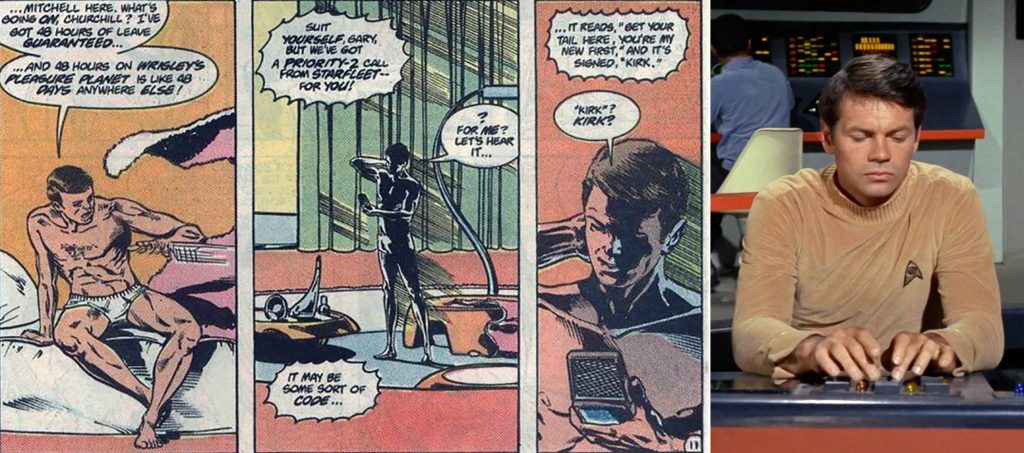
The writer also named starships after Christopher Pike (“The Cage”), Surak (“The Savage Curtain”), Star Trek: The Motion Picture‘s Admiral Nogura… and disgraced U.S. President Richard Nixon. (It figures the Terran Empire would revere someone like Nixon. There’s probably an ISS Thatcher, Trump, Putin, Boebert, and Musk, too.) All of this served to make an already richly told multi-parter even richer.
DC showed prescience when it came to issue #12, which featured the separation of a starship’s saucer and main sections, two years before The Next Generation‘s “Encounter at Farpoint” would first depict such an action onscreen. On the other hand, #14 saw the captured Bird-of-Prey from Star Trek III firing while cloaked (even though it needed to de-cloak before firing in that same movie), which the Enterprise crew would years later find inconceivable in Star Trek VI: The Undiscovered Country when General Chang’s ship exhibited that capability. This illustrates one of the inevitable pitfalls that writers of licensed lore unfortunately face: seeing onscreen canon negate their work down the line, through no fault of their own.

Following “New Frontiers,” DC presented a quartet of one-off tales in issues #17-20 that spotlighted the lives of Nyota Uhura, Montgomery Scott, Pavel Chekov, and Hikaru Sulu, respectively. These stories contained few direct connections to specific episodes, though in #20, Sulu’s mother runs a company that makes giant cyber-suits utilizing multitronic circuits, first introduced in “The Ultimate Computer” as a creation of Richard Daystrom. (The Sulu story is uncomfortably stereotypical with regard to Asian cultures. Time has not been kind to this one.)
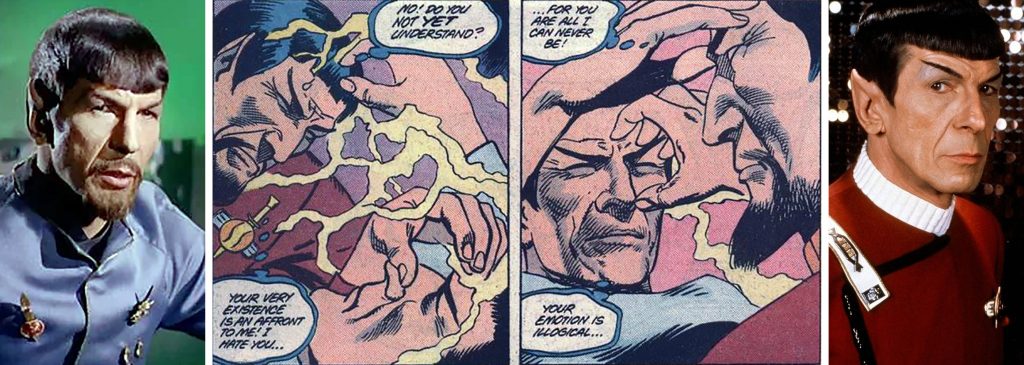
Neither the Sulu nor Uhura stories are overly noteworthy, but Paul Kupperberg’s Scotty-centric tale in issue #18 is quite amusing and gets the engineer’s personality and speech patterns down perfectly. The Chekov story in #19, meanwhile—written by Walter Koenig himself—offers a poignant look at PTSD-like symptoms, with a distressed Pavel growing derelict in his duties, experiencing nightmares of his loved ones suffering, and inciting a mutiny. Koenig’s tale offers great insight into Chekov’s mindset, though it’s McCoy who gets the best line of the issue, while breaking up a crew brawl: “May I remind you, gentlemen, that the rec deck isn’t short for ‘wrecking and decking.'”
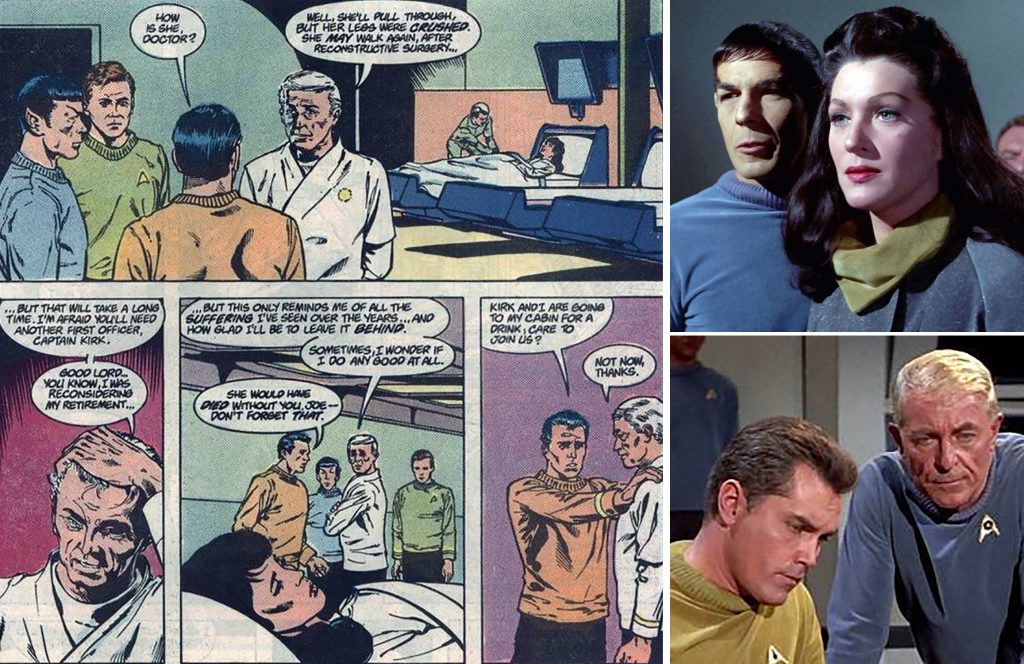
Concurrent with issue #19’s publication, DC’s inaugural annual revealed Kirk’s first mission aboard the Enterprise (one of many licensed first missions, none of which tell the same story). That annual, one of DC’s most engaging tales, is set at multiple points throughout Star Trek history, involving not only the movies’ “current” timeframe—with Kirk telling Saavik how he came to be the Enterprise‘s captain—but also the tenures of Kirk’s predecessors, Robert April (“The Counter-Clock Incident”) and Christopher Pike (“The Menagerie”). Both captains have had starring or recurring roles on Star Trek: Strange New Worlds this past year, so rereading this annual now is a very different experience.

Barr deftly explains the absence of Number One and Philip Boyce (though the latter is oddly called “Joe” in the comic) on The Original Series: she was injured in an onboard accident, while he retired so he wouldn’t have to keep seeing people suffer. (Now if only Strange New Worlds‘ writers would explain where he is.) The writer also lays the groundwork for Mark Piper’s presence in “Where No Man Has Gone Before,” by explaining that McCoy will soon be attending his daughter’s college graduation, making Piper a temporary fill-in. In a clever flashback, Admiral Nogura grants Kirk command of the Enterprise when Pike accepts a fleet captain posting, foreshadowing Nogura’s decision to give the starship back to Kirk during the V’Ger incident.
Next week, we’ll continue our examination of DC Comics’ Trek efforts. Barr’s stellar work was the first time a monthly comic book truly captured the tone and characters of Star Trek on a consistent basis. Once Barr stepped down, DC turned to a revolving roster of fill-in scribes until finding a full-time replacement—who, like his predecessor, continued to introduce sequels, prequels, and tie-ins to the mix. There’s a reason DC’s Star Trek line is so highly revered, so stay tuned.
Looking for more information about Star Trek comics? Check out these resources:
- The Complete Star Trek Comics Index, by yours truly
- The Star Trek Comics Checklist, by Mark Martinez
- The Wixiban Star Trek Collectables Portal, by Colin Merry
- New Life and New Civilizations: Exploring Star Trek Comics, by Joseph F. Berenato
- Star Trek: A Comics History, by Alan J. Porter
Rich Handley has written books about Planet of the Apes, Back to the Future, and Watchmen, as well as licensed Star Wars and Planet of the Apes fiction, and he edited 70 volumes of Eaglemoss’s Star Trek Graphic Novel Collection. Rich co-edited Titan’s Scribe Award-nominated Planet of the Apes: Tales from the Forbidden Zone; nine Sequart anthologies discussing Planet of the Apes, Star Wars, Battlestar Galactica, Hellblazer, Stargate, and classic monsters; and four Crazy 8 Press anthologies about Batman and (now) the Joker. He has contributed essays to DC’s Hellblazer: 30th Anniversary Celebration; IDW’s Star Trek and Star Wars comic-strip reprint books; BOOM! Studios’ Planet of the Apes Archive hardcovers; Sequart anthologies about Star Trek and Blade Runner; ATB Publishing’s Outside In line exploring Star Trek, Buffy the Vampire Slayer, Angel, The X-Files, Twin Peaks, and Babylon 5; and a Becky Books anthology covering Dark Shadows.
Dr. Boyce’s first name being given as “Joe” instead of Phillip was because it was given in correctly in one of the ST reference books available at the time. I *think* it was Bjo Trimble’s Star Trek Concordance, but I’m not 100% certain on that. Some mistakes just perpetuated in those pre-internet days, so if one source got it wrong, lots of other places got it wrong too.