
An ongoing discussion of how the comics provide prequels, sequels, and tie-ins to the Star Trek episodes and films, soon to be a book from BearManor Media. Click here to view an archive of this article series.
76: IDW Publishing, 2007–2008
Ask a hundred Star Trek fans what their favorite aspect of the franchise is, and chances are good you’ll hear “the characters,” “the optimism,” “the social commentary,” “the special effects,” “the humor,” and more. One answer you’ll be sure to hear is “the aliens,” as a big part of Trek‘s appeal is how it has fleshed out the societies of the Klingons, Romulans, Cardassians, Vulcans, and even Ferengi. It’s often joked that the majority of Star Trek‘s aliens are humanoids with bumpy foreheads and noses, and there’s no denying the truth in that. But for all the functionless ridges, Star Trek has done an impressive job of building a galaxy filled with aliens both humanoid and non.
It was with this in mind that IDW launched the first of its two Alien Spotlight miniseries in 2007, which explored aspects of non-Earth cultures from those worlds’ perspectives. The first miniseries, comprising six issues, examined the Gorn, Vulcans, Andorians, Orions, Borg, and Romulans, while the next batch (to be discussed in a later column) covered the tribbles, Klingons, Q Continuum, and Cardassians, along with a second heaping of Romulans. A Ferengi-centric issue from Andrew Steven Harris had been slated for publication, along with one-shots from Mike W. Barr and James Patrick, but neither of those issues saw release.
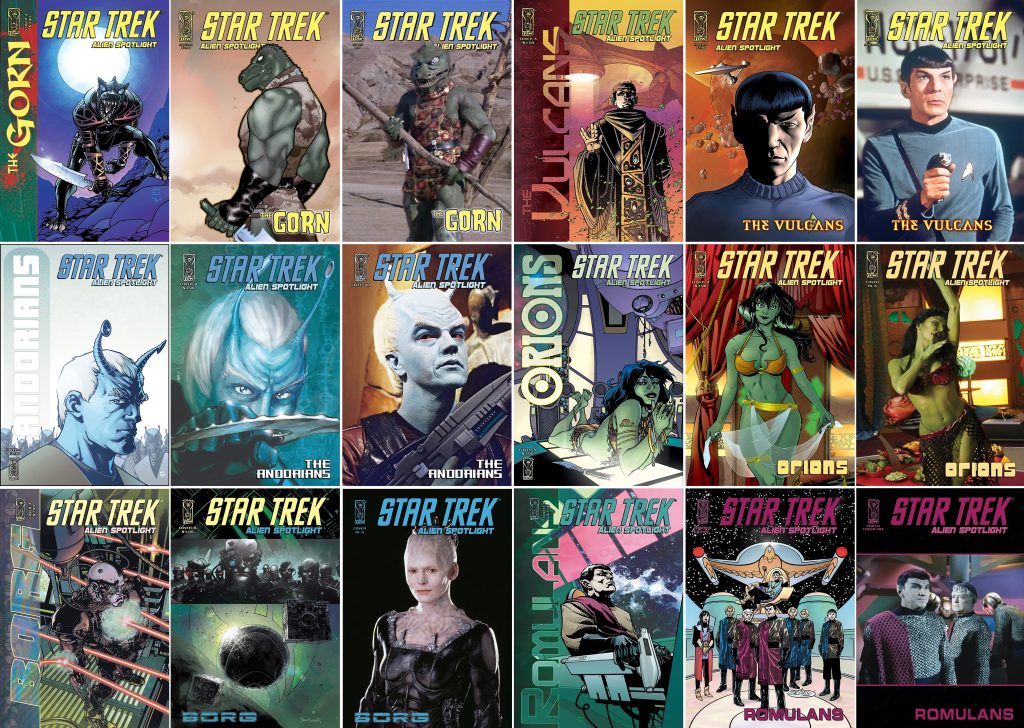
This week, we’ll examine the first six chapters, edited by Harris, Dan Taylor, and Chris Ryall. Each issue offered prequels, sequels, and tie-ins to specific films and episodes, as one might expect given the nature of the miniseries. Scott and David Tipton penned the inaugural issue, Star Trek: The Gorn, focused on the reptilian warriors from “Arena” (and likely overwritten by the revamping of the Gorn on Strange New Worlds). The comic features interior art by David Messina and Sara Pichelli, with covers by Messina and Zach Howard.
The story takes place between Star Trek: The Motion Picture and Star Trek II: The Wrath of Khan, with Pavel Chekov serving under Captain Clark Terrell aboard the USS Reliant, as he did in the latter film. The starship’s crew helps a medical team address an epidemic of Symbalene blood burn at a Federation outpost. The deadly disease was first mentioned in the 1960s episode “The Changeling,” before its devastating effects were disturbingly depicted in Star Trek: Enterprise‘s “Cold Station 12.”

Terrell and Chekov assist in stemming the outbreak’s spread, but their shuttle crashes on a Gorn training world while returning to the Reliant. When the Gorns attempt to offer medical assistance, one Starfleet officer mistakes their peaceful intentions and panics, near-fatally shooting a Gorn doctor. The enraged reptilians nearly slaughter the Starfleet personnel because of this error in judgment, but the physician survives and tells his people to stand down. The Gorns render aid and, amusingly, are relieved when the annoying and incomprehensible Starfleeters finally leave them alone.

Star Trek: The Vulcans, from writer James Patrick and illustrator Josep Maria Beroy, sports covers by Beroy and Zach Howard and is set before the events of Star Trek‘s first pilot, “The Cage,” and retroactively prior to Strange New Worlds. Patrick scripted the one-shot after original author Rick Remender departed the issue, in which Captain Christopher Pike’s Enterprise crew from the pilot are sent to help bring peace to a war-torn planet.

Spock, having recently joined the crew (as depicted in Short Treks‘ “Q&A”) finds it difficult to relate to his shipmates, and José Tyler takes a particular disliking to the Vulcan, suggesting Spock will not be a good fit with others aboard the Enterprise. Pike nearly reassigns Spock until realizing the problem lies not with his new science officer, but with his crew’s inability to accept cultural differences. Therefore, he keeps Spock aboard so the rest will learn to become more tolerant and receptive of new ideas—a philosophy that is Star Trek distilled down to its purest essence. Any time you hear someone complain about modern-day Star Trek being about social justice, remind them it always has been.

Paul D. Storrie’s Star Trek: The Andorians, illustrated by Leonard O’Grady, with covers by O’Grady and Zach Howard, occurs between Star Trek: The Next Generation‘s “All Good Things…” and Star Trek: Generations. When the Enterprise-D visits Andoria, Starfleet intelligence analyst Ortees Sharad hitches a ride home aboard the starship, having learned his lover has joined a faction looking to split from the Federation. She arranges his abduction by her fellow rebels, unaware that was his plan all along, then he challenges the rebel general to deadly combat and wins, dealing a blow to the seditionists.
This richly scripted tale utilizes the complex Andorian marriage structures established in the Star Trek novels from Pocket Books to great effect, and it also connects to Star Trek: Enterprise. When Sharad returns home after years away, he’s surprised to find others calling him a “Fade.” Some have taken to using that term as a slur against Andorians who have sold out to humans by joining Starfleet, as well as against those with Aenar bloodlines. The pale-skinned Andorian subspecies was introduced in “The Aenar,” and some fans have speculated that Commander Thelin, from The Animated Series‘ “Yesteryear,” may have been Aenar given his skin tone.

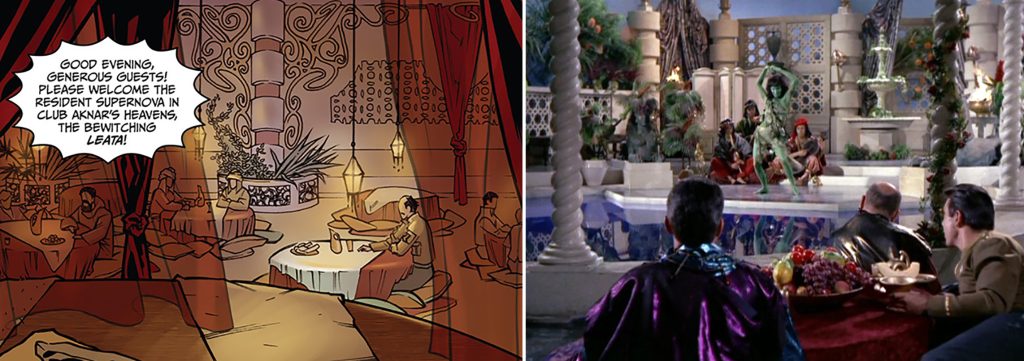
Star Trek: Orions returns to Pike’s crew, courtesy of the Tipton brothers and artists Elena Casagrande and Zach Howard. Initially, each issue of Alien Spotlight was intended to have a different creative team, but the Tiptons were invited to script this issue after author Dan Taylor departed IDW. At Orion’s Club Aknar, a slave girl named Leata seduces a man to obtain information leading her to a diplomatic conference on Babel. Among the delegates are the diminutive, copper-skinned humanoids from “Journey to Babel,” identified as Ithenites in an unfilmed scene from Enterprise‘s “Terra Prime,” marking one of the very few times the species has ever appeared except on television.
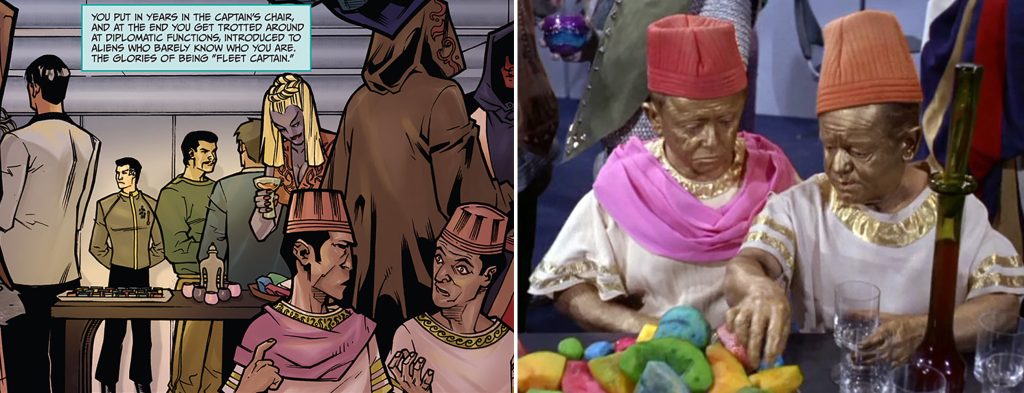
Pike spies Leata attempting to murder a Tellarite delegate, but it turns out she’s not the villain, and Pike helps her expose a plot to kill her master. Pike checks in with Commodore José Mendez (“The Menagerie”), to whom he now reports (on Strange New Worlds his superior is Robert April), explaining the empathy the Mendez illusion displays onscreen: the two men had worked together prior to Pike’s disfigurement. Chris is unsatisfied with his new role as a fleet captain, bored with diplomatic duties and restless for action, mirroring his predecessor Robert April’s reaction to retirement in “The Counter-Clock Incident.”

Club Aknar appears to be the same club from Pike’s Talosian-inspired illusion in “The Cage,” given the matching décor and architecture. This implies Pike had been to Orion before the episode and had visited this same club and enjoyed the company of a dancer, since the Talosians had formed the illusions from his own memories. That makes sense, as he’d considered retiring there after the debacle on Rigel VII… though, uncomfortably, it also means Pike is totally on board with slavery and sex trafficking.
The Borg Collective takes center-stage in Star Trek: Borg, written by Andrew Steven Harris, though the issue was originally assigned to Steve Niles. Illustrated by Sean Murphy, with covers from Murphy and Zach Howard, this one-shot is primarily set between Star Trek: Insurrection and Star Trek: Nemesis, with flashback scenes occurring during The Next Generation‘s freshman season.
The Borg assimilate Federation and Romulan personnel along the border, recalling The Next Generation‘s “The Neutral Zone,” in which the cyborgs were implied to have attacked bases on both sides. Years later, the Borg send an energy wave back through time to rewrite history so all species will be born as Borg—an ambitious plot that fails since the Borg’s pursuit of perfection becomes moot once everyone everywhere is born perfect. Highlights include Geordi La Forge being temporarily assimilated and Admiral Kathryn Janeway being brought in as a Borg expert due to her years of battling them on Voyager.

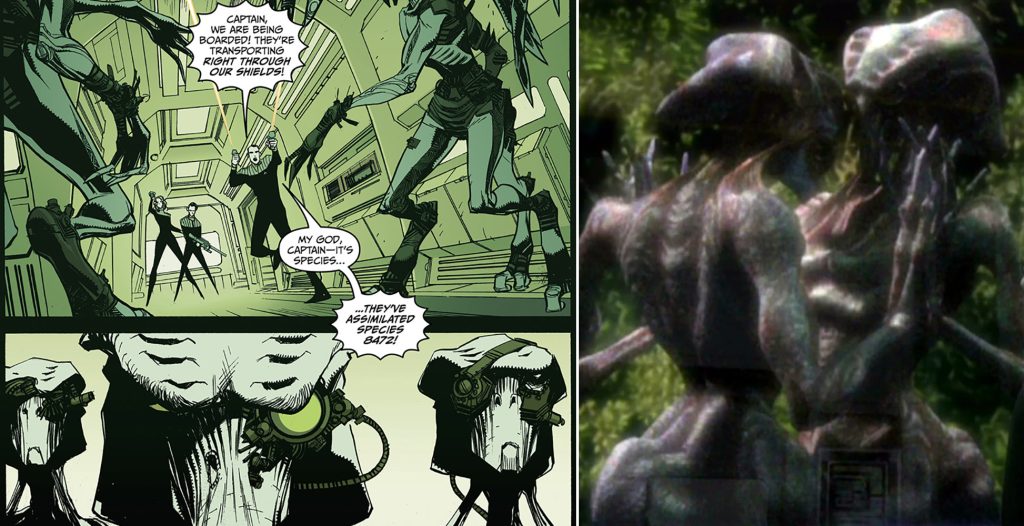
The issue connects with multiple Borg-themed episodes. Jean-Luc Picard’s crew traverses the timestream to stop the incursion and encounters a hypercube crewed by Species 8472 (“Scorpion”), who are assimilated in a future timeline. Moreover, Starfleet is said to have enacted a contingency plan called the Locutus Protocols following Picard’s assimilation in “The Best of Both Worlds,” establishing what to do if another Starfleet captain were ever assimilated by the Borg.
Meanwhile, Jean-Luc experiences taunting visions from the Borg Queen (Star Trek: First Contact), and the Borg use an Omega particle (Voyager‘s “The Omega Directive”) to create a time-altering weapon—a tachyon cascade—so powerful it can rewrite history everywhere. It’s no wonder Janeway was so determined to investigate the possible discovery of such a terrifyingly dangerous substance!
Writer-artist John Byrne made his franchise writing debut in Star Trek: Romulans. Since the 1970s, Byrne has substantially contributed to both DC and Marvel, with notable runs on The Uncanny X-Men, Fantastic Four, Alpha Flight, Incredible Hulk, and Superman. He co-created Marvel’s Emma Frost, Victor Creed, Kitty Pryde, and Scott Lang, and he’s been a heavy hitter in the Star Trek franchise, starting out as one of multiple artists hired for DC’s 1987 miniseries Who’s Who in Star Trek. It’s with IDW, though, that he’s earned a reputation as a top-tier Trek scribe.

To date, Byrne has written and illustrated nearly fifty issues for such titles as Assignment: Earth (starring Gary Seven and Roberta Lincoln), Crew (featuring Number One), Leonard McCoy: Frontier Doctor (showcasing Bones’s solo adventures in the era of The Motion Picture), and New Visions (which recombined episode stills to form Fotonovel-like tales), all of which will be discussed down the line. It’s an impressive legacy that began with his Romulans one-shot and led to other tales about the Empire that were eventually collected as Romulans: Pawns of War.
Featuring covers by Byrne and Zach Howard, the Romulans one-shot takes place before “Balance of Terror” and revisits Mark Lenard’s unnamed commander from that episode (the Star Trek Customizable Card Game has dubbed him Keras—Sarek in reverse). In addition to the commander, the story also features his loyal, equally unnamed Centurion friend (John Warburton), as well as Lawrence Montaigne’s deceitful Decius, assigned to his crew to spy for the Praetor.
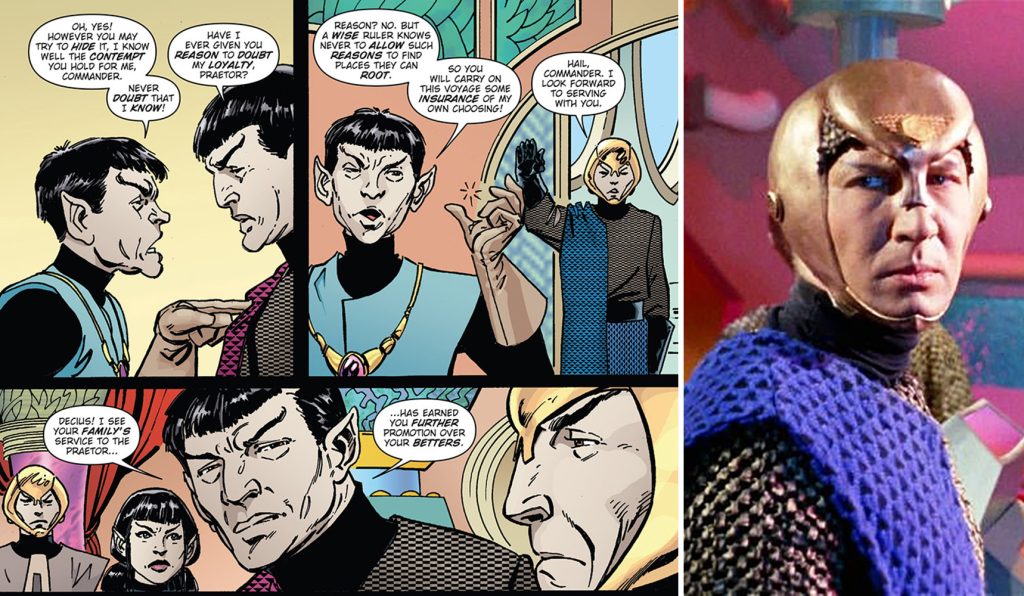
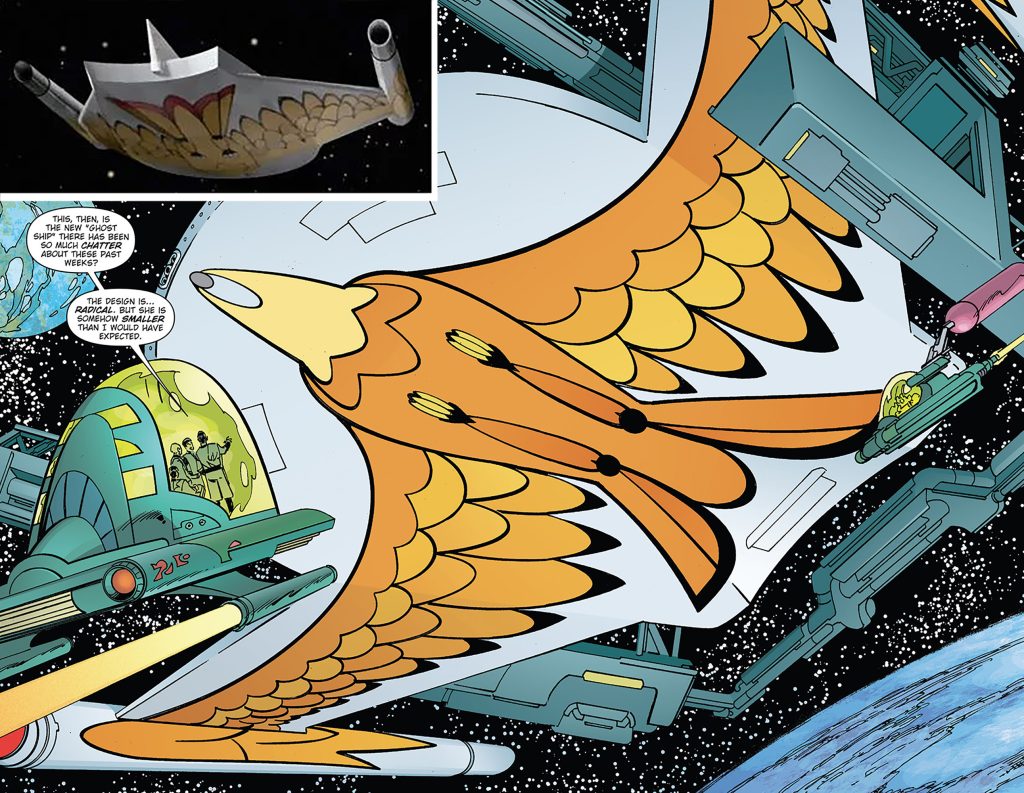
Secretly manipulated by a Klingon operative, the Praetor unveils a “ghost ship” with cloaking capability and a new plasma weapon (both depicted onscreen) in an effort to spark a new war with the Federation. Thus, Byrne establishes the formation of the Klingon-Romulan alliance hinted at in “The Enterprise Incident,” and in so doing reveals why the Klingons later use Romulan cloaking technology while the Romulans utilize cruisers of Klingon design. (Star Trek: Discovery has since depicted the Klingons as possessing cloaking technology years earlier, overwriting this explanation.)
The story spotlights the commander’s family, giving him a wife who loves him and an adult son who longs to make him proud. The commander despises the erratic Praetor, but his criticism of the ruler results in his being assigned to the ghost ship as part of a plan to eliminate the man since the Praetor desires his wife. Malibu’s Deep Space Nine: Celebrity Series—Blood & Honor had previously introduced Ambassador Jannek, another son of Lenard’s character. Jannek isn’t mentioned in Byrne’s tale, but there’s no reason he couldn’t be the latest son’s offscreen sibling.
Byrne and the Tipton brothers have been among IDW’s most prolific contributors, and their stories have been among the publisher’s most highly acclaimed. Next week, we’ll look back at IDW’s Star Trek: The Next Generation—Intelligence Gathering. Since it’s a Tipton title, you can bet it’ll feature prequels, sequels, and tie-ins to onscreen lore.
Looking for more information about Star Trek comics? Check out these resources:
- My ongoing column for Titan Books’ Star Trek Explorer magazine
- The Complete Star Trek Comics Index, curated by yours truly
- The Star Trek Comics Checklist, by Mark Martinez
- The Wixiban Star Trek Collectables Portal, by Colin Merry
- New Life and New Civilizations: Exploring Star Trek Comics, by Joseph F. Berenato (Sequart, 2014)
- Star Trek: A Comics History, by Alan J. Porter (Hermes Press, 2009)
- The Star Trek Comics Weekly page on Facebook
Rich Handley has written, co-written, co-edited, or contributed to dozens of books, both fiction and non-fiction, about Planet of the Apes, Watchmen, Back to the Future, Star Trek, Star Wars, Battlestar Galactica, Hellblazer, Swamp Thing, Stargate, Dark Shadows, The X-Files, Twin Peaks, Red Dwarf, Blade Runner, Doctor Who, Buffy the Vampire Slayer, Batman, the Joker, classic monsters, and more. He has also been a magazine writer and editor for nearly three decades. Rich edited Eaglemoss’s Star Trek Graphic Novel Collection, and he currently writes articles for Titan’s Star Trek Explorer magazine, as well as books for an as-yet-unannounced role-playing game. Learn more about Rich and his work at richhandley.com.
2 thoughts on “Star Trek Comics Weekly #76”
Comments are closed.