
An ongoing discussion of how comics provide prequels, sequels, and tie-ins to Star Trek episodes and films. Read the past installments.
145: IDW Publishing, 2019–2020
Incredible though it may seem, Star Trek: Picard debuted more than five years ago, near the outset of the COVID-19 pandemic. It’s been a long road, getting from there to here—sorry, wrong TV show. But with twelve Star Trek shows behind us and at least three more in the works, it’s easy to get lost in space—sorry, wrong franchise.
The three-season Picard took place twenty years after the events of Star Trek: Nemesis, twelve years after Spock was propelled into the Kelvin timeline in J.J. Abrams first Star Trek entry, and though it proved controversial, it delivered in spades during its final year. IDW has not delved much into Picard’s mythology, though it has produced a couple tie-in comics that set the stage for the first season’s events. This week, we’ll discuss one such offering, Star Trek: Picard—Countdown.

Written by Kirsten Beyer and Mike Johnson, with interior art from Angel Hernández and covers by Michael Pangrazio and Sara Pitre-Durocher, Picard: Countdown is the spiritual successor to two prior IDW projects: Countdown (which set the stage for the 2009 film) and Countdown to Darkness (a prequel to Star Trek Into Darkness). Those miniseries each introduced the characters and status quo from their respective films, and this third Countdown does the same for Picard—which is amusing, since Picard itself nullified several elements of the original Countdown, specifically regarding Data and B-4.
Picard: Countdown occurs in 2385, fourteen years before the episode “Remembrance,” six years after Nemesis, and two years prior to the 2009 movie’s scenes involving Spock working with the prime timeline’s Romulans. With the star Romulus (identified in some licensed materials as Hobus) facing an imminent supernova, Starfleet coordinates with the Empire to help as many citizens as possible in the time before the unavoidable cataclysm. Anyone who has seen Abrams’ trilogy, though, knows that this effort is too little, too late, for the majority of the Romulans are doomed to perish.
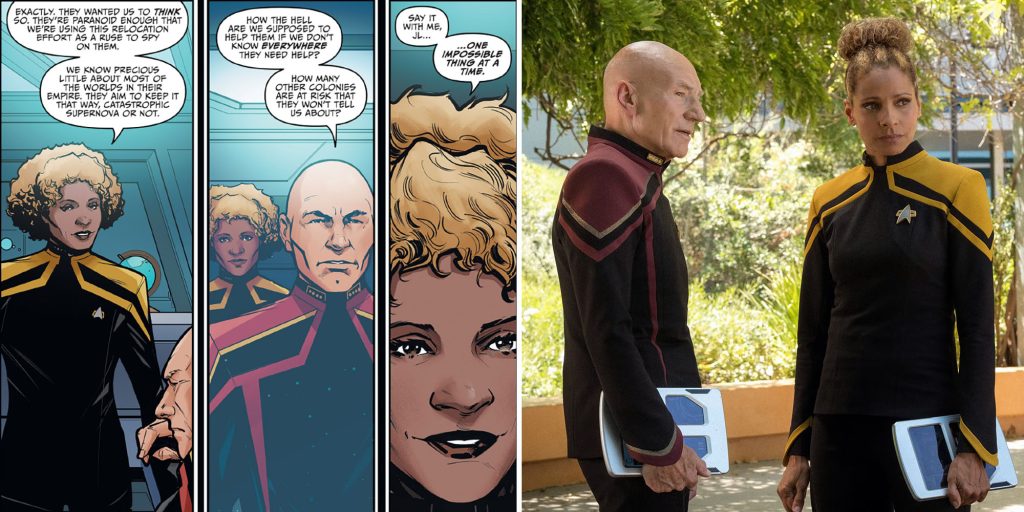
Even as Jean-Luc Picard and Raffi Musiker evacuate Romulan colony worlds, many in the Empire assume malevolent motives on the Federation’s part. On Yuyat Beta, Picard meets Zhaban and Laris, Tal Shiar agents operating as winemakers. The duo, introduced in the first season as Picard’s loyal confidantes, had been embedded on that colony world under the names Noctis and Avem, to spy on Governor Shiana. They fell in love during their mission, apparently a flagrant violation of Tal Shiar policies, and harsh consequences await them as a result.

Zhaban has secret orders to capture Picard’s vessel, the USS Verity, due to the Tal Shiar’s belief that the Federation is using the supernova to take over the Empire. His lover believes in Picard’s integrity, however, so Zhaban trusts her instinct. The two agents betray their employers by helping him regain his ship and carry out the evacuation, for which they are branded as traitors. With nowhere to go that the Romulans won’t find them, Picard offers the couple refuge and employment at his winery in France, which explains their devout loyalty to him at Chateau Picard.
The miniseries serves not only as a prequel to Abrams’ trilogy and Picard, but also as a tie-in to Nemesis. Many Romulans revere Picard for saving them from “the traitor Shinzon” and his attempted Reman takeover. This Nemesis shoutout adds another layer to the Romulans’ evolving opinion of Jean-Luc Picard, from frequent foe (Star Trek: The Next Generation) to unexpected ally (Nemesis) to revered hero (Picard: Countdown) and finally to bitterly resented disappointment (Picard’s “Absolute Candor”). The comic references the latter, in fact, for the admiral mentions Zani, his Qowat Milat friend on Vashti, and offers to bring Laris and Zhaban to her world.

Issue #3 opens with an homage to some of the torments that Jean-Luc faced throughout The Next Generation. From cyborg enslavement in “The Best of Both Worlds” to an induced lifetime of memories in “The Inner Light,” to Cardassian torture in “Chain of Command” and a creepy encounter with the Borg Queen in Star Trek: First Contact, the admiral has endured more than his fair share of mental violations. First Contact demonstrated that his post-traumatic stress disorder is strong, as did the episode “Family” and Picard’s first season, yet the comic deftly turns such suffering into a positive message: that nothing, no matter how terrible, needs to be final. And it’s that lesson which drives Picard to help the Romulans despite two centuries of bloody enmity.

In addition, there’s a subtle connection to the Short Treks episode “Children of Mars” which readers might understandably overlook. Geordi LaForge serves at the Utopia Planitia Shipyards in 2385, overseeing the construction of the relocation ships that will evacuate the Romulan Empire. The Short Treks connection stems from the fact that the comic is set only a few months before the Zhat Vash, in “Children of Mars,” will destroy the shipyards using A500-type synth units. Picard’s third season would depict Geordi managing the Fleet Museum on Athan Prime, so he must have left Utopia Planitia shortly before the synths attacked.
LaForge-centric stories are not always among Star Trek’s best tales, yet the character’s scenes were absolute standouts on Picard, and many of his best arcs have historically been in the comics. With that show concluded, and with IDW wrapping up its current crossover epic featuring the various Trek casts, it would be exciting to see IDW revisit this miniseries. Geordi’s reaction to the slaughter of all his Utopia Planitia colleagues, by synthetic lifeforms similar to his dearly departed best friend Data, could make for a powerfully introspective piece. It’s not uncommon for those who avoid dying in catastrophes to experience survivor’s guilt. Surely, Geordi would suffer that condition after watching his former shipyards destroyed.

Next time, we’ll return to IDW’s Year Five maxiseries, the discussion of which we’ll wrap up in the weeks to come. In the meantime, let’s look back at a unique tale that I forgot to cover during my overview of the prior decade. In 2016, writer-artist Daniel Warren Johnson produced a twelve-page Deep Space Nine ashcan focused on General Martok. The comic, simply titled Star Trek: Martok, is difficult to find these days, but it’s worth obtaining if you can find one without paying a Ferengi’s ransom.
Johnson has produced impressive ashcans based on Star Wars (Green Leader and Old Man Skywalker), Transformers (Void Rivals), Pacific Rim (Cherno), and other franchises, and Martok adds Star Trek to the growing list. The writer had Martok printed at Riverside Graphics, in downtown Chicago, then announced the comic on social media before debuting it at New York Comic Con 2016. Though unlicensed, the ashcan was professionally produced and beautifully illustrated. Notably, it featured Martok’s father Urthog, introduced in the Deep Space Nine novel The Left Hand of Destiny, by Jeffrey Lang and Martok actor J. G. Hertzler.
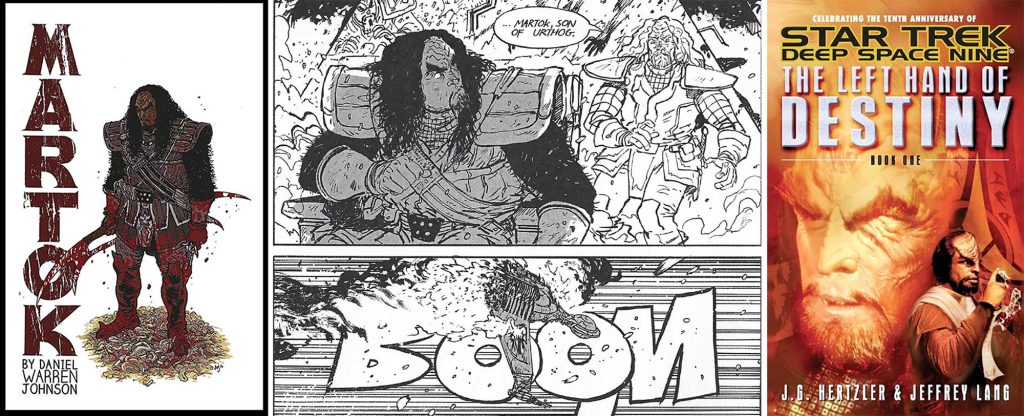
As the Rotarran crew (Deep Space Nine’s “Blaze of Glory”) face a fleet of Jem’Hadar ships, the battlecruiser crashes on an alien world. The Klingons engage the Dominion soldiers in land-based hand-to-hand combat, and while slaughtering Jem’Hadar, Martok envisions the ghost of his father, who died before Martok could prove his family’s honor. It’s a touching tale, and yet…
I must admit that it took me two read-throughs to follow the story fully, since most pages feature no dialogue and rely on battle visuals to present the narrative, which is a bit of a problem due to the comic’s smaller size making it challenging to see all the details. Nonetheless, Martok is a worthy tribute to one of Deep Space Nine’s most nuanced characters, played by one of its most beloved recurring actors, and it ranks among the best when it comes to unlicensed Trek comics. IDW would do well to hire Daniel Warren Johnson for an officially licensed outing or two.
Looking for more information about Star Trek comics? Check out these resources:
- The Complete Star Trek Comics Index, curated by yours truly
- The Star Trek Comics Checklist, by Mark Martinez
- The Wixiban Star Trek Collectables Portal, by Colin Merry
- New Life and New Civilizations: Exploring Star Trek Comics, by Joseph F. Berenato (Sequart, 2014)
- Star Trek: A Comics History, by Alan J. Porter (Hermes Press, 2009)
- The Star Trek Comics Weekly page on Facebook
Rich Handley has authored, edited, or contributed to numerous books and magazines for IDW, BOOM! Studios, DC Comics, Topps, Dark Horse, Lucasfilm, Paramount/CBS, Titan Books, and more. His anthology Musings on Monsters: Observations on the World of Classic Horror was nominated for a 2021 Rondo Award for Book of the Year; he was an editor of IDW’s Eisner Award-winning Star Wars: The Classic Newspaper Strips collection; and he contributed to IDW’s Eisner-nominated Star Trek #400. Rich’s words have appeared in 160 books to date. He edited Eaglemoss’s Star Trek Graphic Novel Collection; co-created Magnetic Press’s Planet of the Apes Role-Playing Game; and has penned licensed Star Trek, Star Wars, and Planet of the Apes fiction. Rich has written about other pop-culture franchises as well, including Dark Shadows Swamp Thing, Hellblazer, Watchmen, Battlestar Galactica, Stargate, Red Dwarf, Batman, Godzilla, and more.