
An ongoing discussion of how the comics provide prequels, sequels, and tie-ins to the Star Trek episodes and films, soon to be a book from BearManor Media. Click here to view an archive of this article series.
84: IDW Publishing, 2009–2010
The year 2009 was significant for Star Trek. Opinions differ on J.J. Abrams’ film trilogy, but the first installment enabled the franchise to re-emerge as a science-fiction giant after a long rest. Four years had passed since Star Trek: Enterprise had been prematurely canceled due to a combination of factors including changes in Paramount leadership, which had resulted in no new episodes being broadcast for the first time in 18 years. Meanwhile, because of the lackluster box office and critical response garnered by 2002’s Star Trek: Nemesis, it had been seven years since a Trek movie had played in theaters.
So the first Abrams film, simply titled Star Trek, ushered in a rebirth. Directed by Abrams, from a screenplay by Roberto Orci and Alex Kurtzman, the movie unveiled a universe divergent from the one fans had known since the 1960s. The premise: a singularity in the 24th century, created by a unique type of supernova, destroys Romulus and propels Spock and Romulan renegade Nero back in time a hundred years. There, the destruction of the USS Kelvin—and thus the death of James T. Kirk’s father—radically alters the course of history, with Nero destroying Vulcan out of an Ahab-like need to avenge his homeworld, and with Earth and Starfleet evolving differently as a result.
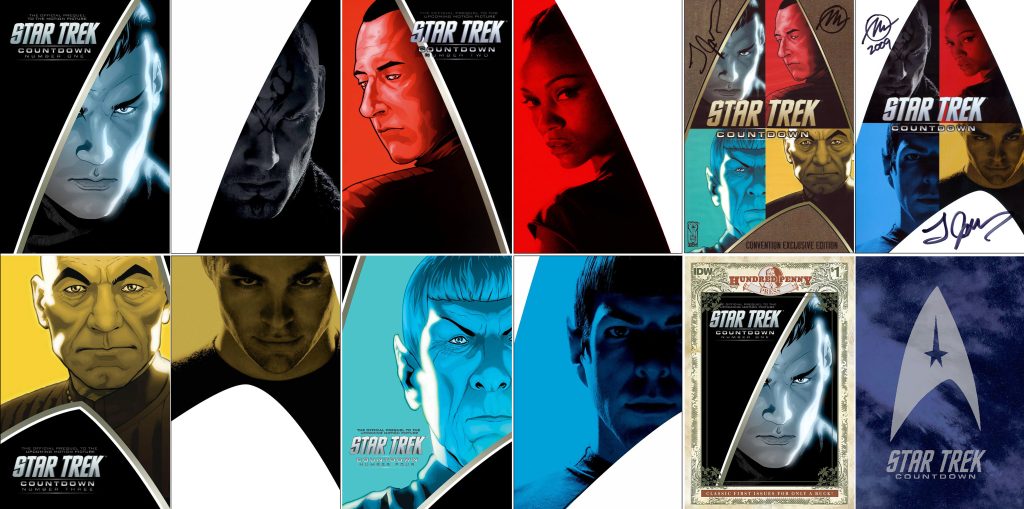
IDW had been helming the comic arm of Star Trek licensing for two years with the prime casts, and it was only natural that it would also offer stories utilizing the newly rebooted “Abramsverse,” which CBS dubbed the “Kelvin timeline” in 2016. As Star Trek Into Darkness and Star Trek Beyond followed, the range of IDW’s Kelvin-centric titles continued to grow, but the first such release was the four-part Star Trek: Countdown. Predating the 2009 film’s release by four months, the miniseries was designed to whet the whistles of anxious fans by showing them the catastrophic events that would lead to the upcoming movie’s storyline.
Writers Mike Johnson and Tim Jones penned the miniseries, based on a story by Orci and Kurtzman, with David Messina providing both interior artwork and covers. The comic’s primary purpose was to reveal Nero’s untold backstory and offer subtext to his onscreen scenes. Reportedly, the concept arose from TrekMovie.com’s Anthony Pascale having pestered Kurtzman and Orci to find a way for the characters of Star Trek: The Next Generation to pass the baton back to Jim Kirk’s crew after they’d passed it forward with both Star Trek VI: The Undiscovered Country and Star Trek: Generations.
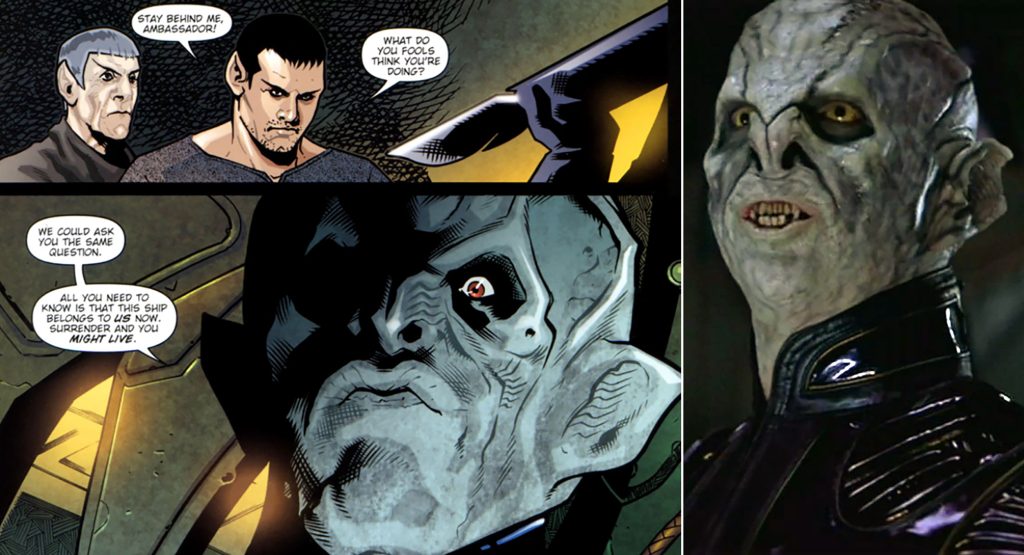
In that regard, Countdown was a success, as it bridged well the gap between The Next Generation and the new timeline. Johnson has since proven his credentials as IDW’s most prolific Star Trek writer. His work is replete with prequels, sequels, and tie-ins to onscreen Star Trek, and Countdown is no exception, for the miniseries connects not only to the 2009 film but also to Star Trek: Nemesis (including a rare appearance by the Remans) and the two-part Next Generation episode “Unification.”
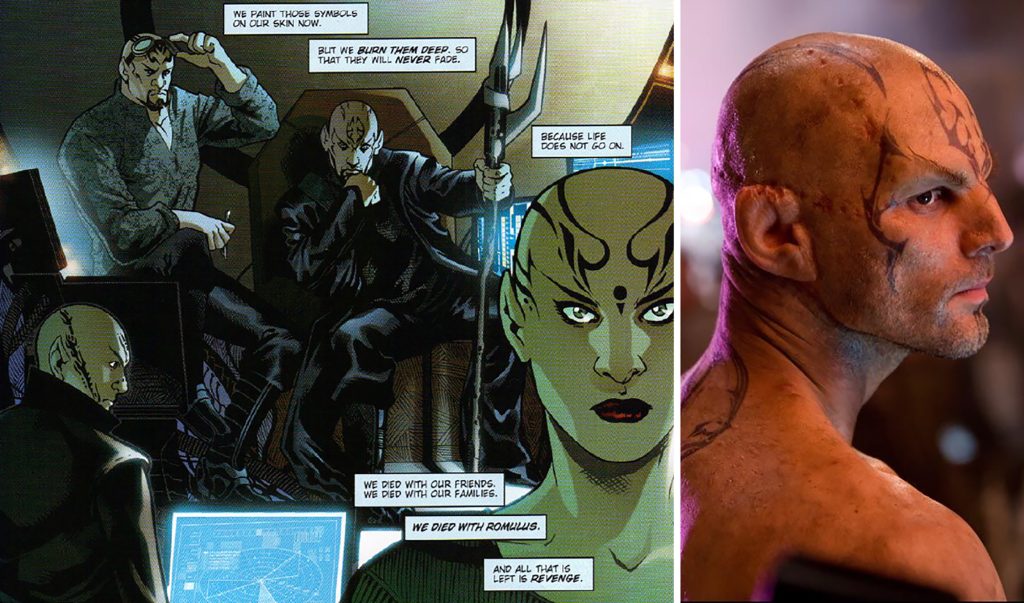
In the course of its four issues, Countdown establishes the film’s status quo. Spock, now the Federation’s ambassador to Romulus, determines that the Hobus System’s star will go supernova, causing a chain reaction that could engulf the entire universe. That may sound like silly science, and many said so at the time of the film’s debut, but Johnson and Jones make it work by noting that this is a unique situation, a perfect storm of cascading factors. Naturally, the Romulan Senate dismisses Spock’s concerns as absurd, but Nero, representing the Mining Guild, believes him.
Nero and the Narada crew obtain a rare ore required to create red matter so Spock can prevent the cataclysm. Pre-film Nero is presented as an honorable man who puts his trust in Spock to save his culture. When that effort fails, Nero loses his family, including his pregnant wife Mandana, and focuses his wrath on Spock. He and his fellow miners, including second-in-command Ayel, thus shave their heads and paint themselves with ancient ritual grief symbols, deftly explaining the new look the Romulans sport onscreen: it’s a way of demonstrating their deep pain and their commitment to vengeance.

It’s not just the Romulans’ appearance that is explained in the comic, but also that of Nero’s massive mining vessel. When the story opens, there’s nothing overly special about it—it’s just a mining ship. But after his homeworld’s destruction, Nero visits a secret Romulan military base to have the Narada fitted with salvaged Borg technology. This explanation takes on new significance given Star Trek: Picard’s subplot involving Hugh and his fellow former Borg drones, though Picard would throw a rather sizable monkey wrench into Countdown’s innards, which we’ll get to in a moment.

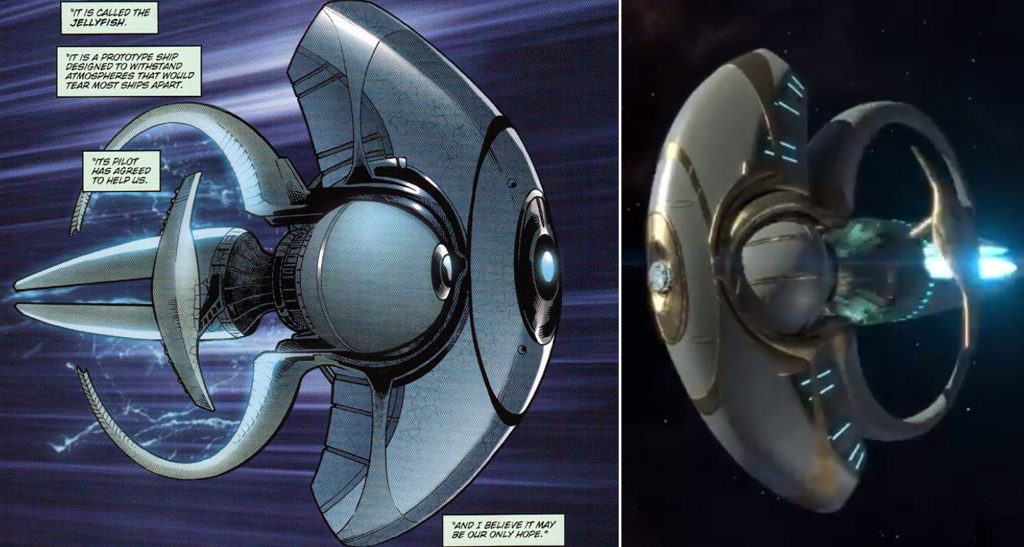
With help from Ambassador Jean-Luc Picard, Data (commanding the Enterprise-E… which should indicate the nature of said wrench), and Geordi La Forge, Spock injects the red matter into the star using a prototype space vessel called the Jellyfish. It turns out La Forge himself designed and built the ship for the purpose of withstanding unstable atmospheres. It’s a good thing, too, for the event horizon of a black hole would certainly qualify as unstable. Despite the loss of Romulus, the mission is a success—but both the Jellyfish and the Narada are pulled through the singularity and into another universe, just in time for the movie to begin and the buttery popcorn to clog arteries.
One effective aspect of Countdown pertains to “Unification” and Spock’s status among his own kind following that episode. The half-Vulcan recalls his early days with the underground movement, when he lived in tunnels and hid in shadows, before society opened its arms and named him a legal resident of Romulus. Although he is now the Federation’s official ambassador to that world, many on Vulcan view him as a defector, and some Romulans don’t trust him either. This brands him an outcast on two worlds, mirroring how he’d felt on Vulcan and Earth his entire life.
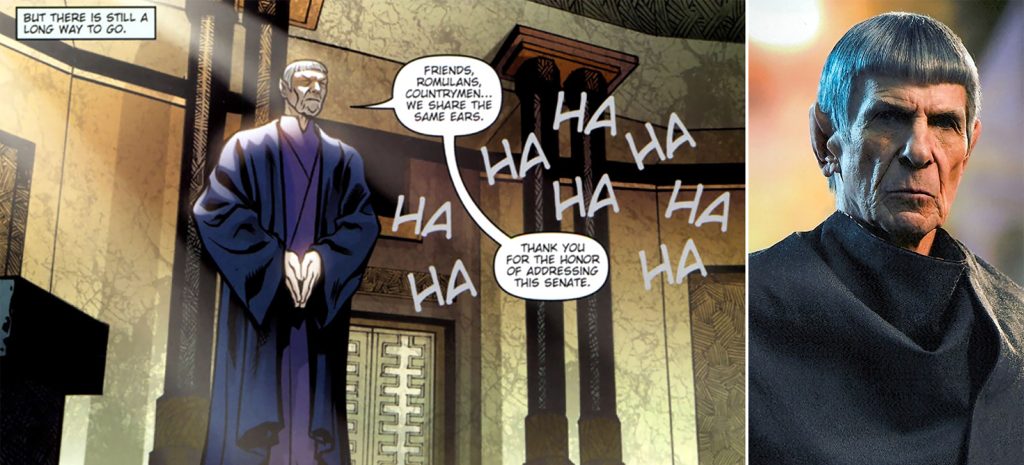
The comic also calls out to The Original Series’ “The Lights of Zetar.” While aboard the Enterprise, Nero attempts to download Memory Alpha’s files but finds his access restricted. It’s safe to assume he’s looking up the Federation library from this episode, in which Mira Romaine dated Scotty and was possessed by space-ghosts, and not the popular online resource for Star Trek fans. Both, however, are quite useful databanks.
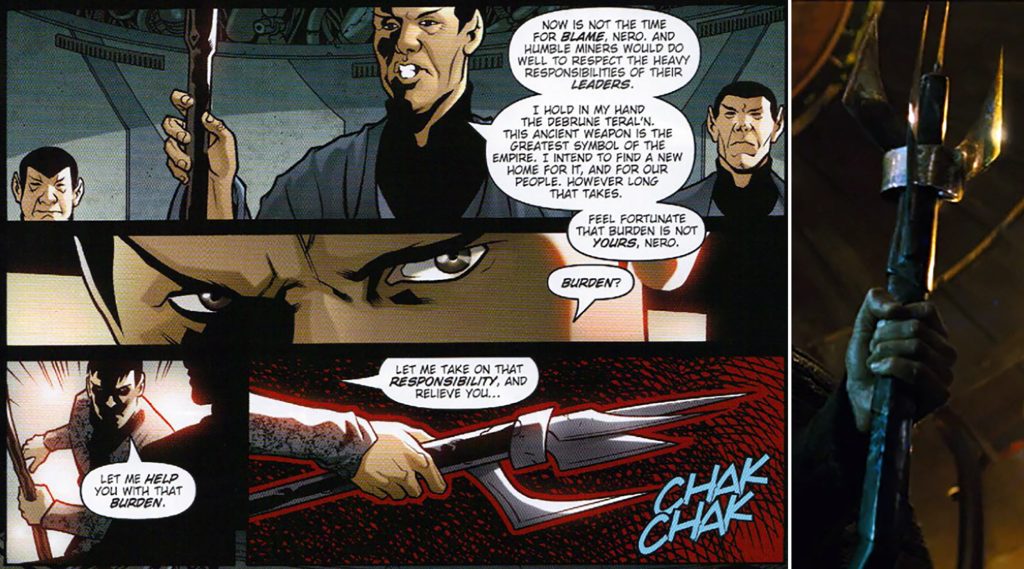
Another tie-in involves “Gambit,” an episode of The Next Generation. After the destruction of Romulus, the Praetor beams to safety aboard Nero’s vessel, holding a trident with retractable blades called the Debrune Teral’n. In “Gambit,” the Debrune were said to be an ancient offshoot of the Romulans, and Countdown connects that culture to the trident, which the Preator describes as the Romulan government’s greatest symbol. After slaying him and his ruling council, Nero takes possession of it, and he later uses this same weapon onscreen to execute Richard Robau.
This brings us to the aforementioned monkey wrench. The miniseries takes place eight years after Nemesis, with Data alive once more and commanding a starship, his neural nets having been successfully imprinted onto B-4’s existing programming. Therein lies the problem, for Star Trek: Picard offered a wholly different post-film history for Data and B-4 than the one presented here. According to the episode “Remembrance,” B-4 was disassembled and placed in Daystrom Institute storage after the movie, while Data’s positronic network was deemed lost after the transfer since the androids’ brains were too dissimilar. He was dead, negating the possibility of Countdown taking place.
While Romulans repurposing Borg tech in Countdown jibes with what transpired on Picard, details involving Data and his “brother” do not. The thing to remember is that as much as we love the novels, comics, and short stories, none of those are truly considered canon by Paramount or CBS. In truth, fans tend to overuse that term and rely too heavily on rigid definitions of what is or isn’t canon (or “cannon,” as it’s often misspelled, and from which all canon arguments should probably be fired). They also misuse the term, such as by claiming Abrams’ films aren’t canon, which of course they are.

The concept of “canon” refers to a collection of works accepted as genuine—the material deemed officially part of a franchise’s tapestry. When it comes to Star Trek, fans like to debate whether literature counts as canon, but the answer is simple: it doesn’t. Those writing the movies and TV shows can ignore anything established in the comics and novels, even those penned by said shows’ and films’ writers and showrunners. This is something the novelists and comic writers recognize, and although Orci and Kurtzman were involved in crafting Countdown, those creating Picard—Kurtzman himself was among those creators—were free to disregard the comics, which they did.
It doesn’t matter in the end, because arbitrary labels are far less important than quality, and Countdown is intelligently plotted and gorgeously illustrated. The fact that Picard discarded some of its developments does not lessen its quality, just as Deep Space Nine’s mirror-universe episodes do not detract from DC’s “New Frontiers” saga. Star Trek is a multiverse, and one can simply view any comics whose concepts have been overwritten as taking place in another reality.
In short, there’s no need to throw out the space-baby with the space-bathwater. Enjoyment is the number-one consideration when it comes to Trek comics, and next week we’ll revisit a miniseries starring… Number One! It’s time for John Byrne’s Star Trek: Crew to take its well-deserved place in the spotlight.
Looking for more information about Star Trek comics? Check out these resources:
- My ongoing column for Titan Books’ Star Trek Explorer magazine
- The Complete Star Trek Comics Index, curated by yours truly
- The Star Trek Comics Checklist, by Mark Martinez
- The Wixiban Star Trek Collectables Portal, by Colin Merry
- New Life and New Civilizations: Exploring Star Trek Comics, by Joseph F. Berenato (Sequart, 2014)
- Star Trek: A Comics History, by Alan J. Porter (Hermes Press, 2009)
- The Star Trek Comics Weekly page on Facebook
Rich Handley has written, co-written, co-edited, or contributed to dozens of books, both fiction and non-fiction, about Planet of the Apes, Watchmen, Back to the Future, Star Trek, Star Wars, Battlestar Galactica, Hellblazer, Swamp Thing, Stargate, Dark Shadows, The X-Files, Twin Peaks, Red Dwarf, Blade Runner, Doctor Who, Buffy the Vampire Slayer, Batman, the Joker, classic monsters, and more. He has also been a magazine writer and editor for nearly three decades. Rich edited Eaglemoss’s Star Trek Graphic Novel Collection, and he currently writes articles for Titan’s Star Trek Explorer magazine, as well as books for an as-yet-unannounced role-playing game. Learn more about Rich and his work at richhandley.com.
One thought on “Star Trek Comics Weekly #84”
Comments are closed.