
An ongoing discussion of how comics provide prequels, sequels, and tie-ins to Star Trek episodes and films. Read the past installments.
146: IDW Publishing, 2020–2021
IDW’s Star Trek: Year Five was an impressive achievement that concluded The Original Series, worked The Animated Series into its fabric, and gave Hikaru Sulu an interspecies love interest. From the standpoint of this column’s focus on comic book prequels, sequels, and tie-ins, Year Five was a blogger’s dream, as evidenced in issues 1–6 and 7–12. Its first twelve chapters revisited Gary Seven (“Assignment: Earth”), the Tholians (“The Tholian Web”), the Iotians (“A Piece of the Action”), Carol and David Marcus (Star Trek II: The Wrath of Khan), and other concepts from the classic era. And the series featured phenomenal cover art by Stephen Thompson and J.J. Lendl.
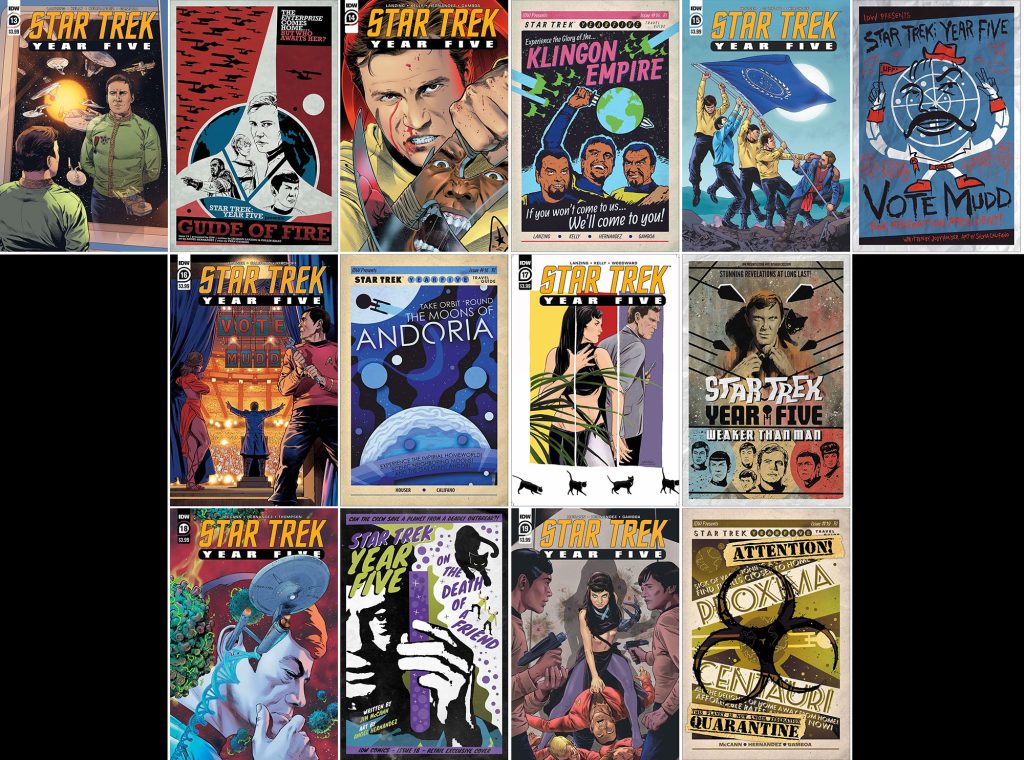
Issues 13–19 continued that trend with stories built around Klingon honor, Federation politics, Harry Mudd, and Gary Seven’s background. As is often the case with the best Trek lore, these stories held a scathing mirror up to real-world issues, particularly the rise of xenophobia, bigoted ignorance, and warmongering fascism in the United States during Donald Trump’s alarming tenure as President of the United States. While the authors were commenting on his troubling 2020 presidency, it is his 2024 presidency that is truly reflected in Year Five’s cautionary tale, even though the comics were written four years before the convicted felon returned to power.
In “Guide of Fire,” writers Jackson Lanzing and Collin Kelly, accompanied by artist Ángel Hernández, demonstrated how even the most admirable of institutions can fall prey to demagogues. Areel Shaw (The Original Series’ “Court Martial”) warns James T. Kirk about the Originalists, a xenophobic group gaining ground in the Federation, with an ideology mirroring the MAGA movement and its bigoted “America First” rhetoric. The former prosecutor, now the Federation’s Attorney General, expresses grave concerns regarding the rise of exclusionary philosophies counter to the inclusive ideals at the heart of Federation policy. She also offers amusing commentary on the change in uniform from The Original Series to Star Trek: The Motion Picture.
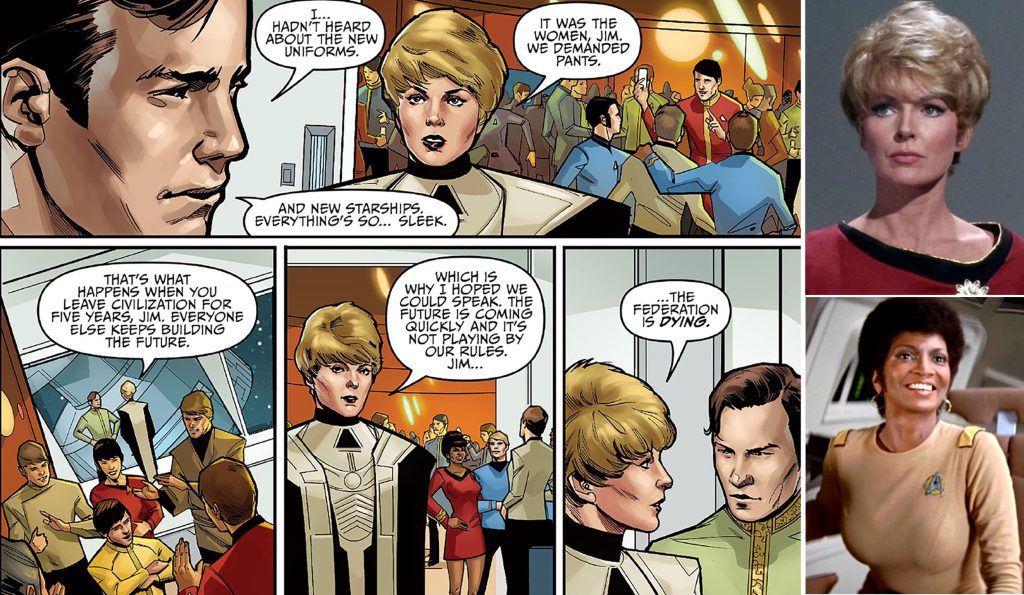
In decrying the Originalists, Shaw speaks for the majority of Americans, as well as for nations outside the United States, who have watched with dread as the corrupt Trump Administration has trampled the U.S. Constitution, alienated American allies, fostered White supremacist and anti-immigrant hate speech, and played on the fears of the ignorant and the bigoted. Shaw runs for President against the Originalists’ candidate, a bloated criminal with bad hair and a lack of couth, morals, or political experience. I’m sure you can see where this is all heading.
This dynamic, of an intelligent and experienced female candidate versus an unqualified male career criminal with a history of grifting, mistreatment of women, and sociopathic behaviors, mirrors the 2016 election between Trump and Hillary Clinton, while presaging the 2024 standoff between Trump and Kamala Harris. Who is the candidate in question? Why, none other than Harcourt Fenton Mudd, from “Mudd’s Women” and “I, Mudd,” as well as episodes of The Animated Series, Discovery, and Short Treks. Due to likeness rights regarding original actor Roger C. Carmel, IDW’s artists drew him as Rainn Wilson, though with Carmel’s paunch, befitting Trump’s physique.
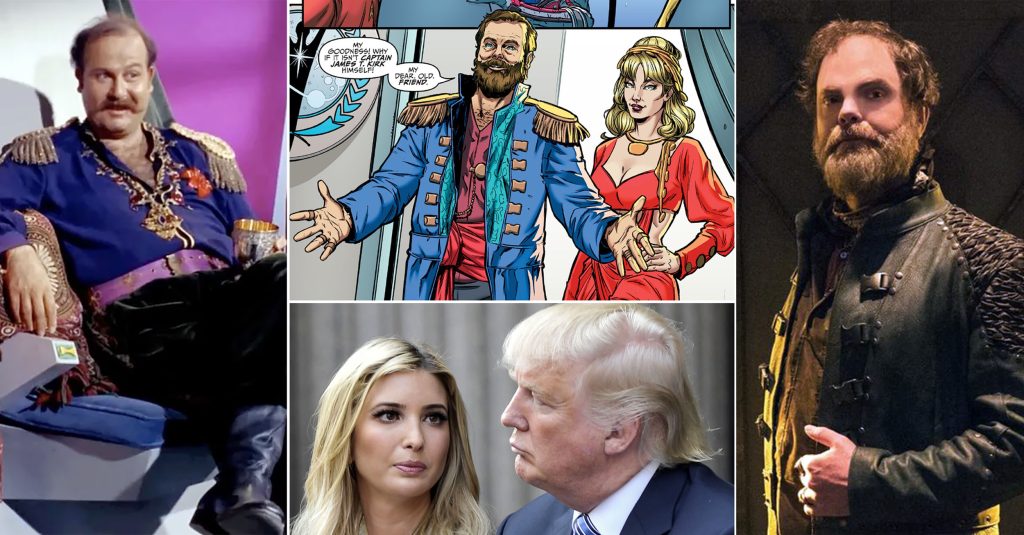

The Mudd-Trump analogy is introduced in issues 15–16, “Vote Mudd for Federation President,” from writer Jody Houser and artist Silvia Califano. Readers learn that after Kirk left Harry on the android planet in “I, Mudd,” surrounded by Stella “harpies,” he made a lucrative profit selling female models into sexual slavery—seemingly a sly reference to “The Business, As Usual, During Altercations,” from J.A. Lawrence’s novella anthology Mudd’s Angels. In hindsight, the writers predicted Trump’s unending scandal involving Jeffrey Epstein and the trafficking of underage girls.
Mudd runs for President, assisted by the pretty blonde android Celia (recall Trump’s tendency to surround himself with attractive blondes, including his own daughter). He espouses xenophobic anti-alien rhetoric befitting the Originalist and MAGA platforms. Mudd, like Trump, is an opportunist. He does not entirely buy into the vile hate speech he spews, but it doesn’t matter since it gains him support and votes from the fearful, disenfranchised, and easily swayed, and it’s what his backers demand of him. Since power and money are what Mudd craves, he hitches his space-wagon to fascist space-bigots and rides it as far as it will take him. If he could overcharge his cultists for red space-hats, he no doubt would.

Harry remains a conman at heart, despite claiming to seek change for the masses, and his ulterior motive is to use the presidency and his backer party to fleece state secrets and technological patents as part of a deplorable grifting scheme. Consider Trump’s theft of thousands of classified documents, the widespread belief that he may have sold them to foreign governments, and the many ways in which he, his family, and his friends have used his administrations to line their own pockets at the expense of the poor and middle class. The metaphor is an unfortunate slam-dunk.
Trump and Mudd are cut from the same gaudy cloth, so much so that rereading these stories in 2025, when the real-world situation is far more dire, is especially disturbing. The only real difference: Mudd can be likable at times, and he’s undeniably intelligent. To hammer home the parallel, issues 13–14 and later 18–19 (“On the Death of a Friend,” from writer Jim McCann and artist Ángel Hernández) center around a deadly pandemic and vaccine research, which dominated news headlines during Trump’s first presidency. Mudd might as well use the slogan “Make Earth Great Again.” MEGA!

Even Mudd’s disdain for Stella matches Trump, who repeatedly divorced his beautiful wives for the next (as the androids might say) “model.” As revealed in Discovery’s “Magic to Make the Sanest Man Go Mad,” Stella was quite beautiful in her younger years. Psychologists could have a field day deconstructing his decision to create the Stella android in her less desirous “I, Mudd” image, instead of the Discovery iteration. If Trump had found the android planet instead of Mudd, might he have created Marla, Ivana, Melania, Ivanka, and Stormy sexbots?
Meanwhile, Klingon honor priest Dev Vo’Qul tortures Kirk aboard the warship Gauntlet to avenge offenses again Klingon operatives in “Errand of Mercy,” “The Trouble with Tribbles,” “Friday’s Child,” and “Elaan of Troyius.” He subjects Kirk to painstiks (The Next Generation’s “The Icarus Factor”), fire, and blades, yet Kirk endures, a man of honor resolutely standing his ground during a turbulent time marked by hatred, saber-rattling, and the spread of lies and nationalistic bile. The Klingons do everything except question his birth certificate, yet no matter what injuries the racist hatemongers inflict, Kirk maintains his dignity and prevails.
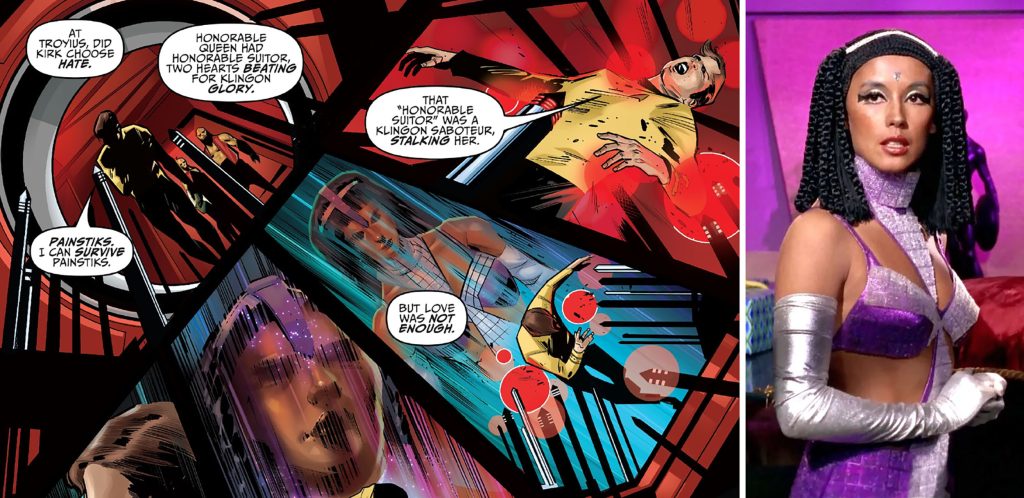
Oddly enough, Dev Vo’Qul comments that Kol (introduced in Discovery’s “Battle at the Binary Stars”) had called Kirk a worthy opponent, even though no episodes mentioned encounters between them. In fact, Kol died a decade before Kirk became captain of the Enterprise, in Discovery’s “Into the Forest I Go.” That doesn’t necessarily create a continuity problem, though, as the two officers may have battled earlier in Kirk’s career; Dev Vo’Qul never says Jim was a captain at the time, after all. Or this may simply have been a typo and should have referred to either Kor (“Errand of Mercy”) or Koloth (“The Trouble with Tribbles”).

Throughout these issues, the authors peppered in homages to numerous episodes. In one panel, an alien carries an Alfa 177 canine, in the same way that Kirk, Spock, and Montgomery Scott each held one in “The Enemy Within.” I’m fairly certain this is the only time this breed of animal has ever appeared in the comics, but I’m sure someone will inform me if I’m mistaken. What’s more, Mudd references his operations on the planet Motherlode (the animated “The Mudd’s Passion”), when once again he engaged in sex trafficking, albeit with a Rigellian hypnoid instead of an Epstein. Oh, and he wears a red tie like his orange-spraypainted counterpart.

When the Enterprise responds to a distress call from Proxima Centauri, Lieutenant Commander Giotto (“The Devil in the Dark”) assembles a security team for the mission. This story deftly resolves an inconsistency involving Zefram Cochrane, said to be from neighboring world Alpha Centauri in “Metamorphosis” yet depicted as an Earth human in Star Trek: First Contact and on Star Trek: Enterprise. As the comic explains, Cochrane colonized the Alpha Centauri system in the late twenty-first century, thus making him a citizen of both worlds. One inconsistency eliminated…

…and another perpetuated. Kirk recalls when his brother Sam (“Operation—Annihilate!” and now Strange New Worlds), had considered proposing to Aurelan. With the couple now deceased, Kirk worries about his orphaned nephew Peter but makes no mention of the other two sons, referenced in “What Are Little Girls Made Of?” yet absent in “Operation—Annihilate!” Apparently, Peter was Jim’s favorite… or maybe he’s just exhausted from trying to figure out his other nephews’ ever-changing names.
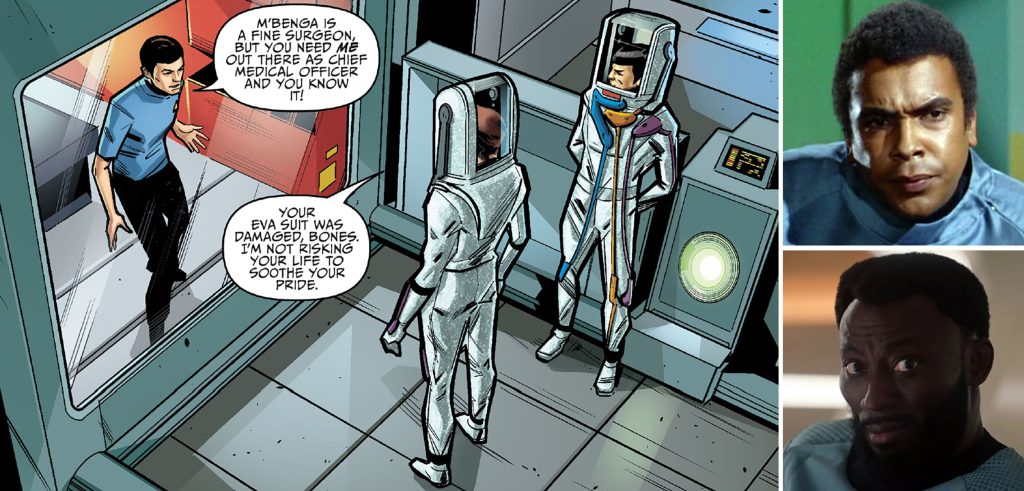
A tie-in to “A Private Little War” and “The Which Survives” occurs when McCoy is exposed to a plague he is attempting to cure, requiring Doctor Joseph M’Benga to take over his efforts. Bones objects, noting that Kirk needs a chief medical officer for this task, not a mere surgeon. In hindsight, this is a rather amusing notion, for only two years after the comic’s release, Strange New Worlds would reveal M’Benga to have preceded McCoy as the ship’s CMO. Maybe McCoy should have specified that the task required a current chief medical officer who wasn’t demoted to surgeon.

Year Five’s overarching sequel to “Assignment: Earth” continues in this batch, with Gary Seven’s shapeshifting partner Isis revealing her villainous nature. She unleashes the pandemic on Proxima Centauri, and as Kirk and McCoy try to save the population, the shapeshifter transports to Enterprise and begins killing crewmembers in brutal fashion. She even transforms into a Tholian, making her nearly invulnerable, but Chekov and Sulu manage to slay her in battle… despite Isis having previously been depicted as alive and non-villainous in other IDW stories set in later time periods. Oops.

Be that as it may, in Year Five she and Gary are villains, and the backstory behind their mysterious employers, Aegis, is revealed in issue 17, “Weaker Than Man,” from Lanzing and Kelly, with breathtaking artwork by James Kenneth Woodward. At a training community called The City, Aegis activates human Caleb Howell as Supervisor Gary Seven, following the death of his predecessor Gary Six. The aliens make Gary immortal, upload vast knowledge into his brain, and assign Isis to seduce and manipulate him. Isis coerces Gary to eliminate James T. Kirk, who poses a threat to Aegis’s plan to end all conflict in the Milky Way by destroying every species other than the Tholians.

Aegis had abducted Caleb’s ancestors six millennia prior and had trained each in turn, just as they’d done with Cardassians, Klingons, Vulcans, Andorians, Kazon, Tamarians (“Darmok”), and thousands of other civilizations, seeking the perfect species to inherit the galaxy after all others are eliminated. (Or something like that. To be honest, while Year Five is an excellent read, Aegis’s evil plan is a bit confusing to parse.) Each Supervisor has their own native animal companion, presumably a fellow shapeshifter, serving as their handler—and, if Isis is any indication, their lover. Try not to focus on the fact that this means Gary and other Supervisors have sex with their pets, especially if you are a fan of Dungeon Crawler Carl.

The depiction of Aegis’s dimension is stunning in its beauty, and in a rare example of continuity among publishers, Woodward draws them to match how DC Comics depicted them, way back in The Next Generation Annual #6. Readers learn about several unchronicled missions, which saw Gary help Genghis Khan (“The Savage Curtain”) become Emperor in 1206, interfere in the Battle of Gravelines in 1588, arrange the assassination of Archduke Franz Ferdinand in 1914 to jumpstart World War I and, amusingly, urge musician Jimi Hendrix to perform at Woodstock in 1969.
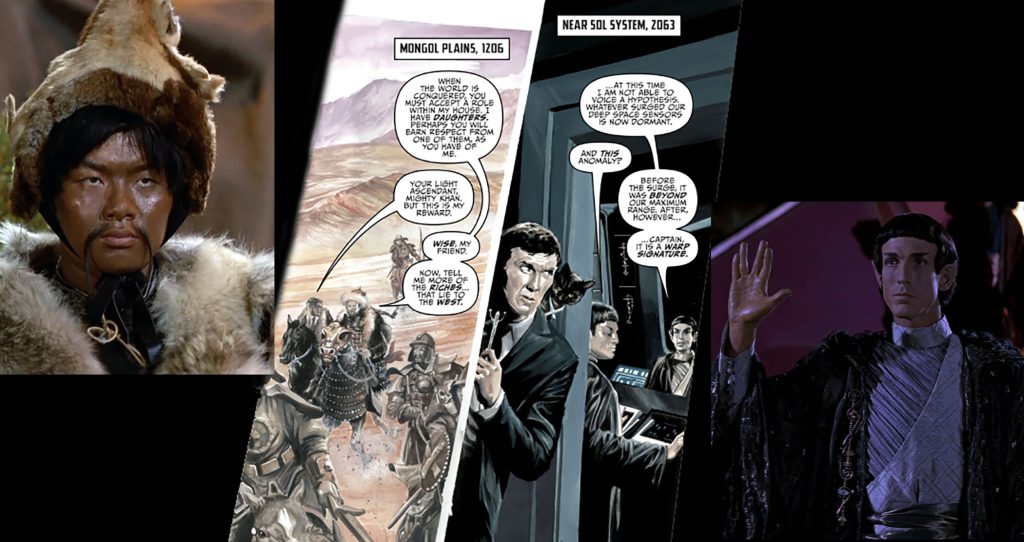
Seven also arranges for Solkar and the T’Plana-Hath to detect Cochrane’s Phoenix warp flight, enabling Earth to join the interstellar community thanks to the Vulcans (First Contact). Gary’s missions range from insidious to benevolent, befitting Aegis’s bizarre motives. It’s a shame the proposed Assignment: Earth television show was never made. As demonstrated not only in Year Five but in other comics, the storytelling potential of new missions for Gary, Isis, and Roberta Lincoln is boundless.
That’s it for this installment of Star Trek Comics Weekly. Next time, we’ll delve into IDW’s Deep Space Nine miniseries Too Long a Sacrifice, as well as the unlicensed fan comic Star Trek: Audacious. After that, we’ll finish up Year Five and head out into bold new adventures with the various Star Trek crews. Stay tuned, ‘cause the human adventure is just beginning.
Looking for more information about Star Trek comics? Check out these resources:
- The Complete Star Trek Comics Index, curated by yours truly
- The Star Trek Comics Checklist, by Mark Martinez
- The Wixiban Star Trek Collectables Portal, by Colin Merry
- New Life and New Civilizations: Exploring Star Trek Comics, by Joseph F. Berenato (Sequart, 2014)
- Star Trek: A Comics History, by Alan J. Porter (Hermes Press, 2009)
- The Star Trek Comics Weekly page on Facebook
Rich Handley has authored numerous books and essays for IDW, BOOM, DC Comics, Topps, Dark Horse, Sequart, Lucasfilm, Paramount/CBS, Titan, and more. His anthology Musings on Monsters: Observations on the World of Classic Horror (with Lou Tambone) was nominated for a Rondo Award for Book of the Year; his prose anthology Planet of the Apes: Tales from the Forbidden Zone (with Jim Beard) received multiple Scribe Award nods; and he co-edited (with Dean Mullaney) IDW’s Eisner Award-winning Star Wars: The Classic Newspaper Strips collections. Rich edited Eaglemoss’s Star Trek Graphic Novel Collection; cowrote Magnetic Press’s Planet of the Apes Role-Playing Game; and has penned licensed Star Trek, Star Wars, and Planet of the Apes fiction. He has written about other pop-culture franchises as well, including Swamp Thing, Hellblazer, Watchmen, Stargate, Red Dwarf, Batman, Godzilla, and more. He has 25 years’ experience as a magazine editor and currently works in academia.
3 thoughts on “Star Trek Comics Weekly #146”
Comments are closed.