
An ongoing discussion of how comics provide prequels, sequels, and tie-ins to Star Trek episodes and films. Read the past installments.
144: IDW Publishing, 2019–2020
With Star Trek: Year Five, IDW offered something different than its usual line of miniseries, one-shots, and ongoing sagas: a 26-chapter arc spanning a year’s worth of storytelling, detailing the final year of James T. Kirk’s five-year mission commanding the USS Enterprise. Star Trek: The Animated Series occurred sometime following the three seasons of the 1960s show, and this week’s batch of issues indicates when.
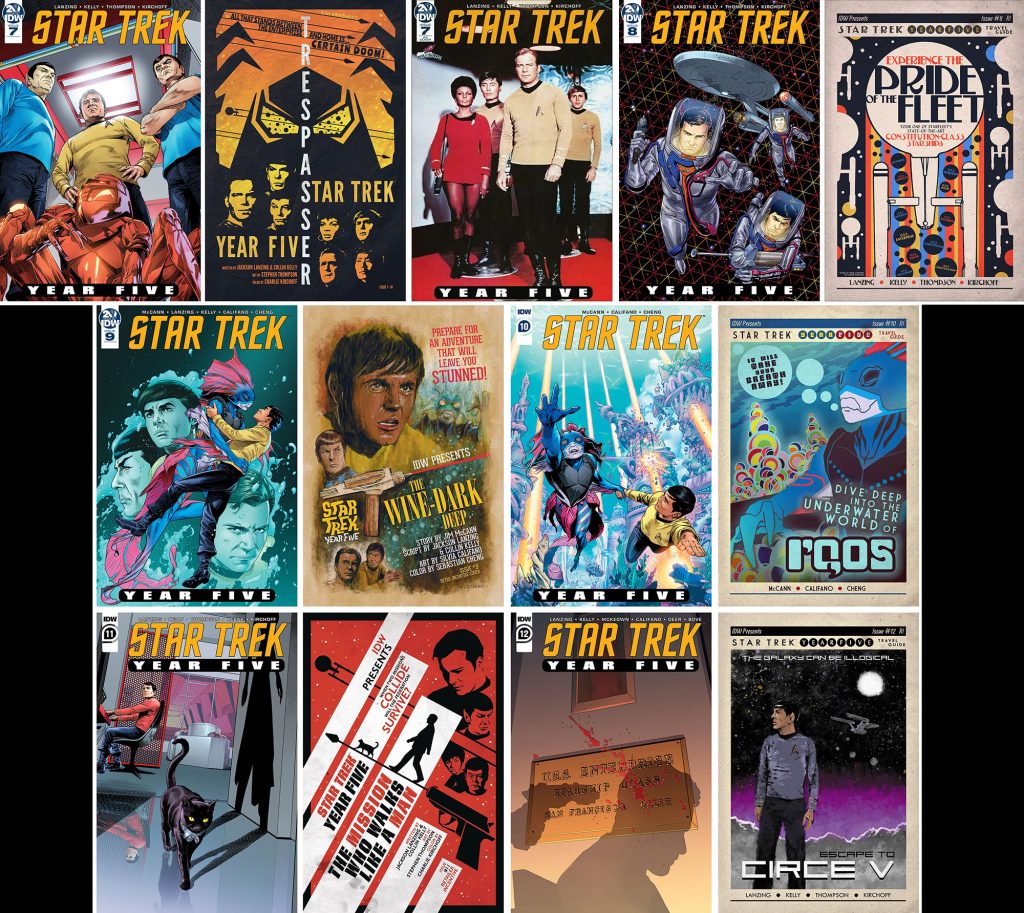
Issues 7–12 feature a trio of two-parters, each a portion of a larger arc spanning the entirety of Year Five. “Trespasser” (#7–8) was written by Jackson Lanzing and Collin Kelly, with art by Stephen Thompson and J.J. Lendl. “The Wine-Dark Deep” (#9–10) was penned by Jim McCann with Lanzing and Kelly, and was drawn by Silvia Califano, Thompson, and Lendl. And the cunningly titled “The Mission Who Walks Like a Man” (#11–12) was scripted by Kelly and Lanzing, accompanied by artists Thompson, Califano, Lendl, Maria Keane, and Kieran McKeown.
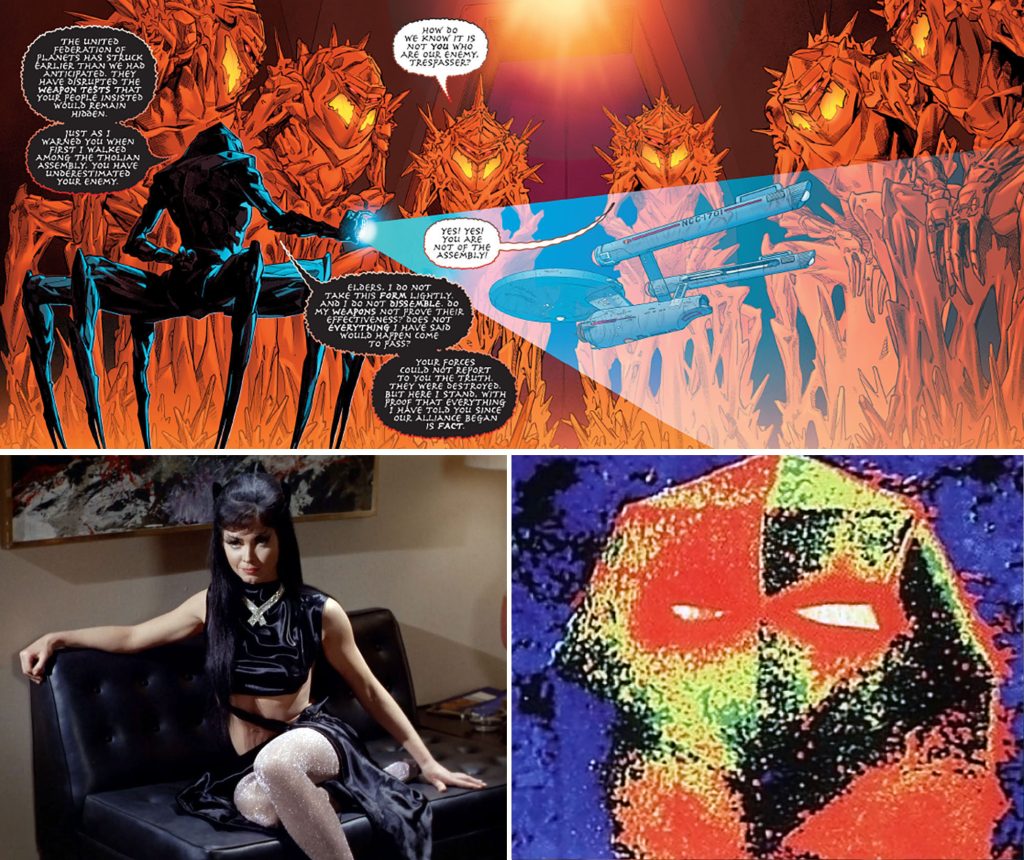
As readers learned with these three tales, the larger arc was that Year Five was ultimately a sprawling sequel to “Assignment: Earth.” That episode, a backdoor pilot for what was to be Star Trek’s first spinoff show, introduced Gary Seven (actor Robert Lansing), his shapeshifting partner Isis (actress April Tatro, voice actor Barbara Babcock, and Sambo the cat), the sarcastic computer Beta 5 (Babcock again), and their flighty secretary, Roberta Lincoln (Terri Garr). The pilot, about mysterious agents working for enigmatic aliens to fix the mistakes of Earth’s past (think Quantum Leap, but without God as a bartender), was not picked up, though the story of Gary, Isis, and Roberta has continued in the comics and novels, Year Five among them.

The titular “trespasser” is Isis disguised as a Tholian, when the shapeshifter manipulates the crystaline xenophobes into waging war against the Federation. The Tholians capture the Enterprise in a web, along with a water-filled I’Qosan vessel, and Kirk and Hikaru Sulu rescue the other ship’s lone aquatic occupant, a gender-fluid alien known as Ayal (which is such a clever double entendre involving the word “fluid”). The starship escapes by destroying the I’Qosan ship, causing its liquid environment to freeze, and thereby shorting out the web. Bright Eyes, a Tholian child adopted by Kirk’s crew in issues 1–6, rescues the captain from dying in space, after which Ayal takes refuge aboard the starship and becomes Sulu’s lover.

Sulu’s love for Ayal is bound neither by gender nor even species, for the latter’s people are amphibious and change gender throughout their lives. This wasn’t the first time Sulu had enjoyed a relationship with a non-human. During DC’s first Star Trek incarnation, he romanced the feline M’Ress, from The Animated Series. In the second run, he dated a ram-horned alien named M’yra (originally slated to be M’Ress, before Paramount’s Richard Arnold infamously made Peter David change it, culminating in David quitting as writer—though he got revenge). Hikaru was also attracted to the well-muscled Klingon warrior Vixis in Star Trek V: The Final Frontier.

Both the M’Ress and M’yra affairs were played for laughs, as was the Vixis scene, yet Ayal provided something more: a moving love story that works surprisingly well considering Ayal’s fish-like nature. Some might balk at the idea of Sulu being attracted to other species, as they did at the revelation of his Kelvin counterpart being gay in Star Trek Beyond. But the inscrutable helmsman is a man of great empathy. He displayed a fascination with other species all the way back in “The Man Trap,” for instance, when viewers witnessed his fatherly tenderness toward Beauregard, a carnivorous plant in the Enterprise’s botany section.
That empathy makes Sulu exactly the kind of person who might be open to interspecies romance—and, amusingly, Beauregard even makes an appearance before Sulu and Ayal consummate their love. “The Wine-Dark Deep” picks up this thread with a visit to Ayal’s planet, I’Qos. This beautifully drawn two-parter presents a powerful story depicting a fascinating underwater culture reminiscent of Atlantis lore, DC’s Aquaman, the Gungans of George Lucas’s Star Wars prequels, the Iskalonians from Marvel’s 1980s Star Wars line, and other fiction in which land- and sea-based societies clash.

Specifically, I’Qos is home to the aquatic I’Qosa (Ayal’s people) and the land-dwelling Lo’Kari (who hate them). Tragically, Chekov causes a planetary war resulting in millions of deaths, by inadvertently pulling his weapon on a Lo’Kari ambassador. And as the war erupts, Ayal ends their romance with Sulu to lead their people in fighting their enemies. For a sizable portion of Year Five, Sulu then blames Chekov for plummeting his lover’s world into mass destruction, and he stops speaking to his friend.
To avoid tension, Spock reassigns Chekov to security and moves Lieutenant Arex (from The Animated Series) to navigation. This deftly sets up the status quo of not only the 1970s cartoon, in which Chekov was absent, but also Star Trek: The Motion Picture, in which he was the Enterprise’s chief of security. Readers can surmise that the animated adventures must occur sometime during the Year Five timeframe, though it presents a bit of a continuity conflict with IDW’s own Star Trek: Year Four, in which Arex was already seated at the navigation console the year prior. Thankfully, it’s not difficult to reconcile the two stories with a modicum of imagination.

A rather more insurmountable obstacle involves Gary Seven and Isis, who are presented here as villains, something they never have been in any other incarnation of Star Trek. Seven manipulates the Tholians into starting an interstellar war, then attempts to destroy the Enterprise for reasons that will be explored in later issues. From Gary’s perspective, eighty years have passed since “Assignment: Earth” (hence, the absence of Roberta Lincoln), and while he regrets betraying a former friend and ally, Seven remains fully loyal to the cause, killing coldly without compunction.
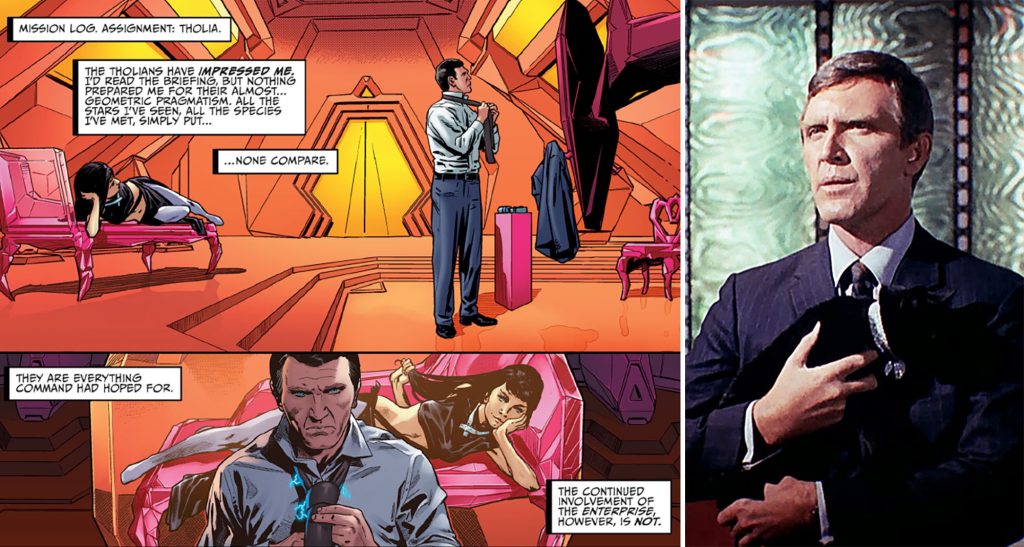
In fact, Seven nearly succeeds in murdering the crew with nerve gas before Kirk evacuates them to a nearby world. With that plot foiled, he instead tries to execute an unarmed Kirk on the starship’s bridge, while Isis savagely slaughters Starfleet crew members on the planet below. The captain gets the upper hand, however, and critically injures the agent, after which Seven and Isis retreat to formulate a new plan. Readers learn that Gary’s ancestors were taken from Earth six thousand years ago, that he was bred and trained to eliminate threats to history, that he and Isis are lovers, and that he no longer feels pain. That last fact comes in handy when Kirk impales his eye and mutilates his face, in one of the most brutal scenes in all of Year Five.
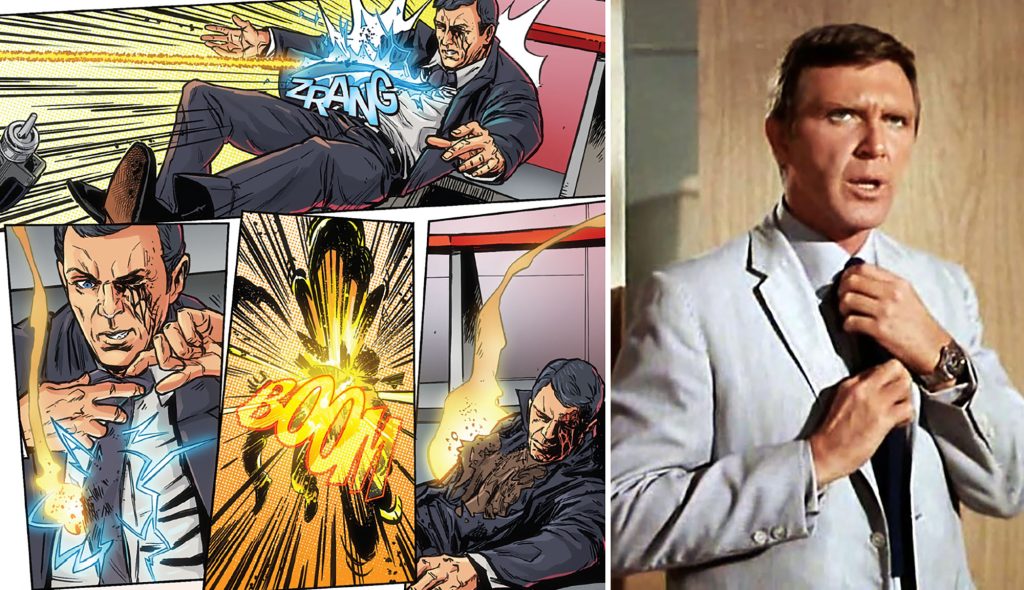
It’s worth noting that the idea of Gary Seven as a villain is not inherently unworkable, and that Year Five’s antagonistic and murderous depiction of Supervisor 194 is intriguing in its unexpected and unorthodox approach. Gary is, after all, a man whose background and employers remained a mystery by the end of “Assignment: Earth,” and it’s not entirely inconceivable that he could have secretly been at least partially villainous. It wouldn’t have been the first TV show to go in that direction, after all. Still, it seems extremely unlikely that this was Gene Roddenberry’s intention, nor does it seem organic to the character we met in the 1960s.
Compounding the problem is that Star Trek: Picard’s second season (which aired after Year Five’s conclusion, likely causing the comic’s creative team to collectively facepalm) added three new Supervisors to the mythos, all of them benevolent: Wesley Crusher, Tallinn, and Kore Soong, who worked for the Travelers, introduced in The Next Generation’s “Where No One Has Gone Before.” As presented on Picard—and more recently on Star Trek: Prodigy—the Supervisors and their Traveler employers (known in Year Five and other lore as the Aegis) are, without a doubt, the good guys. It’s very much a stretch to think they would condone such horrendous actions.

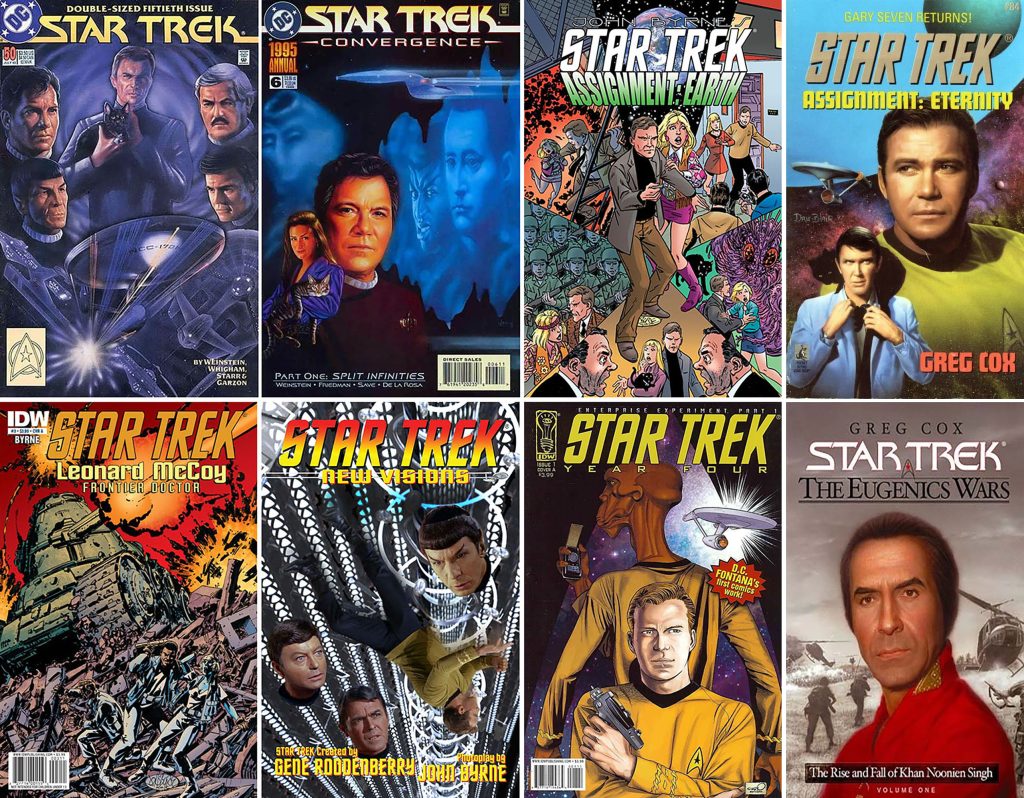
Of course, IDW cannot be faulted with failing to take into account shows that had not yet aired on TV. Still, depicting Gary and his kind as villains flies in the face of a great many licensed tales, such as Greg Cox’s novels Assignment: Eternity and The Eugenics Wars, which have presented them as benevolent individuals working for the betterment of Earth and other worlds. On the comics front, Gary and Isis were also featured in issues #49–50 of DC’s first Star Trek iteration, as well as in the sixth annuals of both Star Trek and Star Trek: The Next Generation, and they were still Kirk’s allies in the era of the classic films, set decades after the timeline of Year Five.
Now, IDW is not beholden to other publishers’ works, so ignoring non-IDW tales can be forgiven. However, IDW itself had presented prior adventures for Gary and Isis (and sometimes Roberta) in which they were not villainous. These included Assignment: Earth, Star Trek: Crew, Star Trek: New Visions, and Leonard McCoy, Frontier Doctor, all of which took place after or concurrent with Year Five’s placement. Reconciling Year Five’s revelations about Isis and Gary with those stories would be no easy task. And that’s a shame, because those comics, all written and drawn by John Byrne, are among IDW’s most acclaimed Star Trek contributions. To see them ignored is disheartening, somewhat marring the otherwise impressive maxiseries that is Year Five.
But then, that’s the nature of licensed publishing. Not everything is going to line up to readers’ satisfaction, and when it doesn’t, it can prove frustrating. Thankfully, Star Trek is a multiverse, which offers a built-in failsafe explanation. The Gary Seven of Year Five is not the same Gary Seven of DC’s tales, or of Cox’s novels, or apparently even of Byrne’s IDW saga—each constitutes its own separate reality, providing its own unique take on the brooding supervisor and his shapeshifting cat. We’ll cover more of Year Five in the weeks ahead. First, though, come back next week for a look at IDW’s Star Trek: Picard prequel tie-in comic, Picard: Countdown. See you then.
Looking for more information about Star Trek comics? Check out these resources:
- The Complete Star Trek Comics Index, curated by yours truly
- The Star Trek Comics Checklist, by Mark Martinez
- The Wixiban Star Trek Collectables Portal, by Colin Merry
- New Life and New Civilizations: Exploring Star Trek Comics, by Joseph F. Berenato (Sequart, 2014)
- Star Trek: A Comics History, by Alan J. Porter (Hermes Press, 2009)
- The Star Trek Comics Weekly page on Facebook
Rich Handley has authored, edited, or contributed to numerous books and magazines for IDW, BOOM! Studios, DC Comics, Topps, Dark Horse, Lucasfilm, Paramount/CBS, Titan Books, and more. His anthology Musings on Monsters: Observations on the World of Classic Horror was nominated for a 2021 Rondo Award for Book of the Year; he was an editor of IDW’s Eisner Award-winning Star Wars: The Classic Newspaper Strips collection; and he contributed to IDW’s Eisner-nominated Star Trek #400. Rich’s words have appeared in 160 books to date. He edited Eaglemoss’s Star Trek Graphic Novel Collection; co-created Magnetic Press’s Planet of the Apes Role-Playing Game; and has penned licensed Star Trek, Star Wars, and Planet of the Apes fiction. Rich has written about other pop-culture franchises as well, including Dark Shadows Swamp Thing, Hellblazer, Watchmen, Battlestar Galactica, Stargate, Red Dwarf, Batman, Godzilla, and more.