
An ongoing discussion of how the comics provide prequels, sequels, and tie-ins to the Star Trek episodes and films, soon to be a book from BearManor Media. Click here to view an archive of this article series.
117: IDW Publishing, 2015–2016
John Byrne’s fumetti-style comics for IDW followed in the footsteps of the classic Star Trek Fotonovels from Mandala Productions and Bantam Books, as well as Germany’s Gong magazine photo-comics. As explained in a prior installment, Byrne’s Star Trek: New Visions line featured manipulations of photo stills from the 1960s TV show, recombined to create original stories. The series was well-received, providing new episodes starring the original Enterprise crew—think Star Trek Continues and Star Trek: New Voyages, but with the actual actors themselves.
Given the nature of the project, New Visions naturally leaned toward prequels and sequels to The Original Series, since Byrne was largely limited to characters and species featured onscreen. Still, he managed to add some new aliens and characters to the mix by photographing friends and colleagues and giving them colorful costumes. Let’s examine issues #6–11, which offered sequels in almost every issue, along with a prequel.

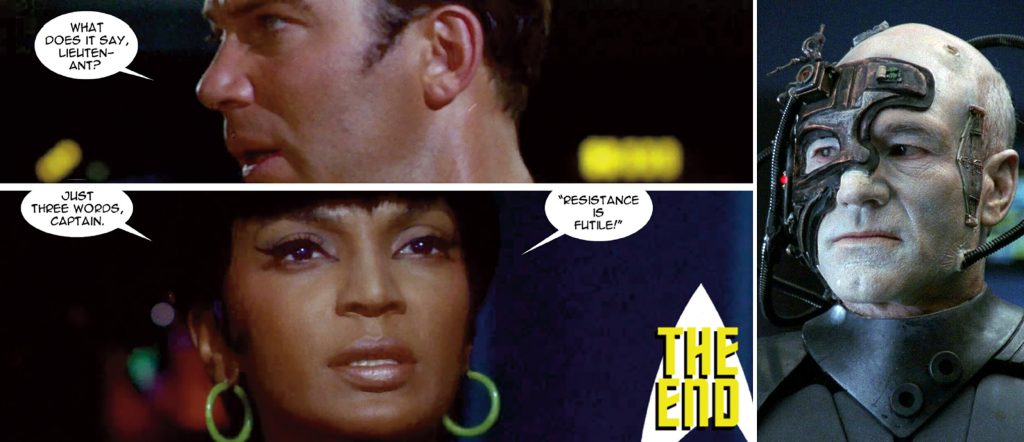
First up: the prequel, foreshadowing the Borg’s introduction in Star Trek: The Next Generation’s “Q Who.” In issue #6, appropriately titled “Resistance,” an alien sphere from the Delta Quadrant destroys Federation worlds as a prelude to invasion, until Montgomery Scott and Spock create a microscopic black hole, causing the ship to implode. But before that, the Enterprise receives an enigmatic transmission proclaiming resistance to be futile, an ominous warning of adventures yet to come.
This wasn’t the first time the Borg had menaced James T. Kirk’s crew, as Shinsei Shinsei, a Tokyopop manga, had featured an origin story for the Borg Queen. In both tales, Starfleet never learns the aliens are called the Borg, neatly sidestepping continuity snafus. From Kirk’s standpoint, they were just another mysterious intelligence, like the Omnimind. When you consider that Jonathan Archer’s crew also encountered the zombie-like cyborgs in Star Trek: Enterprise’s “Regeneration,” it’s amusing how often Starfleet had encountered the Borg before anyone was aware of their existence.
The seventh issue presents a trio of connected tales, titled “1971,” “4860.2,” and “Epilog,” which provide simultaneous sequels to the time-travel episodes “The City on the Edge of Forever” and “Assignment: Earth.” When the Dhoraxi alter history by inciting World War III in 1971, Kirk uses the Guardian of Forever to seek Gary Seven’s help in restoring the timeline. Seven and the Guardian are well aware of each other, which has fascinating untapped story potential. (Take note, Strange New Worlds writers.) The temporal tampering eliminates Starbase 14, mentioned in The Next Generation’s “Code of Honor.” If only it could erase that entire episode.

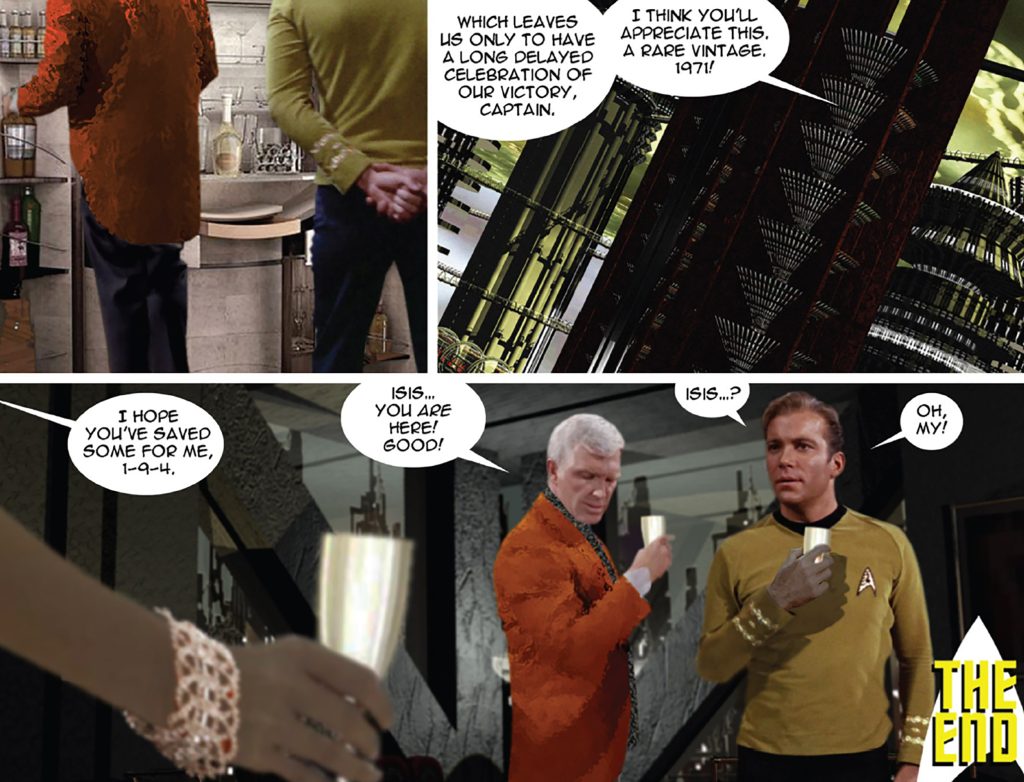
This issue adapts part of “The City on the Edge of Forever,” when Kirk explains to Gary how Starfleet discovered the Guardian’s planet. Roberta Lincoln is absent here, enjoying Thanksgiving with her family, but Isis has a cameo when an elderly Seven summons the captain and the shapeshifter to toast their victory. Rereading IDW’s earlier Gary Seven lore is a different experience now that Star Trek: Year Five has turned him into a brainwashed villain. Stories like this one, for instance, do not jibe with that series’ events, even though both were released by the same publisher. It’s a good thing Star Trek is a multiverse.
“The Survival Equation,” in issue #8, offers a direct sequel to both “What Are Little Girls Made Of?” and “I, Mudd,” via the connective tissue of androids. On Wrigley’s Pleasure Planet (a resort world first mentioned in “The Man Trap” before the 24th-century shows replaced it with Risa), Kirk’s crew discovers multiple Andrea-model androids like the one created by Roger Korby, all serving as sex slaves. The planet’s proprietor, Wrigley, claims to have bought them from Kirk’s brother, which naturally perplexes the captain since his brother Sam died in “Operation—Annihilate!”

It turns out to have been not a Kirk, but Harry Mudd in disguise. In New Visions #4, the conman had been altered to resemble Jim, enabling Byrne to utilize Harry despite likeness rights being unavailable for actor Roger C. Carmel. After learning about the Old Ones’ android machinery on Exo III, Mudd again began selling sex slaves, just as he did in “Mudd’s Women,” but this time with mechanical merchandise instead of live models. Fans often describe Mudd as a “lovable scoundrel” and in other fond terms, but he wasn’t merely a conman and liar. He was also a misogynistic slave trader… who, yeah, was oddly lovable. Hey, it was the 1960s.

The Enterprise returns to Exo III, where Mudd has created an army of Ruks as personal servants, along with a cargo of Andreas to service lecherous clients. The Ruks try to kill Mudd and the officers, just as they’d slain the Old Ones, until Spock deactivates them by shutting down the machines controlling their brains. He then researches the Exo III expedition and learns Korby’s team had included Andrea Milton, an exobiology student in whose image Roger had created the android. It would appear the good doctor, though engaged to Nurse Chapel, had harbored a crush on his former student. Poor Christine. (Take note again, Strange New Worlds writers.)

“This Side of Paradise” gets a sequel in issue #9, “The Hollow Man,” in which Spock takes a leave of absence to assist Leila Kalomi, who suspects her husband, Alan Becker, may be an impostor. It’s great to see Leila return, though it’s easy to identify the source of each panel since her expressions all come from televised scenes. Leila’s correct in her suspicion, for the world on which the couple works turns out to be a prison for an evil entity, S’uora, which had taken possession of Alan in order to escape the planet.
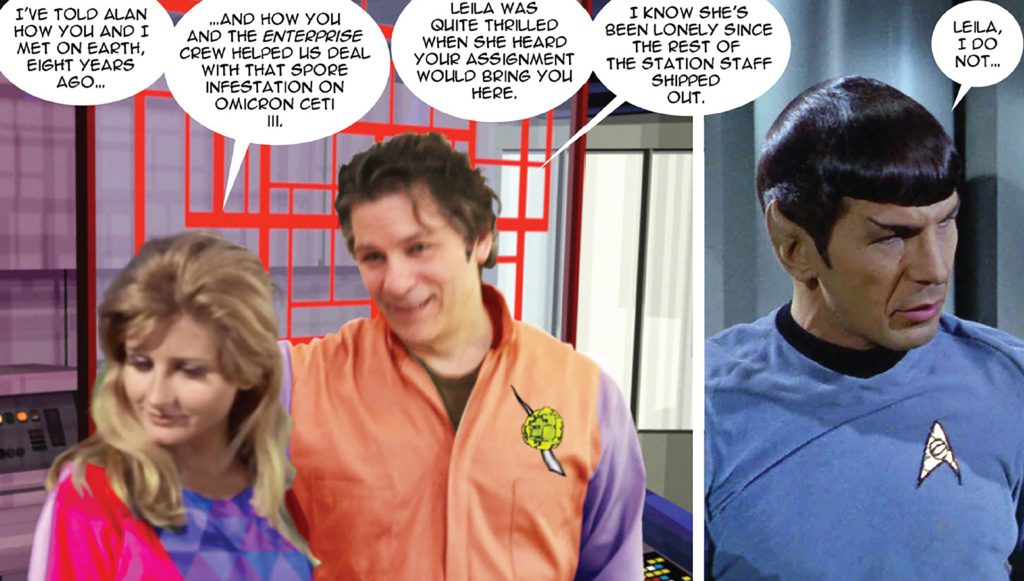
After Alan sustains cranial damage, Spock saves the man’s life via a mind meld, using his own brain as a template on which to rebuild Becker’s. Leila had loved Spock in the past, so it’s doubtful she minds this arrangement—after all, she ends up married to both men in a single body. In any case, between this issue’s S’uora, The Next Generation’s Armus (“Skin of Evil”), Deep Space Nine’s Pah-wraiths (“The Assignment”), and Star Trek V: The Final Frontier’s false Sha-Ka-Ree god, you’d think aliens would stop exiling evil entities to isolated areas—it never goes well once others stumble upon them.
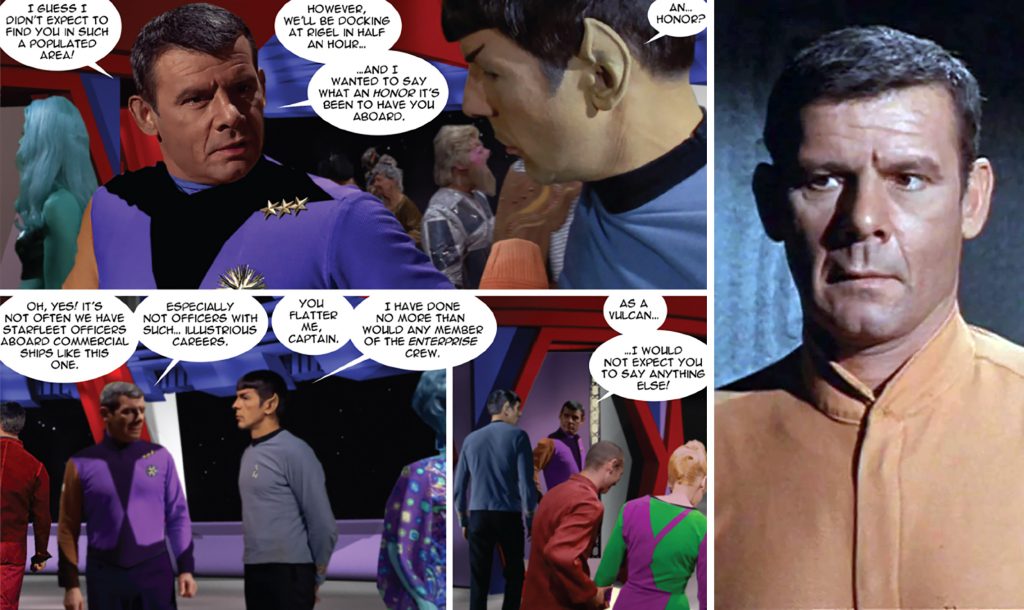
Readers may recognize Harry Landers, who’d played Arthur Coleman in “Turnabout Intruder,” as Byrne repurposes the actor’s likeness to depict the captain of the Rigel Queen. It’s an amusing nod at how several actors portrayed multiple roles on The Original Series, illustrating both a strength and a limitation of producing original photo-stories from existing stills.
The tenth issue sets up Star Trek II: The Wrath of Khan without mentioning either that movie or Khan Noonien Singh, since the events of “Space Seed” have not yet occurred. One commonly perceived plot hole of the second film (one easily reconciled, as discussed below) is that Khan, upon finding Pavel Chekov and Clark Terrell on Ceti Alpha V, comments “I never forget a face, Mr. … Chekov!” The story’s title, in fact—”Mister Chekov”—references that dialogue.

Since Walter Koenig did not join the cast until the second season, some have cited the discrepancy that Khan shouldn’t remember the young Russian from a season-one episode. This comic explains how that could be so, even though an explanation wasn’t really necessary since the TV show never said Chekov had just joined the crew. According to this story (as well as several novels), the ensign had served in engineering before moving up to navigation, and thus was onboard in “Space Seed” even though he wasn’t yet a bridge officer. It thus makes sense for Khan to remember Pavel, as the genetic superman had taken over the engineering deck during the televised encounter.
The issue contains an amusing callback to “The Naked Time,” as Scotty notes that some junior engineers have dubbed the Enterprise’s high-capacity battery banks, which run the length of the secondary hull, the “bowling alley,” a nickname the Scotsman finds disrespectful. Recall Kevin Riley’s demand, while under the Psi 2000 virus’s influence, that a formal dance be held in that area of the ship. Apparently, Riley didn’t mean a literal bowling alley—he was ordering a waltz among the engines!

Byrne takes advantage of the nature of photo-comics by bringing back Enterprise personnel from several episodes. These include Lieutenant DePaul (“Arena” and “A Taste of Armageddon”), said to be the starship’smost highly rated navigator; Charlene Masters (“The Alternative Factor”); Lieutenant Palmer (“The Doomsday Machine”); Lieutenant Shea (“By Any Other Name”); and—reinforcing the Khan tie-in—Marla McGivers (“Space Seed”). McGivers and Shea have significant and similar roles.
Shea trains Chekov in engineering and implies Scotty never gives him the time of day, explaining why the tall officer was a security guard in “By Any Other Name” and not an engineer. McGivers, meanwhile, pesters Kirk about a report she’s written, which he hasn’t bothered to read because he sees no need for a historian on a starship—an unfair bias he’d espoused several times in “Space Seed” regarding McGivers’ role. Neither Kirk nor Scotty come off as effective leaders here, as each largely ignores their junior officers’ needs and talents. It’s no wonder Marla ends up betraying her captain.

Finally, issue #11’s “Of Woman Born” revisits the Greek mythology-inspired “Who Mourns for Adonais?” The issue opens with a nine-page episode adaptation, after which McCoy learns Scotty’s lover, Carolyn Palamas, is pregnant with Apollo’s child. Conception is said to have occurred during the demigod’s attack on Palamas—which is a pretty big deal, since it disturbingly implies Apollo raped her. Although the episode never openly said as much, the script had originally ended with Carolyn impregnated, and author James Blish maintained that ending in his novelization in Star Trek 7.

In the comic, the fetus vanishes from the lieutenant’s womb mere hours after creation, then non-corporeally possesses the ship and attacks the crew. The child pulls his mother into a recreation of Apollo’s temple, where the infant demigod takes on the appearance of his father. That made sense from the artist’s standpoint, for using Michael Forest’s likeness would have been easier than photographing a new actor in the role. In the end, Spock locates mother and child via a mind-meld and brings them back to her reality, after which she transfers to a colony world to raise the baby alone. Poor Scotty.
Intriguingly, the comic reminds viewers that if Greek mythology is accurate, as the episode had indicated it to be, then there could be thousands of people descended from human-Olympian pairings. Ancient myths included many examples of gods and goddesses producing offspring with mortals—Apollo, in fact, was the son of Zeus and a human consort, Leto. This could explain the presence of extrasensory perception in some humans, such as Gary Mitchell and Elizabeth Dehner (“Where No Man Has Gone Before”), Miranda Jones (“Is There in Truth No Beauty?”), and others.
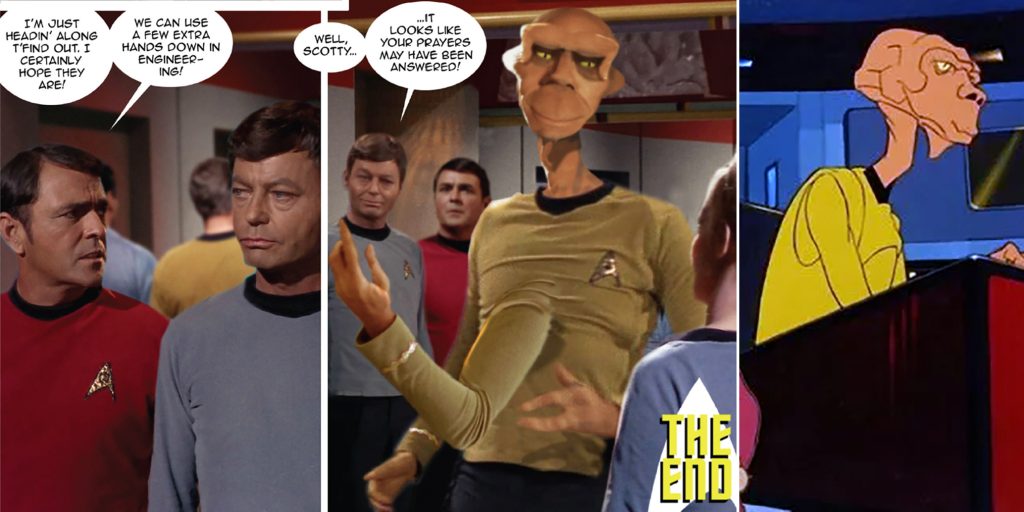
A backup tale, “I Sing of Arms and Heroes,” cleverly ties in to The Animated Series. The Enterprise takes aboard new crewmembers and McCoy prepares to conduct physicals. Scotty muses that he could use some extra hands in engineering—then turns to see three-armed Lieutenant Arex among the arrivals. This places the story before the cartoon’s debut, “Beyond the Farthest Star,” with Arex now rendered as a live-action person instead of in 1970s Filmation style—which is kind of freaky and would be great to see on television. (Take note yet again, Strange New Worlds writers.)
To celebrate Star Trek’s 50th anniversary, IDW also published a New Visions Special adapting the franchise’s first pilot, “The Cage.” Edited by Chris Ryall, the one-shot was a straightforward graphic novelization, making it the closest any issue of New Visions came to fully mirroring the Fotonovels and Gong serials. Next week, we’ll return once more to the Kelvin timeline for another batch of IDW’s Star Trek: 5-Year Mission, where we’ll experience mirroring of a wholly different kind with a return to that alternate universe’s alternate-alternate universe. See you then.
Looking for more information about Star Trek comics? Check out these resources:
- My ongoing column for Titan Books’ Star Trek Explorer magazine
- The Complete Star Trek Comics Index, curated by yours truly
- The Star Trek Comics Checklist, by Mark Martinez
- The Wixiban Star Trek Collectables Portal, by Colin Merry
- New Life and New Civilizations: Exploring Star Trek Comics, by Joseph F. Berenato (Sequart, 2014)
- Star Trek: A Comics History, by Alan J. Porter (Hermes Press, 2009)
- The Star Trek Comics Weekly page on Facebook
Rich Handley has written, co-written, co-edited, or contributed to dozens of books, both fiction and non-fiction, about Planet of the Apes, Watchmen, Back to the Future, Star Trek, Star Wars, Battlestar Galactica, Hellblazer, Swamp Thing, Stargate, Dark Shadows, The X-Files, Twin Peaks, Red Dwarf, Blade Runner, Doctor Who, Buffy the Vampire Slayer, Batman, the Joker, classic monsters, and more. He has also been a magazine writer and editor for nearly three decades. Rich edited Eaglemoss’s Star Trek Graphic Novel Collection, and he currently writes articles for Titan’s Star Trek Explorer magazine, as well as books for an as-yet-unannounced role-playing game. Learn more about Rich and his work at richhandley.com.