An essay by guest blogger Valentina Rossi.
I originally wrote the essay Is the Joker Gay? Queer Representation and the Clown Prince of Crime for the anthology The Man Who Laughs – Exploring the Clown Prince of Crime from Crazy8 Press in 2023. Since then, the Joker has been going through some new permutations, as is his nature. Recently, I was asked to translate my essay into Spanish for the comic site Zona Negativa, which I did with the generous permission of editors Rich Handley and Lou Tambone. I took the occasion to revisit, augment and correct my original essay. This is the result of feedback about the original text, recent developments, and lively discussion with my coauthors.
I present here the new material adapted back into English, as an informal blog entry rather than a proper essay. The original text is available in The Man Who Laughs – Exploring the Clown Prince of Crime, and can be acquired in Amazon.
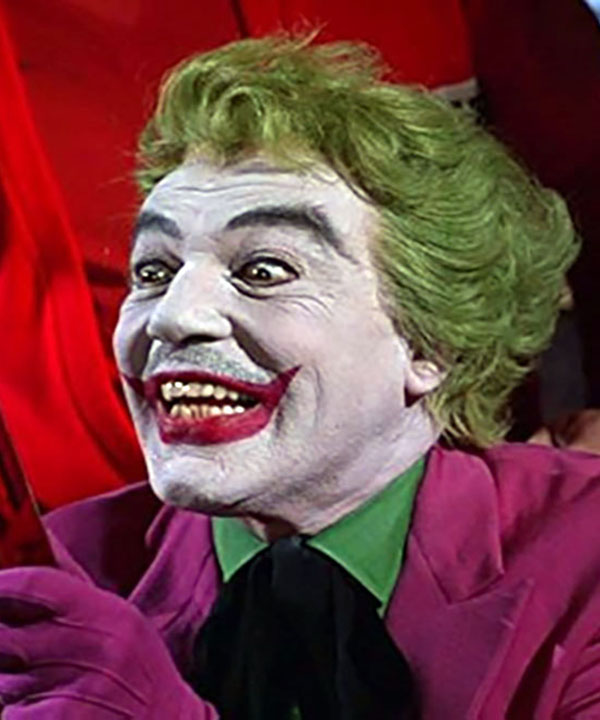
When I wrote about the infamous mustache of César Romero – the Joker in the Batman TV series – I might have sounded a bit glib, even though I have a deep appreciation for that show. I should have mentioned that the facial hair of the Clown Prince of Crime, along with the very noticeable makeup of Batman, are results of enhanced picture quality transfers to formats like Blu-ray. Nobody expected that this series would be seen in high definition in the future – or that we would still be talking about it more than fifty years since it was aired – and that all its splendor and defects would be highly noticeable [1].

In my original essay, I overlooked the Joker that appears in the nineties film Batman (Tim Burton, 1989). In the movie, the actor Jack Nicholson is magnetic as the charismatic, psychotic and farcical Clown Prince of Crime. In my opinion, his representation is a nineties update of the one of the sixties TV series: darker, but with the same sensibility. However, it has two crucial differences. Firstly, he is disfigured, both by his discolored skin and two grotesque scars left by a butcher of a surgeon when attempting to suture a bullet wound in his cheeks. These characteristics bring him closer to the Joker in the comics, inspired by The Man who Laughs (Paul Leni, 1928). This depiction is also greatly inspired by Alan Moore and Brian Bolland’s Batman: The Killing Joke (1988); in particular how the man who will become the Joker loses his last shred of sanity when seeing his hideous and deformed visage – in a puddle in the comic, in a mirror in the film. To prevent the audience from empathizing too much with the villain, the Joker was already a criminal before transforming into a monster in Tim Burton’s version, in contrast with Alan Moore’s where he was just a common man.


The second difference is that, in classic Hollywood melodrama in which all conflicts have to be personal, the murderers of the parents of the future Batman is the criminal who will become the Joker. He will cause young Bruce Wayne to become The Dark Knight, and in turn, many years later, Batman will be responsible for the accident that turns the killer into the Clown Prince of Crime. It is a series of redundant parallels drawn between the characters, which excessively emphasizes their relationship. I prefer the official DC version, where the Wayne family’s killer is simply a small-time criminal named Joe Chill.
So, if the Jack Nicholson’s Joker is so interesting, why did I chose to not mention him in my original essay? The reason is that he is a very macho Joker, in the style of the sixties version. He is an evil clown, but completely heterosexual, there is nothing queer about him. In that sense, he really is very similar to the César Romero version.
I talked originally about Joker (2019) the film by Todd Philips with Joaquin Phoenix as the title character. After the book’s publication, there was a second movie, Joker: Folie à Deux (2024) by the same director. What could be said about that grueling film? The story of the incel Joker continues, and the director makes sure to punish the public that identified with the main character originally. Or at least, so I am told it continues to be, as I must confess I couldn’t make it past the first forty minutes. The film is unpleasant and has a moralistic, self-righteous tone. At least, the initial animated sequence is amusing, in contrast to the rest of the film.
One interesting recent development has been the movie The People’s Joker (Vera Drew, 2022). According to the reviews and analyses I have read, the film takes the idea of the incel Joker from the Todd Phillips motion picture, and reverts it as a trans narrative. The director and main actress, Vera drew – a trans woman herself – retakes the queer and transgressive roots of the Clown Prince of Crime, and in doing so, appropriates the character. Drew comments that she took inspiration from her own life, and in the changing Joker of Arkham Asylum: A Serious House on Serious Earth (Grant Morrison and Dave McKean, 1989). In the same way that the Joker reinvents himself daily in that version, she had to build her identity from the ground up when she embraced her trans identity [2].
However, why do I only mention interviews and synopsis of The People’s Joker? Well, I have not seen the film, as it can not be seen legally in Switzerland, the country where I reside. This is understandable, since it was made without permission from DC Comics, and appropriates the characters of that company for an act of cinematic subversion. I find it quite an interesting proposal, and a refreshing take on the Clown Prince of Crime. On top of that fact, it gave us the first film – non official, unfortunately – of the superhero genre where the main character is trans.
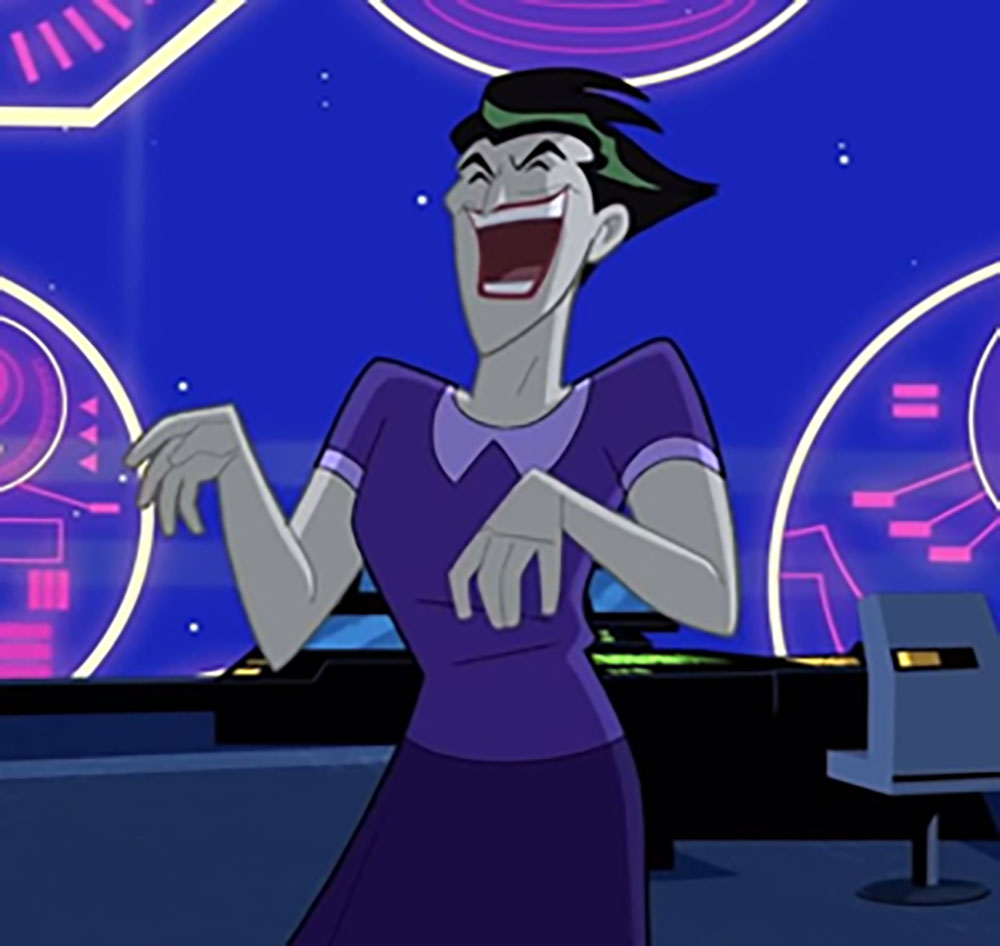
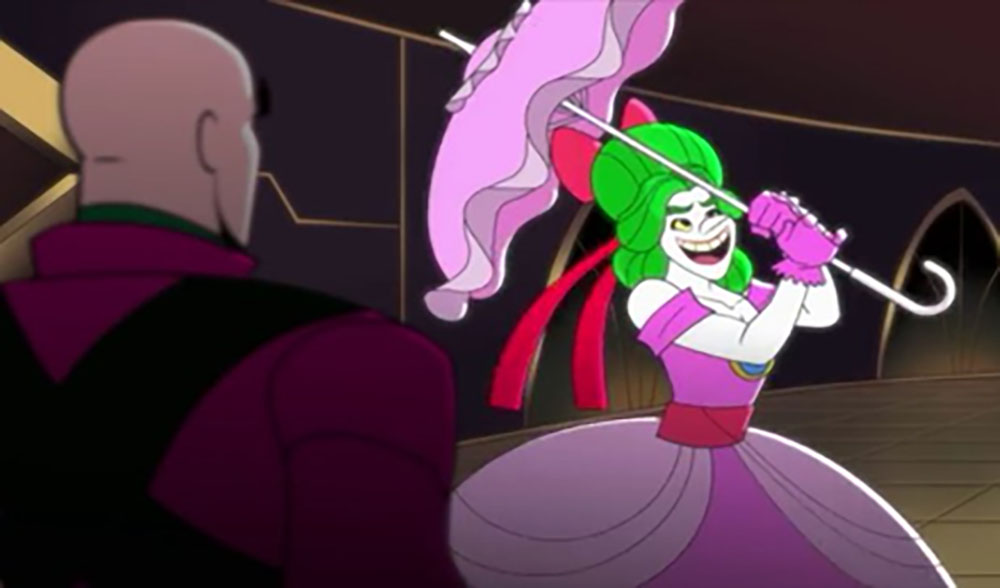
Curiously, the Joker appears in drag in two children’s shows: episode 47 of Justice League Action (2016–2018) and episode 6 of DC Super Friends (2015) [3]. In both occasions he behaves in a prankster way, in Super Friends to make fun of Lex Luthor, and in Justice League Action to infiltrate the Watchtower with a group of tourists. These are cases of the Joker as a Trickster figure [4], and he acts very similarly to Bugs Bunny in various animated shorts, where the rabbit dresses as a woman to confuse or mock his antagonists [5]. In a meta moment in Justice League Action, the Clown Prince of Crime admits that he was inspired by the famous Warner Bros. rabbit shorts! These drag scenes are really amusing, but they are not really queer, and understandably so, since they are aimed at a children’s audience. They come from an old tradition, even older than cinema, from vaudeville and Burlesque theater, later used by comedians like Laurel and Hardy and Charlie Chaplin, and then assimilated into animation like the Warner Bros shorts.
A recent case of much ado about nothing was the infamous ‘pregnant Joker’ story that appeared in issue four of The Joker: The Man Who Stopped Laughing (2022-2024). Written by Matthew Rosenberg, each issue had two stories: the first one was the ongoing conflict between two men that believed themselves to be the real Clown Prince of Crime. This idea is similar to the one expressed in Batman: Three Jokers (2020) by Geoff Johns, but much better developed here, in my opinion. The second story had an out-of-continuity tale in the style of the Silver Age featuring the Joker and his unfortunate minions. In the notable second story of issue four, the exasperated magician Zatanna apparently curses the Clown Prince of Crime, and makes it appear that he is pregnant. While being examined by Doctor Phosphorus in a gynecology exam table, instead of giving birth, he vomits a repugnant homunculus. This little man – in reality an fragment of the villain Clayface – ends up resembling the criminal clown and becomes a mini-Joker. The Clown Prince of Crime adapts him as a son, and the story ends. The tale is about eight pages in length and is amusing and disgusting in equal measure.

However, it sparked controversy on social media because the mere image of a pregnant Joker – an ultimately very feminine image – was enough to provoke the fury of incels, a group notorious for being being particularly misogynistic. Many of them only knew of the villain via the film of Christopher Nolan with Heath Ledger as the Joker [6] , and in some cases they had not even read the offending story. Eventually, the writer made it clear that the story was just a gag, not canon, and the incels simply moved on to find a new reason to be outraged [7].
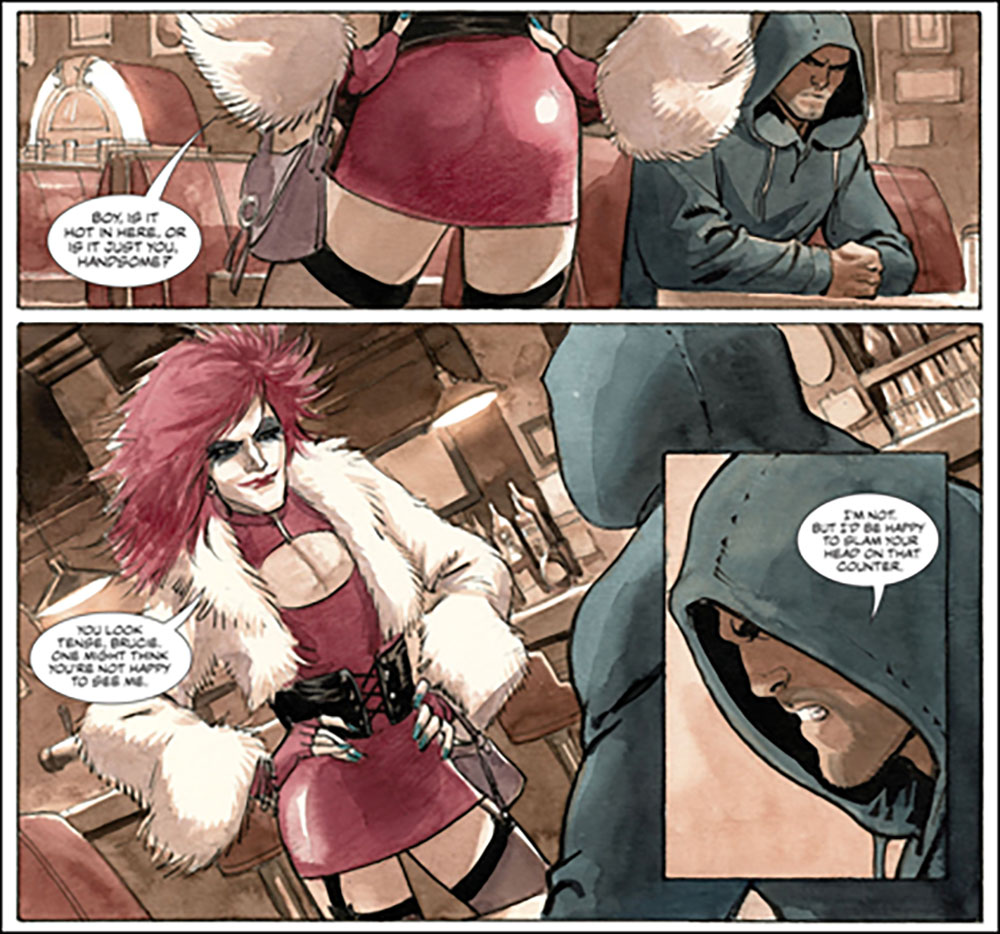
More interesting than this manufactured controversy is an alternate version of the Joker that appears in Batman: The Dark Prince Charming (2017) by Enrico Marini. The Joker arrives to a bar to meet with Bruce Wayne, dressed as a parody of the waitress that might or might not have had an affair with the billionaire socialite. The Clown Prince of Crime is wearing a miniskirt, wig, garters and stockings. The effect is more sexy than grotesque thanks to the art of Marini. But what is rather notable here is that the Joker directly references Dr. Frank-N-Furter, the alien scientist in the cult movie The Rocky Horror Picture Show (Jim Sharman, 1975). We are closing a cycle here, since Tim Curry, the actor who plays Frank-N-Furter was considered to be the voice of the Joker in Batman: The Animated Series (1992-1995) [8].

Finally, I have to say that it was very interesting to revisit the Joker. As expected, the character keeps changing with new iterations. More unexpected was that I was genuinely surprised by some of those. Who knows? Maybe in a few years it might be worth revisiting him again!
About the Author:
Robotics engineer boy by day, cinephile comics fangirl by night, Valentina Rossi is a queer genderfluid Latinoamericana currently living in Switzerland. She fell in love with comic books and Pop Culture in general, when her grandfather lent her his large collection of Editorial Novaro Spanish translations of USA and European series. She contributed essays to the Joker anthology The Man Who Laughs (2023) by Crazy 8 Press, and the Star Trek collection Women Take the Conn: An Unauthorized Star Trek Essay Collection by Women Writers (2024) by Becky Books. Valentina speaks Spanish, English, French, Italian and some German, and can still be found on Twitter/X as @rossi_tg, and in Bluesky as @rossi-tg.bsky.social.
Corrections:
- In the original essay, Harley Quinn’s profession is mentioned as a psychiatrist, she is actually a psychologist.
- The story ‘Dreadful Birthday, Dear Joker… !’ originally published in Batman 321, was published in Batman Novaro 1117 not in Batman Novaro 244 as stated in the original version of this essay.


References:
[1] The sixties Joker as represented by César Romero is discussed at length in the essay Delicious! The Joker as Latin Loverboy by Jim Beard featured in The Man Who Laughs (2023) published by Crazy 8 Press. An excerpt of the essay can be read at 13th Dimension.
[2] An excellent analysis of the film was done by Abraham Josephine Riesman for Rolling Stone.
[3] Part of episode 47 of Justice League Action – Watchtower Tours is available here.
and the full episde 6 of DC Super Friends – A visit from Superman, can be watched at this link.
[4] The idea of the Joker as a Trickster figure is developed in the essay Toward a Short Comparison and Contrast of the Joker with Trickster Characters of African Folklore by LaMarrison Fortel featured in The Man Who Laughs (2023) published by Crazy 8 Press.
[5] Bugs Bunny has appeared in drag in a large number of animated shorts. Some of my favorites are Hillbilly Hare (Robert McKimson, 1950), Rabbit Fire (Chuck Jones, 1951), Rabbit Seasoning (Chuck Jones, 1952) and Bedevilled Rabbit (Robert McKimson, 1957).
[6] I wrote in more detail about Ledger’s Joker as featured on Christopher Nolan’s The Dark Knight (2008) in my original essay.
[7] An article about the pregnant Joker controversy and the comments from writer Matthew Rosenberg can be consulted at this link.
[8] The story of how Tim Curry was considered originally to voice the Joker in Batman: The Animated Series can be read in Fixing the Laughter: Voice Casting the Joker on Batman: The Animated Series by John Trumbull, The Man Who Laughs (2023) published by Crazy 8 Press.