
An ongoing discussion of how the comics provide prequels, sequels, and tie-ins to the Star Trek episodes and films, soon to be a book from BearManor Media. Click here to view an archive of this article series.
66: Marvel Comics, 1996–1998
Marvel’s first licensed Star Trek comics lasted from December 1979, when it adapted The Motion Picture as Marvel Comics Super Special #15, until February 1982, when its short-lived monthly title concluded. In the course of two years and a few months, Marvel released eighteen issues, along with the Super Special and two reprint digests. Yet during its second time at bat, from November 1996 to July 1998, the publisher produced a whopping 94 issues, comprising ashcans, monthly titles, miniseries, and one-shots. That’s five times as many issues in a shorter span of time. Impressive!
In recent months, we’ve examined how Marvel provided prequels, sequels, and tie-ins to onscreen lore in the pages of Star Trek Unlimited, Deep Space Nine, Voyager, Starfleet Academy, Early Voyages, and Untold Voyages. This week, we’ll wrap up our Marvel coverage with a look at the publisher’s seven one-shots, starting with its adaptation of the film Star Trek: First Contact, in which Jean-Luc Picard, still dealing with PTSD from his assimilation in “The Best of Both Worlds,” becomes obsessed with destroying the Borg.
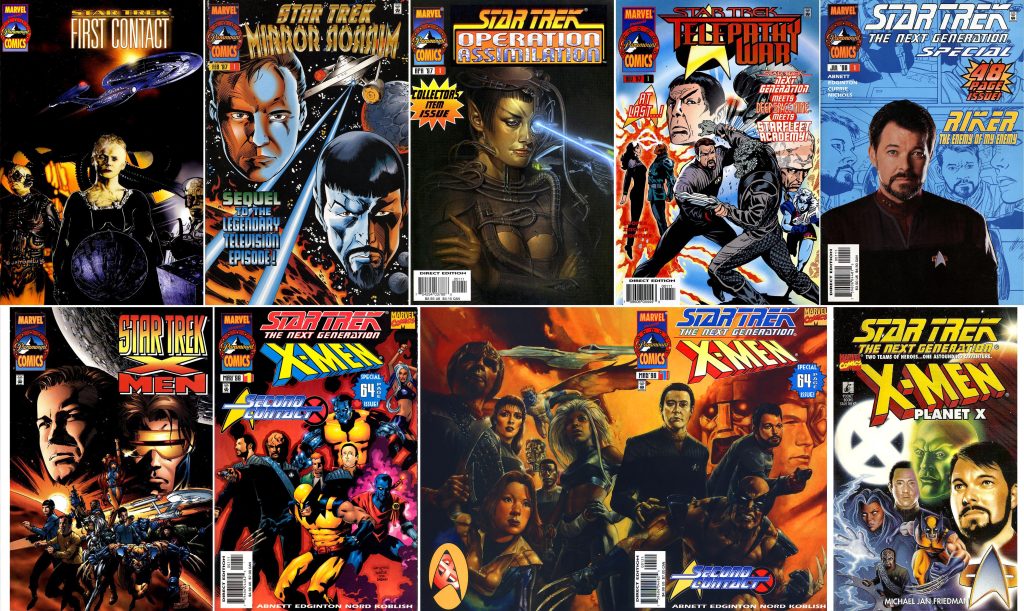
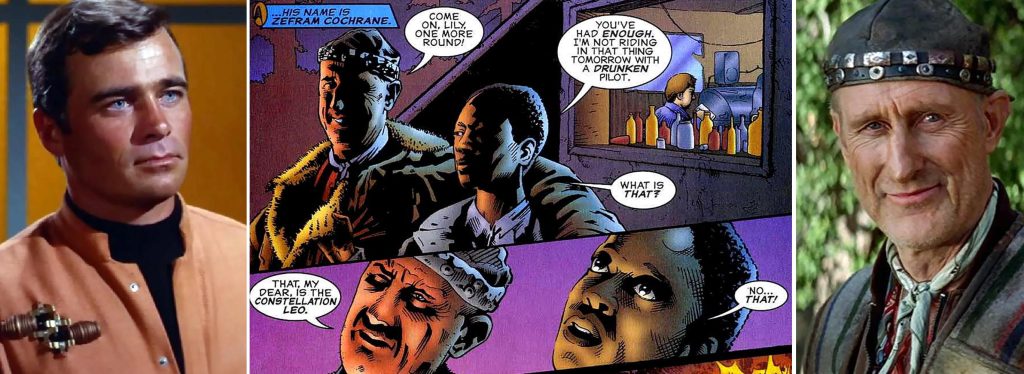
Scripted by John Vornholt from the movie’s screenplay, the adaptation was illustrated by Rod Whigham, Terry Pallot, and Philip Moy, with cover art by Jeff Pittarelli. Though published by Marvel, the adaptation had been slated for release by Malibu Graphics and was edited by that company’s staff. As in the film, the Borg attempt to alter history by preventing Zefram Cochrane from launching Earth’s first warp-capable vessel and making first contact with the Vulcans. This makes the movie (and thus the comic) a sequel not only to “The Best of Both Worlds” but also to “Metamorphosis,” which had introduced Cochrane as an old man rejuvenated by an incorporeal alien.
For the movie, James Cromwell assumed the role originated by Glenn Corbett, who looked as much like Cromwell as Benedict Cumberbatch did Ricardo Montalban; plus, Cromwell was nearly 60 at the time of filming, despite playing a man who would have been in his thirties (to quote Pavel Chekov, “Heh, must be de radiation”). All joking aside, though, Cromwell was fantastic as Cochrane, whom he’d again portray on both Star Trek: Enterprise and Lower Decks. Despite the discontinuity, his performance was a joy to watch, so let’s just agree to squint, pretend they’re the same guy and the right age, and be grateful for two exemplary castings for this intriguing character.
A month later, Marvel debuted the first of three crossovers with the X-Men franchise. Star Trek had previously been paired up with the TV show Here Come the Brides in Pocket Books’ Ishmael, while Gold Key’s Star Trek #22 had been tied to issues #170 and #180 of DC Comics’ Star-Spangled War Stories. Both of these sequels were presented under the radar, however, unnoticed by many fans or even by the publishers. DC’s Robert Greenberger had hoped to have the Enterprise crew meet Superman in the 1980s, but Paramount nixed that idea, and Marvel’s Star Trek/X-Men, cleverly titled “Star TreX,” ended up being the first true Star Trek comic book crossover event.
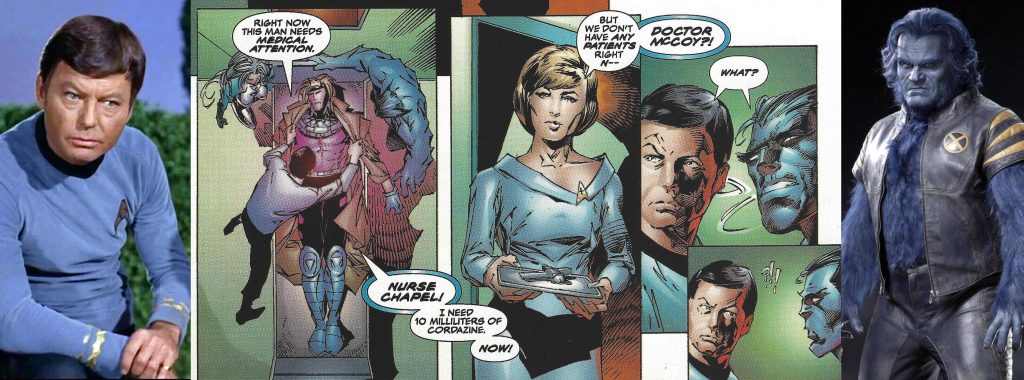
Scripted by Uncanny X-Men and Generation X writer Scott Lobdell, the one-shot featured a lineup of artistic talents too lengthy to list. I’ll admit up front that as a general rule, I am not a multi-franchise crossover fan. In my opinion (your mileage may vary and that’s fine—vive la différence, IDIC, and all that), crossovers tend to dilute both franchises they combine. I know they’re popular, but they’re just not my cup of Earl Grey. That being said, Star Trek/X-Men is surprisingly fun and plays off the strengths of both teams, and the obvious gag about both universes containing a Doctor McCoy earns its laughs.
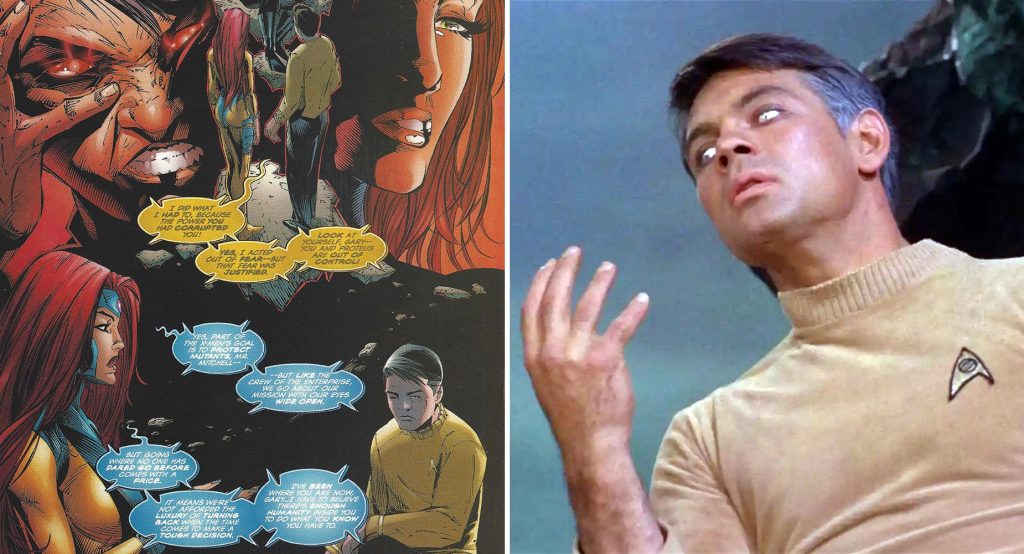
After the Enterprise finds a psionic rift near Delta Vega (the one from “Where No Man Has Gone Before,” not the 2009 film), a ship from another dimension arrives carrying the X-Men, who seek to stop the villainous Deathbird. They discover the late Gary Mitchell has been reanimated by Deathbird’s deceased mutant ally Proteus, whose reality-warping skills are similar to Mitchell’s powers. Jim Kirk’s crew and the Spandex crowd stop the Mitchell/Proteus mutant zombie from dominating both universes, then seal the rift. The phrase “Mitchell/Proteus mutant zombie,” by the way, illustrates my general problem with crossovers: they create some rather silly scenarios, even when they’re enjoyable.
Prior comics had revisited elements of “Where No Man Has Gone Before,” especially the energy barrier at the galaxy’s edge, while DC had offered flashbacks to Kirk’s adventures with Mitchell in their younger years. “Star TreX,” however, was the first (not the last) to bring Gary back to life, and Lobdell deserves credit for not disrespecting the source material, which sometimes happens with “[Character name] is alive again” storylines. Mitchell is largely controlled by Proteus, but the final scene, in which he regains his humanity and urges Kirk to shoot him again before he can commit mass murder, provides a poignant callback to the episode, redeeming Gary after his onscreen actions.
Marvel would later craft a sequel, ST:TNG/X-Men: Second Contact, that would team up the X-Men with Picard’s crew. Written by Dan Abnett and Ian Edginton, Second Contact was drawn by Cary Nord and Scott Koblish, with a pair of vibrant covers by the duo and Vince Evans. Serving as a sequel to both Star Trek/X-Men and First Contact, Second Contact takes place immediately after the film, with the Enterprise-D returning to the 24th century from Cochrane’s era. En route, the Starfleet officers make an unintended pit-stop in the 1990s of an alternate Earth populated by costume-clad mutants, making Star Trek‘s Earth part of Marvel’s expansive multiverse (Earth-1701, perhaps?).
The crew are surprised to find the Eugenics Wars not taking place as they should be, per “Space Seed,” an early sign they’ve entered another continuity (or maybe this is simply the timeline altered by Enterprise, Deep Space Nine, and Strange New Worlds—see It’s Been a Long Road Getting from There to Here). The teams then work together to resolve paradoxes involving the Battle of Wolf 359 (The Next Generation‘s “The Best of Both Worlds” and Deep Space Nine‘s “Emissary”) and the “Days of Future Past” storyline from Marvel’s The Uncanny X-Men #141–142. Amusingly, a film adaptation of the latter would feature Patrick Stewart as X-Men‘s Charles Xavier.
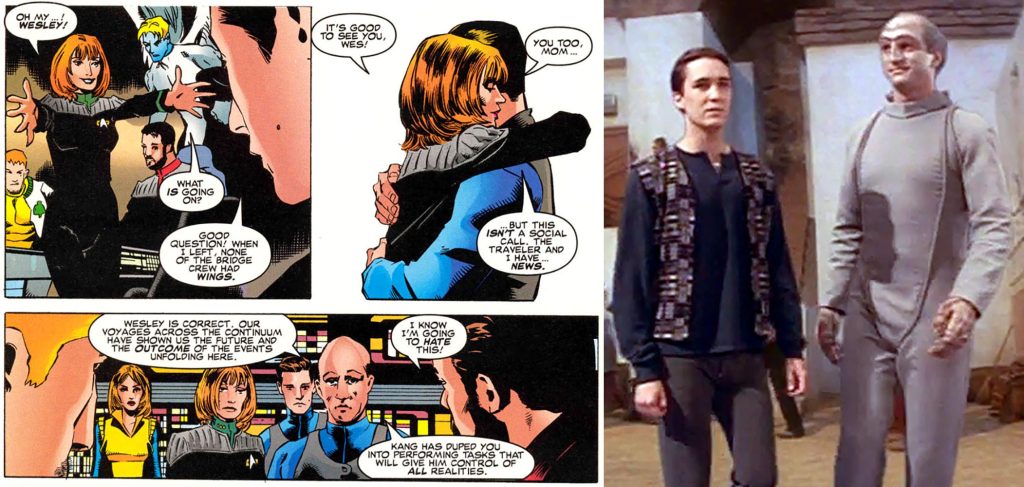
Supervillain Kang the Conqueror claims the starship’s arrival has caused a rift that will destroy all of existence, and everyone buys this claim almost immediately, as though unaware supervillains lie. The Starfleeters and mutants battle Star Trek‘s Borg and X-Men‘s Sentinels, encounter a reality-displaced Tasha Yar (who died in both “Skin of Evil” and “Yesterday’s Enterprise“), and strive to repair history. But wait, they’ve been tricked! Thankfully, deus ex machinas Wesley Crusher and the Traveler, who’ve been sailing the space-time continuum together since “Journey’s End,” show up to reveal Kang has deceived them.
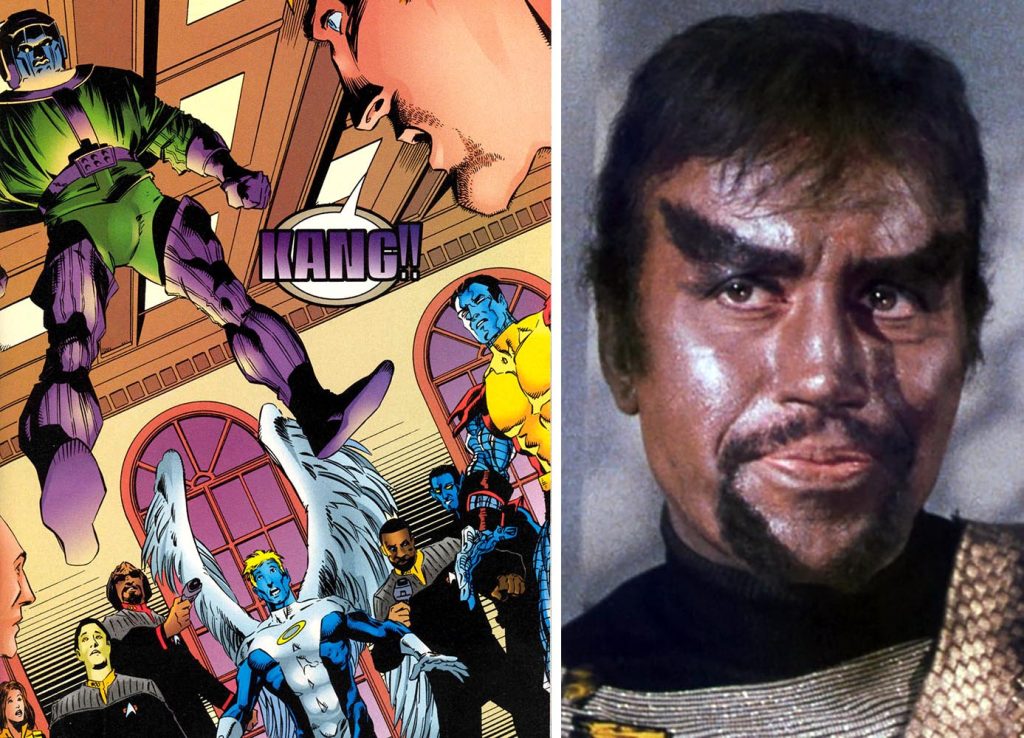
It’s a moment worthy of a Scooby-Doo villain-unmasking, but it’s undeniably fun to see Wes and his mysterious mentor again. Regrettably, the writers do not reference Klingon warrior Kang, which seems like a missed opportunity. You’d think some of Picard’s crew, particularly Worf, would make the connection between Kang the Conqueror and Kang the Klingon. In any case, only the first two chapters of the crossover were produced by Marvel. The concluding third was Michael Jan Friedman’s novel ST:TNG/X-Men: Planet X, published by Pocket Books, and it’s a hoot.
The Marvel one-shots were a sequel goldmine, and Star Trek: Mirror Mirror was no exception. The comic takes place moments after the episode “Mirror, Mirror,” which introduced the alternate universe that would later be explored on Deep Space Nine, Enterprise, and Discovery. Tom DeFalco wrote this one-shot, adeptly illustrated by Mark Bagley and Larry Mahlstedt, and while its plot ignores DC’s extraordinary “New Frontiers” storyline, it is nonetheless very engaging.
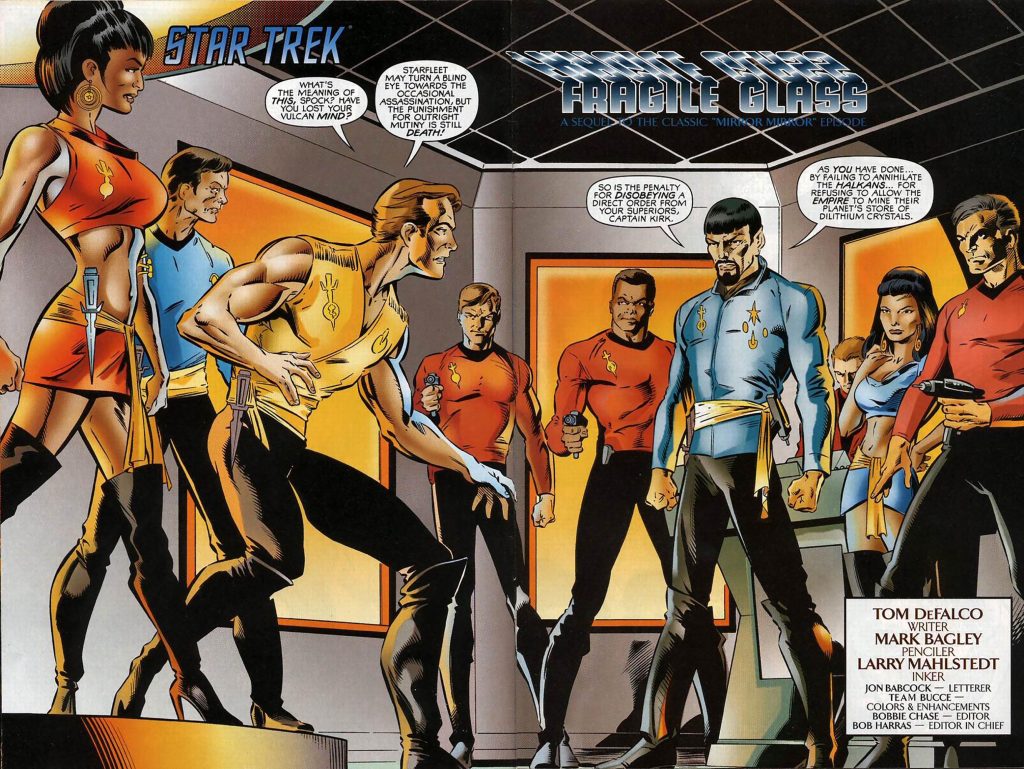
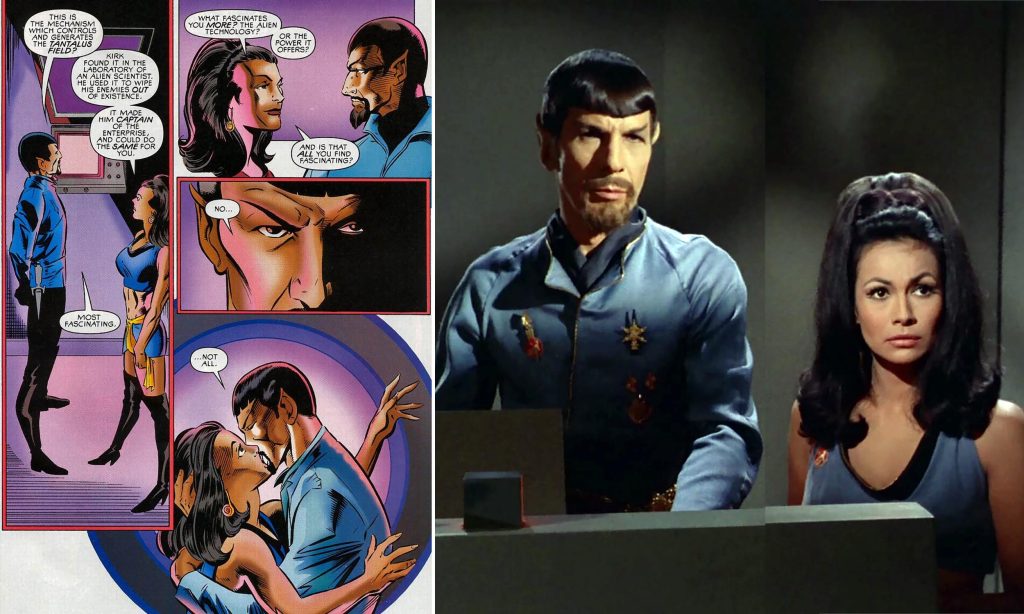
The counterparts of Kirk, Nyota Uhura, Leonard McCoy, and Montgomery Scott return to their own universe, where mirror-Spock arrests the captain for failing to punish the Halkans. The Vulcan thwarts Sulu’s assassination attempts, takes Marlena Moreau as his lover with a wonderfully awkward kiss, and convinces the Halkans not to resist the Empire’s dilithium-mining efforts, providing a logical solution that satisfies both Imperial demands and Halkan philosophies without requiring mass slaughter. It’s a masterful bit of maneuvering from bearded Spock, even though the TV shows have since overwritten this and other licensed mirror-universe lore. The counterpart of Matt Decker (“The Doomsday Machine”) then rewards him by naming Spock the Enterprise‘s new captain.
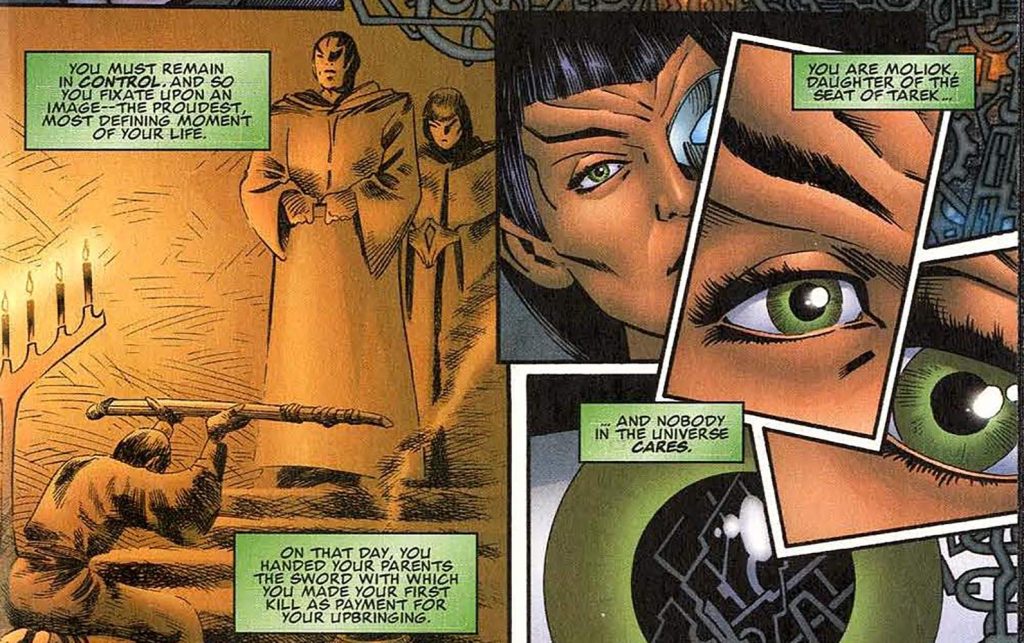
One of Marvel’s most powerful Trek tales was Operation Assimilation, from writer Paul Jenkins (of DC’s Hellblazer fame). Like the First Contact adaptation, this was also slated for a Malibu release before Marvel regained the license. The lush interior art from Steve Erwin and Terry Pallot is gorgeous, as is the standout cover by Hajime Sorayama, and the plot picks up on The Next Generation‘s season-one finale, “The Neutral Zone,” which brought the reclusive Romulans onto the 24th-century playing field. Operation Assimilation occurs shortly before that episode, building on atrocities described by Romulan Commanders Tebok and Thei.
An unknown vessel arrives at the Romulan Neutral Zone. This new enemy—the Borg, of course—decimates a Romulan ship and assimilates its crew, including its ambitious commander, Moliok. In “The Neutral Zone,” an unidentified adversary had attacked both Romulan and Federation bases, and “Q Who” later revealed this to have been the work of the Collective. The comic depicts one such attack, and the image of the cyborg Romulan emotionlessly slaying her own brethren is haunting, with Moliok running through a gamut of emotions and regrets before succumbing to assimilation. Creepy and effective, it’s among Marvel’s best offerings.
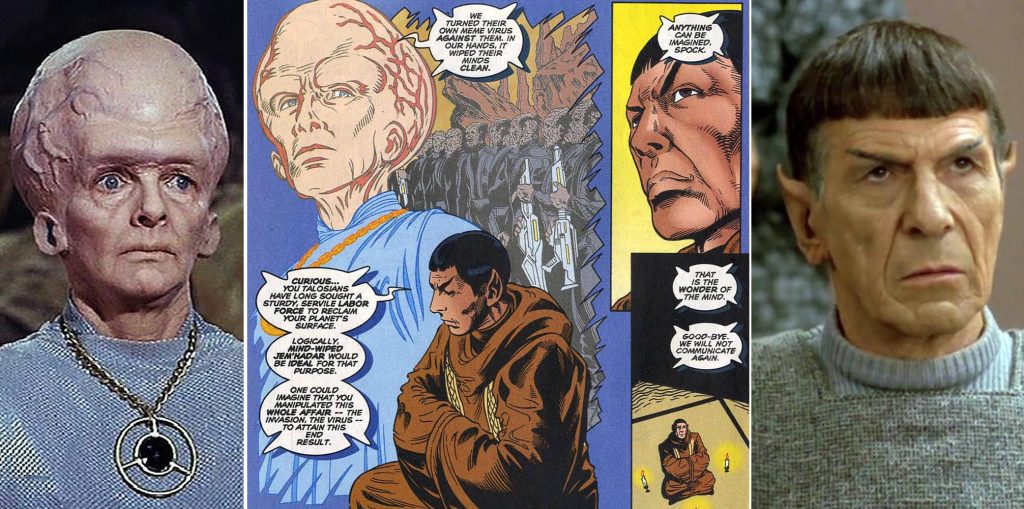
The Telepathy War one-shot, from Chris Cooper, Patrick Zircher, and Steve Moncuse, concluded Marvel’s inter-title crossover event (one of several for the franchise, the most recent of which took place in IDW’s Star Trek, Defiant, and Day of Blood titles). The “Telepathy War” saga spanned Starfleet Academy #12, Deep Space Nine #12–13, Star Trek Unlimited #6, and Voyager #13. The Telepathy War saga has been discussed at length in prior columns, and this one-shot features another appearance by the Talosians (“The Cage” and “The Menagerie”), who’d also shown up in those earlier chapters.
The Jem’Hadar attack Talos IV as part of a Dominion plot to spread a meme virus that disrupts telepathic brains. (It’s a shame the Cardassians aren’t involved, because otherwise I’d make a joke about Kardashians being a meme virus that destroys human brains. Oh, look, I just did.) The plot fails, however, and the Talosians wipe the soldiers’ minds, removing all knowledge of their Dominion masters and thereby gaining a viable, servile labor force. Spock, in fact, suspects the Keeper may have engineered the entire crisis for that very reason. This begs the question of whether any Talosians actually died in the invasion, or if it was all merely an illusion while the telepaths dominated the Jem’Hadar’s minds. To quote an old Tootsie Pop commercial, “The world may never know.”
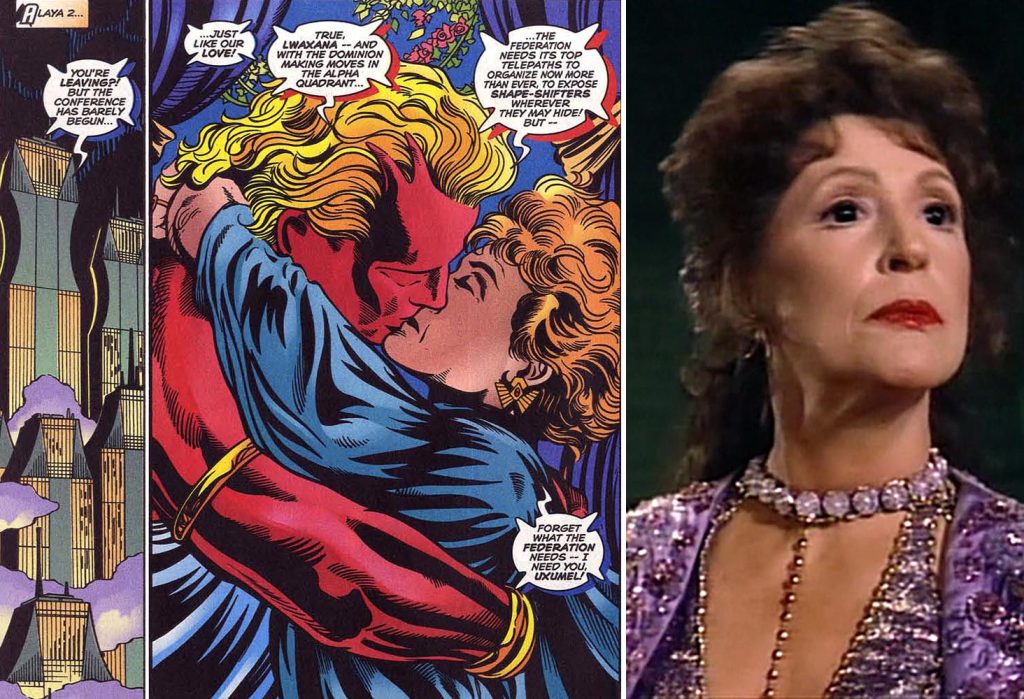
A notable episode tie-in is provided in the comic’s B-plot, in which Lwaxana Troi attends a telepath conference and becomes romantically involved with a man named Uxumel, because of course she does. This is Lwaxana Troi we’re talking about. If a character is male and has a pulse, she marries him. Ms. Troi’s love stories rarely end well, however, and by issue’s end Uxumel takes his own life after being stricken with the meme virus, which renders his entire population deaf, mute, and blind. Even by her standards, that’s grim. Never date Lwaxana Troi, folks. Nothing good can come of it.
Marvel’s final one-shot (though not its final issue, which was Voyager: Splashdown #4) was a Next Generation special titled Riker: The Enemy of My Enemy, from Abnett and Edginton, with art by Andrew Currie and Art Nichols. The comic sequelized both The Next Generation‘s “Preemptive Strike,” in which Ro Laren joined the Maquis, and Star Trek III: The Search for Spock, which introduced Christopher Lloyd’s Commander Kruge.
A rogue Klingon House, allied with Ro’s Maquis cell, tries to steal Starfleet’s declassified Project: Genesis files (Star Trek II: The Wrath of Khan), so Will Riker goes undercover to infiltrate the Maquis and retrieve them before the Klingons can use the weapon to reshape planets throughout the galaxy. After a staged court-martial, Riker seeks out Ro and gains her trust in order to expose the plot. Though his defection is a ruse, she’s glad to see her shipmate again, and he lets her evade capture when he returns to the Enterprise.
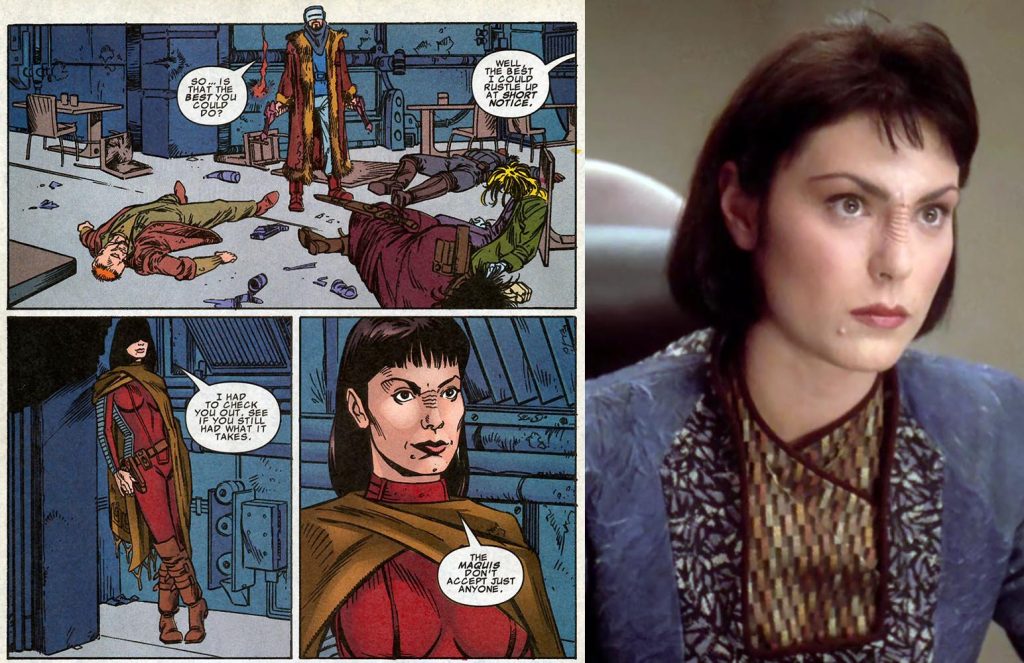
Riker’s cover story riffs on Deep Space Nine‘s “Defiant,” in which transporter duplicate Thomas Riker abandons Starfleet to join the Maquis. Will claims Starfleet had refused to let him visit his duplicate in prison, and that he’d thus grown disillusioned with official policies. What’s significant is that Riker later admits his ruse contained elements of truth. Given Star Trek: Picard‘s revelation that Will eventually left Starfleet for an idyllic lifestyle with his Imzadi, there’s a world of storytelling potential there. It’d be fascinating to see a writer explore Riker’s disenchantment.
Surprisingly, the villain in this tale is Commander K’Nera, a Klingon who, in “Heart of Glory,” had been dispatched to arrest the renegades Korris, Konmel, and Kunivas. The reason it’s surprising is that K’Nera was not a villain onscreen—quite the opposite, in fact, as he was presented as a Klingon of honor. But for failing to extradite the renegades, K’Nera had been stripped of his rank, after which he’d allied with the House of Duras in a bid to restore his honor. The deaths of Lursa and B’Etor in Star Trek: Generations had thrown that plan into a spiral, and so he’d desperately sought out the Maquis.
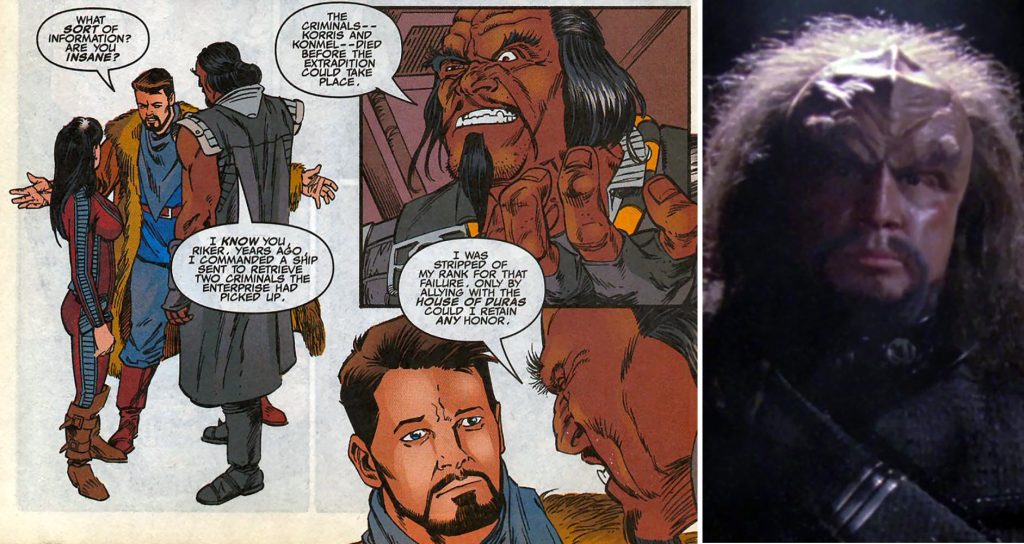
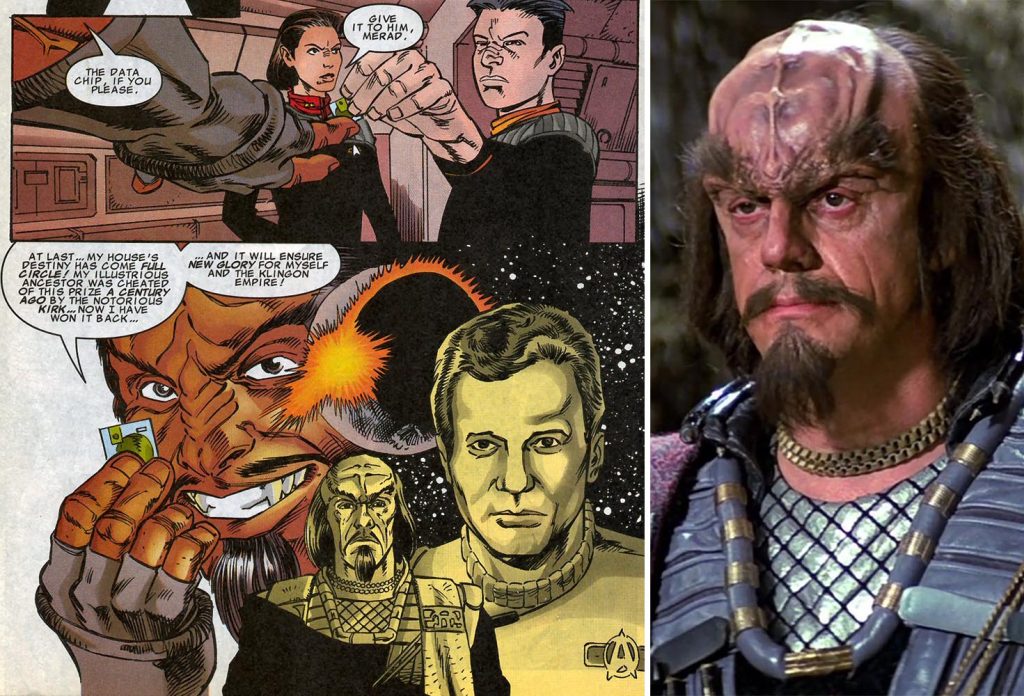
The Star Trek III connection? K’Nera is said to be kin to the House of Kruge, explaining his keen interest in the Genesis files. Some artistic license is employed to make K’Nera look more like Kruge than he did on TV, but hey, that’s how comics work. In the end, K’Nera betrays Ro, proving himself to be as dishonorable as his infamous ancestor. This may come as something of a shock to first-time readers, given his scenes with Worf in “Heart of Glory,” but desperate men can make poor decisions and become villains despite their honorable intentions.
When it comes to Star Trek comics, Marvel was most definitely not a villain. In the course of its two tenures, the publisher added 113 comics to the Trek library. Some might dismiss two brief runs, each canceled after only two years, as a failed venture, but 113 issues is no small legacy. In fact, that puts Marvel in a respectable fourth place behind IDW, DC, and the British strips—and unlike the U.K. stories, Marvel’s output was extremely enjoyable. Next week, this column will enter the 21st-century publishing space as WildStorm charts its own 23rd– and 24th-century adventures on the final frontier.
Looking for more information about Star Trek comics? Check out these resources:
- My ongoing column for Titan Books’ Star Trek Explorer magazine
- The Complete Star Trek Comics Index, curated by yours truly
- The Star Trek Comics Checklist, by Mark Martinez
- The Wixiban Star Trek Collectables Portal, by Colin Merry
- New Life and New Civilizations: Exploring Star Trek Comics, by Joseph F. Berenato (Sequart, 2014)
- Star Trek: A Comics History, by Alan J. Porter (Hermes Press, 2009)
- The Star Trek Comics Weekly page on Facebook
Rich Handley has written, co-written, co-edited, or contributed to dozens of books, both fiction and non-fiction, about Planet of the Apes, Watchmen, Back to the Future, Star Trek, Star Wars, Battlestar Galactica, Hellblazer, Swamp Thing, Stargate, Dark Shadows, The X-Files, Twin Peaks, Red Dwarf, Blade Runner, Doctor Who, Buffy the Vampire Slayer, Batman, the Joker, classic monsters, and more. He has also been a magazine writer and editor for nearly three decades. Rich edited Eaglemoss’s Star Trek Graphic Novel Collection, and he currently writes articles for Titan’s Star Trek Explorer magazine, as well as books for an as-yet-unannounced role-playing game. Learn more about Rich and his work at richhandley.com.
2 thoughts on “Star Trek Comics Weekly #66”
Comments are closed.