
An ongoing discussion of how the comics provide prequels, sequels, and tie-ins to the Star Trek episodes and films, soon to be a book from BearManor Media. Click here to view an archive of this article series.
102: IDW Publishing and Morgan Gendel, 2012–2013
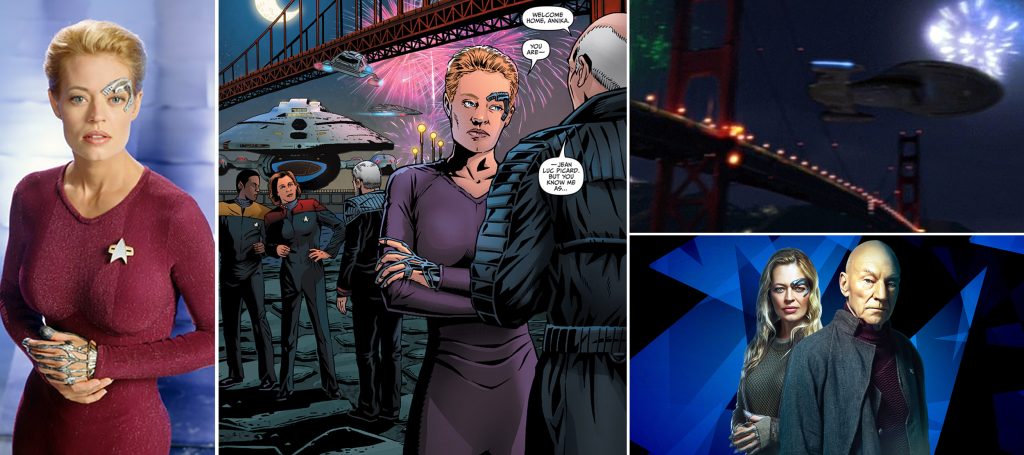
In Star Trek: Picard’s first season, The Next Generation’s Jean-Luc Picard was teamed up with Voyager’s Annika Hansen (Seven of Nine) to save the galaxy from an ominous threat. The experience was a nightmare for them both, as the two former drones (dubbed “xBs” on that show) revisited the horrors of assimilation aboard a Borg cube, culminating in Seven connecting once more with a Collective hive-mind.
Many hailed the pairing as a highlight of Picard’s debut season, but for comics fans the plot was familiar, for a very similar story had been told in IDW’s 2012 miniseries Hive—and, weirdly enough, one of its creators would go on to become the executive producer and showrunner of Picard’s second and third seasons. Picard’s Terry Matalas cowrote Hive with Travis Fickett, and the comic was exquisitely drawn by Joe Corroney and Matt and Shawn Fillbach, with Corroney and David Messina turning in striking cover art. The four-part miniseries, celebrating The Next Generation’s 25th anniversary, was based on a story by Brannon Braga.
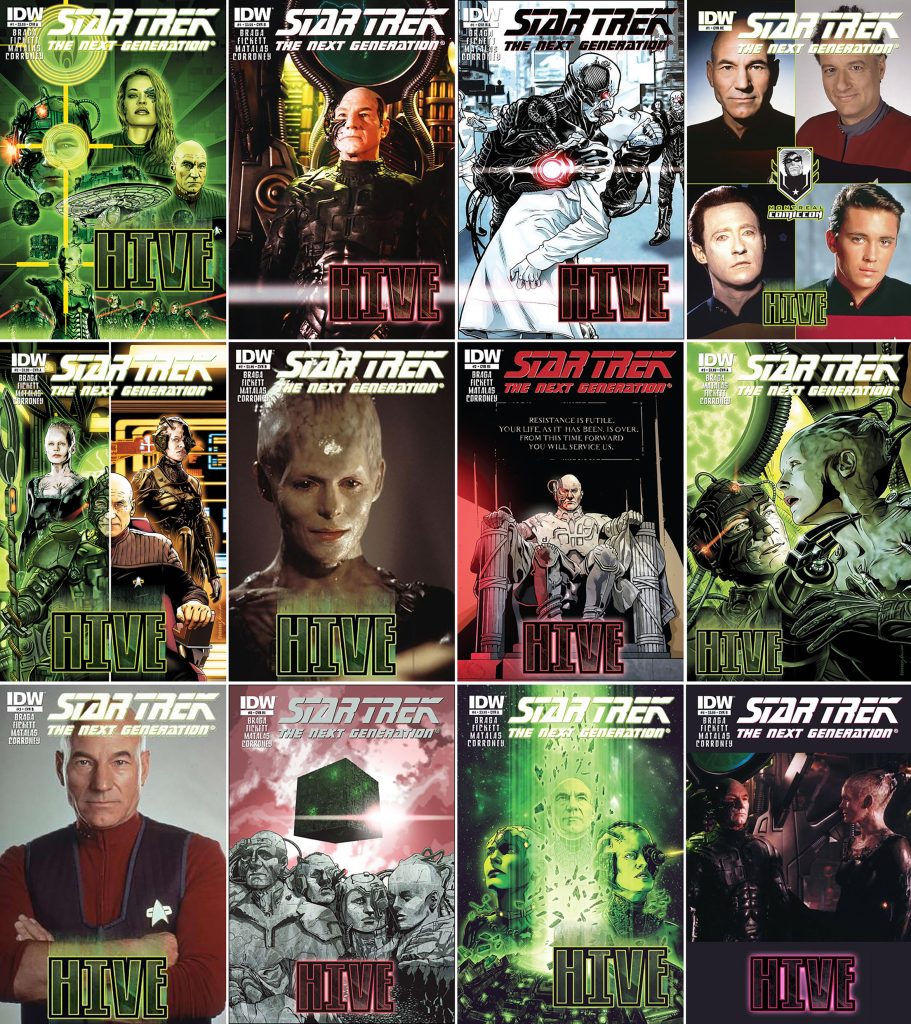
Braga had been a writer and producer on The Next Generation, Voyager, and Enterprise, as well as the feature films Star Trek: Generations and Star Trek: First Contact, so he was well-versed in the Borg Collective. IDW asked him to come up with a storyline since he’d conceived many of Voyager’s Borg-centric episodes. As he explained to StarTrek.com in 2012, he’d had the idea in his mind for years, as he’d hoped to present “the final chapter in the Borg saga.” And he did… though in the end, it wasn’t.
The Borg Queen seeks Picard’s help in stopping the Voldranaii, an inter-dimensional species from “a chaos realm.” The Collective had failed to assimilate the Lovecraftian demon-like aliens, she claims, and now they’re hellbent on killing all life in this universe. This is just a lie, however—the first step of another attempt to assimilate the galaxy—for the Borg had engineered the Voldranaii themselves to trick Starfleet into making peace with their longtime adversaries. Perhaps the Queen had read Alan Moore’s Watchmen and decided Ozymandias had the right idea all along.
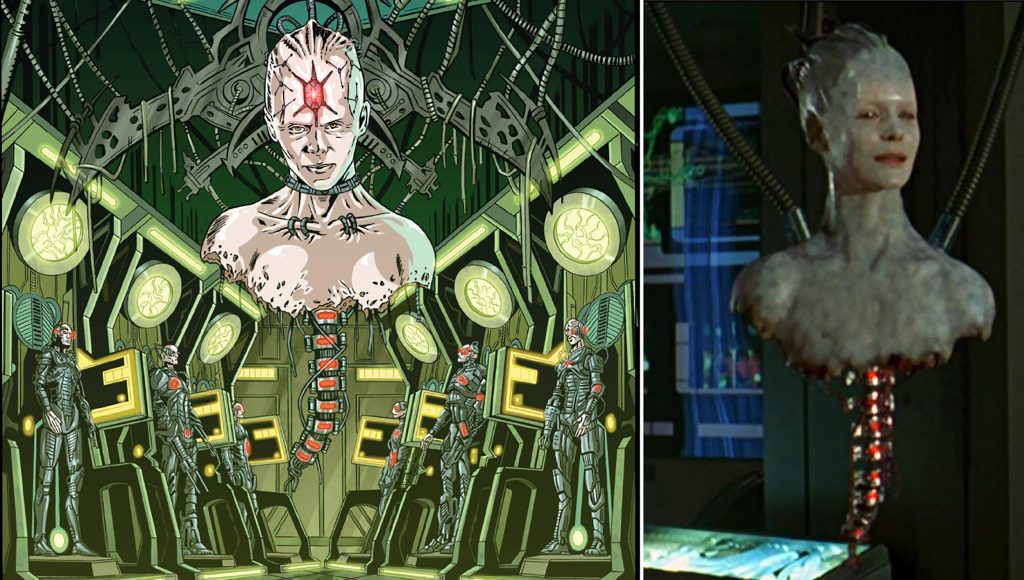
The Queen assigns Seven of Nine as her ambassador to the Enterprise-E. Three years earlier, Picard had met Seven when the USS Voyager had returned home from the Delta Quadrant, and the two had hatched a plot to destroy the Borg from within. This had entailed Annika being voluntarily reassimilated, with a secret implant allowing her to retain her individuality and spy on the Borg undetected. Unbeknownst to them, the Queen had been aware of their scheming and had programmed Seven to transform into an arachnoid sentinel drone and betray her comrades. All of this would be undone by the events of Picard, but it’s an intriguing read, particularly in light of Matalas’s involvement.
As all-out war unfolds, the comic incorporates elements of “Cause and Effect.” With the Borg in pursuit, Picard takes the Enterprise-E into the Typhon Expanse, an unstable region in which the Enterprise-D and the USS Bozeman had been caught in a temporal causality loop in that episode. Here, Picard uses the Expanse’s anomalous qualities to his advantage, knowing the Borg will not enter temporally unstable sectors. Starfleet vessels, on the other hand, seem to enter temporally unstable sectors all the time, and it never ends well. Starfleet should probably pay more attention to how the Borg do things.
Hive’s core premise—a Federation enemy seeking a false alliance to thwart a threat from another realm, only to betray the Enterprise crew at a crucial moment—is nothing new. This same concept had been utilized in Star Trek/Doctor Who: Assimilation², published only a few months earlier, with the Borg requesting help in defeating the Cybermen, then breaking the truce once the crisis passed. The idea had even played out in Voyager’s “Scorpion” with the Borg and Species 8472. You’d think the Borg would realize this trick never works… or that Starfleet would at least see it coming.

Picard is eventually reassimilated as well, then spends five centuries as Locutus, his Borg alter-ego from “The Best of Both Worlds.” But after assimilating pretty much everyone and everything everywhere (not all at once), Locutus decides the Collective, in attempting to attain perfection, have failed in their mission, for despite their galactic domination, their existence lacks meaning. Therefore, he reactivates Data, using the android’s matrix that was copied into B-4’s positronic brain (Star Trek: Insurrection), and together they harness time travel to alter history, kill the Queen, and prevent any of it from happening.
How does Picard accomplish this? Well, the Borg had assimilated the Daystrom Institute, giving Locutus access to B-4’s brain. Unfortunately, this poses a continuity snafu in hindsight, thanks to Star Trek: Picard. As revealed in “Remembrance,” the attempted upload of Data’s consciousness to B-4’s brain failed, rendering the android’s reactivation impossible. Still, the writers accurately predicted B-4’s storage at the Daystrom Institute, where Picard saw Bruce Maddox and Agnes Jurati studying the prototype’s disassembled form. That’s impressive.

In bookend sequences, Picard is reunited with Vash, his lover from “Captain’s Holiday,” who takes shore leave with him on Rigel III. That world, in “All Good Things…,” had been the home of Geordi La Forge and wife Leah Brahms in a potential future. (More on them in a moment.) A Picard-Vash lovemaking session is interrupted when Jean-Luc senses the Borg Queen reaching out to his mind—Picard still hears the Collective despite having been freed from enslavement, per First Contact—but he sees her again in the final chapter… at Seven of Nine’s funeral.

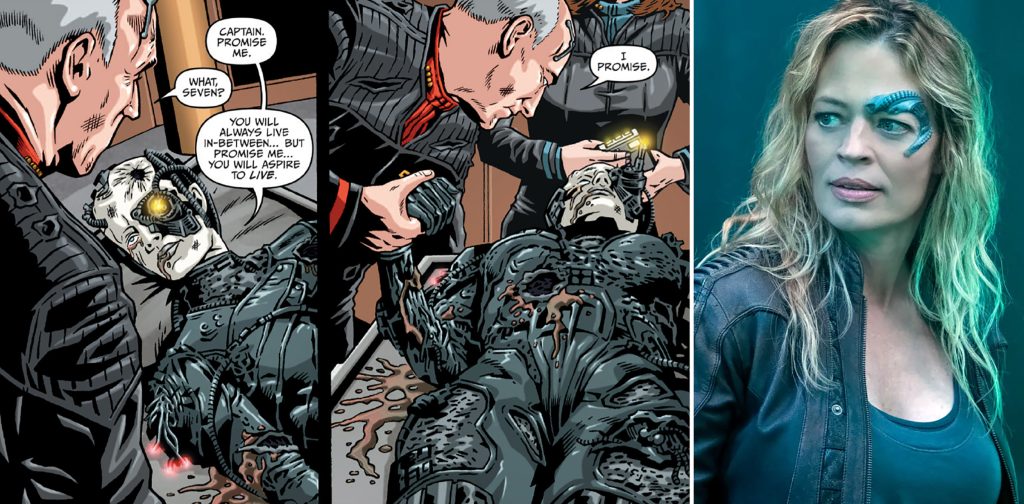
In fact, Seven dies twice in Hive. In the 24th century, she and Picard enter the Queen’s cube to introduce a weaponized nano-virus created by Locutus, capable of infecting the entire hive. The plan works, and as the Borg die throughout the galaxy, Seven protects Picard’s mind and frees thousands of drones. She sadly perishes, but the surviving drones build a colony of their own and revere the memory of their savior.
She also dies in the aborted 29th century, by which point Seven has spent five centuries serving the Collective; in order to destroy the Queen, Data and Locutus must first assassinate her sentinel. That death is negated by her earlier demise thanks to time travel, but it’s all moot considering her status as a living, breathing Fenris Ranger on Star Trek: Picard. Between the B-4 and Seven of Nine plots, the TV show has rendered Hive apocryphal, just as it did with Star Trek: Countdown. Plus, the Borg still exist by the time of Picard. We can still enjoy both comics, but they no longer jibe with canon.
There’s a subplot running through Hive involving Lieutenant Kira Archer, presumably a descendant of Star Trek: Enterprise’s Jonathan Archer, though that’s not explicitly stated. Having lost a brother to the Borg, Kira (presumably not a relative of Deep Space Nine’s Kira Nerys) holds a grudge against the Collective so strong that she refuses to accept the idea of working with them, and she advocates for executing the reassimilated Seven. For this, the lieutenant is treated like a rogue officer, but it turns out she’s correct.

Around the same time Hive hit stands, another comic provided a sequel to one of The Next Generation’s most beloved episodes: ”The Inner Light,” in which Picard lived out the memories of a dead civilization. The comic was scripted by the same writer as the episode, and like Hive, it involved Picard’s mind having been plugged into a computer network. Due to the rave reviews the episode received, writer Morgan Gendel pitched a sequel script appropriately titled “The Outer Light,” which was never filmed.
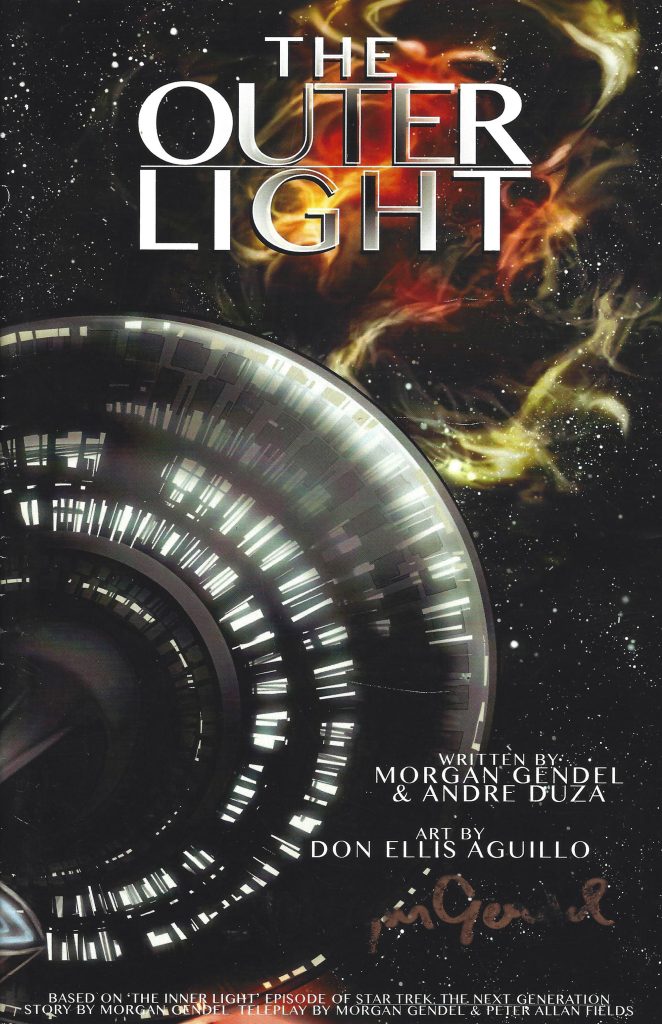
Twenty years later, Gendel teamed up with fellow scribe Andre Duza and artist Don Ellis Aguillo to turn his teleplay into an unlicensed comic. Gendel first approached Neill Brengettsey to create artwork for what was to be a graphic novel, then he hired Aguillo instead and changed the format. The Outer Light was announced as an eleven-part webcomic to be serialized at TrekMovie.com, but only a few chapters appeared there before the comic was taken down following negative feedback from fans.
The screenwriter published the full story as a printed and autographed one-shot, which he sold for a time at science-fiction conventions and via mail. Regrettably, Aguillo was not quite up to the task of illustrating The Outer Light. He’s undeniably talented, with a penchant for drawing technology, but his character depictions often failed to resemble the actors, and his renderings of Picard and Eline, in particular, were rather distorted. His Picard, in fact, looked like Eric Menyuk’s character the Traveler.
The premise: Following his experience on Kataan, Picard mourns Eline and Meribor, the wife and daughter he’d known while living thirty simulated years as a man named Kamin. He’s understandably in shock when the Enterprise finds a thousand-year-old Kataanian compound housing scientists from Kamin’s era, including the real Eline and her actual husband, Lumien. Both Meribor and Kamin were fictional constructs, created by the nucleonic mind-lock with which he’d interfaced in the episode, so there’s no father-daughter reunion. After a millennium in hypersleep, the survivors are now dying, and they spend their time reliving memories of Kataan via nucleonic tech.
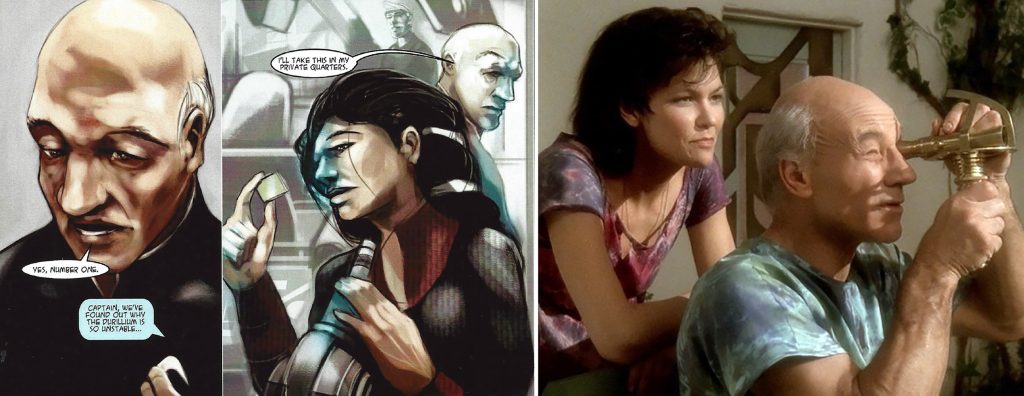
Picard and Eline enjoy a brief romance despite her marriage, then she dies in his arms as he tearfully plays his flute. The plot thus echoes the Geordi-Leah relationship in “Booby Trap,” “Galaxy’s Child,” and “All Good Things…” (other than the tragic ending): a man falls for the simulation of a woman he’s not met, the man meets the woman in person and learns she’s married, and the man and woman end up together. Eline’s parting gift is a mind-lock unit of his own, which lets him imagine her alive in his bed at night. It may sound creepy, but it’s actually kind of romantic… and, well, yeah, creepy.
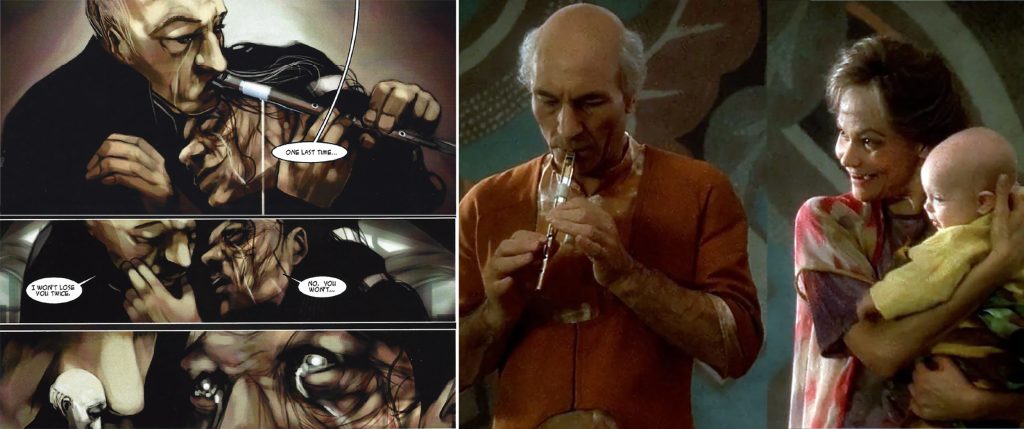
Here is some of Neill Brengettsey’s original artwork, which was far superior to what Don Ellis Aguillo did. My thanks to Andre Duza for sending this to me.

By this point, the IDW run had caught up with the theatrical release of Star Trek Into Darkness. Next week’s column will consider how the publisher presaged the film with Countdown to Darkness, then revealed the aftermath in a story arc of its ongoing comic, aptly titled After Darkness. See you then, darkly.
Looking for more information about Star Trek comics? Check out these resources:
- My ongoing column for Titan Books’ Star Trek Explorer magazine
- The Complete Star Trek Comics Index, curated by yours truly
- The Star Trek Comics Checklist, by Mark Martinez
- The Wixiban Star Trek Collectables Portal, by Colin Merry
- New Life and New Civilizations: Exploring Star Trek Comics, by Joseph F. Berenato (Sequart, 2014)
- Star Trek: A Comics History, by Alan J. Porter (Hermes Press, 2009)
- The Star Trek Comics Weekly page on Facebook
Rich Handley has written, co-written, co-edited, or contributed to dozens of books, both fiction and non-fiction, about Planet of the Apes, Watchmen, Back to the Future, Star Trek, Star Wars, Battlestar Galactica, Hellblazer, Swamp Thing, Stargate, Dark Shadows, The X-Files, Twin Peaks, Red Dwarf, Blade Runner, Doctor Who, Buffy the Vampire Slayer, Batman, the Joker, classic monsters, and more. He has also been a magazine writer and editor for nearly three decades. Rich edited Eaglemoss’s Star Trek Graphic Novel Collection, and he currently writes articles for Titan’s Star Trek Explorer magazine, as well as books for an as-yet-unannounced role-playing game. Learn more about Rich and his work at richhandley.com.
One thought on “Star Trek Comics Weekly #102”
Comments are closed.