
An ongoing discussion of how the comics provide prequels, sequels, and tie-ins to the Star Trek episodes and films, soon to be a book from BearManor Media. Click here to view an archive of this article series.
138: IDW Publishing, 2019
Crossovers were quite common for a time at IDW, pairing Star Trek with Zombies Vs. Robots, CVO: Covert Vampiric Operations, Legion of Super-Heroes, Doctor Who, Planet of the Apes, Green Lantern, and Transformers. Marvel had previously matched up Trek with The X-Men, Pocket Books had published a Here Come the Brides crossover, and Gold Key had covertly teamed Trek with Star-Spangled War Stories.
There have also been multiple in-universe crossovers. DC Comics had James T. Kirk’s TV-era crew meet their film-era selves, and also added The Animated Series‘ characters to the lineup. DC’s The Modala Imperative crossed over The Original Series with The Next Generation; DC and Malibu created a multi-company, multi-show crossover with Deep Space Nine/The Next Generation (collected as The Landmark Crossover); and WildStorm produced a second TNG/DS9 crossover titled Divided We Fall. Meanwhile, Marvel’s Telepathy War epic brought together every cast from The Original Series to Voyager, along with the cadets from Marvel’s Starfleet Academy line.

IDW has offered multiple in-universe crossovers as well, starting with the Kelvin reality’s James Kirk and his crew meeting the Deep Space Nine cast in “The Q Gambit” (Star Trek #35–40). Since then, the company has provided other multi-show crossovers with Flesh and Stone, The Q Conflict, and the Day of Blood saga, which recently played out in the pages of both Star Trek and Star Trek: Defiant, featuring characters from The Original Series, The Next Generation, Deep Space Nine, Voyager, Enterprise, Discovery, Lower Decks, Strange New Worlds, and the films.
In an upcoming issue of Titan Books’ Star Trek Explorer magazine, I’ll be discussing all of the above in great depth, so stay tuned. But for the purpose of this installment of Star Trek Comics Weekly, let’s delve into how The Q Conflict offered a plethora of episode sequels, prequels, and tie-ins. Written by Scott and David Tipton, the six-part miniseries was illustrated by David Messina and Elisabetta D’Amico, with Messina, George Caltsoudas, and James Kenneth Woodward providing covers.

The comic cleverly combined the crews of Jim Kirk, Jean-Luc Picard, Kathryn Janeway, and Benjamin Sisko in a sprawling sequel to the classic episodes “Arena,” “The Squire of Gothos,” and “Errand of Mercy,” as well as Q’s appearances on The Next Generation and other series. It featured amusing interactions between characters who might otherwise not have met, such as Pavel Chekov and Captain Janeway, though the limited page count often minimized such exchanges to a panel or two. One poignant moment tied in with Deep Space Nine‘s “Tears of the Prophets,” with Worf working alongside a younger Jadzia Dax from before her death. The Klingon finds being around her again difficult, for she has no knowledge of their time together, nor of the tragic fate awaiting her.
Jonathan Archer’s crew from Star Trek: Enterprise are nowhere to be seen, and also absent are Arex and M’Ress from The Animated Series, as well as Saavik and others from the movies. But it’s just as well, for even with the four starship crews, many of the characters receive precious little screentime. Had Archer’s officers, M’Ress, Arex, and Saavik been added to the mix, the comic might have become too claustrophobic.

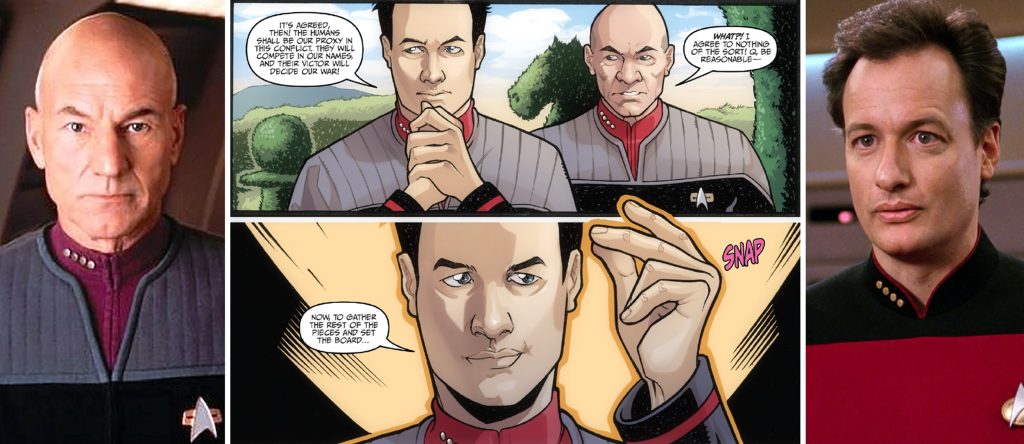
The story opens with several stars suddenly going supernova, but then Cestus III’s sun returns to normalcy. It’s a mystery defying the laws of physics, caused by the Q Continuum waging war on the Metrons (“Arena”), the Organians (“Errand of Mercy”), and Trelane’s people (“The Squire of Gothos”), whom the Q view as inferior upstarts in need of a smackdown. When the cosmic conflict threatens the fabric of the universe, Q conscripts Kirk, Picard, Sisko, Janeway, and their crews to act as the gods’ proxies in a grandiose tournament.
Some licensed tales have depicted Trelane as one of the Q, though here they represent separate breeds of omnipotence. The licensees and authors have been inconsistent on this point, but the comic alludes to their pair-ups in other media by presenting the tricksters as comradely rivals with shared past adventures. Trelane is still an immature, petulant child subject to his parents’ restrictions, as he was in “The Squire of Gothos,” and a cover variant to issue #1 features two beings who might well be those parents.
The Metron from “Arena” represents their species in the conflict, and it would appear this individual’s name is simply “Metron” since that’s how they prefer to be addressed. The above-noted cover variant features other Metrons as archaically clad as the one from the episode. As on TV, the Metron is arrogant and dismissive toward humanity, indicating their opinion of our species has changed little in the century that has passed.
Representing the Organians is Ayelborne, who is just as polite, gracious, and humble as in “Errand of Mercy.” As a being of peace, Ayelborne has no interest in the war or in Q’s antics, and he endearingly apologizes to the Starfleeters when Q intrusively pulls them into the gods’ affairs. The Organians and Metrons want nothing to do with any of this, whereas Q and Trelane revel in the chance for some costume play and theatrics.
Q has been a staple frenemy since his 1987 debut, appearing not only on The Next Generation, but also Deep Space Nine, Voyager, and Lower Decks, as well as throughout the second season of Picard. Actor John de Lancie has emerged as one of Star Trek‘s greatest assets, and the Tiptons put him to good use in The Q Conflict, balancing his typical trickster buffoonery with a privately noble desire to end the war he incited, in order to minimize collateral damage to the universe’s mortal species.

It’s not just the four main gods that appear in The Q Conflict, as the writers deftly work in other powerful beings as well. Deep Space Nine‘s Bajoran Prophets decline to take part in the tournament, so Q goads them into appearing by making the captains compete to get their attention. Kirk wins the round by bringing his starship into the wormhole, which spurs the Prophets to appear as Edith Keeler (“The City on the Edge of Forever”), Gary Mitchell (who became a god himself in “Where No Man Has Gone Before”), and Christopher Pike (Jeffrey Hunter’s version from “The Cage” and “The Menagerie”).

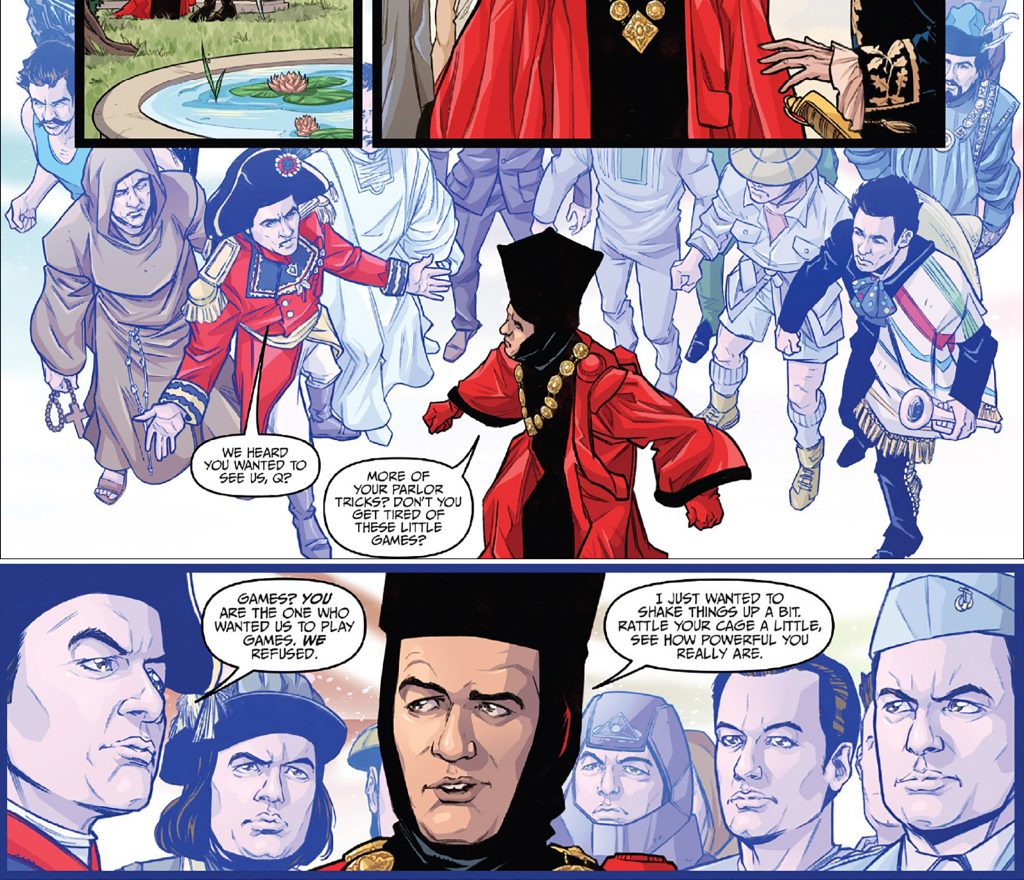
The agitated Prophets treat Kirk with patient understanding, knowing it’s not his fault, but they show Q who’s boss by attacking in the form of Q’s various guises, including a Post-Atomic Horror soldier, a 16th-century sea captain, and a 20th-century U.S. Marine (“Encounter at Farpoint”); a Franciscan monk, a French marshal, and a Soong android (“Hide and Q”); a mortal human and a mariachi musician (“Déjà Q”); a safari explorer and the Sheriff of Nottingham (“Qpid”); a boxer (“Q-Less”); a god of the afterlife (“Tapestry”); and even a Borg, as he appeared in the video game Star Trek: Borg.
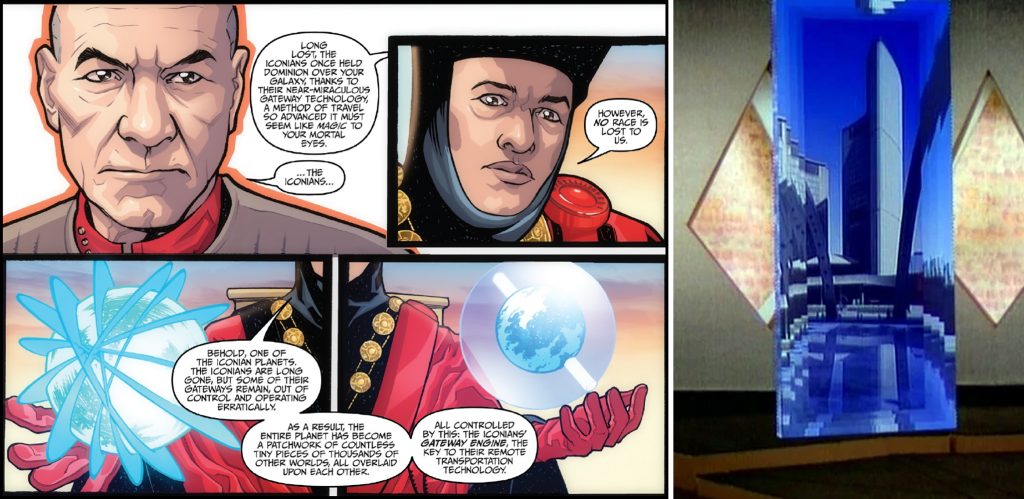
One tournament challenge involves procuring an Iconian gateway engine (“Contagion”) enabling remote transportation to various points in space-time. The malfunctioning device has created a patchwork of pieces from thousands of worlds, however, making its use far too risky. A Planet Killer (“The Doomsday Machine”) also makes an appearance, with the crews destroying the monstrous weapons platform via quantum torpedoes.
Q goes too far when he orders the captains to find an Omega molecule, the most powerful substance known to exist, per Voyager‘s “The Omega Directive.” Recognizing the incalculable danger such a molecule would pose to the galaxy, the officers refuse to comply and move against him. Q’s irresponsibly destructive contest causes a schism in the Continuum, with half the Q supporting the war and the others deeming him reckless.

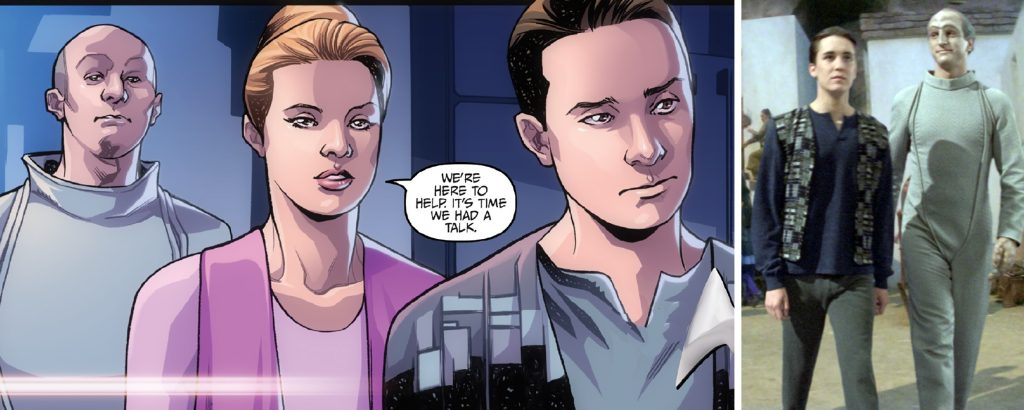
To that end, Q2 (“Déjà Q”) and Amanda Rogers (“True Q”) step in to end the chaos, as do the Traveler and his protégé Wesley Crusher (“Journey’s End”). Q2, it seems, backs Q’s warmongering but objects to foolhardily instigating the wormhole deities. Amanda and Wesley help the officers end the conflict, for which Q strips them of their powers. Human once more, Amanda embarks on a career in the biological sciences, while Wes returns to Starfleet service. This explains his being in the USS Titan‘s crew in a deleted scene from Star Trek: Nemesis, though Picard‘s “Farewell” would reverse that development by having him still be omnipotent two decades later.
The Q Conflict culminates in an amusingly absurd battle inside the Continuum, between the Starfleet crews and an army of alien constructs summoned to battle them. These include Borg, Jem’Hadar, and Breen, as well as Kaylars and Talosians (“The Cage”), salt vampires (“The Man Trap”), mugatos (“A Private Little War”), Melkots (“Spectre of the Gun”), Excalbians (“The Savage Curtain”), Armus creatures (“Skin of Evil”), parasites (“Conspiracy”), and even Q’s own Napoleonic pig-men (“Hide and Q”).
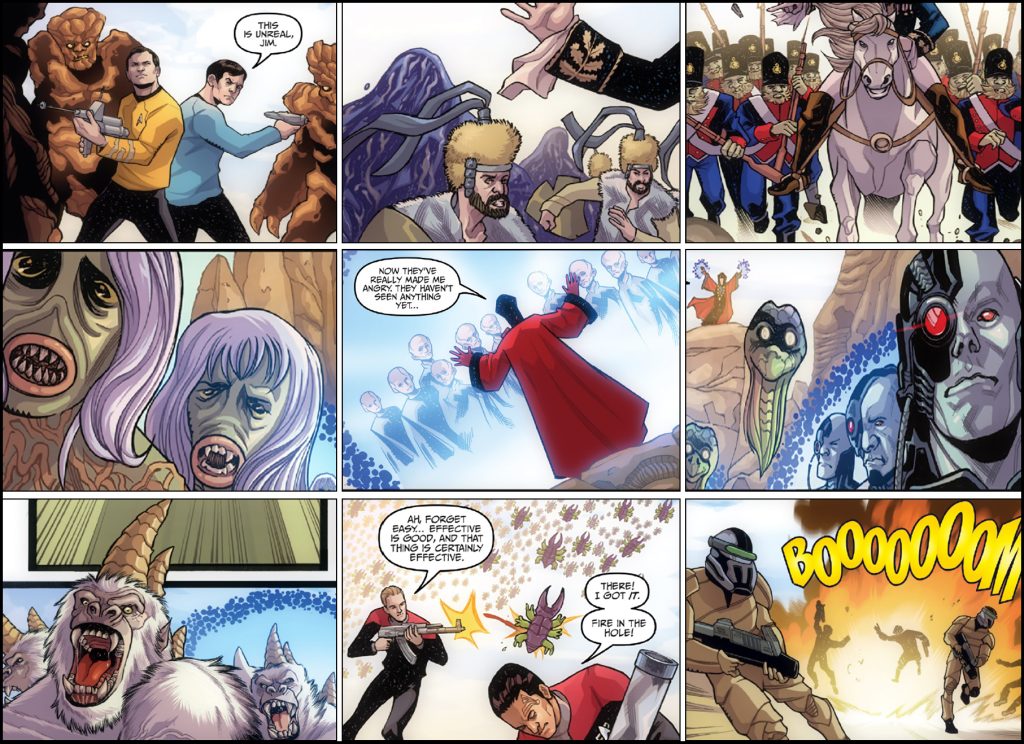
As crossovers go, the miniseries is quite enjoyable, if a bit over the top. The Tiptons nail the characterizations of the four gods, as well as the main characters, and they include a healthy dose of well-placed humor. They even poke fun at the gimmicky nature of their own story, with Quark complaining about being chosen despite not being in Starfleet—neatly beating online haters to the punch. The comic glosses over how this will affect history since characters remember future events, but it succeeds in what it sets out to do.
Retroactively, The Q Conflict presages the “Godshock” storyline from IDW’s recent crossover, which shares some similarities with its premise. We’ll get to that eventually, but in the meantime we’ll examine Star Trek: Year Five. That title was replete with prequels, sequels, and tie-ins, so you won’t want to miss it.
Looking for more information about Star Trek comics? Check out these resources:
- My ongoing column for Titan Books’ Star Trek Explorer magazine
- The Complete Star Trek Comics Index, curated by yours truly
- The Star Trek Comics Checklist, by Mark Martinez
- The Wixiban Star Trek Collectables Portal, by Colin Merry
- New Life and New Civilizations: Exploring Star Trek Comics, by Joseph F. Berenato (Sequart, 2014)
- Star Trek: A Comics History, by Alan J. Porter (Hermes Press, 2009)
- The Star Trek Comics Weekly page on Facebook
Rich Handley has written, co-written, co-edited, or contributed to dozens of books, both fiction and non-fiction, about Planet of the Apes, Watchmen, Back to the Future, Star Trek, Star Wars, Battlestar Galactica, Hellblazer, Swamp Thing, Stargate, Dark Shadows, The X-Files, Twin Peaks, Red Dwarf, Blade Runner, Doctor Who, Buffy the Vampire Slayer, Batman, the Joker, classic monsters, and more. He has also been a magazine writer and editor for nearly three decades. Rich edited Eaglemoss’s Star Trek Graphic Novel Collection, and he currently writes articles for Titan’s Star Trek Explorer magazine, as well as books for an as-yet-unannounced role-playing game. Learn more about Rich and his work at richhandley.com.
3 thoughts on “Star Trek Comics Weekly #138”
Comments are closed.