An ongoing discussion of how comics provide prequels, sequels, and tie-ins to Star Trek episodes and films. Read the past installments.
Crossovers occupy an odd corner of the comic-book genre. Properties owned by one company are matched up with those of another, or with other properties owned by the same company, enabling characters to meet who would unlikely otherwise interact. Imagine James Bond smuggling spice with Chewbacca, or Rick Grimes battling Thanos alongside Wanda Maximoff, or Winnie the Pooh solving crimes and eating honey with Sherlock Holmes. Now imagine how difficult it would be to make such stories readable.
In the late 1970s and early ’80s, DC Comics and Marvel Comics co-published crossovers teaming up Superman and Spider-Man, Batman and the Hulk, and even Superman and He-Man. The 1990s added to the mix Alien vs. Predator, Ape Nation (combining Planet of the Apes and Alien Nation), Batman/Judge Dredd, and even The Punisher Meets Archie, along with the Amalgam Comics shared-universe imprint from Marvel and DC. Comics have since been awash with crossovers, including several involving Star Trek.
In-Universe Comic Crossovers
Multiple publishers have produced in-universe crossovers, with the casts of one Star Trek show meeting those from another. Some might cite DC’s Star Trek #33 (1986) as the first example, since it propelled James T. Kirk’s crew from The Original Series two decades into their own future to encounter their older film-era selves in maroon. However, that involved only a single crew and thus wouldn’t truly fit the bill.
It’s also tempting to claim the first was Power Records’ Passage to Moauv (1975), which featured The Animated Series‘ M’Ress, but since she was drawn as a blue-skinned humanoid instead of a cat, and since Arex was visibly replaced with a human, that wouldn’t count either. A decade later, DC Comics’ Star Trek #37 finally added Arex and M’Ress to the comics, though that’s probably cheating anyway since the 1970s cartoon was merely a continuation of the 1960s show.
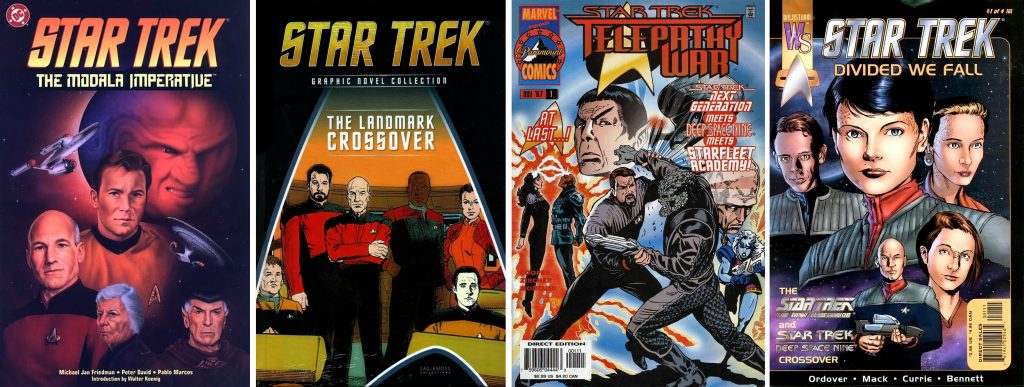
DC published The Modala Imperative in 1991, establishing the first bona fide Star Trek comics crossover. The miniseries comprised two connected arcs, one based on The Original Series, the other on The Next Generation. The story, which revolved around a Ferengi scheme in two centuries, featured Spock and Leonard McCoy in both eras. In 1995, the publisher’s sixth annuals for Star Trek and Star Trek: The Next Generation crossed over those two crews, and that same year DC and Malibu Comics produced the first multi-company multi-show crossover miniseries, Deep Space Nine/The Next Generation, later collected as The Landmark Crossover.
Three years later, Marvel launched its epic “Telepathy War” storyline, a six-part arc leveraging the casts of The Next Generation, Deep Space Nine, and Voyager, as well as Marvel’s original Starfleet Academy series, with tie-ins to Christopher Pike’s tenure as depicted in Star Trek‘s pilot, “The Cage.” Then, in 2001, WildStorm’s Star Trek: Divided We Fall again paired Deep Space Nine with The Next Generation.
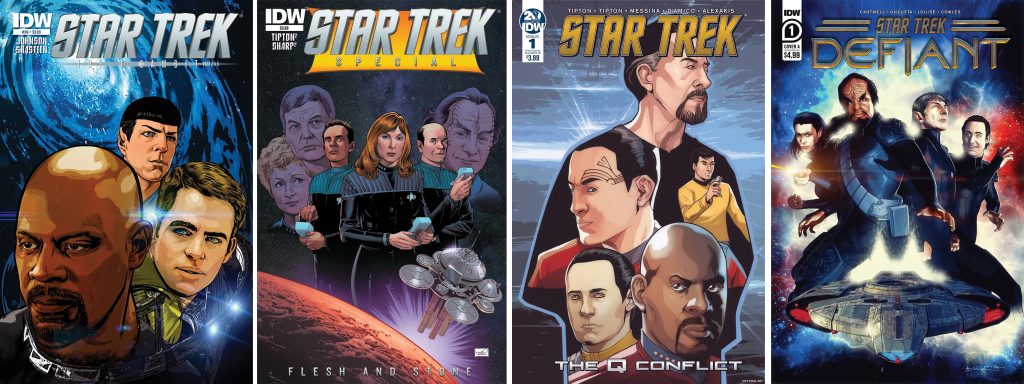
The year 2014 saw the release of IDW’s first multi-show crossover, when Kirk’s officers teamed up with the Deep Space Nine cast in the Kelvin timeline, in the six-part “The Q Gambit” (Star Trek #35–40). A week after that storyline began, the one-shot Flesh and Stone brought together the chief medical officers of every show from The Original Series to Enterprise, resulting in IDW’s first franchise-wide team-up. The publisher next produced The Q Conflict in 2019, which mixed and matched Kirk’s crew with those of Jean-Luc Picard, Kathryn Janeway, and Benjamin Sisko.
Most recently, IDW launched a pair of ongoing sister titles, Star Trek and Star Trek: Defiant, culminating in the Day of Blood and Lore War crossover events and the spinoff miniseries Sons of Star Trek. This sweeping saga has featured a wide array of characters (or their descendants) from The Original Series, The Next Generation, Deep Space Nine, Voyager, Enterprise, Discovery, Lower Decks, Strange New Worlds, and the theatrical films, making it Trek‘s largest-scope comics crossover to date. In addition, several anthology comics have presented stories starring multiple casts: WildStorm’s Star Trek Special and IDW’s Star Trek Waypoint.
A Novel Approach to Crossovers
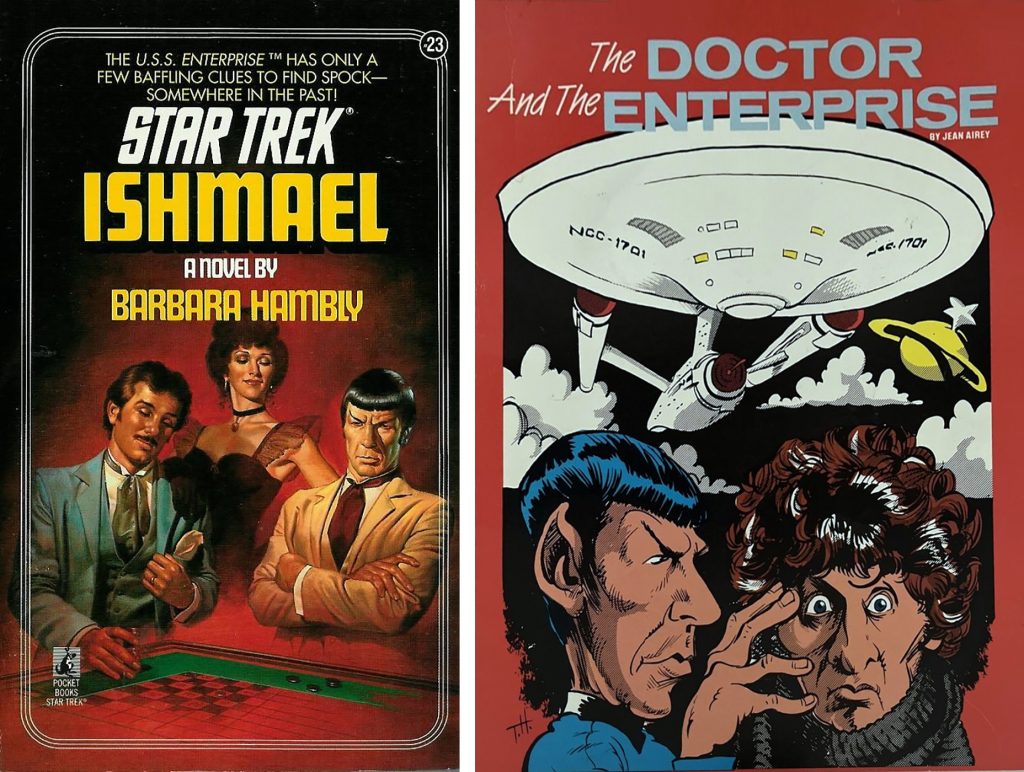
The above crossovers all took place entirely within the Star Trek mythos, but an even larger set of stories have paired up Star Trek with other franchises. Pocket Books’ 1985 novel Ishmael, by Barbara Hambly, combined Star Trek with ABC-TV’s 1960s comedy Western Here Come the Brides, a clever in-joke since the latter starred Mark “Sarek” Lenard, alongside Robert Brown (Lazarus from “The Alternative Factor”) and David Soul (Makora from “The Apple”). The novel involved a Klingon plot to alter history by assassinating Lenard’s Brides character Aaron Stemple, later revealed to be an ancestor of Spock’s mother, Amanda Grayson. That amusing twist meant Amanda’s husband was a dead-ringer for her blood relative.
In addition to Here Come the Brides, the book also featured characters from the BBC’s Doctor Who; Western classics Have Gun Will Travel (for which Gene Roddenberry wrote scripts), Bonanza, Maverick, Rawhide, The Rifleman, Gunsmoke, and Clint Eastwood’s “Man With No Name” films; and even Star Wars and Battlestar Galactica, in the form of unnamed cameos by Han Solo, Apollo, and Starbuck.
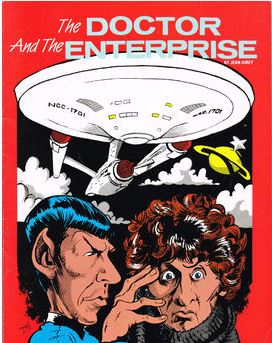
Meanwhile, the unauthorized 1981 novel The Doctor and the Enterprise, from Jean Airey and Pyrodonian Renegades, had Kirk’s crew meet Tom Baker’s Fourth Doctor from Doctor Who. IDW’s Star Trek line has offered a number of multi-franchise crossovers, though it was not the first comics publisher to do so. With that in mind, let’s examine the history of franchise mash-up comics, going all the way back to the early days.
Star Trek Meets Star-Spangled War Stories
Star Trek‘s very first crossover comic, published in 1974, might raise an eyebrow or two. Gold Key’s Star Trek #22, written by Gerry Boudreau, with art by Alberto Giolitti, was not billed as tying in with other works, but it was directly connected to two non-Trek Boudreau tales from DC Comics’ Star-Spangled War Stories: issues #170 (“UFM,” June 1973) and #180 (“Return,” June 1974).
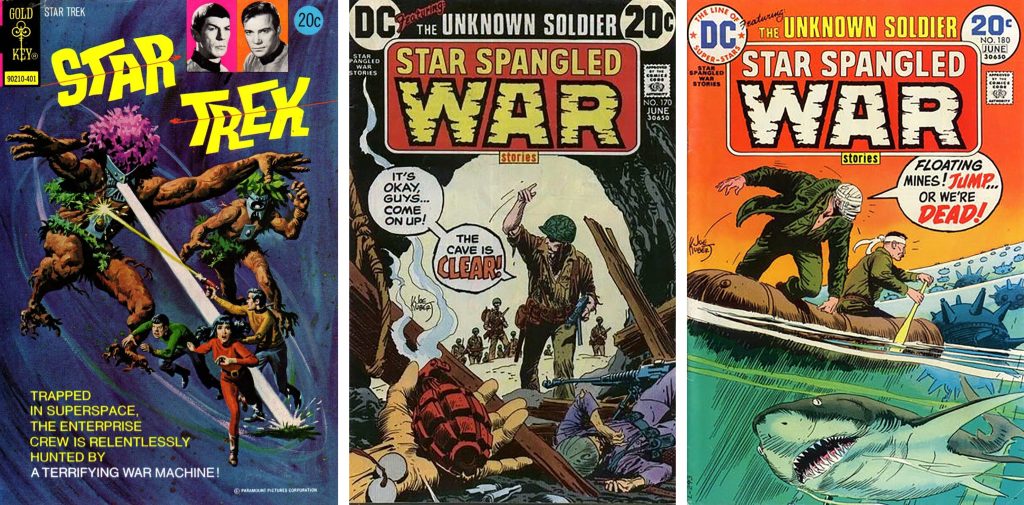
Boudreau penned the Trek chapter for Gold Key as a stealth sequel (that is, one not advertised as such) to the DC stories. The Star Trek tale was the second one published, making that a sequel to War Stories #170, and thus War Stories #180 a prequel to Star Trek #22 since it took place years earlier. In the Gold Key tale, a woman named Rhuna told Kirk about her lover Kyr Nostrand’s past exploits, and that story was then chronicled in War Stories #180. Neither comic mentioned the other, however, explaining how this two-company crossover could have slipped through the cracks unnoticed.
Star Trek (Almost) Meets Superman
During DC’s 1980s Star Trek run, editor Robert Greenberger had hoped to have the Enterprise crew meet Superman. “When I saw the Teenage Mutant Ninja Turtles figures in Star Trek uniforms at Toy Fair,” Greenberger recalls, “I saw the possibilities immediately. DC agreed to let me explore that possibility. Paula Block at Paramount thought it had promise, so she took it to the weekly meeting where all licensing pitches were discussed. She put my idea forth, and some male executive at the other end of the table said, ‘Superman’s not real,’ and I was told the idea could not move forward. As you might imagine, I was disappointed when I saw [Marvel’s] X-Men/Star Trek crossover happen.” Still, the implication was amusing: the executive in question apparently thought both Star Trek and the X-Men were real.
Star Trek Meets Bloom County
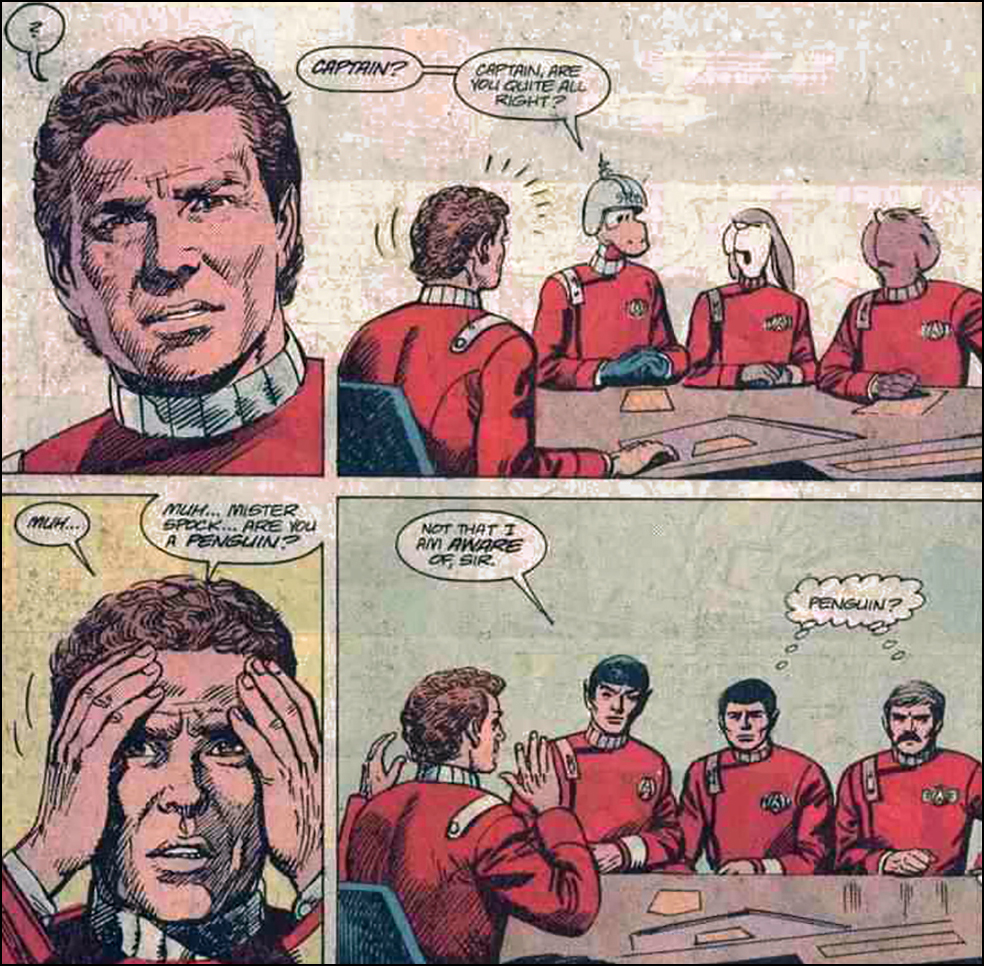
DC’s plans to have the Enterprise crew meet the Man of Steel may have faltered, but the publisher did pull off an unexpected crossover of sorts with Berkeley Breathed’s Bloom County. The daily newspaper strip had often featured Vietnam veteran Cutter John engaging in Star Trek fantasies with his anthropomorphic animal pals. So in DC’s Star Trek #51, writer Peter David returned the favor by having a Star Trek character experience a Bloom County fantasy.
Specifically, David had Jim Kirk hallucinate Spock, Montgomery Scott, and Hikaru Sulu sporting the heads of Bloom County‘s Opus (wearing the Spock helmet from the classic comic strip) and his pals Portnoy and Hodge-Podge, who in Bloom County had accompanied Cutter John in his wheelchair, the Starship Enterpoop. In one of the series’ funniest moments, a visibly shaken Kirk asked, “Mr. Spock… are you a penguin?” Spock’s utterly calm reply: “Not that I am aware of, sir.”
Star Trek Meets Lost in Space (Sort of)
During DC’s second time at bat, Peter David and guest co-writer Bill Mumy presented a thinly disguised crossover between the original Star Trek crew and the cast of Mumy’s Lost in Space. The latter cast’s names were changed from the Robinsons to the Worthy, but it was clear to readers, from the characters’ appearances, the nature of the story, and Mumy’s involvement, who they were meant to be. This three-part tale, published in 1990’s Star Trek #13–15, paid fond homage to Irwin Allen’s silly but lovable Lost in Space, which aired on CBS from 1965 to 1968.
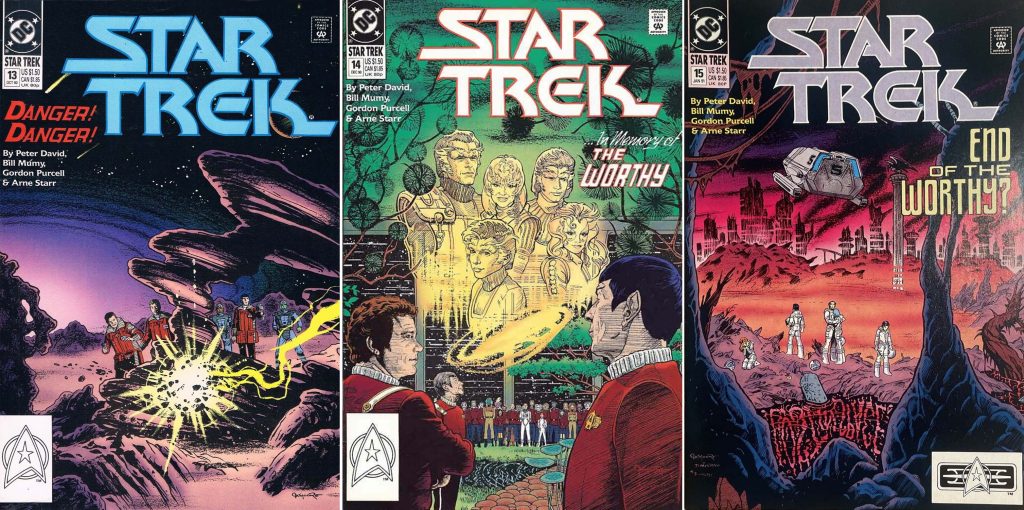
Mumy portrayed Will Robinson on that show, and the titular Worthy were drawn to resemble the Robinsons. The family had a similarly built robot protector and a crashed, saucer-shaped spaceship, and their leader, Catalano, was named after Lost in Space star Guy Williams, born Armand Joseph Catalano. To hammer home the motif, one cover even featured the Lost in Space robot’s frequent warning, “Danger! Danger!” Readers reveled in the sheer lunacy of it, which was typical fare for David’s lauded run, but those in charge of licensing may have found themselves echoing Doctor Smith’s motto, “Oh, the pain… the pain.”
Star Trek Meets X-Men
In 1996, Marvel unveiled Star Trek/X-Men. Written by Scott Lobdell and illustrated by a whopping fifteen artists, the one-shot—appropriately titled Star TreX—featured Kirk’s best friend turned power-hungry god, Gary Mitchell (“Where No Man Has Gone Before”), along with a visit from the X-Men via a psionic energy space rift. The biggest chuckle was provided when Leonard McCoy and the mutant known as Beast (Hank McCoy) simultaneously replied “Yes?” to someone summoning “Dr. McCoy,” a possible hint at what might have inspired the crossover in the first place.
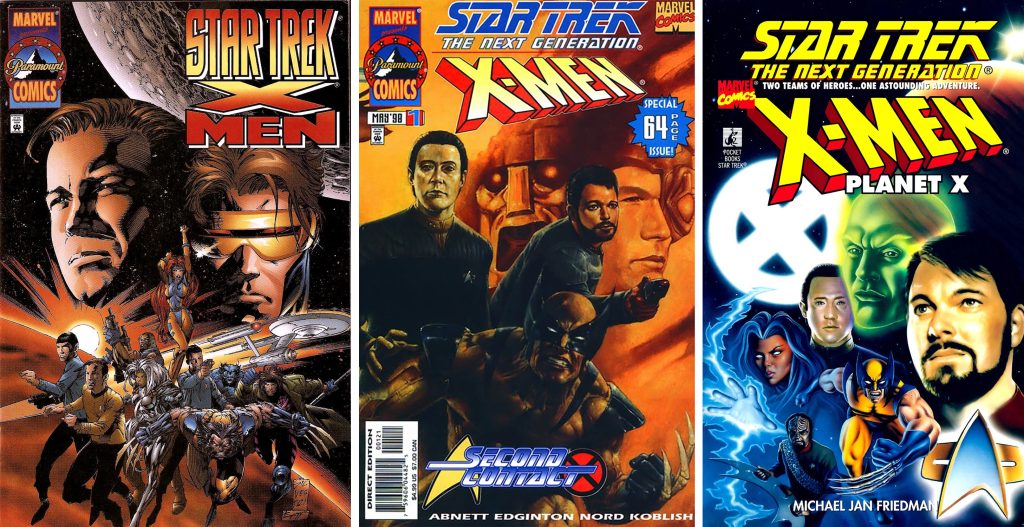
Star Trek: The Next Generation/X-Men—Second Contact followed, written by Dan Abnett and Ian Edginton, with art by Cary Nord and Scott Koblish, after which prolific Trek scribe Michael Jan Friedman’s Pocket novel Planet X completed the trilogy in prose form. The two X-Men comics now reside in licensing limbo, for the expired Marvel contract prevents other publishers from reprinting them. In recent years, that created a stumbling block for Eaglemoss’s Star Trek Graphic Novel Collection, throwing a wrench in the company’s plan to reprint every Star Trek comic ever published (which didn’t happen anyway due to Eaglemoss’s financial problems).
Star Trek Meets the Undead and (Sort of) Transformers
If you thought zombies and the final frontier couldn’t mix, then you’d be wrong, and not just because zombies have appeared in Enterprise‘s “Impulse” and Lower Decks‘ “Second Contact” (no relation to the X-Men crossover). In 2011, IDW kicked off its multi-title crossover Infestation, with the undead infecting several IDW-licensed universes (Star Trek, Transformers, G.I. Joe, and Ghostbusters), the publisher’s own Zombies Vs. Robots and CVO: Covert Vampiric Operations, and Bolt Creative’s Pocket God game.
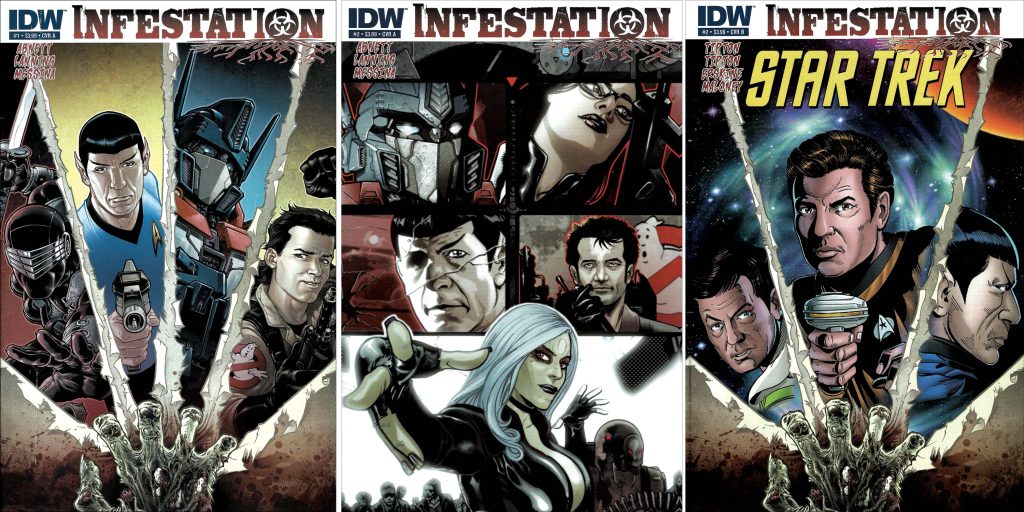
In between bookends by Abnett, Andy Lanning, and David Messina, Infestation comprised separate titles for each franchise, with Star Trek: Infestation spanning two chapters written by Scott and David Tipton, and illustrated by Gary Erskine, Casey Maloney, and Luis Antonio Delgado. Set between the first two Trek films, the story was well written and beautifully drawn, with Kirk’s crew sporting Star Trek: The Motion Picture‘s uniforms. Infestation only partially qualifies as a crossover, though, since the Transformers, Star Trek, Ghostbusters, and G.I. Joe casts never interacted—at least, not in this series. (More on that further down.)
Star Trek Meets Legion of Super-Heroes

That same year, IDW and DC Comics partnered on Star Trek/Legion of Super-Heroes, courtesy of Chris Roberson, Jeffrey and Philip Moy, and Romulo Fajardo Jr. Kirk’s crew encountered DC’s Legionnaires after each group ended up on 23rd-century Earth, but this was not either of their respective Earths. Rather, the comic’s timeline was a new one to both franchises—a novelty when it comes to crossovers, which typically take place in one source reality or the other. As expected, the two teams joined forces to defeat a deadly foe (naturally, or else it wouldn’t be either Star Trek or Legion of Super-Heroes) and repair their erased timelines.
Star Trek (Officially) Meets Doctor Who
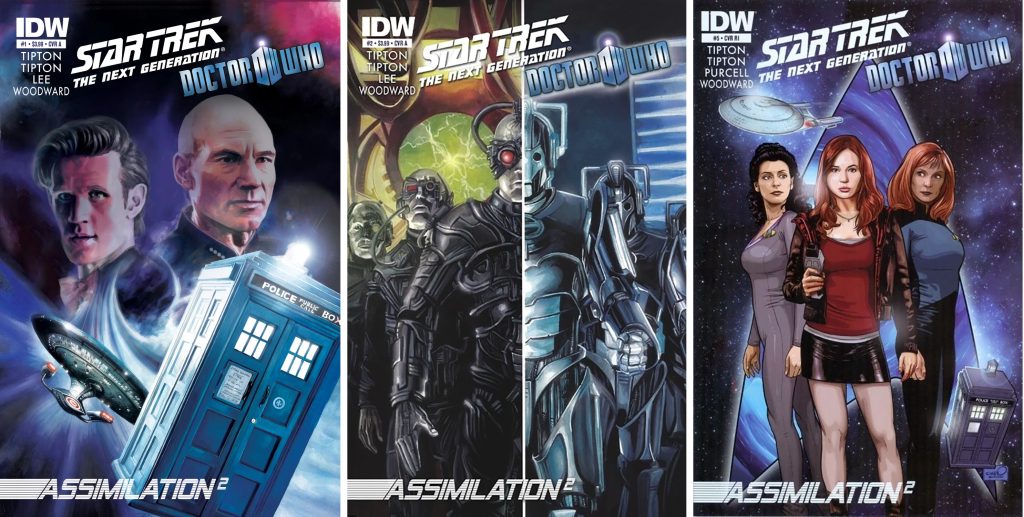
In 2012, the Tiptons teamed up with Tony Lee to pen a story that remains a strong contender for the best Star Trek comic-book crossover to date: a meeting with Matt Smith’s Eleventh Doctor in the eight-issue Star Trek: The Next Generation/Doctor Who: Assimilation2. Not only did the team-up make more sense than other crossovers (both shows are science fiction, and the Enterprise and the TARDIS can both traverse time, space, and multiple realities), but J.K. Woodward’s artwork was simply gorgeous. Add in a deadly alliance between the Borg and the Cybermen, and you have one hell of a ride across two popular franchises.
Star Trek Meets Planet of the Apes
The Tipton brothers have made a name for themselves as Star Trek‘s go-to crossover team, and 2014’s Star Trek/Planet of the Apes: The Primate Directive demonstrated why that’s so. The title’s clever pun was worth the cover price alone, but the Tiptons’ gift at capturing characters’ voices thoroughly sold the concept. Plus, in true Planet of the Apes fashion, there was even an unexpected twist ending.
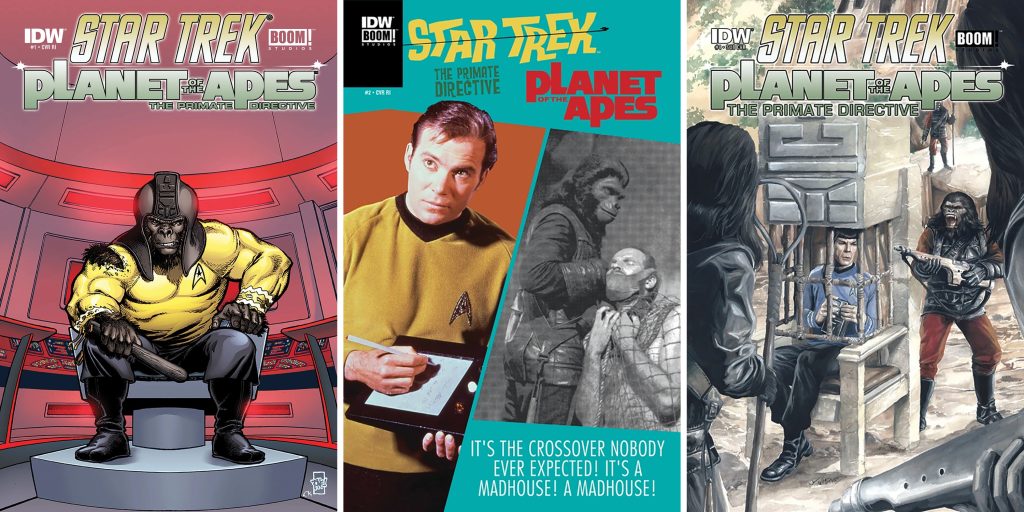
The Primate Directive was more fun than a starship full of monkeys, and not just because this article’s author received a cameo as an injured redshirt. The idea of George Taylor, Nova, Zira, and Cornelius working alongside the Enterprise gang to repel Klingon invaders sounds like something a child of the 1970s might have come up with while playing with Mego action figures, and one cover alluded to this fact by featuring Mego’s Planet of the Apes “Throne” playset.
Star Trek (Unofficially)Meets Doctor Who and Big Bang Theory

Even the most savvy Star Trek comics collectors might have overlooked A Doctor for the Enterprise, from screenwriter David Gerrold and artists Troy Boyle and Jeff Austin, which once again saw the Enterprise crew meeting the Doctor—this time, Jim Kirk’s cast and David Tenant’s Tenth Doctor. Produced by Experimenter Publishing and DG Publishing, this unauthorized comic was published in 2014 at the Amazing Stories website, then was offered in a limited-edition, autographed collector’s print run of 500 copies, courtesy of Florida-based Dolphin Printing.
The company billed A Doctor for the Enterprise as a parody for legal reasons, but it’s really not, and admittedly the main appeal is that it was written by the creator of the tribbles. Though announced in 2013 by Amazing Stories publisher Steve Davidson, back when Assimilation2 was still hitting stands, the comic didn’t come out until two years later due to behind-the-scenes delays. In the end, this retelling of “The Trouble with Tribbles,” with the Doctor and his nemesis the Daleks added to the mix, was revealed to be a dream in the mind of Big Bang Theory‘s Sheldon Cooper. Bazinga!
Star Trek Meets Green Lantern
IDW’s next two crossovers took DC’s Hal Jordan to the Kelvin timeline for Mike Johnson’s Star Trek/Green Lantern: The Spectrum War (2015) and Star Trek/Green Lantern: Stranger Worlds (2016), both illustrated by Angel Hernández. Members of Kirk’s crew, as well as Romulan Praetor Decius (“Balance of Terror”), Klingon General Chang (Star Trek VI: The Undiscovered Country), and the ruler of the Gorn Hegemony (“Arena” and now Strange New Worlds), are chosen by power rings from the DC universe to receive an array of superpowers.
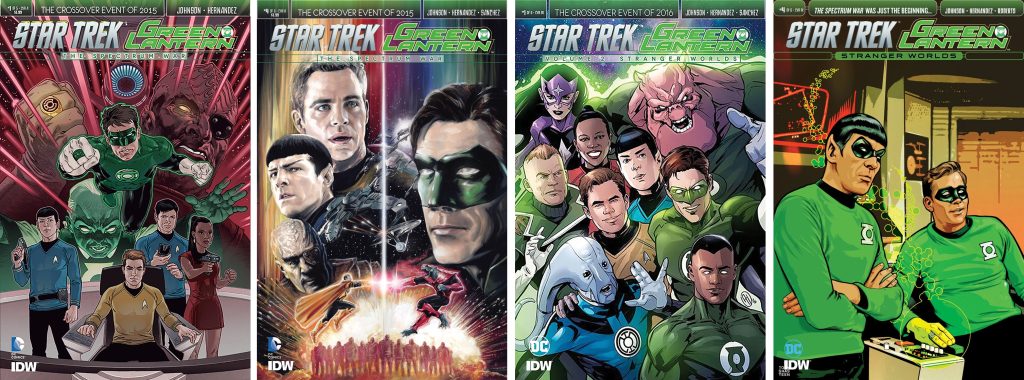
Kirk’s crew portrayed as flying superheroes is rather surreal. Still, of all the stories pairing up Starfleet personnel with the Spandex-clad superhero crowd, the two Green Lantern titles perhaps work the best. This is primarily due to the Lanterns’ mythology being steeped in science fiction, and because both miniseries take place outside the prime Star Trek timeline, which makes them easier to accept. A third miniseries had been intended to complete the arc, but that story was never published.
Star Trek (Almost) Meets Aliens
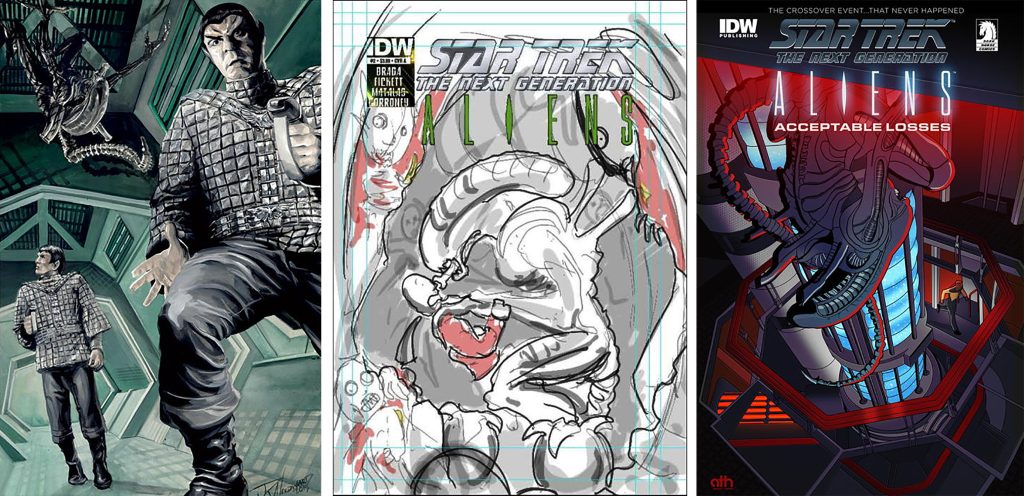
In 2017, IDW paired up the Tiptons with artists J.K. Woodward, Tristan Jones, and Aaron Harvey to create Star Trek: The Next Generation/Aliens: Acceptable Losses, in partnership with Aliens licensee Dark Horse Comics. The miniseries, heralding The Next Generation‘s 30th anniversary, would have featured the Borg, the Romulans, and Aliens‘ Xenomorph “Facehuggers.” Alas, Dark Horse vice president Randy Stradley announced the project’s cancelation, and few details have surfaced regarding the intended storyline.
Online, Woodward and Harvey have each released some of the concept art they’d created. As Harvey explained at his website, “To celebrate Alien Day (4/26), I finalized some cover art I pitched for the sadly canceled 2017 IDW/Dark Horse Comics crossover comic Star Trek: The Next Generation/Aliens: Acceptable Losses. Really would have been interested to see this come to fruition, but crossovers are always a precarious thing—especially between big franchises!”
Star Trek (Finally) Meets Transformers
What makes Transformers so popular is that its characters can morph into a variety of vehicles and animals. The vast franchise, created by toy companies Hasbro and Takara Tomy, includes comics, toys, video games, cartoons, and films, and it features a never-ending battle between extraterrestrial robotic species: primary protagonists the Autobots, and their nefarious enemies the Decepticons. Transformers ranks among the highest-grossing media franchises of all time, due in part to Michael Bay’s theatrical blockbusters.
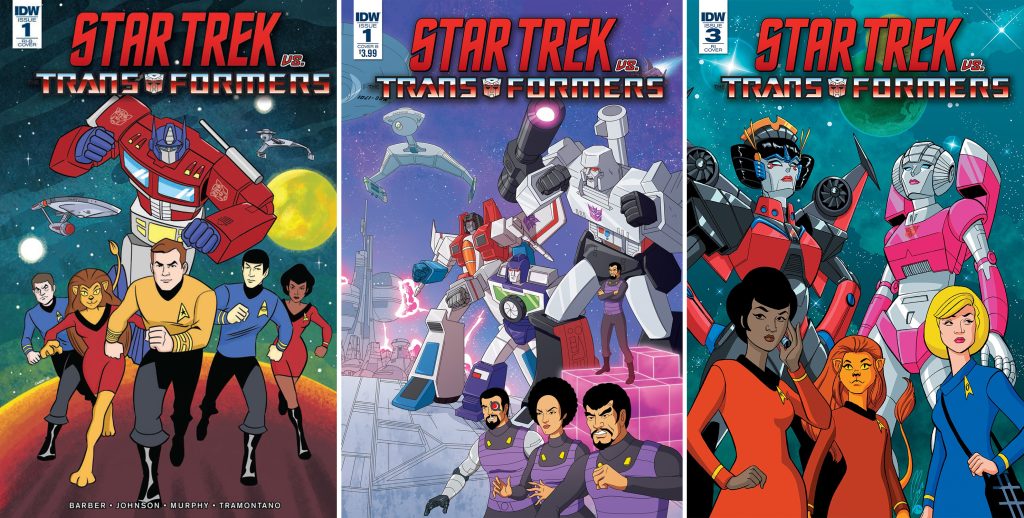
Star Trek had brushed up against the robots’ reality in Infestation, but it would be eight years before the twain would meet. Despite its sci-fi premise and built-in audience, Transformers is not a property one might expect to pair well with Trek. Yet in 2018, IDW released the five-issue Star Trek vs. Transformers, from John Barber, Mike Johnson, Philip Murphy, and Jack Lawrence. The miniseries worked surprisingly well, thanks to the savvy decision to illustrate it in the style of Star Trek: The Animated Series. With Arex and M’Ress along for the ride, this amusing crossover proved delightful, and the Enterprise itself even became a Transformer by story’s end.
A Crossover to Bear
Not everyone is a fan of crossovers, and understandably so. Enjoying them requires a sizable suspension of disbelief on the part of readers, and such tales carry the danger of coming off as forced or nonsensical if not properly executed. It’s all well and good to decide, “Hey, wouldn’t it be cool to have Marty McFly and Doc Brown meet Rorschach and Ozymandias?” But it’s quite another to come up with a viable scenario that would do justice to both Back to the Future and Watchmen.
What the above Star Trek titles have in common is that no matter how improbable the mash-up, each was crafted by passionately enthusiastic and well-versed creators. It’s easy to dismiss these stories as non-canon given their multi-franchise nature, but that doesn’t mean one can’t enjoy the end result. To date, no one has yet crossed Star Trek over with such sci-fi franchises as Star Wars, Battlestar Galactica, Firefly, Stargate, Babylon 5, or The Orville, but that could change someday, depending on who ends up with each respective license. It’s only a matter of time (and space).
(A version of this article originally appeared in Titan Magazines’ Star Trek Explorer issue #13.)
Looking for more information about Star Trek comics? Check out these resources:
- The Complete Star Trek Comics Index, curated by yours truly
- The Star Trek Comics Checklist, by Mark Martinez
- The Wixiban Star Trek Collectables Portal, by Colin Merry
- New Life and New Civilizations: Exploring Star Trek Comics, by Joseph F. Berenato (Sequart, 2014)
- Star Trek: A Comics History, by Alan J. Porter (Hermes Press, 2009)
- The Star Trek Comics Weekly page on Facebook
Rich Handley has authored, edited, or contributed to numerous books and magazines for IDW, BOOM! Studios, DC Comics, Topps, Dark Horse, Lucasfilm, Paramount/CBS, Titan Books, and more. His anthology Musings on Monsters: Observations on the World of Classic Horror was nominated for a 2021 Rondo Award for Book of the Year; he was an editor of IDW’s Eisner Award-winning Star Wars: The Classic Newspaper Strips collection; and he contributed to IDW’s Eisner-nominated Star Trek #400. Rich’s words have appeared in 160 books to date. He edited Eaglemoss’s Star Trek Graphic Novel Collection; co-created Magnetic Press’s Planet of the Apes Role-Playing Game; and has penned licensed Star Trek, Star Wars, and Planet of the Apes fiction. Rich has written about other pop-culture franchises as well, including Dark Shadows Swamp Thing, Hellblazer, Watchmen, Battlestar Galactica, Stargate, Red Dwarf, Batman, Godzilla, and more.
One thought on “Star Trek Comics Weekly Special: Exploring Strange New Franchises With Comic-Book Crossovers”
Comments are closed.